SUBSCRIBE TO OUR FREE NEWSLETTER
Daily news & progressive opinion—funded by the people, not the corporations—delivered straight to your inbox.
5
#000000
#FFFFFF
To donate by check, phone, or other method, see our More Ways to Give page.
Daily news & progressive opinion—funded by the people, not the corporations—delivered straight to your inbox.
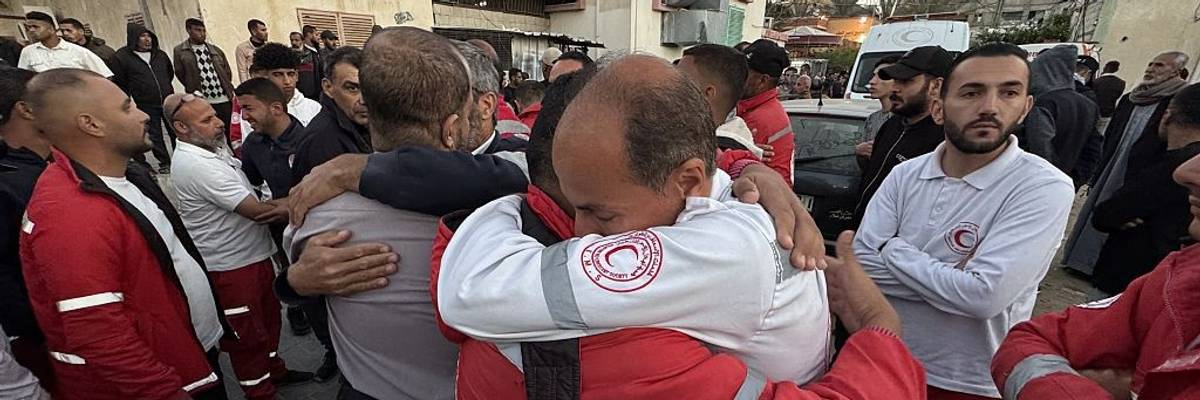
Eight civil defense and Palestinian Red Crescent members who were killed in an attack by the Israeli army on an ambulance and fire truck were brought to Nasser Hospital in Khan Younis, Gaza on March 30, 2025.
A majority of aid workers who were killed last year died in attacks in Gaza, despite a ceasefire that was reached last October.
"The technology may change, but the laws of war do not," said the United Nations' top humanitarian official on Wednesday as the international community marked World Humanitarian Day—and a record number of violent attacks against aid workers in 2025, with the expanded use of drones partially driving the increased threat to workers' safety.
According to the Aid Worker Security Database and the UN Office for the Coordination of Humanitarian Affairs (OCHA), 907 aid workers were killed, injured, or kidnapped last year.
Nearly 300 more were detained or arrested, said OCHA.
The number of humanitarians who were killed dropped slightly from the previous year, down to 350 from 387. But the death toll was the second highest ever recorded, and a majority of those killed—186—were attacked in Gaza, despite a "ceasefire" agreement that was reached last October.
More than two-thirds of those killed in Gaza were victims of aerial bombardment.
OCHA noted that "cheap and adaptable armed drones are putting lethal capabilities into more hands," with armies now able to wage more explosive attacks from afar and reach "deeper into towns and cities."
The prevalence of armed drones has been linked to 80% of civilian deaths in Sudan in the first four months of this year, while in Colombia, weaponized drone attacks quadrupled between 2024-25.
As the technology of war changes, said OCHA, "our humanity must not... Civilians, including humanitarians, must be protected."
One aid worker was killed in March in the Democratic Republic of Congo when a drone struck a residential building, while four humanitarian convoys were attacked by drones in a single week in May in Ukraine.
"Weaponized drones have become the new face of an old danger: the deliberate or reckless destruction of civilian life,” said Tom Fletcher, the UN humanitarian chief.
“But just calling it out will not protect the next aid worker," Fletcher added. "States must uphold international humanitarian law and use every tool to protect civilians and our colleagues. And for those who break the rules, there must be real consequences."
So far in 2026, 82 aid workers have already been killed, while 322 have been injured and 235 have been kidnapped.
"On World Humanitarian Day, we honor humanitarian workers everywhere, and the courage and sacrifices they make every day to help others," said the global humanitarian group Oxfam. "We stand in solidarity with our staff and partners on the frontlines, often working at immense personal risk, and urge governments to uphold their obligations to protect them."
Dear Common Dreams reader, It’s been nearly 30 years since I co-founded Common Dreams with my late wife, Lina Newhouser. We had the radical notion that journalism should serve the public good, not corporate profits. It was clear to us from the outset what it would take to build such a project. No paid advertisements. No corporate sponsors. No millionaire publisher telling us what to think or do. Many people said we wouldn't last a year, but we proved those doubters wrong. Together with a tremendous team of journalists and dedicated staff, we built an independent media outlet free from the constraints of profits and corporate control. Our mission has always been simple: To inform. To inspire. To ignite change for the common good. Building Common Dreams was not easy. Our survival was never guaranteed. When you take on the most powerful forces—Wall Street greed, fossil fuel industry destruction, Big Tech lobbyists, and uber-rich oligarchs who have spent billions upon billions rigging the economy and democracy in their favor—the only bulwark you have is supporters who believe in your work. But here’s the urgent message from me today. It's never been this bad out there. And it's never been this hard to keep us going. At the very moment Common Dreams is most needed, the threats we face are intensifying. We need your support now more than ever. We don't accept corporate advertising and never will. We don't have a paywall because we don't think people should be blocked from critical news based on their ability to pay. Everything we do is funded by the donations of readers like you. When everyone does the little they can afford, we are strong. But if that support retreats or dries up, so do we. Will you donate now to make sure Common Dreams not only survives but thrives? —Craig Brown, Co-founder |
"The technology may change, but the laws of war do not," said the United Nations' top humanitarian official on Wednesday as the international community marked World Humanitarian Day—and a record number of violent attacks against aid workers in 2025, with the expanded use of drones partially driving the increased threat to workers' safety.
According to the Aid Worker Security Database and the UN Office for the Coordination of Humanitarian Affairs (OCHA), 907 aid workers were killed, injured, or kidnapped last year.
Nearly 300 more were detained or arrested, said OCHA.
The number of humanitarians who were killed dropped slightly from the previous year, down to 350 from 387. But the death toll was the second highest ever recorded, and a majority of those killed—186—were attacked in Gaza, despite a "ceasefire" agreement that was reached last October.
More than two-thirds of those killed in Gaza were victims of aerial bombardment.
OCHA noted that "cheap and adaptable armed drones are putting lethal capabilities into more hands," with armies now able to wage more explosive attacks from afar and reach "deeper into towns and cities."
The prevalence of armed drones has been linked to 80% of civilian deaths in Sudan in the first four months of this year, while in Colombia, weaponized drone attacks quadrupled between 2024-25.
As the technology of war changes, said OCHA, "our humanity must not... Civilians, including humanitarians, must be protected."
One aid worker was killed in March in the Democratic Republic of Congo when a drone struck a residential building, while four humanitarian convoys were attacked by drones in a single week in May in Ukraine.
"Weaponized drones have become the new face of an old danger: the deliberate or reckless destruction of civilian life,” said Tom Fletcher, the UN humanitarian chief.
“But just calling it out will not protect the next aid worker," Fletcher added. "States must uphold international humanitarian law and use every tool to protect civilians and our colleagues. And for those who break the rules, there must be real consequences."
So far in 2026, 82 aid workers have already been killed, while 322 have been injured and 235 have been kidnapped.
"On World Humanitarian Day, we honor humanitarian workers everywhere, and the courage and sacrifices they make every day to help others," said the global humanitarian group Oxfam. "We stand in solidarity with our staff and partners on the frontlines, often working at immense personal risk, and urge governments to uphold their obligations to protect them."
"The technology may change, but the laws of war do not," said the United Nations' top humanitarian official on Wednesday as the international community marked World Humanitarian Day—and a record number of violent attacks against aid workers in 2025, with the expanded use of drones partially driving the increased threat to workers' safety.
According to the Aid Worker Security Database and the UN Office for the Coordination of Humanitarian Affairs (OCHA), 907 aid workers were killed, injured, or kidnapped last year.
Nearly 300 more were detained or arrested, said OCHA.
The number of humanitarians who were killed dropped slightly from the previous year, down to 350 from 387. But the death toll was the second highest ever recorded, and a majority of those killed—186—were attacked in Gaza, despite a "ceasefire" agreement that was reached last October.
More than two-thirds of those killed in Gaza were victims of aerial bombardment.
OCHA noted that "cheap and adaptable armed drones are putting lethal capabilities into more hands," with armies now able to wage more explosive attacks from afar and reach "deeper into towns and cities."
The prevalence of armed drones has been linked to 80% of civilian deaths in Sudan in the first four months of this year, while in Colombia, weaponized drone attacks quadrupled between 2024-25.
As the technology of war changes, said OCHA, "our humanity must not... Civilians, including humanitarians, must be protected."
One aid worker was killed in March in the Democratic Republic of Congo when a drone struck a residential building, while four humanitarian convoys were attacked by drones in a single week in May in Ukraine.
"Weaponized drones have become the new face of an old danger: the deliberate or reckless destruction of civilian life,” said Tom Fletcher, the UN humanitarian chief.
“But just calling it out will not protect the next aid worker," Fletcher added. "States must uphold international humanitarian law and use every tool to protect civilians and our colleagues. And for those who break the rules, there must be real consequences."
So far in 2026, 82 aid workers have already been killed, while 322 have been injured and 235 have been kidnapped.
"On World Humanitarian Day, we honor humanitarian workers everywhere, and the courage and sacrifices they make every day to help others," said the global humanitarian group Oxfam. "We stand in solidarity with our staff and partners on the frontlines, often working at immense personal risk, and urge governments to uphold their obligations to protect them."