SUBSCRIBE TO OUR FREE NEWSLETTER
Daily news & progressive opinion—funded by the people, not the corporations—delivered straight to your inbox.
5
#000000
#FFFFFF
To donate by check, phone, or other method, see our More Ways to Give page.
Daily news & progressive opinion—funded by the people, not the corporations—delivered straight to your inbox.
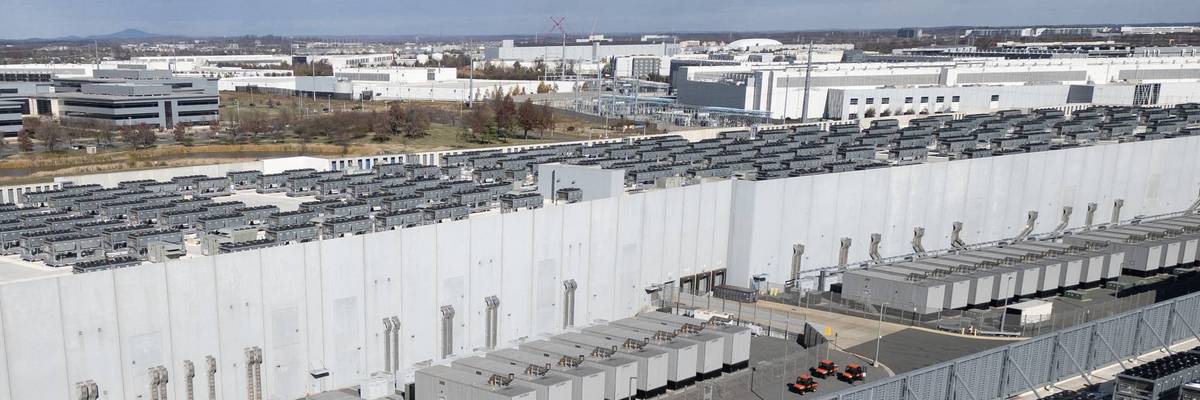
An aerial view shows cooling vent fans on the roof next to generators on the lower level of a Digital Realty data center in Ashburn, Virginia on November 12, 2025.
“The rush to build more and more data centers is causing harm far beyond the data centers themselves."
A trio of green groups on Friday sued the US Environmental Protection Agency over its approval of two new chemicals for semiconductor manufacturing, arguing that the EPA allowed potentially dangerous substances to be sold despite acknowledging significant gaps in its understanding of their health risks.
CHIPS Communities United and the Sierra Club, represented by Earthjustice, filed suit in the US Court of Appeals for the 9th Circuit in San Francisco challenging the approvals. The groups contend that the EPA violated the Toxic Substances Control Act (TSCA) by permitting the chemicals’ use without adequately assessing their risks to employees in semiconductor plants and the communities in which they are located.
According to Earthjustice, the EPA identified potential hazards including cancer, neurological damage, and even sudden death, but also acknowledged that it lacked sufficient information to determine the full extent of those risks. The names of the chemicals are redacted in the complaint—in which they are identified by their EPA premanufacture notice numbers, P-26-0029 and P-26-0045—because the agency has designated their identities as confidential business information.
“The Trump administration is rushing dangerous chemicals to market without the review or the protection that the law requires,” Earthjustice senior attorney Jonathan Kalmuss-Katz said in a statement announcing the lawsuit. “Here, EPA admits that it has not evaluated the full extent of these chemicals’ health risks, yet it is still sending them into communities across the country and leaving the public to discover their effects one doctor’s visit at a time.”
CHIPS Communities United coalition director Judith Barish said: “Neighbors and workers are exposed to toxic chemicals in semiconductor factories. Over decades, workers in chip [factories] have been harmed by workplace exposure and residents of nearby communities have been impacted by hazardous air or water that is contaminated by these chemicals."
"We call on the EPA to stop approving chemicals that can harm public health without understanding the risks," Barish added.
As Earthjustice noted:
Semiconductor manufacturing is a major ongoing source of [per- and polyfluoroalkyl substances], a large class of toxic “forever chemicals,” along with other industrial manufacturing sources. PFAS don’t easily break down and can persist in our bodies and the environment for decades or more. Semiconductors are also foundational hardware for artificial intelligence (AI) data centers, affecting many communities in addition to those surrounding the massive polluting chip factories.
The groups' lawsuit comes over a month after the EPA under President Donald Trump—who campaigned on what critics say was a largely empty promise to "make America healthy again"—and agency Administrator Lee Zeldin approved a fifth “forever chemical” pesticide pushed by industry lobbyists.
"EPA’s approval of these unstudied chemicals is just the latest example of the Trump EPA refusing to follow the legal risk assessment processes under TSCA and prioritizing industry profits over public health," Earthjustice said on Friday. "Last year, the agency proposed shifts to how it conducts risk evaluations for chemicals already in use and on the market that would let it ignore the real-world risks posed by toxic chemicals."
Harmful chemicals associated with data center cooling, fire suppression, and production of semiconductors and other electronic components include refrigerants such as Freon and Opteon, Teflon coatings for cable insulation, Krytox for pumps and robotics, and Viton for sealing.
Additionally, as the Natural Resources Defense Council explained, data center cooling systems "can consume vast quantities of water and pollute large quantities of water, depending on the type of cooling system used. For example, evaporative cooling consumes large quantities of water while some immersion cooling techniques rely on harmful chemicals such as PFAS."
While much critical attention on the lack of guardrails on unchecked AI development has focused on the risks of the technology itself and its economic implications—which experts say includes the shorter-term danger of mass unemployment and the long-term threat that superintelligent machines could one day subjugate or even wipe out humanity—the green groups are highlighting environmental and health hazards amid the worsening climate emergency.
"The rush to build more and more data centers is causing harm far beyond the data centers themselves," Jane Williams, chair of the Grassroots Network National Clean Air Team at Sierra Club, said Friday.
“From the plants where toxic chemicals are used to make semiconductors, to the roads these chemicals are transported on, and finally to the incinerators where they are disposed, EPA’s approval of these dangerously unstudied chemicals places the public at risk," Williams added. "These chemicals are suspected to be persistent bioaccumulative toxins, a category of chemicals that contaminate breast milk, cord blood, and the next generation. This action is an assault on the future.”
Dear Common Dreams reader, It’s been nearly 30 years since I co-founded Common Dreams with my late wife, Lina Newhouser. We had the radical notion that journalism should serve the public good, not corporate profits. It was clear to us from the outset what it would take to build such a project. No paid advertisements. No corporate sponsors. No millionaire publisher telling us what to think or do. Many people said we wouldn't last a year, but we proved those doubters wrong. Together with a tremendous team of journalists and dedicated staff, we built an independent media outlet free from the constraints of profits and corporate control. Our mission has always been simple: To inform. To inspire. To ignite change for the common good. Building Common Dreams was not easy. Our survival was never guaranteed. When you take on the most powerful forces—Wall Street greed, fossil fuel industry destruction, Big Tech lobbyists, and uber-rich oligarchs who have spent billions upon billions rigging the economy and democracy in their favor—the only bulwark you have is supporters who believe in your work. But here’s the urgent message from me today. It's never been this bad out there. And it's never been this hard to keep us going. At the very moment Common Dreams is most needed, the threats we face are intensifying. We need your support now more than ever. We don't accept corporate advertising and never will. We don't have a paywall because we don't think people should be blocked from critical news based on their ability to pay. Everything we do is funded by the donations of readers like you. When everyone does the little they can afford, we are strong. But if that support retreats or dries up, so do we. Will you donate now to make sure Common Dreams not only survives but thrives? —Craig Brown, Co-founder |
A trio of green groups on Friday sued the US Environmental Protection Agency over its approval of two new chemicals for semiconductor manufacturing, arguing that the EPA allowed potentially dangerous substances to be sold despite acknowledging significant gaps in its understanding of their health risks.
CHIPS Communities United and the Sierra Club, represented by Earthjustice, filed suit in the US Court of Appeals for the 9th Circuit in San Francisco challenging the approvals. The groups contend that the EPA violated the Toxic Substances Control Act (TSCA) by permitting the chemicals’ use without adequately assessing their risks to employees in semiconductor plants and the communities in which they are located.
According to Earthjustice, the EPA identified potential hazards including cancer, neurological damage, and even sudden death, but also acknowledged that it lacked sufficient information to determine the full extent of those risks. The names of the chemicals are redacted in the complaint—in which they are identified by their EPA premanufacture notice numbers, P-26-0029 and P-26-0045—because the agency has designated their identities as confidential business information.
“The Trump administration is rushing dangerous chemicals to market without the review or the protection that the law requires,” Earthjustice senior attorney Jonathan Kalmuss-Katz said in a statement announcing the lawsuit. “Here, EPA admits that it has not evaluated the full extent of these chemicals’ health risks, yet it is still sending them into communities across the country and leaving the public to discover their effects one doctor’s visit at a time.”
CHIPS Communities United coalition director Judith Barish said: “Neighbors and workers are exposed to toxic chemicals in semiconductor factories. Over decades, workers in chip [factories] have been harmed by workplace exposure and residents of nearby communities have been impacted by hazardous air or water that is contaminated by these chemicals."
"We call on the EPA to stop approving chemicals that can harm public health without understanding the risks," Barish added.
As Earthjustice noted:
Semiconductor manufacturing is a major ongoing source of [per- and polyfluoroalkyl substances], a large class of toxic “forever chemicals,” along with other industrial manufacturing sources. PFAS don’t easily break down and can persist in our bodies and the environment for decades or more. Semiconductors are also foundational hardware for artificial intelligence (AI) data centers, affecting many communities in addition to those surrounding the massive polluting chip factories.
The groups' lawsuit comes over a month after the EPA under President Donald Trump—who campaigned on what critics say was a largely empty promise to "make America healthy again"—and agency Administrator Lee Zeldin approved a fifth “forever chemical” pesticide pushed by industry lobbyists.
"EPA’s approval of these unstudied chemicals is just the latest example of the Trump EPA refusing to follow the legal risk assessment processes under TSCA and prioritizing industry profits over public health," Earthjustice said on Friday. "Last year, the agency proposed shifts to how it conducts risk evaluations for chemicals already in use and on the market that would let it ignore the real-world risks posed by toxic chemicals."
Harmful chemicals associated with data center cooling, fire suppression, and production of semiconductors and other electronic components include refrigerants such as Freon and Opteon, Teflon coatings for cable insulation, Krytox for pumps and robotics, and Viton for sealing.
Additionally, as the Natural Resources Defense Council explained, data center cooling systems "can consume vast quantities of water and pollute large quantities of water, depending on the type of cooling system used. For example, evaporative cooling consumes large quantities of water while some immersion cooling techniques rely on harmful chemicals such as PFAS."
While much critical attention on the lack of guardrails on unchecked AI development has focused on the risks of the technology itself and its economic implications—which experts say includes the shorter-term danger of mass unemployment and the long-term threat that superintelligent machines could one day subjugate or even wipe out humanity—the green groups are highlighting environmental and health hazards amid the worsening climate emergency.
"The rush to build more and more data centers is causing harm far beyond the data centers themselves," Jane Williams, chair of the Grassroots Network National Clean Air Team at Sierra Club, said Friday.
“From the plants where toxic chemicals are used to make semiconductors, to the roads these chemicals are transported on, and finally to the incinerators where they are disposed, EPA’s approval of these dangerously unstudied chemicals places the public at risk," Williams added. "These chemicals are suspected to be persistent bioaccumulative toxins, a category of chemicals that contaminate breast milk, cord blood, and the next generation. This action is an assault on the future.”
A trio of green groups on Friday sued the US Environmental Protection Agency over its approval of two new chemicals for semiconductor manufacturing, arguing that the EPA allowed potentially dangerous substances to be sold despite acknowledging significant gaps in its understanding of their health risks.
CHIPS Communities United and the Sierra Club, represented by Earthjustice, filed suit in the US Court of Appeals for the 9th Circuit in San Francisco challenging the approvals. The groups contend that the EPA violated the Toxic Substances Control Act (TSCA) by permitting the chemicals’ use without adequately assessing their risks to employees in semiconductor plants and the communities in which they are located.
According to Earthjustice, the EPA identified potential hazards including cancer, neurological damage, and even sudden death, but also acknowledged that it lacked sufficient information to determine the full extent of those risks. The names of the chemicals are redacted in the complaint—in which they are identified by their EPA premanufacture notice numbers, P-26-0029 and P-26-0045—because the agency has designated their identities as confidential business information.
“The Trump administration is rushing dangerous chemicals to market without the review or the protection that the law requires,” Earthjustice senior attorney Jonathan Kalmuss-Katz said in a statement announcing the lawsuit. “Here, EPA admits that it has not evaluated the full extent of these chemicals’ health risks, yet it is still sending them into communities across the country and leaving the public to discover their effects one doctor’s visit at a time.”
CHIPS Communities United coalition director Judith Barish said: “Neighbors and workers are exposed to toxic chemicals in semiconductor factories. Over decades, workers in chip [factories] have been harmed by workplace exposure and residents of nearby communities have been impacted by hazardous air or water that is contaminated by these chemicals."
"We call on the EPA to stop approving chemicals that can harm public health without understanding the risks," Barish added.
As Earthjustice noted:
Semiconductor manufacturing is a major ongoing source of [per- and polyfluoroalkyl substances], a large class of toxic “forever chemicals,” along with other industrial manufacturing sources. PFAS don’t easily break down and can persist in our bodies and the environment for decades or more. Semiconductors are also foundational hardware for artificial intelligence (AI) data centers, affecting many communities in addition to those surrounding the massive polluting chip factories.
The groups' lawsuit comes over a month after the EPA under President Donald Trump—who campaigned on what critics say was a largely empty promise to "make America healthy again"—and agency Administrator Lee Zeldin approved a fifth “forever chemical” pesticide pushed by industry lobbyists.
"EPA’s approval of these unstudied chemicals is just the latest example of the Trump EPA refusing to follow the legal risk assessment processes under TSCA and prioritizing industry profits over public health," Earthjustice said on Friday. "Last year, the agency proposed shifts to how it conducts risk evaluations for chemicals already in use and on the market that would let it ignore the real-world risks posed by toxic chemicals."
Harmful chemicals associated with data center cooling, fire suppression, and production of semiconductors and other electronic components include refrigerants such as Freon and Opteon, Teflon coatings for cable insulation, Krytox for pumps and robotics, and Viton for sealing.
Additionally, as the Natural Resources Defense Council explained, data center cooling systems "can consume vast quantities of water and pollute large quantities of water, depending on the type of cooling system used. For example, evaporative cooling consumes large quantities of water while some immersion cooling techniques rely on harmful chemicals such as PFAS."
While much critical attention on the lack of guardrails on unchecked AI development has focused on the risks of the technology itself and its economic implications—which experts say includes the shorter-term danger of mass unemployment and the long-term threat that superintelligent machines could one day subjugate or even wipe out humanity—the green groups are highlighting environmental and health hazards amid the worsening climate emergency.
"The rush to build more and more data centers is causing harm far beyond the data centers themselves," Jane Williams, chair of the Grassroots Network National Clean Air Team at Sierra Club, said Friday.
“From the plants where toxic chemicals are used to make semiconductors, to the roads these chemicals are transported on, and finally to the incinerators where they are disposed, EPA’s approval of these dangerously unstudied chemicals places the public at risk," Williams added. "These chemicals are suspected to be persistent bioaccumulative toxins, a category of chemicals that contaminate breast milk, cord blood, and the next generation. This action is an assault on the future.”