

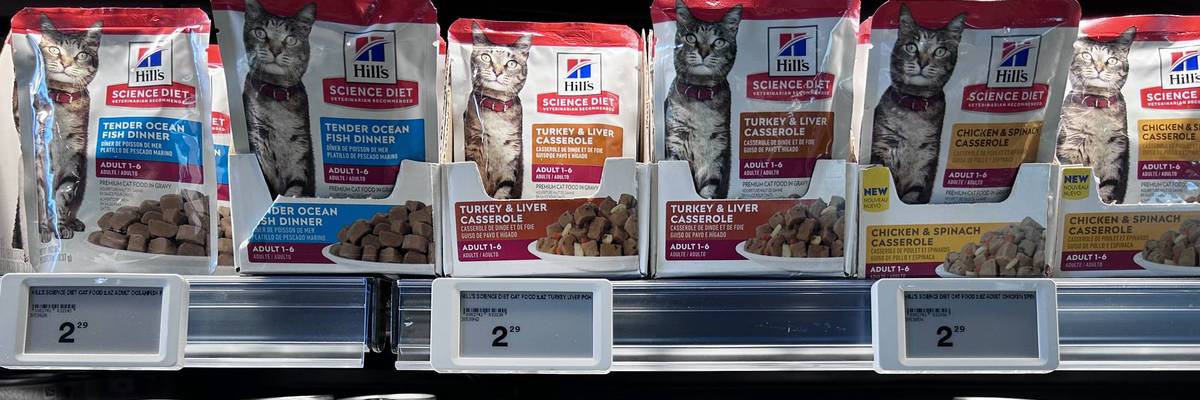
Automated digital display price tags at Petco store, Manhattan, New York on October 12, 2023.
Union Report Warns Electronic Shelf Labels Could Kill Jobs and Crush Wages
Some states are cracking down on "surveillance pricing." But a report out from the AFL-CIO suggests that the risk of electronic shelf labels are much broader than just price gouging.
Lawmakers are already raising concerns that electronic shelf labels could be used by grocery chains to jack up prices on shoppers. But the technology could also be used to shrink paychecks and kill jobs, according to a report out Wednesday from the research arm of the AFL-CIO.
The new report examines marketing materials used by electronic shelf label (ESL) companies to sell their products to grocery chains. It finds that they are often billed as a tool allowing retailers to save on labor costs, automate work, and reduce hours for real employees.
"Grocery giants like to claim that electronic shelf labels will free up workers to serve customers directly, but this report shows this is not the case," said Ademola Oyefeso, the international vice president of the United Food and Commercial Workers International Union (UFCW), which represents over 800,000 grocery industry employees. "Using studies and marketing material from the manufacturers pushing the technology, we know ESLs could actually cost workers and their families billions of dollars in lost income."
The AFL-CIO Tech Institute, which conducted the report, examined studies from two ESL manufacturers, Pricer and Vusion Group, that examined how their systems were used at specific stores.
The 2022 study by Pricer found that by automating price changes, its system saved one store about 5,200 worker hours annually. Vusion, meanwhile, found in 2024 that its technology saved about 600 hours of work over about six months, or 1,200 annually.
Using data from the US Bureau of Labor Statistics, the AFL-CIO projected that at these rates, were the technology to be adopted at all of the nearly 60,000 grocery stores in the US, it would reduce the number of worker hours annually by anywhere from 71 million to 308 million.
Using hourly wage data, they found that this translated to the loss of between $1.61 billion-$6.97 billion in annual wages and between 44,000-192,000 full-time jobs. That's anywhere from $608 to $2,633 per employee.
The issue of using ESLs to gouge customers has already become an area of focus for lawmakers in Congress. Earlier this year, Democrats in the US House and Senate introduced legislation to prohibit "surveillance pricing," which involves targeting individual shoppers with increased prices by analyzing their personal data.
Surveillance pricing has been used in e-commerce to fluctuate prices for individual consumers of everything from grocery delivery to airline tickets. But as facial recognition and other surveillance technologies grow more powerful, fears have grown that ESLs could be used to bring surveillance practices into the physical realm.
“Through our analysis, we found that the implementation of electronic shelf labels are likely going to drive prices even higher. The reason being that these labels are connected to the same algorithmic pricing software that online retailers are already using,” said Sunny Glottmann, the policy and programs manager at the AFL-CIO Tech Institute and co-author of the report.
"Electronic shelf labels create the infrastructure that would make rapid algorithmic price changes easier to implement at scale, and this raises concerns for consumers that are already struggling with grocery costs," Glottmann said.
At least three states—Connecticut, Maryland, and New Jersey—have banned some forms of surveillance pricing, and other states are also considering a ban.
Unions like the AFL-CIO and UFCW say that legislating only against surveillance pricing is much too narrow, encompassing only a small segment of the dangers posed by ESLs.
"Policymakers should ban ESLs outright, rather than rely on narrower disclosure or dynamic-pricing laws that leave the underlying technology in place," the AFL-CIO report says, noting New Jersey's one-year moratorium on the technology as a good starting place.
"When grocery store workers lose income, that means less money to spend at other stores and businesses in the community," Oyefeso said. "Banning this technology should be a top priority for lawmakers at every level, like New Jersey has done with a moratorium on ESLs and a ban on predatory pricing practices outright. More states should follow suit to protect both shoppers and workers.”
We are at a crossroads
This country and this world are at a monumental crossroads. In a few short weeks, US voters will have an opportunity to beat back the forces of fascism and confront the billionaires who are rigging the economy, our media system, and our democracy, making it increasingly impossible for ordinary people to get by. We’re not just talking about the election. We’re talking about what must be done once these fascist elements are vanquished from power. We need a bolder set of solutions than what either major party has so far been willing to offer and a working-class movement ready to fight like hell for it. Trump didn't emerge from nowhere. The conditions that fueled MAGA authoritarianism were created by decades of radical neoliberal economic policies and a corrupt political system dominated by corporate interests. They slashed taxes on the super-rich, promising that the benefits would trickle down. They said giveaways to the corporate titans would make life more affordable for the rest of us. It was all bullshit. And when a bitter, betrayed populace searches for someone to blame, right-wing demagogues have little trouble finding scapegoats. People know when they're being lied to, but you won't hear any of this from the corporate media. Only independent journalism—powered and funded by people who believe in building a better world—can deliver truly trustworthy daily news. Our Fall Campaign is underway, and we need your help. To power our newsroom through the rest of the year, we need to raise $125,000 by midnight on October 31. So if you share our vision, please contribute whatever you can to sustain our work. |
Lawmakers are already raising concerns that electronic shelf labels could be used by grocery chains to jack up prices on shoppers. But the technology could also be used to shrink paychecks and kill jobs, according to a report out Wednesday from the research arm of the AFL-CIO.
The new report examines marketing materials used by electronic shelf label (ESL) companies to sell their products to grocery chains. It finds that they are often billed as a tool allowing retailers to save on labor costs, automate work, and reduce hours for real employees.
"Grocery giants like to claim that electronic shelf labels will free up workers to serve customers directly, but this report shows this is not the case," said Ademola Oyefeso, the international vice president of the United Food and Commercial Workers International Union (UFCW), which represents over 800,000 grocery industry employees. "Using studies and marketing material from the manufacturers pushing the technology, we know ESLs could actually cost workers and their families billions of dollars in lost income."
The AFL-CIO Tech Institute, which conducted the report, examined studies from two ESL manufacturers, Pricer and Vusion Group, that examined how their systems were used at specific stores.
The 2022 study by Pricer found that by automating price changes, its system saved one store about 5,200 worker hours annually. Vusion, meanwhile, found in 2024 that its technology saved about 600 hours of work over about six months, or 1,200 annually.
Using data from the US Bureau of Labor Statistics, the AFL-CIO projected that at these rates, were the technology to be adopted at all of the nearly 60,000 grocery stores in the US, it would reduce the number of worker hours annually by anywhere from 71 million to 308 million.
Using hourly wage data, they found that this translated to the loss of between $1.61 billion-$6.97 billion in annual wages and between 44,000-192,000 full-time jobs. That's anywhere from $608 to $2,633 per employee.
The issue of using ESLs to gouge customers has already become an area of focus for lawmakers in Congress. Earlier this year, Democrats in the US House and Senate introduced legislation to prohibit "surveillance pricing," which involves targeting individual shoppers with increased prices by analyzing their personal data.
Surveillance pricing has been used in e-commerce to fluctuate prices for individual consumers of everything from grocery delivery to airline tickets. But as facial recognition and other surveillance technologies grow more powerful, fears have grown that ESLs could be used to bring surveillance practices into the physical realm.
“Through our analysis, we found that the implementation of electronic shelf labels are likely going to drive prices even higher. The reason being that these labels are connected to the same algorithmic pricing software that online retailers are already using,” said Sunny Glottmann, the policy and programs manager at the AFL-CIO Tech Institute and co-author of the report.
"Electronic shelf labels create the infrastructure that would make rapid algorithmic price changes easier to implement at scale, and this raises concerns for consumers that are already struggling with grocery costs," Glottmann said.
At least three states—Connecticut, Maryland, and New Jersey—have banned some forms of surveillance pricing, and other states are also considering a ban.
Unions like the AFL-CIO and UFCW say that legislating only against surveillance pricing is much too narrow, encompassing only a small segment of the dangers posed by ESLs.
"Policymakers should ban ESLs outright, rather than rely on narrower disclosure or dynamic-pricing laws that leave the underlying technology in place," the AFL-CIO report says, noting New Jersey's one-year moratorium on the technology as a good starting place.
"When grocery store workers lose income, that means less money to spend at other stores and businesses in the community," Oyefeso said. "Banning this technology should be a top priority for lawmakers at every level, like New Jersey has done with a moratorium on ESLs and a ban on predatory pricing practices outright. More states should follow suit to protect both shoppers and workers.”
Lawmakers are already raising concerns that electronic shelf labels could be used by grocery chains to jack up prices on shoppers. But the technology could also be used to shrink paychecks and kill jobs, according to a report out Wednesday from the research arm of the AFL-CIO.
The new report examines marketing materials used by electronic shelf label (ESL) companies to sell their products to grocery chains. It finds that they are often billed as a tool allowing retailers to save on labor costs, automate work, and reduce hours for real employees.
"Grocery giants like to claim that electronic shelf labels will free up workers to serve customers directly, but this report shows this is not the case," said Ademola Oyefeso, the international vice president of the United Food and Commercial Workers International Union (UFCW), which represents over 800,000 grocery industry employees. "Using studies and marketing material from the manufacturers pushing the technology, we know ESLs could actually cost workers and their families billions of dollars in lost income."
The AFL-CIO Tech Institute, which conducted the report, examined studies from two ESL manufacturers, Pricer and Vusion Group, that examined how their systems were used at specific stores.
The 2022 study by Pricer found that by automating price changes, its system saved one store about 5,200 worker hours annually. Vusion, meanwhile, found in 2024 that its technology saved about 600 hours of work over about six months, or 1,200 annually.
Using data from the US Bureau of Labor Statistics, the AFL-CIO projected that at these rates, were the technology to be adopted at all of the nearly 60,000 grocery stores in the US, it would reduce the number of worker hours annually by anywhere from 71 million to 308 million.
Using hourly wage data, they found that this translated to the loss of between $1.61 billion-$6.97 billion in annual wages and between 44,000-192,000 full-time jobs. That's anywhere from $608 to $2,633 per employee.
The issue of using ESLs to gouge customers has already become an area of focus for lawmakers in Congress. Earlier this year, Democrats in the US House and Senate introduced legislation to prohibit "surveillance pricing," which involves targeting individual shoppers with increased prices by analyzing their personal data.
Surveillance pricing has been used in e-commerce to fluctuate prices for individual consumers of everything from grocery delivery to airline tickets. But as facial recognition and other surveillance technologies grow more powerful, fears have grown that ESLs could be used to bring surveillance practices into the physical realm.
“Through our analysis, we found that the implementation of electronic shelf labels are likely going to drive prices even higher. The reason being that these labels are connected to the same algorithmic pricing software that online retailers are already using,” said Sunny Glottmann, the policy and programs manager at the AFL-CIO Tech Institute and co-author of the report.
"Electronic shelf labels create the infrastructure that would make rapid algorithmic price changes easier to implement at scale, and this raises concerns for consumers that are already struggling with grocery costs," Glottmann said.
At least three states—Connecticut, Maryland, and New Jersey—have banned some forms of surveillance pricing, and other states are also considering a ban.
Unions like the AFL-CIO and UFCW say that legislating only against surveillance pricing is much too narrow, encompassing only a small segment of the dangers posed by ESLs.
"Policymakers should ban ESLs outright, rather than rely on narrower disclosure or dynamic-pricing laws that leave the underlying technology in place," the AFL-CIO report says, noting New Jersey's one-year moratorium on the technology as a good starting place.
"When grocery store workers lose income, that means less money to spend at other stores and businesses in the community," Oyefeso said. "Banning this technology should be a top priority for lawmakers at every level, like New Jersey has done with a moratorium on ESLs and a ban on predatory pricing practices outright. More states should follow suit to protect both shoppers and workers.”