SUBSCRIBE TO OUR FREE NEWSLETTER
Daily news & progressive opinion—funded by the people, not the corporations—delivered straight to your inbox.
5
#000000
#FFFFFF
To donate by check, phone, or other method, see our More Ways to Give page.
Daily news & progressive opinion—funded by the people, not the corporations—delivered straight to your inbox.
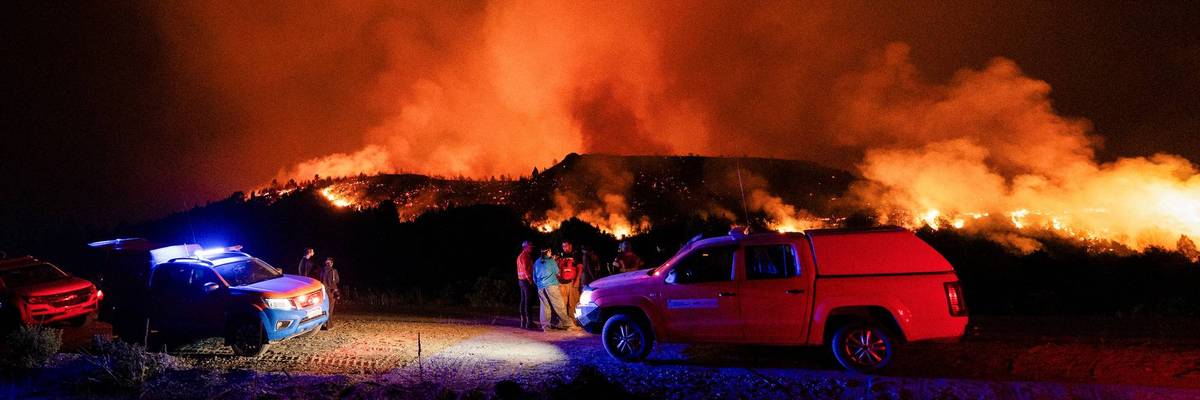
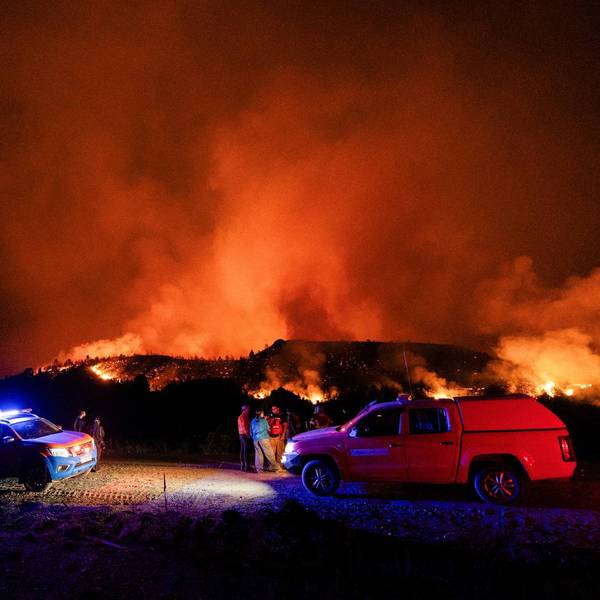
Volunteers and firefighters work to extinguish a forest fire burning in the Patagonian region of Chubut province, Argentina, on February 1, 2026.
"Existing climate mitigation approaches, including scaling up renewable energy and protecting carbon-storing ecosystems, are critical to limit the increase in global temperatures," said the lead author.
In the lead-up to the Trump administration effectively destroying the US Environmental Protection Agency's ability to combat the fossil fuel-driven climate emergency, an international team of scientists warned Wednesday that "Earth's climate is now departing from the stable conditions that supported human civilization for millennia."
Various institutions, including in the United States, have confirmed that 2025 was among the hottest years on record, and January continued that trend. Meanwhile, governments and polluting industries have repeatedly refused to impose policies that adequately heed experts' calls for action.
"In an effort to mitigate dangerous levels of warming, the Paris Agreement formalized the aim of limiting warming to 1.5°C above preindustrial levels, yet global temperatures have recently breached this limit for 12 consecutive months, coinciding with record-breaking heat, wildfires, floods, and other extremes," the scientists noted Wednesday in the journal One Earth.
They wrote that "crossing critical temperature thresholds may trigger self-reinforcing feedbacks and tipping dynamics that amplify warming and destabilize distant Earth system components. Uncertain tipping thresholds make precaution essential, as crossing them could commit the planet to a hothouse trajectory with long-lasting and potentially irreversible consequences."
A "hothouse trajectory," they wrote, is "a pathway in which self-reinforcing feedbacks push the climate system past a point of no return, committing the planet to substantially higher long-term temperatures, even if emissions are later reduced."
"Sixteen major tipping elements have been identified, 10 of which could add to global temperature if triggered," the experts detailed. "Tipping may already be underway or could occur soon for the Greenland and West Antarctic ice sheets, boreal permafrost, mountain glaciers, and parts of the Amazon rainforest."
As an example, they pointed to ice melt in the Arctic, explaining that the resulting water "could perturb the Atlantic Meridional Overturning Circulation (AMOC), which is already showing signs of weakening. A weakened AMOC could alter global atmospheric circulation, shifting tropical rain belts and drying parts of the Amazon. This cascade of events could trigger large-scale Amazon forest dieback, with major consequences for the region's carbon storage and biodiversity."
Concerned about the Point of No Return? Today we published a paper on the risk of a hothouse Earth trajectory. You can read it here: authors.elsevier.com/c/1mbW49C~Iu...
[image or embed]
— Prof William Ripple (@williamripple.bsky.social) February 11, 2026 at 2:43 PM
The team of eight was led by William Ripple, who has previously emphasized alongside other experts that "we are on the brink of an irreversible climate disaster" and "fossil fuels—and the fossil fuel industry and its enablers—are driving a multitude of interlinked crises that jeopardize the breadth and stability of life on Earth."
Ripple, distinguished professor of ecology at Oregon State University (OSU), said in a Wednesday statement that "after a million years of oscillating between ice ages separated by warmer periods, the Earth's climate stabilized more than 11,000 years ago, enabling agriculture and complex societies."
"We're now moving away from that stability and could be entering a period of unprecedented climate change," he stressed. "Existing climate mitigation approaches, including scaling up renewable energy and protecting carbon-storing ecosystems, are critical to limit the increase in global temperatures."
Study co-author Christopher Wolf, a former OSU postdoctoral researcher who is now a scientist with Terrestrial Ecosystems Research Associates (TERA), noted that already, "climate model simulations suggest the recent 12-month breach indicates the long-term average temperature increase is at or near 1.5°C."
"It's likely that global temperatures are as warm as, or warmer than, at any point in the last 125,000 years and that climate change is advancing faster than many scientists predicted," he said.
"Policymakers and the public remain largely unaware of the risks posed by what would effectively be a point-of-no-return transition," Wolf added. "And while averting the hothouse trajectory won't be easy, it's much more achievable than trying to backtrack once we're on it."
🆕 Several Earth system components may be closer to destabilisation than previously thought. Crossing key temperature thresholds could trigger feedback loops, pushing the planet toward a “Hothouse Earth” trajectory. Study by @oregonstate.edu, @iiasa.ac.at & PIK: www.sciencedirect.com/science/arti...
[image or embed]
— PIK_climate (@pik-potsdam.bsky.social) February 11, 2026 at 11:52 AM
The team's warnings came in the wake of Big Oil-backed President Donald Trump claiming in a United Nations speech last year that climate change is "the greatest con job ever perpetrated on the world," and ditching dozens of relevant organizations and treaties, including the Paris Agreement.
On Thursday, the Trump administration continued its war on the climate, revoking the "endangerment finding" that allowed the EPA to pass regulations fighting the global emergency—which was forcefully condemned by scientists and activists.
"In case there was any remaining doubt, the truth is very clear: Trump cares nothing for the health and well-being of our communities or our climate," said Erin Doran, senior staff attorney at the advocacy group Food & Water Watch. "He is concerned only with making more money for the billionaire fossil fuel polluters that help to fund his dangerous political agenda."
"The notion that the EPA shouldn't regulate climate emissions is inconsistent with the law, the science, and the realities of the climate crisis," Doran added. "EPA is charged with protecting human health and the environment, yet this rule does neither, benefiting only the fossil fuel industry at our expense. It's absurd, and we'll be fighting back."
Dear Common Dreams reader, It’s been nearly 30 years since I co-founded Common Dreams with my late wife, Lina Newhouser. We had the radical notion that journalism should serve the public good, not corporate profits. It was clear to us from the outset what it would take to build such a project. No paid advertisements. No corporate sponsors. No millionaire publisher telling us what to think or do. Many people said we wouldn't last a year, but we proved those doubters wrong. Together with a tremendous team of journalists and dedicated staff, we built an independent media outlet free from the constraints of profits and corporate control. Our mission has always been simple: To inform. To inspire. To ignite change for the common good. Building Common Dreams was not easy. Our survival was never guaranteed. When you take on the most powerful forces—Wall Street greed, fossil fuel industry destruction, Big Tech lobbyists, and uber-rich oligarchs who have spent billions upon billions rigging the economy and democracy in their favor—the only bulwark you have is supporters who believe in your work. But here’s the urgent message from me today. It's never been this bad out there. And it's never been this hard to keep us going. At the very moment Common Dreams is most needed, the threats we face are intensifying. We need your support now more than ever. We don't accept corporate advertising and never will. We don't have a paywall because we don't think people should be blocked from critical news based on their ability to pay. Everything we do is funded by the donations of readers like you. When everyone does the little they can afford, we are strong. But if that support retreats or dries up, so do we. Will you donate now to make sure Common Dreams not only survives but thrives? —Craig Brown, Co-founder |
In the lead-up to the Trump administration effectively destroying the US Environmental Protection Agency's ability to combat the fossil fuel-driven climate emergency, an international team of scientists warned Wednesday that "Earth's climate is now departing from the stable conditions that supported human civilization for millennia."
Various institutions, including in the United States, have confirmed that 2025 was among the hottest years on record, and January continued that trend. Meanwhile, governments and polluting industries have repeatedly refused to impose policies that adequately heed experts' calls for action.
"In an effort to mitigate dangerous levels of warming, the Paris Agreement formalized the aim of limiting warming to 1.5°C above preindustrial levels, yet global temperatures have recently breached this limit for 12 consecutive months, coinciding with record-breaking heat, wildfires, floods, and other extremes," the scientists noted Wednesday in the journal One Earth.
They wrote that "crossing critical temperature thresholds may trigger self-reinforcing feedbacks and tipping dynamics that amplify warming and destabilize distant Earth system components. Uncertain tipping thresholds make precaution essential, as crossing them could commit the planet to a hothouse trajectory with long-lasting and potentially irreversible consequences."
A "hothouse trajectory," they wrote, is "a pathway in which self-reinforcing feedbacks push the climate system past a point of no return, committing the planet to substantially higher long-term temperatures, even if emissions are later reduced."
"Sixteen major tipping elements have been identified, 10 of which could add to global temperature if triggered," the experts detailed. "Tipping may already be underway or could occur soon for the Greenland and West Antarctic ice sheets, boreal permafrost, mountain glaciers, and parts of the Amazon rainforest."
As an example, they pointed to ice melt in the Arctic, explaining that the resulting water "could perturb the Atlantic Meridional Overturning Circulation (AMOC), which is already showing signs of weakening. A weakened AMOC could alter global atmospheric circulation, shifting tropical rain belts and drying parts of the Amazon. This cascade of events could trigger large-scale Amazon forest dieback, with major consequences for the region's carbon storage and biodiversity."
Concerned about the Point of No Return? Today we published a paper on the risk of a hothouse Earth trajectory. You can read it here: authors.elsevier.com/c/1mbW49C~Iu...
[image or embed]
— Prof William Ripple (@williamripple.bsky.social) February 11, 2026 at 2:43 PM
The team of eight was led by William Ripple, who has previously emphasized alongside other experts that "we are on the brink of an irreversible climate disaster" and "fossil fuels—and the fossil fuel industry and its enablers—are driving a multitude of interlinked crises that jeopardize the breadth and stability of life on Earth."
Ripple, distinguished professor of ecology at Oregon State University (OSU), said in a Wednesday statement that "after a million years of oscillating between ice ages separated by warmer periods, the Earth's climate stabilized more than 11,000 years ago, enabling agriculture and complex societies."
"We're now moving away from that stability and could be entering a period of unprecedented climate change," he stressed. "Existing climate mitigation approaches, including scaling up renewable energy and protecting carbon-storing ecosystems, are critical to limit the increase in global temperatures."
Study co-author Christopher Wolf, a former OSU postdoctoral researcher who is now a scientist with Terrestrial Ecosystems Research Associates (TERA), noted that already, "climate model simulations suggest the recent 12-month breach indicates the long-term average temperature increase is at or near 1.5°C."
"It's likely that global temperatures are as warm as, or warmer than, at any point in the last 125,000 years and that climate change is advancing faster than many scientists predicted," he said.
"Policymakers and the public remain largely unaware of the risks posed by what would effectively be a point-of-no-return transition," Wolf added. "And while averting the hothouse trajectory won't be easy, it's much more achievable than trying to backtrack once we're on it."
🆕 Several Earth system components may be closer to destabilisation than previously thought. Crossing key temperature thresholds could trigger feedback loops, pushing the planet toward a “Hothouse Earth” trajectory. Study by @oregonstate.edu, @iiasa.ac.at & PIK: www.sciencedirect.com/science/arti...
[image or embed]
— PIK_climate (@pik-potsdam.bsky.social) February 11, 2026 at 11:52 AM
The team's warnings came in the wake of Big Oil-backed President Donald Trump claiming in a United Nations speech last year that climate change is "the greatest con job ever perpetrated on the world," and ditching dozens of relevant organizations and treaties, including the Paris Agreement.
On Thursday, the Trump administration continued its war on the climate, revoking the "endangerment finding" that allowed the EPA to pass regulations fighting the global emergency—which was forcefully condemned by scientists and activists.
"In case there was any remaining doubt, the truth is very clear: Trump cares nothing for the health and well-being of our communities or our climate," said Erin Doran, senior staff attorney at the advocacy group Food & Water Watch. "He is concerned only with making more money for the billionaire fossil fuel polluters that help to fund his dangerous political agenda."
"The notion that the EPA shouldn't regulate climate emissions is inconsistent with the law, the science, and the realities of the climate crisis," Doran added. "EPA is charged with protecting human health and the environment, yet this rule does neither, benefiting only the fossil fuel industry at our expense. It's absurd, and we'll be fighting back."
In the lead-up to the Trump administration effectively destroying the US Environmental Protection Agency's ability to combat the fossil fuel-driven climate emergency, an international team of scientists warned Wednesday that "Earth's climate is now departing from the stable conditions that supported human civilization for millennia."
Various institutions, including in the United States, have confirmed that 2025 was among the hottest years on record, and January continued that trend. Meanwhile, governments and polluting industries have repeatedly refused to impose policies that adequately heed experts' calls for action.
"In an effort to mitigate dangerous levels of warming, the Paris Agreement formalized the aim of limiting warming to 1.5°C above preindustrial levels, yet global temperatures have recently breached this limit for 12 consecutive months, coinciding with record-breaking heat, wildfires, floods, and other extremes," the scientists noted Wednesday in the journal One Earth.
They wrote that "crossing critical temperature thresholds may trigger self-reinforcing feedbacks and tipping dynamics that amplify warming and destabilize distant Earth system components. Uncertain tipping thresholds make precaution essential, as crossing them could commit the planet to a hothouse trajectory with long-lasting and potentially irreversible consequences."
A "hothouse trajectory," they wrote, is "a pathway in which self-reinforcing feedbacks push the climate system past a point of no return, committing the planet to substantially higher long-term temperatures, even if emissions are later reduced."
"Sixteen major tipping elements have been identified, 10 of which could add to global temperature if triggered," the experts detailed. "Tipping may already be underway or could occur soon for the Greenland and West Antarctic ice sheets, boreal permafrost, mountain glaciers, and parts of the Amazon rainforest."
As an example, they pointed to ice melt in the Arctic, explaining that the resulting water "could perturb the Atlantic Meridional Overturning Circulation (AMOC), which is already showing signs of weakening. A weakened AMOC could alter global atmospheric circulation, shifting tropical rain belts and drying parts of the Amazon. This cascade of events could trigger large-scale Amazon forest dieback, with major consequences for the region's carbon storage and biodiversity."
Concerned about the Point of No Return? Today we published a paper on the risk of a hothouse Earth trajectory. You can read it here: authors.elsevier.com/c/1mbW49C~Iu...
[image or embed]
— Prof William Ripple (@williamripple.bsky.social) February 11, 2026 at 2:43 PM
The team of eight was led by William Ripple, who has previously emphasized alongside other experts that "we are on the brink of an irreversible climate disaster" and "fossil fuels—and the fossil fuel industry and its enablers—are driving a multitude of interlinked crises that jeopardize the breadth and stability of life on Earth."
Ripple, distinguished professor of ecology at Oregon State University (OSU), said in a Wednesday statement that "after a million years of oscillating between ice ages separated by warmer periods, the Earth's climate stabilized more than 11,000 years ago, enabling agriculture and complex societies."
"We're now moving away from that stability and could be entering a period of unprecedented climate change," he stressed. "Existing climate mitigation approaches, including scaling up renewable energy and protecting carbon-storing ecosystems, are critical to limit the increase in global temperatures."
Study co-author Christopher Wolf, a former OSU postdoctoral researcher who is now a scientist with Terrestrial Ecosystems Research Associates (TERA), noted that already, "climate model simulations suggest the recent 12-month breach indicates the long-term average temperature increase is at or near 1.5°C."
"It's likely that global temperatures are as warm as, or warmer than, at any point in the last 125,000 years and that climate change is advancing faster than many scientists predicted," he said.
"Policymakers and the public remain largely unaware of the risks posed by what would effectively be a point-of-no-return transition," Wolf added. "And while averting the hothouse trajectory won't be easy, it's much more achievable than trying to backtrack once we're on it."
🆕 Several Earth system components may be closer to destabilisation than previously thought. Crossing key temperature thresholds could trigger feedback loops, pushing the planet toward a “Hothouse Earth” trajectory. Study by @oregonstate.edu, @iiasa.ac.at & PIK: www.sciencedirect.com/science/arti...
[image or embed]
— PIK_climate (@pik-potsdam.bsky.social) February 11, 2026 at 11:52 AM
The team's warnings came in the wake of Big Oil-backed President Donald Trump claiming in a United Nations speech last year that climate change is "the greatest con job ever perpetrated on the world," and ditching dozens of relevant organizations and treaties, including the Paris Agreement.
On Thursday, the Trump administration continued its war on the climate, revoking the "endangerment finding" that allowed the EPA to pass regulations fighting the global emergency—which was forcefully condemned by scientists and activists.
"In case there was any remaining doubt, the truth is very clear: Trump cares nothing for the health and well-being of our communities or our climate," said Erin Doran, senior staff attorney at the advocacy group Food & Water Watch. "He is concerned only with making more money for the billionaire fossil fuel polluters that help to fund his dangerous political agenda."
"The notion that the EPA shouldn't regulate climate emissions is inconsistent with the law, the science, and the realities of the climate crisis," Doran added. "EPA is charged with protecting human health and the environment, yet this rule does neither, benefiting only the fossil fuel industry at our expense. It's absurd, and we'll be fighting back."