SUBSCRIBE TO OUR FREE NEWSLETTER
Daily news & progressive opinion—funded by the people, not the corporations—delivered straight to your inbox.
5
#000000
#FFFFFF
To donate by check, phone, or other method, see our More Ways to Give page.
Daily news & progressive opinion—funded by the people, not the corporations—delivered straight to your inbox.

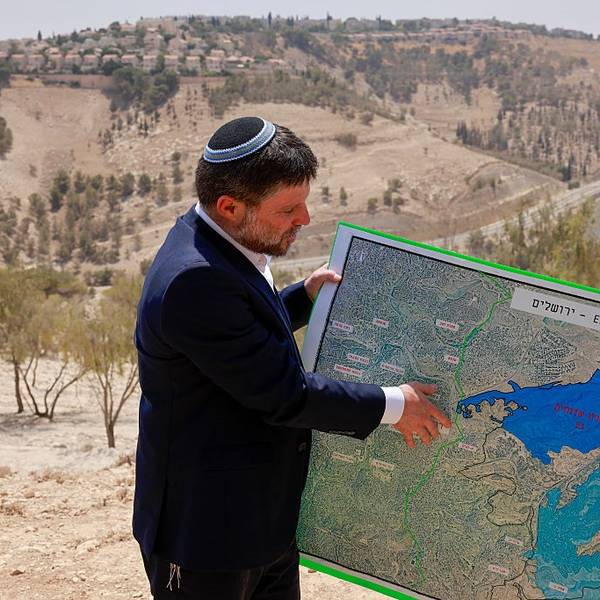
Israeli Finance Minister Bezalel Smotrich holds a map of an area known as E1 in the occupied West Bank on August 14, 2025.
"If you want to 'target sanctions at those who participate in illegal settlement expansion,' you're going to have to sanction the entire Israeli government, so we look forward to seeing that."
As the Canadian and several European governments on Thursday denounced Israel's latest move to divide the illegally occupied West Bank with its E1 settlement project, the critical countries faced fresh calls to actually respond with sanctions.
When the Israeli government last August approved a plan to build 3,401 housing units for settlers in the E1 area east of Jerusalem, Finance Minister Bezalel Smotrich proclaimed that the proposal "buries the idea of a Palestinian state," a comment that came as his country was nearly two years into a military operation in the Gaza Strip globally condemned as genocide.
Bedouin Palestinians who live in the area and Israeli peace groups are challenging the E1 plan in court, but that didn't deter the Ministry of Construction and Housing from issuing a tender to build seven residential compounds with 1,234 units on Wednesday. Contractors can submit bids until October 19, a week before Israel's October 27 parliamentary election. Criticism was swift.
The Israeli watchdog group Peace Now said that "this is a last-minute maneuver that is part of the scorched-earth policy the government is pursuing at the end of its term to secure long years of conflict and bloodshed for Israel. Building in E1 will ruin the possibility of reaching an end to the conflict and a peace arrangement based on two states. The government is trying to sign contracts with contractors before the elections so that it will be much harder for the next government to cancel the construction."
Sarah Sanbar, acting Israel and Palestine researcher at the US-based organization Human Rights Watch (HRW), stressed that "the E1 project isn't just housing; it's erasure of Palestinians, their homes, and their livelihoods... Israel cannot be allowed to alter 'facts on the ground' and entrench apartheid with impunity."
"Behind housing units in E1 are Palestinian families facing displacement. Companies bidding to build those houses are bidding on complicity in a war crime," Sanbar said. "Other countries have a duty to prevent companies under their jurisdiction from profiting off illegal settlement construction."
J Street, a liberal Zionist group also based in the United States, called for immediate action from the White House and Congress, which have long given Israel billions of dollars a year in military aid, even as the death tolls have soared in Gaza and the West Bank, where Israel Defense Forces troops are often accused of refusing to stop or even enabling settler violence against Palestinians.
"The E1 project would build an Israeli city in the heart of the West Bank—territory that should form the core of a future Palestinian state. It would also sever East Jerusalem and other major Palestinian population centers from one another, further restricting Palestinian movement," J Street noted. "Combined with this government's approval of more than 100 new settlements and its support for hundreds of new outposts across the West Bank, the E1 tender can only be understood as a key part of a systematic effort to undermine the viability of Palestinian statehood."
The United Kingdom's foreign secretary, Ed Miliband, on Wednesday put out a lengthy statement declaring the publication of the tender as "an unacceptable and destructive act," and that "settlement expansion and attempts to create irreversible divisions on the ground threaten peace, security, and the prospects for a viable Palestinian state."
"Britain will not stand back and accept the destruction of the two-state solution," he pledged. "In the coming weeks we will set out a comprehensive set of measures to respond to Israeli government policies, protect the viability of the Palestinian state, target sanctions at those who participate in illegal settlement expansion, and support a just and lasting peace for Israelis and Palestinians."
While Israel's Foreign Minister Gideon Sa'ar and Minister of National Security Itamar Ben-Gvir responded to Milliband with hostility, Kenneth Roth, a senior fellow at Yale University and former longtime leader of HRW, said it is "nice to see this."
Welcoming the "strong words from Britain objecting to Israel's continuing settlement expansion," Roth wondered, "Will the UK refer these war crimes (Art. 49 of the Fourth Geneva Convention) to the International Criminal Court for prosecution?"
Zarah Sultana, a member of the UK Parliament for Coventry South who co-founded Your Party with former Labour Leader Jeremy Corbyn, responded on social media with a jab at her country's Labour leadership: "Stop selling them arms then, Ed."
Rohan Talbot, director of advocacy and campaigns at the British charity Medical Aid for Palestinians, told Miliband, "If you want to 'target sanctions at those who participate in illegal settlement expansion,' you're going to have to sanction the entire Israeli government, so we look forward to seeing that."
On Thursday, the office of UK Prime Minister Andy Burnham announced that he joined leaders from Canada, France, Germany, Italy, the Netherlands, and Norway for a joint statement slamming the tender for the E1 settlement project as "unacceptable" and all Israeli settlements in the West Bank as illegal under international law, as "reaffirmed by the United Nations Security Council."
"At a time of grave instability in the West Bank with unprecedented levels of violence by settlers against civilians, and serious restrictions on the Palestinian economy, this decision is even more concerning," the coalition said, urging the Israeli government to "retract these plans immediately" and businesses to "not consider bidding for construction tenders."
Businesses considering bids "should be aware of legal and reputational consequences including the risk of involving themselves in serious breaches of international law," the seven governments said. "We reiterate our commitment to a comprehensive, just and lasting peace based on the two-state solution. We will continue to act in its interest."
Replying on social media, Canadians for Justice and Peace in the Middle East said that "Israel will not back down from its 'doomsday' E1 settlement expansion until there are real consequences. If countries like Canada are serious, they must immediately impose sanctions against any person, organization, or company involved in this war crime."
Dear Common Dreams reader, It’s been nearly 30 years since I co-founded Common Dreams with my late wife, Lina Newhouser. We had the radical notion that journalism should serve the public good, not corporate profits. It was clear to us from the outset what it would take to build such a project. No paid advertisements. No corporate sponsors. No millionaire publisher telling us what to think or do. Many people said we wouldn't last a year, but we proved those doubters wrong. Together with a tremendous team of journalists and dedicated staff, we built an independent media outlet free from the constraints of profits and corporate control. Our mission has always been simple: To inform. To inspire. To ignite change for the common good. Building Common Dreams was not easy. Our survival was never guaranteed. When you take on the most powerful forces—Wall Street greed, fossil fuel industry destruction, Big Tech lobbyists, and uber-rich oligarchs who have spent billions upon billions rigging the economy and democracy in their favor—the only bulwark you have is supporters who believe in your work. But here’s the urgent message from me today. It's never been this bad out there. And it's never been this hard to keep us going. At the very moment Common Dreams is most needed, the threats we face are intensifying. We need your support now more than ever. We don't accept corporate advertising and never will. We don't have a paywall because we don't think people should be blocked from critical news based on their ability to pay. Everything we do is funded by the donations of readers like you. When everyone does the little they can afford, we are strong. But if that support retreats or dries up, so do we. Will you donate now to make sure Common Dreams not only survives but thrives? —Craig Brown, Co-founder |
As the Canadian and several European governments on Thursday denounced Israel's latest move to divide the illegally occupied West Bank with its E1 settlement project, the critical countries faced fresh calls to actually respond with sanctions.
When the Israeli government last August approved a plan to build 3,401 housing units for settlers in the E1 area east of Jerusalem, Finance Minister Bezalel Smotrich proclaimed that the proposal "buries the idea of a Palestinian state," a comment that came as his country was nearly two years into a military operation in the Gaza Strip globally condemned as genocide.
Bedouin Palestinians who live in the area and Israeli peace groups are challenging the E1 plan in court, but that didn't deter the Ministry of Construction and Housing from issuing a tender to build seven residential compounds with 1,234 units on Wednesday. Contractors can submit bids until October 19, a week before Israel's October 27 parliamentary election. Criticism was swift.
The Israeli watchdog group Peace Now said that "this is a last-minute maneuver that is part of the scorched-earth policy the government is pursuing at the end of its term to secure long years of conflict and bloodshed for Israel. Building in E1 will ruin the possibility of reaching an end to the conflict and a peace arrangement based on two states. The government is trying to sign contracts with contractors before the elections so that it will be much harder for the next government to cancel the construction."
Sarah Sanbar, acting Israel and Palestine researcher at the US-based organization Human Rights Watch (HRW), stressed that "the E1 project isn't just housing; it's erasure of Palestinians, their homes, and their livelihoods... Israel cannot be allowed to alter 'facts on the ground' and entrench apartheid with impunity."
"Behind housing units in E1 are Palestinian families facing displacement. Companies bidding to build those houses are bidding on complicity in a war crime," Sanbar said. "Other countries have a duty to prevent companies under their jurisdiction from profiting off illegal settlement construction."
J Street, a liberal Zionist group also based in the United States, called for immediate action from the White House and Congress, which have long given Israel billions of dollars a year in military aid, even as the death tolls have soared in Gaza and the West Bank, where Israel Defense Forces troops are often accused of refusing to stop or even enabling settler violence against Palestinians.
"The E1 project would build an Israeli city in the heart of the West Bank—territory that should form the core of a future Palestinian state. It would also sever East Jerusalem and other major Palestinian population centers from one another, further restricting Palestinian movement," J Street noted. "Combined with this government's approval of more than 100 new settlements and its support for hundreds of new outposts across the West Bank, the E1 tender can only be understood as a key part of a systematic effort to undermine the viability of Palestinian statehood."
The United Kingdom's foreign secretary, Ed Miliband, on Wednesday put out a lengthy statement declaring the publication of the tender as "an unacceptable and destructive act," and that "settlement expansion and attempts to create irreversible divisions on the ground threaten peace, security, and the prospects for a viable Palestinian state."
"Britain will not stand back and accept the destruction of the two-state solution," he pledged. "In the coming weeks we will set out a comprehensive set of measures to respond to Israeli government policies, protect the viability of the Palestinian state, target sanctions at those who participate in illegal settlement expansion, and support a just and lasting peace for Israelis and Palestinians."
While Israel's Foreign Minister Gideon Sa'ar and Minister of National Security Itamar Ben-Gvir responded to Milliband with hostility, Kenneth Roth, a senior fellow at Yale University and former longtime leader of HRW, said it is "nice to see this."
Welcoming the "strong words from Britain objecting to Israel's continuing settlement expansion," Roth wondered, "Will the UK refer these war crimes (Art. 49 of the Fourth Geneva Convention) to the International Criminal Court for prosecution?"
Zarah Sultana, a member of the UK Parliament for Coventry South who co-founded Your Party with former Labour Leader Jeremy Corbyn, responded on social media with a jab at her country's Labour leadership: "Stop selling them arms then, Ed."
Rohan Talbot, director of advocacy and campaigns at the British charity Medical Aid for Palestinians, told Miliband, "If you want to 'target sanctions at those who participate in illegal settlement expansion,' you're going to have to sanction the entire Israeli government, so we look forward to seeing that."
On Thursday, the office of UK Prime Minister Andy Burnham announced that he joined leaders from Canada, France, Germany, Italy, the Netherlands, and Norway for a joint statement slamming the tender for the E1 settlement project as "unacceptable" and all Israeli settlements in the West Bank as illegal under international law, as "reaffirmed by the United Nations Security Council."
"At a time of grave instability in the West Bank with unprecedented levels of violence by settlers against civilians, and serious restrictions on the Palestinian economy, this decision is even more concerning," the coalition said, urging the Israeli government to "retract these plans immediately" and businesses to "not consider bidding for construction tenders."
Businesses considering bids "should be aware of legal and reputational consequences including the risk of involving themselves in serious breaches of international law," the seven governments said. "We reiterate our commitment to a comprehensive, just and lasting peace based on the two-state solution. We will continue to act in its interest."
Replying on social media, Canadians for Justice and Peace in the Middle East said that "Israel will not back down from its 'doomsday' E1 settlement expansion until there are real consequences. If countries like Canada are serious, they must immediately impose sanctions against any person, organization, or company involved in this war crime."
As the Canadian and several European governments on Thursday denounced Israel's latest move to divide the illegally occupied West Bank with its E1 settlement project, the critical countries faced fresh calls to actually respond with sanctions.
When the Israeli government last August approved a plan to build 3,401 housing units for settlers in the E1 area east of Jerusalem, Finance Minister Bezalel Smotrich proclaimed that the proposal "buries the idea of a Palestinian state," a comment that came as his country was nearly two years into a military operation in the Gaza Strip globally condemned as genocide.
Bedouin Palestinians who live in the area and Israeli peace groups are challenging the E1 plan in court, but that didn't deter the Ministry of Construction and Housing from issuing a tender to build seven residential compounds with 1,234 units on Wednesday. Contractors can submit bids until October 19, a week before Israel's October 27 parliamentary election. Criticism was swift.
The Israeli watchdog group Peace Now said that "this is a last-minute maneuver that is part of the scorched-earth policy the government is pursuing at the end of its term to secure long years of conflict and bloodshed for Israel. Building in E1 will ruin the possibility of reaching an end to the conflict and a peace arrangement based on two states. The government is trying to sign contracts with contractors before the elections so that it will be much harder for the next government to cancel the construction."
Sarah Sanbar, acting Israel and Palestine researcher at the US-based organization Human Rights Watch (HRW), stressed that "the E1 project isn't just housing; it's erasure of Palestinians, their homes, and their livelihoods... Israel cannot be allowed to alter 'facts on the ground' and entrench apartheid with impunity."
"Behind housing units in E1 are Palestinian families facing displacement. Companies bidding to build those houses are bidding on complicity in a war crime," Sanbar said. "Other countries have a duty to prevent companies under their jurisdiction from profiting off illegal settlement construction."
J Street, a liberal Zionist group also based in the United States, called for immediate action from the White House and Congress, which have long given Israel billions of dollars a year in military aid, even as the death tolls have soared in Gaza and the West Bank, where Israel Defense Forces troops are often accused of refusing to stop or even enabling settler violence against Palestinians.
"The E1 project would build an Israeli city in the heart of the West Bank—territory that should form the core of a future Palestinian state. It would also sever East Jerusalem and other major Palestinian population centers from one another, further restricting Palestinian movement," J Street noted. "Combined with this government's approval of more than 100 new settlements and its support for hundreds of new outposts across the West Bank, the E1 tender can only be understood as a key part of a systematic effort to undermine the viability of Palestinian statehood."
The United Kingdom's foreign secretary, Ed Miliband, on Wednesday put out a lengthy statement declaring the publication of the tender as "an unacceptable and destructive act," and that "settlement expansion and attempts to create irreversible divisions on the ground threaten peace, security, and the prospects for a viable Palestinian state."
"Britain will not stand back and accept the destruction of the two-state solution," he pledged. "In the coming weeks we will set out a comprehensive set of measures to respond to Israeli government policies, protect the viability of the Palestinian state, target sanctions at those who participate in illegal settlement expansion, and support a just and lasting peace for Israelis and Palestinians."
While Israel's Foreign Minister Gideon Sa'ar and Minister of National Security Itamar Ben-Gvir responded to Milliband with hostility, Kenneth Roth, a senior fellow at Yale University and former longtime leader of HRW, said it is "nice to see this."
Welcoming the "strong words from Britain objecting to Israel's continuing settlement expansion," Roth wondered, "Will the UK refer these war crimes (Art. 49 of the Fourth Geneva Convention) to the International Criminal Court for prosecution?"
Zarah Sultana, a member of the UK Parliament for Coventry South who co-founded Your Party with former Labour Leader Jeremy Corbyn, responded on social media with a jab at her country's Labour leadership: "Stop selling them arms then, Ed."
Rohan Talbot, director of advocacy and campaigns at the British charity Medical Aid for Palestinians, told Miliband, "If you want to 'target sanctions at those who participate in illegal settlement expansion,' you're going to have to sanction the entire Israeli government, so we look forward to seeing that."
On Thursday, the office of UK Prime Minister Andy Burnham announced that he joined leaders from Canada, France, Germany, Italy, the Netherlands, and Norway for a joint statement slamming the tender for the E1 settlement project as "unacceptable" and all Israeli settlements in the West Bank as illegal under international law, as "reaffirmed by the United Nations Security Council."
"At a time of grave instability in the West Bank with unprecedented levels of violence by settlers against civilians, and serious restrictions on the Palestinian economy, this decision is even more concerning," the coalition said, urging the Israeli government to "retract these plans immediately" and businesses to "not consider bidding for construction tenders."
Businesses considering bids "should be aware of legal and reputational consequences including the risk of involving themselves in serious breaches of international law," the seven governments said. "We reiterate our commitment to a comprehensive, just and lasting peace based on the two-state solution. We will continue to act in its interest."
Replying on social media, Canadians for Justice and Peace in the Middle East said that "Israel will not back down from its 'doomsday' E1 settlement expansion until there are real consequences. If countries like Canada are serious, they must immediately impose sanctions against any person, organization, or company involved in this war crime."