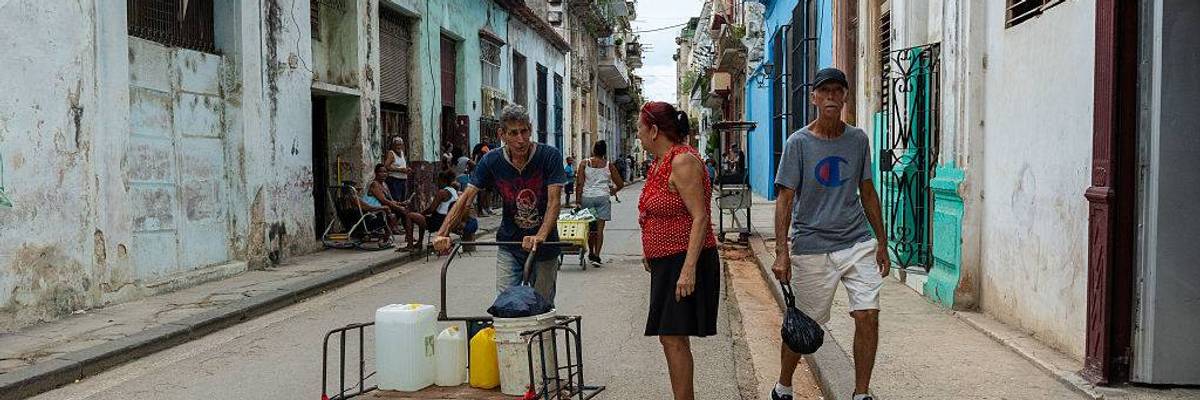
Residents collect water from tanker trucks and carry containers through the streets amid widespread shortages in Havana, Cuba, on June 5, 2026.
'We've Been Four Days Without Light': Cubans Describe Suffering After Four-Month US Oil Blockade
The oil embargo has also devastated Cuba's tourism industry, with multiple international hotel chains abandoning the country.
The US military for the last four months has been blockading oil shipments from entering Cuba, and residents living on the island are saying the situation is growing increasingly dire.
In a Monday report from The Guardian, several Cubans described how their lives have been thrown into turmoil by the Trump administration's oil blockade, which began shortly after the US military invaded Venezuela and abducted President Nicolás Maduro earlier this year.
As noted by The Guardian, Cuba's gas stations have now been empty for months because of the blockade, and the state's power company struggles to keep electricity on for even a few hours every day.
One unnamed doctor in Havana who spoke to The Guardian said that "we’ve been four days without light" in his apartment building, and warned that the fuel shortages would cause even more severe crises on the island the longer they persist.
"Without electricity, water is also a problem," the doctor said. "And there are mosquitoes everywhere."
Havana resident Martha Pérez told The Guardian that she has had to buy gas from "an online supermarket," but added that "the price is US$29 a bottle when it used to be just a few cents when I bought it from the state."
As reported by The Associated Press on Monday, Cubans have been buying fuel on the black market at exorbitant prices that most people cannot afford.
Rather than pay such high sums for gas, many Cubans have simply given up driving all together.
Auto body shop owner Diriel Valdez told the AP that his business has been severely hurt by the oil embargo because Cubans aren't bothering to have their cars maintained or repaired amidst the fuel shortages.
“People don’t want to do major repairs anymore,” Valdez said. “A lot of them have their cars parked. They don’t have much hope that they’ll be circulating the way they used to."
Adding to the economic misery, The Wall Street Journal reported on Saturday that many international businesses that have operated in Cuba for years are now pulling out due to the cost of maintaining operations.
The oil embargo has been particularly harsh on Cuba's tourism industry, and the Journal reported that "Spanish hotel giants Iberostar and Meliá have said they are giving up management of at least a dozen Cuban hotels each," while "Royalton Hotels & Resorts, a Canadian operator, ceased operations after grappling with a collapse in tourism."
We are at a crossroads
This country and this world are at a monumental crossroads. In a few short weeks, US voters will have an opportunity to beat back the forces of fascism and confront the billionaires who are rigging the economy, our media system, and our democracy, making it increasingly impossible for ordinary people to get by. We’re not just talking about the election. We’re talking about what must be done once these fascist elements are vanquished from power. We need a bolder set of solutions than what either major party has so far been willing to offer and a working-class movement ready to fight like hell for it. Trump didn't emerge from nowhere. The conditions that fueled MAGA authoritarianism were created by decades of radical neoliberal economic policies and a corrupt political system dominated by corporate interests. They slashed taxes on the super-rich, promising that the benefits would trickle down. They said giveaways to the corporate titans would make life more affordable for the rest of us. It was all bullshit. And when a bitter, betrayed populace searches for someone to blame, right-wing demagogues have little trouble finding scapegoats. People know when they're being lied to, but you won't hear any of this from the corporate media. Only independent journalism—powered and funded by people who believe in building a better world—can deliver truly trustworthy daily news. Our Fall Campaign is underway, and we need your help. To power our newsroom through the rest of the year, we need to raise $125,000 by midnight on October 31. So if you share our vision, please contribute whatever you can to sustain our work. |
The US military for the last four months has been blockading oil shipments from entering Cuba, and residents living on the island are saying the situation is growing increasingly dire.
In a Monday report from The Guardian, several Cubans described how their lives have been thrown into turmoil by the Trump administration's oil blockade, which began shortly after the US military invaded Venezuela and abducted President Nicolás Maduro earlier this year.
As noted by The Guardian, Cuba's gas stations have now been empty for months because of the blockade, and the state's power company struggles to keep electricity on for even a few hours every day.
One unnamed doctor in Havana who spoke to The Guardian said that "we’ve been four days without light" in his apartment building, and warned that the fuel shortages would cause even more severe crises on the island the longer they persist.
"Without electricity, water is also a problem," the doctor said. "And there are mosquitoes everywhere."
Havana resident Martha Pérez told The Guardian that she has had to buy gas from "an online supermarket," but added that "the price is US$29 a bottle when it used to be just a few cents when I bought it from the state."
As reported by The Associated Press on Monday, Cubans have been buying fuel on the black market at exorbitant prices that most people cannot afford.
Rather than pay such high sums for gas, many Cubans have simply given up driving all together.
Auto body shop owner Diriel Valdez told the AP that his business has been severely hurt by the oil embargo because Cubans aren't bothering to have their cars maintained or repaired amidst the fuel shortages.
“People don’t want to do major repairs anymore,” Valdez said. “A lot of them have their cars parked. They don’t have much hope that they’ll be circulating the way they used to."
Adding to the economic misery, The Wall Street Journal reported on Saturday that many international businesses that have operated in Cuba for years are now pulling out due to the cost of maintaining operations.
The oil embargo has been particularly harsh on Cuba's tourism industry, and the Journal reported that "Spanish hotel giants Iberostar and Meliá have said they are giving up management of at least a dozen Cuban hotels each," while "Royalton Hotels & Resorts, a Canadian operator, ceased operations after grappling with a collapse in tourism."
- ‘This Is a Lie’: Rubio Falsely Claims That There Is No US Blockade on Oil Entering Cuba ›
- 'Economic Warfare': Cuba Faces Island-Wide Blackout Amid Illegal Trump Blockade ›
- 'The Siege Must Be Broken': Countries Called to Ship Fuel to Cuba After Trump Tariffs Struck Down ›
- Opinion | What the Corporate Media Never Says In Its Coverage of Cuba | Common Dreams ›
The US military for the last four months has been blockading oil shipments from entering Cuba, and residents living on the island are saying the situation is growing increasingly dire.
In a Monday report from The Guardian, several Cubans described how their lives have been thrown into turmoil by the Trump administration's oil blockade, which began shortly after the US military invaded Venezuela and abducted President Nicolás Maduro earlier this year.
As noted by The Guardian, Cuba's gas stations have now been empty for months because of the blockade, and the state's power company struggles to keep electricity on for even a few hours every day.
One unnamed doctor in Havana who spoke to The Guardian said that "we’ve been four days without light" in his apartment building, and warned that the fuel shortages would cause even more severe crises on the island the longer they persist.
"Without electricity, water is also a problem," the doctor said. "And there are mosquitoes everywhere."
Havana resident Martha Pérez told The Guardian that she has had to buy gas from "an online supermarket," but added that "the price is US$29 a bottle when it used to be just a few cents when I bought it from the state."
As reported by The Associated Press on Monday, Cubans have been buying fuel on the black market at exorbitant prices that most people cannot afford.
Rather than pay such high sums for gas, many Cubans have simply given up driving all together.
Auto body shop owner Diriel Valdez told the AP that his business has been severely hurt by the oil embargo because Cubans aren't bothering to have their cars maintained or repaired amidst the fuel shortages.
“People don’t want to do major repairs anymore,” Valdez said. “A lot of them have their cars parked. They don’t have much hope that they’ll be circulating the way they used to."
Adding to the economic misery, The Wall Street Journal reported on Saturday that many international businesses that have operated in Cuba for years are now pulling out due to the cost of maintaining operations.
The oil embargo has been particularly harsh on Cuba's tourism industry, and the Journal reported that "Spanish hotel giants Iberostar and Meliá have said they are giving up management of at least a dozen Cuban hotels each," while "Royalton Hotels & Resorts, a Canadian operator, ceased operations after grappling with a collapse in tourism."
- ‘This Is a Lie’: Rubio Falsely Claims That There Is No US Blockade on Oil Entering Cuba ›
- 'Economic Warfare': Cuba Faces Island-Wide Blackout Amid Illegal Trump Blockade ›
- 'The Siege Must Be Broken': Countries Called to Ship Fuel to Cuba After Trump Tariffs Struck Down ›
- Opinion | What the Corporate Media Never Says In Its Coverage of Cuba | Common Dreams ›