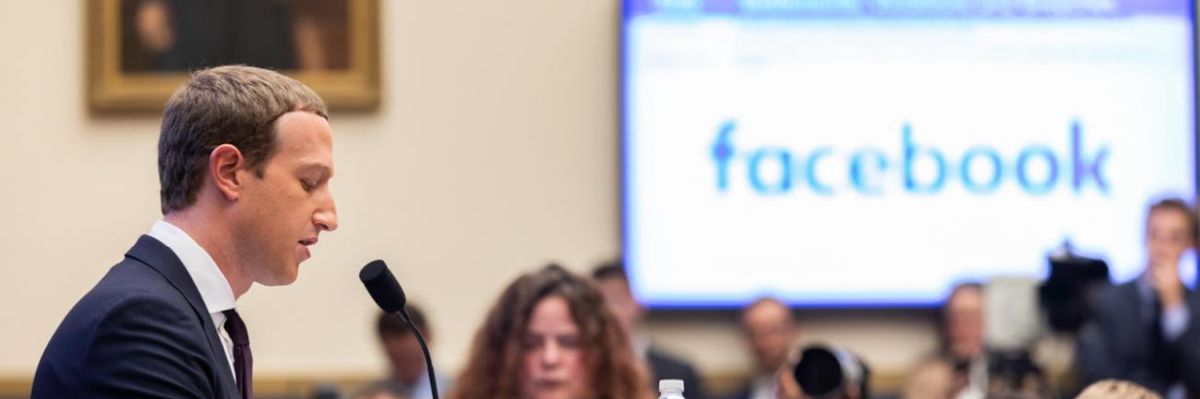
Facebook CEO Mark Zuckerberg testified before the House Financial Services Committee on October 23, 2019 Washington, D.C. (Photo: Aurora Samperio/NurPhoto via Getty Images)
'America Has a Monopoly Problem': Coalition Backs Legislation to Break Up Big Tech
"Reining in these companies is an essential first step to reverse the damage of concentrated corporate power throughout our economy."
"There is a clear and compelling need for Congress and the antitrust enforcement agencies to take action that restores competition, improves innovation, and safeguards our democracy."
--House Judiciary Committee

- The American Innovation and Choice Online Act (H.R. 3816), to promote innovation and competition by prohibiting dominant Big Tech platforms from anti-competitive discrimination;
- The Ending Platform Monopolies Act (H.R. 3825), to give government enforcers the ability to break up or separate certain parts of the businesses that create conflicts of interest;
- The Platform Competition and Opportunity Act (H.R. 3826), to prevent the most problematic mergers and acquisitions, such as those that include competitors, potential or nascent competitors, or will enhance or maintain the company's market power;
- The Augmenting Compatibility and Competition by Enabling Service Switching (ACCESS) Act (H.R. 3849), to require Big Tech platforms to allow users to take their data with them if they decide to leave;
- The Merger Filing Fee Modernization Act (H.R. 3843), to authorize much-needed funding for antitrust enforcement agencies; and
- The State Antitrust Enforcement Venue Act (H.R. 3460), to make it easier for state attorneys general to bring a federal antitrust suit rather than having a defendant seek to move a case to a more favorable venue.
An Urgent Message From Our Co-Founder
Dear Common Dreams reader, It’s been nearly 30 years since I co-founded Common Dreams with my late wife, Lina Newhouser. We had the radical notion that journalism should serve the public good, not corporate profits. It was clear to us from the outset what it would take to build such a project. No paid advertisements. No corporate sponsors. No millionaire publisher telling us what to think or do. Many people said we wouldn't last a year, but we proved those doubters wrong. Together with a tremendous team of journalists and dedicated staff, we built an independent media outlet free from the constraints of profits and corporate control. Our mission has always been simple: To inform. To inspire. To ignite change for the common good. Building Common Dreams was not easy. Our survival was never guaranteed. When you take on the most powerful forces—Wall Street greed, fossil fuel industry destruction, Big Tech lobbyists, and uber-rich oligarchs who have spent billions upon billions rigging the economy and democracy in their favor—the only bulwark you have is supporters who believe in your work. But here’s the urgent message from me today. It's never been this bad out there. And it's never been this hard to keep us going. At the very moment Common Dreams is most needed, the threats we face are intensifying. We need your support now more than ever. We don't accept corporate advertising and never will. We don't have a paywall because we don't think people should be blocked from critical news based on their ability to pay. Everything we do is funded by the donations of readers like you. When everyone does the little they can afford, we are strong. But if that support retreats or dries up, so do we. Will you donate now to make sure Common Dreams not only survives but thrives? —Craig Brown, Co-founder |
"There is a clear and compelling need for Congress and the antitrust enforcement agencies to take action that restores competition, improves innovation, and safeguards our democracy."
--House Judiciary Committee

- The American Innovation and Choice Online Act (H.R. 3816), to promote innovation and competition by prohibiting dominant Big Tech platforms from anti-competitive discrimination;
- The Ending Platform Monopolies Act (H.R. 3825), to give government enforcers the ability to break up or separate certain parts of the businesses that create conflicts of interest;
- The Platform Competition and Opportunity Act (H.R. 3826), to prevent the most problematic mergers and acquisitions, such as those that include competitors, potential or nascent competitors, or will enhance or maintain the company's market power;
- The Augmenting Compatibility and Competition by Enabling Service Switching (ACCESS) Act (H.R. 3849), to require Big Tech platforms to allow users to take their data with them if they decide to leave;
- The Merger Filing Fee Modernization Act (H.R. 3843), to authorize much-needed funding for antitrust enforcement agencies; and
- The State Antitrust Enforcement Venue Act (H.R. 3460), to make it easier for state attorneys general to bring a federal antitrust suit rather than having a defendant seek to move a case to a more favorable venue.
"There is a clear and compelling need for Congress and the antitrust enforcement agencies to take action that restores competition, improves innovation, and safeguards our democracy."
--House Judiciary Committee
- The American Innovation and Choice Online Act (H.R. 3816), to promote innovation and competition by prohibiting dominant Big Tech platforms from anti-competitive discrimination;
- The Ending Platform Monopolies Act (H.R. 3825), to give government enforcers the ability to break up or separate certain parts of the businesses that create conflicts of interest;
- The Platform Competition and Opportunity Act (H.R. 3826), to prevent the most problematic mergers and acquisitions, such as those that include competitors, potential or nascent competitors, or will enhance or maintain the company's market power;
- The Augmenting Compatibility and Competition by Enabling Service Switching (ACCESS) Act (H.R. 3849), to require Big Tech platforms to allow users to take their data with them if they decide to leave;
- The Merger Filing Fee Modernization Act (H.R. 3843), to authorize much-needed funding for antitrust enforcement agencies; and
- The State Antitrust Enforcement Venue Act (H.R. 3460), to make it easier for state attorneys general to bring a federal antitrust suit rather than having a defendant seek to move a case to a more favorable venue.