5
#000000
#FFFFFF
To donate by check, phone, or other method, see our More Ways to Give page.
Daily news & progressive opinion—funded by the people, not the corporations—delivered straight to your inbox.
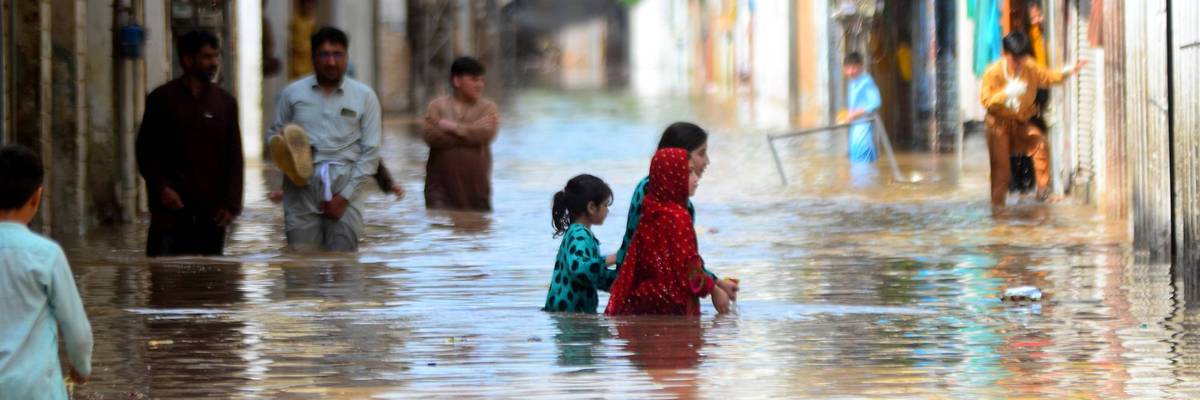
Children try to walk through floodwater in Khyber Pakhtunkhwa, Pakistan, on April 4, 2026.
A new United Nations report finds that well over half of the world's children live in areas facing drought, 1.5 billion face heatwaves, and 370 million are exposed to flooding.
As global fossil fuel giants report windfall profits from the US-Israeli war on Iran and President Donald Trump pushes to continue oil, gas, and coal extraction despite the clear risks to the planet, the United Nations children's welfare agency on Tuesday provided "the most detailed global picture to date" of how children across the world—in low-, middle-, and high-income countries—are being impacted by the fossil-fueled climate emergency.
According to the Children’s Climate Risk Report 2026 by the UN Children's Fund (UNICEF), nearly every child in the world is now exposed to at least one climate hazard, including riverine or coastal flooding, dangerous heatwaves, severe storms, or drought—all extreme weather events that scientists say are being made more hazardous by continued greenhouse gas emissions, which are pushing the goal of limiting planetary heating to 1.5°C further out of reach, according to experts.
There were 2.4 billion children on Earth in 2025, and according to the report, 2.3 billion of them are estimated to live in areas with air pollution—identified in the report as is "not primarily driven by Earth’s climate but... highly sensitive to and compounded by it."
Well over half of the world's children, 1.8 billion, are exposed to drought, and 1.5 billion are living in areas facing heatwaves that have grown longer and more severe as fossil fuel extraction has continued despite scientists' and energy experts' warnings.
About 1.2 billion children are exposed to extreme heat where they live, while about 370 million live in areas affected by either riverine flooding or coastal flooding—which have been driven by more severe tropical storms, affecting 662 million children worldwide and frequently disrupting homes, schools, and health services.
Children in sub-Saharan Africa were identified as the most vulnerable to climate hazards, with communities facing extreme heat, drought, and heatwaves.
Children in South Asian countries, such as Bangladesh and Pakistan, were found to have the most children exposed to multiple hazards at the highest intensities, such as flooding and extreme heatwaves.
"The climate crisis does not manifest as a single event. For millions of children, the reality is a complex and dangerous cascade of multiple, overlapping hazards," reads the report's executive summary. "This compounding of threats overwhelms the capacity of unprepared social services and undermines the resilience of families and communities. For instance, intense droughts can devastate crops and worsen food insecurity. Dry vegetation left behind by a drought can fuel wildfires, which in turn exacerbate air pollution and leave the land vulnerable to flash floods later in the year. These floods can destroy infrastructure such as homes, schools and hospitals, displace communities, and spread waterborne diseases."
"These effects can create a vicious cycle: Destroyed homes can lead to displacement, which can result in a lack of shelter, depriving children of protection from additional impacts and making them even more susceptible to future hazards," continues the report. "Disrupted education can have lifelong consequences, making it harder for children to build a stable future and break free from hardship."
The report calls on governments to reduce fossil fuel emissions and "take ambitious action" to secure a just transition toward renewable energy; protect children through inclusive climate adaptation and loss and damage funding; and invest in climate education to ensure that "children’s needs and perspectives are reflected in local, national, regional, and global decision-making on climate policy and climate finance."
UNICEF emphasized that "we know what works: installing solar power to keep children learning during power outages, switching to groundwater aquifers for drinking water as surface water sources dry up, upgrading sanitation systems to recycle water for farming, and building shelters to protect children and their families from tropical storms."
Specific recommendations in the report include:
Tom Slaymaker, a monitoring specialist for a joint UNICEF and World Health Organization program focused on water supply, sanitation, and hygiene, said the message in the report "is clear."
"Climate change is not only changing the planet, but also children," said Slaymaker. "Without urgent, child-focused climate action, the shocks they face today will only intensify. But with the right investment and political will, we can reduce risks, strengthen systems, and give children the chance to survive and thrive.”
Catherine Russell, executive director of UNICEF, said the agency's analysis "can help governments and decision-makers plan better and invest more effectively in resilient services."
"When we strengthen health and education systems, and improve infrastructure with children in mind," said Russell, "we protect them from today’s climate threats and help secure their future.”
Dear Common Dreams reader, It’s been nearly 30 years since I co-founded Common Dreams with my late wife, Lina Newhouser. We had the radical notion that journalism should serve the public good, not corporate profits. It was clear to us from the outset what it would take to build such a project. No paid advertisements. No corporate sponsors. No millionaire publisher telling us what to think or do. Many people said we wouldn't last a year, but we proved those doubters wrong. Together with a tremendous team of journalists and dedicated staff, we built an independent media outlet free from the constraints of profits and corporate control. Our mission has always been simple: To inform. To inspire. To ignite change for the common good. Building Common Dreams was not easy. Our survival was never guaranteed. When you take on the most powerful forces—Wall Street greed, fossil fuel industry destruction, Big Tech lobbyists, and uber-rich oligarchs who have spent billions upon billions rigging the economy and democracy in their favor—the only bulwark you have is supporters who believe in your work. But here’s the urgent message from me today. It's never been this bad out there. And it's never been this hard to keep us going. At the very moment Common Dreams is most needed, the threats we face are intensifying. We need your support now more than ever. We don't accept corporate advertising and never will. We don't have a paywall because we don't think people should be blocked from critical news based on their ability to pay. Everything we do is funded by the donations of readers like you. When everyone does the little they can afford, we are strong. But if that support retreats or dries up, so do we. Will you donate now to make sure Common Dreams not only survives but thrives? —Craig Brown, Co-founder |
As global fossil fuel giants report windfall profits from the US-Israeli war on Iran and President Donald Trump pushes to continue oil, gas, and coal extraction despite the clear risks to the planet, the United Nations children's welfare agency on Tuesday provided "the most detailed global picture to date" of how children across the world—in low-, middle-, and high-income countries—are being impacted by the fossil-fueled climate emergency.
According to the Children’s Climate Risk Report 2026 by the UN Children's Fund (UNICEF), nearly every child in the world is now exposed to at least one climate hazard, including riverine or coastal flooding, dangerous heatwaves, severe storms, or drought—all extreme weather events that scientists say are being made more hazardous by continued greenhouse gas emissions, which are pushing the goal of limiting planetary heating to 1.5°C further out of reach, according to experts.
There were 2.4 billion children on Earth in 2025, and according to the report, 2.3 billion of them are estimated to live in areas with air pollution—identified in the report as is "not primarily driven by Earth’s climate but... highly sensitive to and compounded by it."
Well over half of the world's children, 1.8 billion, are exposed to drought, and 1.5 billion are living in areas facing heatwaves that have grown longer and more severe as fossil fuel extraction has continued despite scientists' and energy experts' warnings.
About 1.2 billion children are exposed to extreme heat where they live, while about 370 million live in areas affected by either riverine flooding or coastal flooding—which have been driven by more severe tropical storms, affecting 662 million children worldwide and frequently disrupting homes, schools, and health services.
Children in sub-Saharan Africa were identified as the most vulnerable to climate hazards, with communities facing extreme heat, drought, and heatwaves.
Children in South Asian countries, such as Bangladesh and Pakistan, were found to have the most children exposed to multiple hazards at the highest intensities, such as flooding and extreme heatwaves.
"The climate crisis does not manifest as a single event. For millions of children, the reality is a complex and dangerous cascade of multiple, overlapping hazards," reads the report's executive summary. "This compounding of threats overwhelms the capacity of unprepared social services and undermines the resilience of families and communities. For instance, intense droughts can devastate crops and worsen food insecurity. Dry vegetation left behind by a drought can fuel wildfires, which in turn exacerbate air pollution and leave the land vulnerable to flash floods later in the year. These floods can destroy infrastructure such as homes, schools and hospitals, displace communities, and spread waterborne diseases."
"These effects can create a vicious cycle: Destroyed homes can lead to displacement, which can result in a lack of shelter, depriving children of protection from additional impacts and making them even more susceptible to future hazards," continues the report. "Disrupted education can have lifelong consequences, making it harder for children to build a stable future and break free from hardship."
The report calls on governments to reduce fossil fuel emissions and "take ambitious action" to secure a just transition toward renewable energy; protect children through inclusive climate adaptation and loss and damage funding; and invest in climate education to ensure that "children’s needs and perspectives are reflected in local, national, regional, and global decision-making on climate policy and climate finance."
UNICEF emphasized that "we know what works: installing solar power to keep children learning during power outages, switching to groundwater aquifers for drinking water as surface water sources dry up, upgrading sanitation systems to recycle water for farming, and building shelters to protect children and their families from tropical storms."
Specific recommendations in the report include:
Tom Slaymaker, a monitoring specialist for a joint UNICEF and World Health Organization program focused on water supply, sanitation, and hygiene, said the message in the report "is clear."
"Climate change is not only changing the planet, but also children," said Slaymaker. "Without urgent, child-focused climate action, the shocks they face today will only intensify. But with the right investment and political will, we can reduce risks, strengthen systems, and give children the chance to survive and thrive.”
Catherine Russell, executive director of UNICEF, said the agency's analysis "can help governments and decision-makers plan better and invest more effectively in resilient services."
"When we strengthen health and education systems, and improve infrastructure with children in mind," said Russell, "we protect them from today’s climate threats and help secure their future.”
As global fossil fuel giants report windfall profits from the US-Israeli war on Iran and President Donald Trump pushes to continue oil, gas, and coal extraction despite the clear risks to the planet, the United Nations children's welfare agency on Tuesday provided "the most detailed global picture to date" of how children across the world—in low-, middle-, and high-income countries—are being impacted by the fossil-fueled climate emergency.
According to the Children’s Climate Risk Report 2026 by the UN Children's Fund (UNICEF), nearly every child in the world is now exposed to at least one climate hazard, including riverine or coastal flooding, dangerous heatwaves, severe storms, or drought—all extreme weather events that scientists say are being made more hazardous by continued greenhouse gas emissions, which are pushing the goal of limiting planetary heating to 1.5°C further out of reach, according to experts.
There were 2.4 billion children on Earth in 2025, and according to the report, 2.3 billion of them are estimated to live in areas with air pollution—identified in the report as is "not primarily driven by Earth’s climate but... highly sensitive to and compounded by it."
Well over half of the world's children, 1.8 billion, are exposed to drought, and 1.5 billion are living in areas facing heatwaves that have grown longer and more severe as fossil fuel extraction has continued despite scientists' and energy experts' warnings.
About 1.2 billion children are exposed to extreme heat where they live, while about 370 million live in areas affected by either riverine flooding or coastal flooding—which have been driven by more severe tropical storms, affecting 662 million children worldwide and frequently disrupting homes, schools, and health services.
Children in sub-Saharan Africa were identified as the most vulnerable to climate hazards, with communities facing extreme heat, drought, and heatwaves.
Children in South Asian countries, such as Bangladesh and Pakistan, were found to have the most children exposed to multiple hazards at the highest intensities, such as flooding and extreme heatwaves.
"The climate crisis does not manifest as a single event. For millions of children, the reality is a complex and dangerous cascade of multiple, overlapping hazards," reads the report's executive summary. "This compounding of threats overwhelms the capacity of unprepared social services and undermines the resilience of families and communities. For instance, intense droughts can devastate crops and worsen food insecurity. Dry vegetation left behind by a drought can fuel wildfires, which in turn exacerbate air pollution and leave the land vulnerable to flash floods later in the year. These floods can destroy infrastructure such as homes, schools and hospitals, displace communities, and spread waterborne diseases."
"These effects can create a vicious cycle: Destroyed homes can lead to displacement, which can result in a lack of shelter, depriving children of protection from additional impacts and making them even more susceptible to future hazards," continues the report. "Disrupted education can have lifelong consequences, making it harder for children to build a stable future and break free from hardship."
The report calls on governments to reduce fossil fuel emissions and "take ambitious action" to secure a just transition toward renewable energy; protect children through inclusive climate adaptation and loss and damage funding; and invest in climate education to ensure that "children’s needs and perspectives are reflected in local, national, regional, and global decision-making on climate policy and climate finance."
UNICEF emphasized that "we know what works: installing solar power to keep children learning during power outages, switching to groundwater aquifers for drinking water as surface water sources dry up, upgrading sanitation systems to recycle water for farming, and building shelters to protect children and their families from tropical storms."
Specific recommendations in the report include:
Tom Slaymaker, a monitoring specialist for a joint UNICEF and World Health Organization program focused on water supply, sanitation, and hygiene, said the message in the report "is clear."
"Climate change is not only changing the planet, but also children," said Slaymaker. "Without urgent, child-focused climate action, the shocks they face today will only intensify. But with the right investment and political will, we can reduce risks, strengthen systems, and give children the chance to survive and thrive.”
Catherine Russell, executive director of UNICEF, said the agency's analysis "can help governments and decision-makers plan better and invest more effectively in resilient services."
"When we strengthen health and education systems, and improve infrastructure with children in mind," said Russell, "we protect them from today’s climate threats and help secure their future.”