
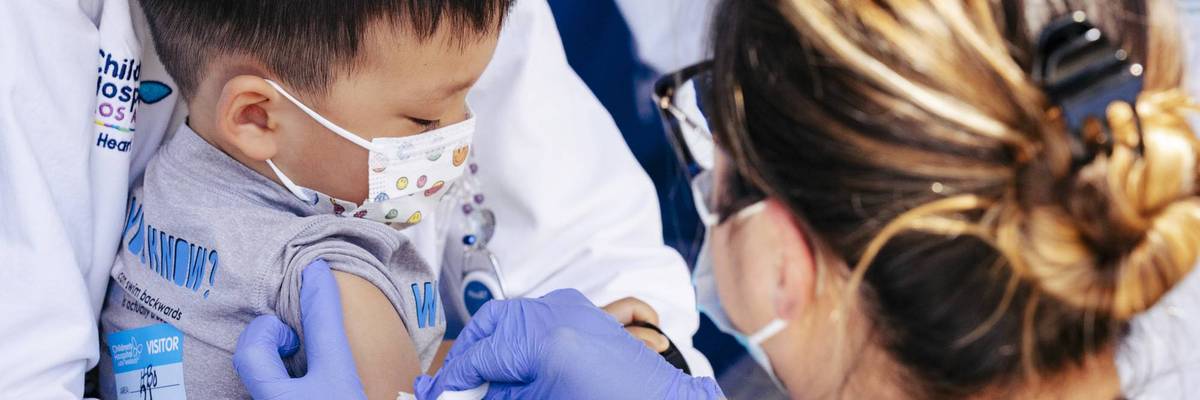
Children's Hospital Los Angeles nurse Monica Lopez prepares to administer the Pfizer Covid-19 vaccine to a young patient on June 21, 2022 in Los Angeles, California.
Nearly 2.5 Million Children Have Lost Medicaid and CHIP—So Far—During Trump’s Second Term
The drop in children covered by Medicaid comes before the most draconian changes to the program made by Republicans' 2025 budget law are set to take effect next year.
Nearly 2.5 million children living in the US have lost access to Medicaid or Children's Health Insurance Program coverage during President Donald Trump's second term, according to data published on Monday by the Georgetown University Center for Children and Families.
In total, five states have seen children's enrollment in Medicaid and CHIP fall by 10% or higher since January 2025, with Indiana seeing a drop in enrollment in those programs of more than 23%.
Colorado and Hawaii were the only two states to see a net increase in children in Medicaid or CHIP over that same period.
Joan Alker, executive director of the Center for Children and Families, described the drop in children enrolled in the programs as "a lot," and said it was important to track because "when Medicaid child enrollment declines, the number of uninsured kids typically goes up."
President Donald Trump and congressional Republicans cut spending on Medicaid by an estimated $900 billion over a 10-year period when they enacted the One Big Beautiful Bill Act in 2025. The Congressional Budget Office projects these cuts will leave more than 10 million fewer people enrolled in the program by 2034.
One way the GOP budget law is projected to kick people off Medicaid has been to add extra administrative burdens and paperwork for people who qualify for the program.
As explained by a Scripps News report published last week, Medicaid starting next year will make beneficiaries enroll twice a year instead of just once, while also mandating adults who "earn above a typical income cutoff and do not have children... work or volunteer at least 80 hours a month, or enroll in school."
Eileen Appelbaum, co-director of the Center for Economic and Policy Research, told Scripps News that this will result in many people not receiving Medicaid coverage despite being qualified for it.
"The best guesses from the experts are that two-thirds of the people that will be disqualified will actually be eligible, but they just couldn't handle the paperwork," Appelbaum explained.
In an op-ed published by Stat on Monday, Brown University epidemiologists Abdullah Shihipar and Brandon DL Marshall highlighted how getting out of the new Medicaid work requirements by proving yourself "medically frail" is shaping up to be a "nightmare scenario for millions of Americans."
"Let’s say you are undergoing cancer treatment, but you don’t have the right paperwork for your renewal," Shihipar and Marshall wrote. "As a result, you’re disenrolled from Medicaid. You desperately try to fix the mistake, but you are faced with long wait times and no answers, so you cease treatment altogether... Paperwork here is not merely an annoyance, it is a matter of life or death for millions with Medicaid coverage."
An Urgent Message From Our Co-Founder
Dear Common Dreams reader, It’s been nearly 30 years since I co-founded Common Dreams with my late wife, Lina Newhouser. We had the radical notion that journalism should serve the public good, not corporate profits. It was clear to us from the outset what it would take to build such a project. No paid advertisements. No corporate sponsors. No millionaire publisher telling us what to think or do. Many people said we wouldn't last a year, but we proved those doubters wrong. Together with a tremendous team of journalists and dedicated staff, we built an independent media outlet free from the constraints of profits and corporate control. Our mission has always been simple: To inform. To inspire. To ignite change for the common good. Building Common Dreams was not easy. Our survival was never guaranteed. When you take on the most powerful forces—Wall Street greed, fossil fuel industry destruction, Big Tech lobbyists, and uber-rich oligarchs who have spent billions upon billions rigging the economy and democracy in their favor—the only bulwark you have is supporters who believe in your work. But here’s the urgent message from me today. It's never been this bad out there. And it's never been this hard to keep us going. At the very moment Common Dreams is most needed, the threats we face are intensifying. We need your support now more than ever. We don't accept corporate advertising and never will. We don't have a paywall because we don't think people should be blocked from critical news based on their ability to pay. Everything we do is funded by the donations of readers like you. When everyone does the little they can afford, we are strong. But if that support retreats or dries up, so do we. Will you donate now to make sure Common Dreams not only survives but thrives? —Craig Brown, Co-founder |
Nearly 2.5 million children living in the US have lost access to Medicaid or Children's Health Insurance Program coverage during President Donald Trump's second term, according to data published on Monday by the Georgetown University Center for Children and Families.
In total, five states have seen children's enrollment in Medicaid and CHIP fall by 10% or higher since January 2025, with Indiana seeing a drop in enrollment in those programs of more than 23%.
Colorado and Hawaii were the only two states to see a net increase in children in Medicaid or CHIP over that same period.
Joan Alker, executive director of the Center for Children and Families, described the drop in children enrolled in the programs as "a lot," and said it was important to track because "when Medicaid child enrollment declines, the number of uninsured kids typically goes up."
President Donald Trump and congressional Republicans cut spending on Medicaid by an estimated $900 billion over a 10-year period when they enacted the One Big Beautiful Bill Act in 2025. The Congressional Budget Office projects these cuts will leave more than 10 million fewer people enrolled in the program by 2034.
One way the GOP budget law is projected to kick people off Medicaid has been to add extra administrative burdens and paperwork for people who qualify for the program.
As explained by a Scripps News report published last week, Medicaid starting next year will make beneficiaries enroll twice a year instead of just once, while also mandating adults who "earn above a typical income cutoff and do not have children... work or volunteer at least 80 hours a month, or enroll in school."
Eileen Appelbaum, co-director of the Center for Economic and Policy Research, told Scripps News that this will result in many people not receiving Medicaid coverage despite being qualified for it.
"The best guesses from the experts are that two-thirds of the people that will be disqualified will actually be eligible, but they just couldn't handle the paperwork," Appelbaum explained.
In an op-ed published by Stat on Monday, Brown University epidemiologists Abdullah Shihipar and Brandon DL Marshall highlighted how getting out of the new Medicaid work requirements by proving yourself "medically frail" is shaping up to be a "nightmare scenario for millions of Americans."
"Let’s say you are undergoing cancer treatment, but you don’t have the right paperwork for your renewal," Shihipar and Marshall wrote. "As a result, you’re disenrolled from Medicaid. You desperately try to fix the mistake, but you are faced with long wait times and no answers, so you cease treatment altogether... Paperwork here is not merely an annoyance, it is a matter of life or death for millions with Medicaid coverage."
- 'Major Warning Sign of What's to Come': Number of Young Kids Without Health Insurance Surges ›
- Pediatricians Warn Trump Attack on Medicaid 'Will Harm Children's Long-Term Health' ›
- 'Terrible Development': Trump Admin Restricts State Efforts to Help Kids Stay on Medicaid ›
Nearly 2.5 million children living in the US have lost access to Medicaid or Children's Health Insurance Program coverage during President Donald Trump's second term, according to data published on Monday by the Georgetown University Center for Children and Families.
In total, five states have seen children's enrollment in Medicaid and CHIP fall by 10% or higher since January 2025, with Indiana seeing a drop in enrollment in those programs of more than 23%.
Colorado and Hawaii were the only two states to see a net increase in children in Medicaid or CHIP over that same period.
Joan Alker, executive director of the Center for Children and Families, described the drop in children enrolled in the programs as "a lot," and said it was important to track because "when Medicaid child enrollment declines, the number of uninsured kids typically goes up."
President Donald Trump and congressional Republicans cut spending on Medicaid by an estimated $900 billion over a 10-year period when they enacted the One Big Beautiful Bill Act in 2025. The Congressional Budget Office projects these cuts will leave more than 10 million fewer people enrolled in the program by 2034.
One way the GOP budget law is projected to kick people off Medicaid has been to add extra administrative burdens and paperwork for people who qualify for the program.
As explained by a Scripps News report published last week, Medicaid starting next year will make beneficiaries enroll twice a year instead of just once, while also mandating adults who "earn above a typical income cutoff and do not have children... work or volunteer at least 80 hours a month, or enroll in school."
Eileen Appelbaum, co-director of the Center for Economic and Policy Research, told Scripps News that this will result in many people not receiving Medicaid coverage despite being qualified for it.
"The best guesses from the experts are that two-thirds of the people that will be disqualified will actually be eligible, but they just couldn't handle the paperwork," Appelbaum explained.
In an op-ed published by Stat on Monday, Brown University epidemiologists Abdullah Shihipar and Brandon DL Marshall highlighted how getting out of the new Medicaid work requirements by proving yourself "medically frail" is shaping up to be a "nightmare scenario for millions of Americans."
"Let’s say you are undergoing cancer treatment, but you don’t have the right paperwork for your renewal," Shihipar and Marshall wrote. "As a result, you’re disenrolled from Medicaid. You desperately try to fix the mistake, but you are faced with long wait times and no answers, so you cease treatment altogether... Paperwork here is not merely an annoyance, it is a matter of life or death for millions with Medicaid coverage."
- 'Major Warning Sign of What's to Come': Number of Young Kids Without Health Insurance Surges ›
- Pediatricians Warn Trump Attack on Medicaid 'Will Harm Children's Long-Term Health' ›
- 'Terrible Development': Trump Admin Restricts State Efforts to Help Kids Stay on Medicaid ›