SUBSCRIBE TO OUR FREE NEWSLETTER
Daily news & progressive opinion—funded by the people, not the corporations—delivered straight to your inbox.
5
#000000
#FFFFFF
To donate by check, phone, or other method, see our More Ways to Give page.
Daily news & progressive opinion—funded by the people, not the corporations—delivered straight to your inbox.
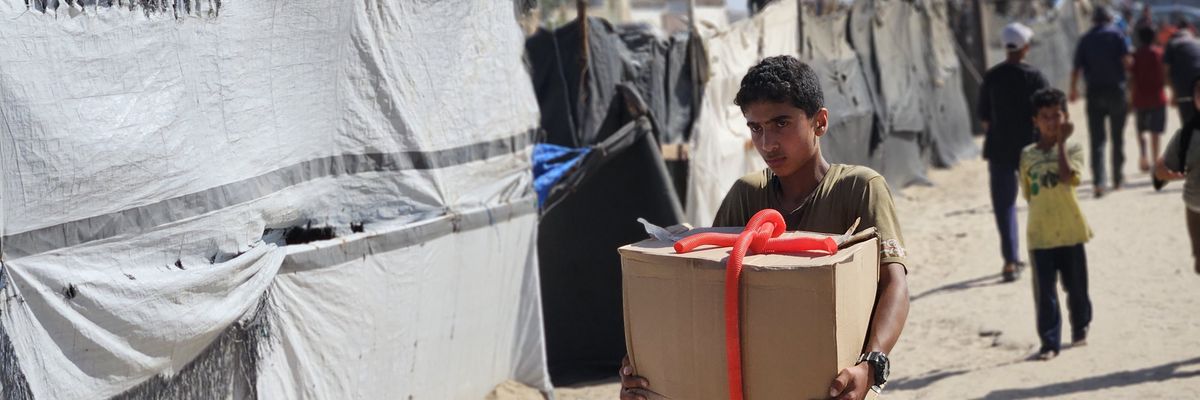
A Palestinian boy carries a food box at a humanitarian aid distribution point controlled by the Gaza Humanitarian Foundation in southern Gaza on May 27, 2025.
The delivery hub was run by the Israel- and U.S.-backed Gaza Humanitarian Foundation, which aid agencies have boycotted.
After walking an average of 9.3 miles to an aid distribution hub set up by the U.S.- and Israel-backed private foundation that Israel has allowed to provide humanitarian relief in Gaza, Palestinians on Tuesday faced gunfire from Israeli troops at the site, with at least one person killed and 48 wounded—and rights groups' worst fears about the aid scheme confirmed.
The first day of operations for the Gaza Humanitarian Foundation (GHF), which has enlisted private U.S. security contractors to help with aid distribution in southern Gaza, came 11 weeks into Israel's total blockade on humanitarian aid.
The blockade has pushed the enclave toward famine and resulted in the entire population facing "high levels of acute food insecurity," according to the Integrated Food Security Phase Classification.
With thousands of Palestinian children facing malnutrition and their parents left without any way to help them in recent weeks, crowds of people broke through fencing and rushed toward the distribution site on Tuesday.
Amid the chaotic scene, an Associated Press journalist reported hearing Israeli tank and gun fire and seeing flares from a military helicopter.
Israel has said the Israel Defense Forces (IDF) would not be involved in GHF operations, but told the AP that it had fired "warning shots."
It was not clear whether the reported casualties were the result of IDF gunfire or private contractors working with GHF, which said its contractors "fell back" before returning to the site and resuming aid operations.
Ajith Sunghay, head of the Office of the United Nations High Commissioner for Human Rights (OHCHR) in the occupied Palestinian territories, said Wednesday that the IDF caused the casualties.
"It is through gunshots," Sunghay told reporters in Geneva. "We are trying to confirm what has happened to them in the sense of seriousness [of the injuries]. What we know is that it was shooting from the IDF."
He said the number of injuries and deaths at the distribution point could increase as experts continue gathering information, and noted that Israeli troops have fired on Palestinians who were retrieving humanitarian aid before.
"From January to March 2024, our office has documented 26 incidents where the Israel Defense Forces fired shots while people were collecting humanitarian aid, causing casualties at Al Kuwaiti roundabout and Al Naburasi roundabout," Sunghay told UN News.
The U.N. and other humanitarian agencies have refused to work with GHF, saying its plan to distribute aid only at four distribution points in southern Gaza—which Palestinians must travel to and from with aid boxes weighing up to 44 pounds—will forcibly displace people who have already been forced to leave their homes and place them in harm's way.
In a press briefing on Tuesday, U.S. State Department spokesperson Tammy Bruce would not answer questions about whether the Palestinians who travel south for aid would be able to return to their homes or if the operation would expand to other parts of Gaza to reach more starving civilians, many of whom are injured and can't travel easily to distribution points.
Jens Laerke, a spokesperson for the U.N. Office for the Coordination of Humanitarian Affairs (OCHA), said the U.N.—which has years of experience providing relief in Gaza—has long been prepared to provide aid to people across the enclave but has been prevented from doing so by Israel's blockade.
"Right now, nearly 180,000 pallets of food and other life-saving aid stand ready to enter Gaza, the hungriest place on earth," he told UN News. "The supplies have already been paid for by the world's donors. It is cleared for customs, approved, and ready to move. We can get the aid in—immediately, at scale, and for as long as necessary."
Jake Wood, a former U.S. marine who was appointed executive director of GHF, resigned this week, saying the Geneva-based group's plan for distributing aid violated the "humanitarian principles of humanity, neutrality, impartiality, and independence."
The Washington Post reported Tuesday that the foundation's chief operating officer, David Burke, also resigned. A former U.S. Agency for International Development official has stepped in as interim executive director.
GHF said Wednesday that it was continuing operations, providing food boxes that are expected to feed "5.5 people for 3.5 days, totaling 840,262 meals."
Emma DeSouza, founder of Civic Initiative, reported that the boxes only contain "two bags of flour, some dry pasta, lentils, and biscuits."
Philippe Lazzarini, commissioner-general of the United Nations Relief and Works Agency for Palestine Refugees in the Near East, said that "the humanitarian community in Gaza, including UNRWA, is ready" to provide aid safely and effectively to Palestinians.
"We already have an aid distribution system that is fit for purpose," Lazzarini said. "We have the experience and expertise to reach people in need. Meanwhile, the clock is ticking towards famine, so humanitarian [work] must be allowed to do its life-saving work now."
This country and this world are at a monumental crossroads. US voters have an opportunity to beat back the forces of fascism and confront the billionaires who are rigging the economy, our media system, and our democracy, making it increasingly impossible for ordinary people to get by. We’re not just talking about the election. We’re talking about what must be done once these fascist elements are vanquished from power. We need a bolder set of solutions than what either major party has so far been willing to offer and a working-class movement ready to fight like hell for it. Trump didn't emerge from nowhere. The conditions that fueled MAGA authoritarianism were created by decades of radical neoliberal economic policies and a corrupt political system dominated by corporate interests. They slashed taxes on the super-rich, promising that the benefits would trickle down. They said giveaways to the corporate titans would make life more affordable for the rest of us. It was all bullshit. And when a bitter, betrayed populace searches for someone to blame, right-wing demagogues have little trouble finding scapegoats. People know when they're being lied to, but you won't hear any of this from the corporate media. Only independent journalism—powered and funded by people who believe in building a better world—can deliver truly trustworthy daily news. If you share our vision, please contribute whatever you can to sustain our work. |
After walking an average of 9.3 miles to an aid distribution hub set up by the U.S.- and Israel-backed private foundation that Israel has allowed to provide humanitarian relief in Gaza, Palestinians on Tuesday faced gunfire from Israeli troops at the site, with at least one person killed and 48 wounded—and rights groups' worst fears about the aid scheme confirmed.
The first day of operations for the Gaza Humanitarian Foundation (GHF), which has enlisted private U.S. security contractors to help with aid distribution in southern Gaza, came 11 weeks into Israel's total blockade on humanitarian aid.
The blockade has pushed the enclave toward famine and resulted in the entire population facing "high levels of acute food insecurity," according to the Integrated Food Security Phase Classification.
With thousands of Palestinian children facing malnutrition and their parents left without any way to help them in recent weeks, crowds of people broke through fencing and rushed toward the distribution site on Tuesday.
Amid the chaotic scene, an Associated Press journalist reported hearing Israeli tank and gun fire and seeing flares from a military helicopter.
Israel has said the Israel Defense Forces (IDF) would not be involved in GHF operations, but told the AP that it had fired "warning shots."
It was not clear whether the reported casualties were the result of IDF gunfire or private contractors working with GHF, which said its contractors "fell back" before returning to the site and resuming aid operations.
Ajith Sunghay, head of the Office of the United Nations High Commissioner for Human Rights (OHCHR) in the occupied Palestinian territories, said Wednesday that the IDF caused the casualties.
"It is through gunshots," Sunghay told reporters in Geneva. "We are trying to confirm what has happened to them in the sense of seriousness [of the injuries]. What we know is that it was shooting from the IDF."
He said the number of injuries and deaths at the distribution point could increase as experts continue gathering information, and noted that Israeli troops have fired on Palestinians who were retrieving humanitarian aid before.
"From January to March 2024, our office has documented 26 incidents where the Israel Defense Forces fired shots while people were collecting humanitarian aid, causing casualties at Al Kuwaiti roundabout and Al Naburasi roundabout," Sunghay told UN News.
The U.N. and other humanitarian agencies have refused to work with GHF, saying its plan to distribute aid only at four distribution points in southern Gaza—which Palestinians must travel to and from with aid boxes weighing up to 44 pounds—will forcibly displace people who have already been forced to leave their homes and place them in harm's way.
In a press briefing on Tuesday, U.S. State Department spokesperson Tammy Bruce would not answer questions about whether the Palestinians who travel south for aid would be able to return to their homes or if the operation would expand to other parts of Gaza to reach more starving civilians, many of whom are injured and can't travel easily to distribution points.
Jens Laerke, a spokesperson for the U.N. Office for the Coordination of Humanitarian Affairs (OCHA), said the U.N.—which has years of experience providing relief in Gaza—has long been prepared to provide aid to people across the enclave but has been prevented from doing so by Israel's blockade.
"Right now, nearly 180,000 pallets of food and other life-saving aid stand ready to enter Gaza, the hungriest place on earth," he told UN News. "The supplies have already been paid for by the world's donors. It is cleared for customs, approved, and ready to move. We can get the aid in—immediately, at scale, and for as long as necessary."
Jake Wood, a former U.S. marine who was appointed executive director of GHF, resigned this week, saying the Geneva-based group's plan for distributing aid violated the "humanitarian principles of humanity, neutrality, impartiality, and independence."
The Washington Post reported Tuesday that the foundation's chief operating officer, David Burke, also resigned. A former U.S. Agency for International Development official has stepped in as interim executive director.
GHF said Wednesday that it was continuing operations, providing food boxes that are expected to feed "5.5 people for 3.5 days, totaling 840,262 meals."
Emma DeSouza, founder of Civic Initiative, reported that the boxes only contain "two bags of flour, some dry pasta, lentils, and biscuits."
Philippe Lazzarini, commissioner-general of the United Nations Relief and Works Agency for Palestine Refugees in the Near East, said that "the humanitarian community in Gaza, including UNRWA, is ready" to provide aid safely and effectively to Palestinians.
"We already have an aid distribution system that is fit for purpose," Lazzarini said. "We have the experience and expertise to reach people in need. Meanwhile, the clock is ticking towards famine, so humanitarian [work] must be allowed to do its life-saving work now."