SUBSCRIBE TO OUR FREE NEWSLETTER
Daily news & progressive opinion—funded by the people, not the corporations—delivered straight to your inbox.
5
#000000
#FFFFFF
To donate by check, phone, or other method, see our More Ways to Give page.
Daily news & progressive opinion—funded by the people, not the corporations—delivered straight to your inbox.
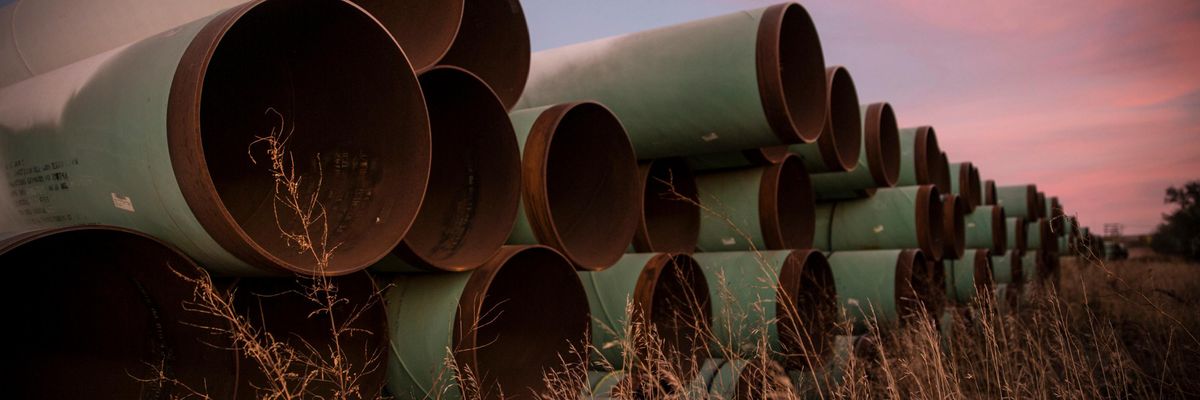
Miles of unused pipe, prepared for the proposed Keystone XL pipeline, sit in a lot on October 14, 2014 outside Gascoyne, North Dakota. (Photo: Andrew Burton via Getty Images)
In a move that progressives described as unsurprising yet outrageous, TC Energy Corporation, the Canadian company behind the now-defunct Keystone XL pipeline, is seeking more than $15 billion in compensation from the United States government, which it has accused of violating free trade obligations by blocking further development of the tar sands oil project.
"America didn't want your pipeline. You took the risk. Taxpayers are not going to pay $15 billion for your failed and risky investment. You lost. This is how capitalism works."
--Jane Kleeb, Nebraska Democratic Party
After President Joe Biden rescinded the Keystone XL permit on the first day of his term, TC Energy announced last month that the pipeline is officially dead, marking a huge victory for the climate movement following a decade of organizing.
"To recover economic damages" stemming from the Biden administration's cancellation of the project, the fossil fuel giant on Friday filed a Notice of Intent with the U.S. State Department to initiate a legacy North American Free Trade Agreement (NAFTA) claim under the United States-Mexico-Canada Agreement (USMCA).
TC Energy's decision to sue the U.S. government was denounced by Jane Kleeb, an advocate for progressive rural policies and chair of the Nebraska Democratic Party, who called it "disgusting yet predictable."
Arguing that "this is how capitalism works," Kleeb said the Calgary-based corporation--not U.S. taxpayers--should be responsible for bearing the costs of the failed investment. It was TC Energy, after all, that "took the risk," said Kleeb. She added that the company "lost" when the U.S. rejected its pipeline.
TC Energy reportedly took a $2.2 billion hit last month when it formally pulled the plug on Keystone XL. In addition, the Alberta government, which had invested public money in the project, was liable for $1.3 billion when the pipeline was terminated.
Just days after Biden revoked the Keystone XL permit in January, Kyla Tienhaara, an assistant professor of environmental studies at Queen's University, warned that Alberta Premier Jason Kenney was "scrambling for a way to recoup some of Alberta's losses," and he viewed NAFTA as "offering some hope."
According to Tienhaara:
The former North American Free Trade Agreement (NAFTA) contained a chapter on investment that allowed foreign investors to sue governments in international arbitration. The owner of Keystone XL--TC Energy (previously TransCanada)--used NAFTA to launch a US$15 billion lawsuit in 2016 after President Barack Obama canceled the project.
At the time, some legal experts thought the company had a reasonable chance of winning. We will never know, because the case was dropped when President Donald Trump indicated he was willing to let the project proceed.
This time may be different if TC Energy chooses to proceed with a claim. NAFTA has been replaced by a new agreement--the U.S.-Mexico-Canada Agreement (USMCA). Unlike NAFTA, USMCA does not permit Canadian investors to sue the U.S. government (or American investors to sue the Canadian government).
Because investments in the Keystone XL pipeline predate USMCA, TC Energy's lawsuit is still able to invoke NAFTA's Investor-State Dispute Settlement (ISDS) clause, which allows foreign investors to sue governments for profits that are "lost" due to regulatory interventions.
However, Tienhaara wrote, "TC Energy's claim may now be weaker because the permit issued by the Trump administration explicitly stated that it could be rescinded, essentially at the president's whim."
"Nevertheless," she added, "many investors have proceeded with claims on the basis of much weaker cases. Investors bet on positive outcomes in arbitration, as much as they bet on governments not taking action to halt catastrophic climate change. This is because the anticipated rewards, in both instances, are high."
While lamenting the fact that legacy NAFTA claims are permitted until 2023, Canadian environmentalist and human rights activist Maude Barlow, a leading proponent of equitable access to water around the globe, rejoiced that USMCA does not allow ISDS claims.
TC Energy's announcement of its lawsuit came amid a deadly heat wave in British Columbia and the U.S. Pacific Northwest and just before an underwater gas pipeline burst in the Gulf of Mexico, setting the ocean on fire.
Journalist Emily Atkin on Sunday told CNN's chief media correspondent Brian Stelter that policymakers are failing to treat the climate crisis "like the planetary emergency that it is."
While Biden received praise for playing a decisive role in ending the Keystone XL project, the president has yet to exercise his authority to revoke permits for the Dakota Access and Line 3 pipelines. Last month, his administration approved an expansion of Line 3 despite opposition from climate justice campaigners and warnings from scientists who have described the tar sands project as a "climate time bomb."
Dear Common Dreams reader, It’s been nearly 30 years since I co-founded Common Dreams with my late wife, Lina Newhouser. We had the radical notion that journalism should serve the public good, not corporate profits. It was clear to us from the outset what it would take to build such a project. No paid advertisements. No corporate sponsors. No millionaire publisher telling us what to think or do. Many people said we wouldn't last a year, but we proved those doubters wrong. Together with a tremendous team of journalists and dedicated staff, we built an independent media outlet free from the constraints of profits and corporate control. Our mission has always been simple: To inform. To inspire. To ignite change for the common good. Building Common Dreams was not easy. Our survival was never guaranteed. When you take on the most powerful forces—Wall Street greed, fossil fuel industry destruction, Big Tech lobbyists, and uber-rich oligarchs who have spent billions upon billions rigging the economy and democracy in their favor—the only bulwark you have is supporters who believe in your work. But here’s the urgent message from me today. It's never been this bad out there. And it's never been this hard to keep us going. At the very moment Common Dreams is most needed, the threats we face are intensifying. We need your support now more than ever. We don't accept corporate advertising and never will. We don't have a paywall because we don't think people should be blocked from critical news based on their ability to pay. Everything we do is funded by the donations of readers like you. When everyone does the little they can afford, we are strong. But if that support retreats or dries up, so do we. Will you donate now to make sure Common Dreams not only survives but thrives? —Craig Brown, Co-founder |
In a move that progressives described as unsurprising yet outrageous, TC Energy Corporation, the Canadian company behind the now-defunct Keystone XL pipeline, is seeking more than $15 billion in compensation from the United States government, which it has accused of violating free trade obligations by blocking further development of the tar sands oil project.
"America didn't want your pipeline. You took the risk. Taxpayers are not going to pay $15 billion for your failed and risky investment. You lost. This is how capitalism works."
--Jane Kleeb, Nebraska Democratic Party
After President Joe Biden rescinded the Keystone XL permit on the first day of his term, TC Energy announced last month that the pipeline is officially dead, marking a huge victory for the climate movement following a decade of organizing.
"To recover economic damages" stemming from the Biden administration's cancellation of the project, the fossil fuel giant on Friday filed a Notice of Intent with the U.S. State Department to initiate a legacy North American Free Trade Agreement (NAFTA) claim under the United States-Mexico-Canada Agreement (USMCA).
TC Energy's decision to sue the U.S. government was denounced by Jane Kleeb, an advocate for progressive rural policies and chair of the Nebraska Democratic Party, who called it "disgusting yet predictable."
Arguing that "this is how capitalism works," Kleeb said the Calgary-based corporation--not U.S. taxpayers--should be responsible for bearing the costs of the failed investment. It was TC Energy, after all, that "took the risk," said Kleeb. She added that the company "lost" when the U.S. rejected its pipeline.
TC Energy reportedly took a $2.2 billion hit last month when it formally pulled the plug on Keystone XL. In addition, the Alberta government, which had invested public money in the project, was liable for $1.3 billion when the pipeline was terminated.
Just days after Biden revoked the Keystone XL permit in January, Kyla Tienhaara, an assistant professor of environmental studies at Queen's University, warned that Alberta Premier Jason Kenney was "scrambling for a way to recoup some of Alberta's losses," and he viewed NAFTA as "offering some hope."
According to Tienhaara:
The former North American Free Trade Agreement (NAFTA) contained a chapter on investment that allowed foreign investors to sue governments in international arbitration. The owner of Keystone XL--TC Energy (previously TransCanada)--used NAFTA to launch a US$15 billion lawsuit in 2016 after President Barack Obama canceled the project.
At the time, some legal experts thought the company had a reasonable chance of winning. We will never know, because the case was dropped when President Donald Trump indicated he was willing to let the project proceed.
This time may be different if TC Energy chooses to proceed with a claim. NAFTA has been replaced by a new agreement--the U.S.-Mexico-Canada Agreement (USMCA). Unlike NAFTA, USMCA does not permit Canadian investors to sue the U.S. government (or American investors to sue the Canadian government).
Because investments in the Keystone XL pipeline predate USMCA, TC Energy's lawsuit is still able to invoke NAFTA's Investor-State Dispute Settlement (ISDS) clause, which allows foreign investors to sue governments for profits that are "lost" due to regulatory interventions.
However, Tienhaara wrote, "TC Energy's claim may now be weaker because the permit issued by the Trump administration explicitly stated that it could be rescinded, essentially at the president's whim."
"Nevertheless," she added, "many investors have proceeded with claims on the basis of much weaker cases. Investors bet on positive outcomes in arbitration, as much as they bet on governments not taking action to halt catastrophic climate change. This is because the anticipated rewards, in both instances, are high."
While lamenting the fact that legacy NAFTA claims are permitted until 2023, Canadian environmentalist and human rights activist Maude Barlow, a leading proponent of equitable access to water around the globe, rejoiced that USMCA does not allow ISDS claims.
TC Energy's announcement of its lawsuit came amid a deadly heat wave in British Columbia and the U.S. Pacific Northwest and just before an underwater gas pipeline burst in the Gulf of Mexico, setting the ocean on fire.
Journalist Emily Atkin on Sunday told CNN's chief media correspondent Brian Stelter that policymakers are failing to treat the climate crisis "like the planetary emergency that it is."
While Biden received praise for playing a decisive role in ending the Keystone XL project, the president has yet to exercise his authority to revoke permits for the Dakota Access and Line 3 pipelines. Last month, his administration approved an expansion of Line 3 despite opposition from climate justice campaigners and warnings from scientists who have described the tar sands project as a "climate time bomb."
In a move that progressives described as unsurprising yet outrageous, TC Energy Corporation, the Canadian company behind the now-defunct Keystone XL pipeline, is seeking more than $15 billion in compensation from the United States government, which it has accused of violating free trade obligations by blocking further development of the tar sands oil project.
"America didn't want your pipeline. You took the risk. Taxpayers are not going to pay $15 billion for your failed and risky investment. You lost. This is how capitalism works."
--Jane Kleeb, Nebraska Democratic Party
After President Joe Biden rescinded the Keystone XL permit on the first day of his term, TC Energy announced last month that the pipeline is officially dead, marking a huge victory for the climate movement following a decade of organizing.
"To recover economic damages" stemming from the Biden administration's cancellation of the project, the fossil fuel giant on Friday filed a Notice of Intent with the U.S. State Department to initiate a legacy North American Free Trade Agreement (NAFTA) claim under the United States-Mexico-Canada Agreement (USMCA).
TC Energy's decision to sue the U.S. government was denounced by Jane Kleeb, an advocate for progressive rural policies and chair of the Nebraska Democratic Party, who called it "disgusting yet predictable."
Arguing that "this is how capitalism works," Kleeb said the Calgary-based corporation--not U.S. taxpayers--should be responsible for bearing the costs of the failed investment. It was TC Energy, after all, that "took the risk," said Kleeb. She added that the company "lost" when the U.S. rejected its pipeline.
TC Energy reportedly took a $2.2 billion hit last month when it formally pulled the plug on Keystone XL. In addition, the Alberta government, which had invested public money in the project, was liable for $1.3 billion when the pipeline was terminated.
Just days after Biden revoked the Keystone XL permit in January, Kyla Tienhaara, an assistant professor of environmental studies at Queen's University, warned that Alberta Premier Jason Kenney was "scrambling for a way to recoup some of Alberta's losses," and he viewed NAFTA as "offering some hope."
According to Tienhaara:
The former North American Free Trade Agreement (NAFTA) contained a chapter on investment that allowed foreign investors to sue governments in international arbitration. The owner of Keystone XL--TC Energy (previously TransCanada)--used NAFTA to launch a US$15 billion lawsuit in 2016 after President Barack Obama canceled the project.
At the time, some legal experts thought the company had a reasonable chance of winning. We will never know, because the case was dropped when President Donald Trump indicated he was willing to let the project proceed.
This time may be different if TC Energy chooses to proceed with a claim. NAFTA has been replaced by a new agreement--the U.S.-Mexico-Canada Agreement (USMCA). Unlike NAFTA, USMCA does not permit Canadian investors to sue the U.S. government (or American investors to sue the Canadian government).
Because investments in the Keystone XL pipeline predate USMCA, TC Energy's lawsuit is still able to invoke NAFTA's Investor-State Dispute Settlement (ISDS) clause, which allows foreign investors to sue governments for profits that are "lost" due to regulatory interventions.
However, Tienhaara wrote, "TC Energy's claim may now be weaker because the permit issued by the Trump administration explicitly stated that it could be rescinded, essentially at the president's whim."
"Nevertheless," she added, "many investors have proceeded with claims on the basis of much weaker cases. Investors bet on positive outcomes in arbitration, as much as they bet on governments not taking action to halt catastrophic climate change. This is because the anticipated rewards, in both instances, are high."
While lamenting the fact that legacy NAFTA claims are permitted until 2023, Canadian environmentalist and human rights activist Maude Barlow, a leading proponent of equitable access to water around the globe, rejoiced that USMCA does not allow ISDS claims.
TC Energy's announcement of its lawsuit came amid a deadly heat wave in British Columbia and the U.S. Pacific Northwest and just before an underwater gas pipeline burst in the Gulf of Mexico, setting the ocean on fire.
Journalist Emily Atkin on Sunday told CNN's chief media correspondent Brian Stelter that policymakers are failing to treat the climate crisis "like the planetary emergency that it is."
While Biden received praise for playing a decisive role in ending the Keystone XL project, the president has yet to exercise his authority to revoke permits for the Dakota Access and Line 3 pipelines. Last month, his administration approved an expansion of Line 3 despite opposition from climate justice campaigners and warnings from scientists who have described the tar sands project as a "climate time bomb."