SUBSCRIBE TO OUR FREE NEWSLETTER
Daily news & progressive opinion—funded by the people, not the corporations—delivered straight to your inbox.
5
#000000
#FFFFFF
To donate by check, phone, or other method, see our More Ways to Give page.
Daily news & progressive opinion—funded by the people, not the corporations—delivered straight to your inbox.
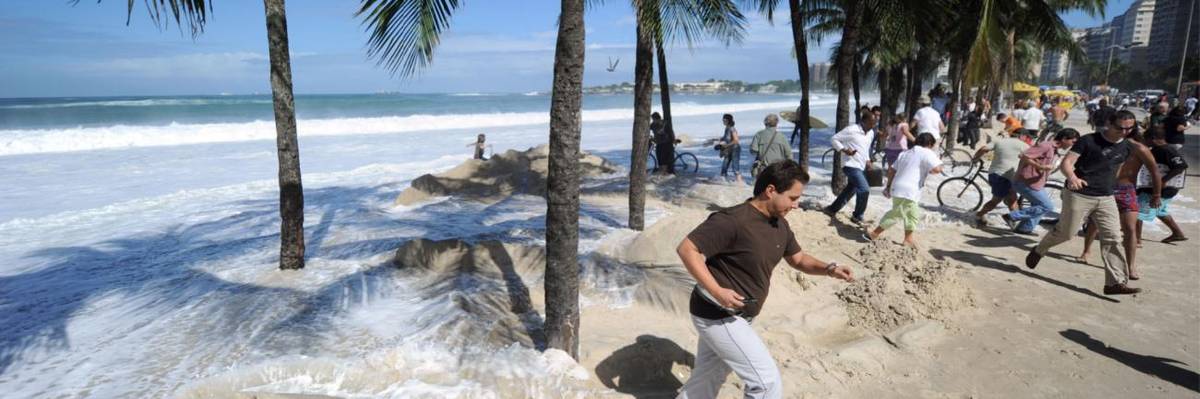
People run away from the waves flooding Rio de Janeiro's Copacabana beach and its sidewalk on April 9, 2010. The unusual roughness was, according to experts, caused by the same climate phenomenon that originated the heaviest rains in the area in half a century, unleashing floods and mudslides which killed an estimated 380 people in the state of Rio de Janeiro. (Photo: Antonio Scorza/AFP via Getty Images)
Although more than 90% of cities around the world report facing risks of flooding, drought, extreme weather, and other hazards due to the climate crisis, nearly half of the cities in a new survey reported that they have no plans in place to adapt to the planetary emergency, with one in four citing budgetary constraints for their inability to confront the crisis.
The Carbon Disclosure Project (CDP), a global non-profit which runs the world's largest database showing disclosures from governments and companies regarding their environmental impacts, released the results of a survey of 800 cities which are home to 810 million people around the world.
The cities were found (pdf) to be taking a total of 3,417 actions to cope with and mitigate the effects of the climate crisis, but chronic lack of funding from national governments has left a quarter of the cities surveyed unable to afford taking action, including planning green spaces, improving fuel economy to reduce vehicle emissions, implementing green retrofitting measures, and transitioning to renewable energy.
"Despite the progress cities have made to build resilience through risk assessments and adaptation planning, much more must be done to protect all populations from the worst impacts of climate change," the report reads. "For 74% of cities, climate change is increasing risks to already vulnerable populations...Joining the dots between climate change and threats to water security, public health, and social equality is crucial to effectively address these issues and ensure cities remain resilient, prosperous, and healthy places for generations to come."
"As the world seeks to recover from Covid-19, recovery funds and stimulus packages need to focus on a green and just recovery. There is an opportunity here for cities to access funding and to implement climate projects focused on increasing resilience, protecting the most vulnerable and building an equitable and fair society."
--Carbon Disclosure Project
More than 420 cities reported that 1,142 climate projects require financing, demanding an investment of $72 billion--which, CDP said, should be included in recovery plans as the world continues to face the coronavirus pandemic.
"As the world seeks to recover from Covid-19, recovery funds and stimulus packages need to focus on a green and just recovery," the report reads. "There is an opportunity here for cities to access funding and to implement climate projects focused on increasing resilience, protecting the most vulnerable and building an equitable and fair society. If Covid-19 recovery is not sustainable and equitable, we risk locking cities into infrastructure that is not aligned with the U.N. Sustainable Development Goals and a 1.5degC future."
According to The Guardian, Columbus, Ohio; Rio De Janeiro; and Southend-on-Sea, England are among the cities reporting budget constraints which have harmed their ability to prepare for the continued impacts of the climate emergency.
CDP global director Kyra Appleby noted that although 20% of cities surveyed said they face the risk of infectious diseases spreading, and linked the threat to the climate crisis--as several experts have--the need to ensure a green recovery appears to have eluded many policymakers.
"There are enormous benefits from adaptation and resilience, but they don't appear on the balance sheet," Appleby told The Guardian. "Only a fraction of recovery spending [from the coronavirus pandemic] is being put towards climate change, and even less towards adaptation."
Cities disclosing their environmental impacts and climate plans to CDP are "outperforming on urgently needed decarbonization compared to the global average," according to the organization, with 42% of their energy coming "from renewable sources compared to a 26% global average."
"To push their action further and faster," CDP said, "cities are seeking funding for projects in transport (16% of projects), renewable energy (12%), energy efficiency/retrofits (12%), water management (12%), and waste management (11%)."
According to the report, cities raised the greatest concerns about the climate emergency's effects on public health and water supply.
"Cities will require support from all levels of government, including partnerships with national governments to finance and achieve our global climate commitments," said Kelly Shultz, lead for sustainable cities at Bloomberg Philanthropies.
Dear Common Dreams reader, It’s been nearly 30 years since I co-founded Common Dreams with my late wife, Lina Newhouser. We had the radical notion that journalism should serve the public good, not corporate profits. It was clear to us from the outset what it would take to build such a project. No paid advertisements. No corporate sponsors. No millionaire publisher telling us what to think or do. Many people said we wouldn't last a year, but we proved those doubters wrong. Together with a tremendous team of journalists and dedicated staff, we built an independent media outlet free from the constraints of profits and corporate control. Our mission has always been simple: To inform. To inspire. To ignite change for the common good. Building Common Dreams was not easy. Our survival was never guaranteed. When you take on the most powerful forces—Wall Street greed, fossil fuel industry destruction, Big Tech lobbyists, and uber-rich oligarchs who have spent billions upon billions rigging the economy and democracy in their favor—the only bulwark you have is supporters who believe in your work. But here’s the urgent message from me today. It's never been this bad out there. And it's never been this hard to keep us going. At the very moment Common Dreams is most needed, the threats we face are intensifying. We need your support now more than ever. We don't accept corporate advertising and never will. We don't have a paywall because we don't think people should be blocked from critical news based on their ability to pay. Everything we do is funded by the donations of readers like you. When everyone does the little they can afford, we are strong. But if that support retreats or dries up, so do we. Will you donate now to make sure Common Dreams not only survives but thrives? —Craig Brown, Co-founder |
Although more than 90% of cities around the world report facing risks of flooding, drought, extreme weather, and other hazards due to the climate crisis, nearly half of the cities in a new survey reported that they have no plans in place to adapt to the planetary emergency, with one in four citing budgetary constraints for their inability to confront the crisis.
The Carbon Disclosure Project (CDP), a global non-profit which runs the world's largest database showing disclosures from governments and companies regarding their environmental impacts, released the results of a survey of 800 cities which are home to 810 million people around the world.
The cities were found (pdf) to be taking a total of 3,417 actions to cope with and mitigate the effects of the climate crisis, but chronic lack of funding from national governments has left a quarter of the cities surveyed unable to afford taking action, including planning green spaces, improving fuel economy to reduce vehicle emissions, implementing green retrofitting measures, and transitioning to renewable energy.
"Despite the progress cities have made to build resilience through risk assessments and adaptation planning, much more must be done to protect all populations from the worst impacts of climate change," the report reads. "For 74% of cities, climate change is increasing risks to already vulnerable populations...Joining the dots between climate change and threats to water security, public health, and social equality is crucial to effectively address these issues and ensure cities remain resilient, prosperous, and healthy places for generations to come."
"As the world seeks to recover from Covid-19, recovery funds and stimulus packages need to focus on a green and just recovery. There is an opportunity here for cities to access funding and to implement climate projects focused on increasing resilience, protecting the most vulnerable and building an equitable and fair society."
--Carbon Disclosure Project
More than 420 cities reported that 1,142 climate projects require financing, demanding an investment of $72 billion--which, CDP said, should be included in recovery plans as the world continues to face the coronavirus pandemic.
"As the world seeks to recover from Covid-19, recovery funds and stimulus packages need to focus on a green and just recovery," the report reads. "There is an opportunity here for cities to access funding and to implement climate projects focused on increasing resilience, protecting the most vulnerable and building an equitable and fair society. If Covid-19 recovery is not sustainable and equitable, we risk locking cities into infrastructure that is not aligned with the U.N. Sustainable Development Goals and a 1.5degC future."
According to The Guardian, Columbus, Ohio; Rio De Janeiro; and Southend-on-Sea, England are among the cities reporting budget constraints which have harmed their ability to prepare for the continued impacts of the climate emergency.
CDP global director Kyra Appleby noted that although 20% of cities surveyed said they face the risk of infectious diseases spreading, and linked the threat to the climate crisis--as several experts have--the need to ensure a green recovery appears to have eluded many policymakers.
"There are enormous benefits from adaptation and resilience, but they don't appear on the balance sheet," Appleby told The Guardian. "Only a fraction of recovery spending [from the coronavirus pandemic] is being put towards climate change, and even less towards adaptation."
Cities disclosing their environmental impacts and climate plans to CDP are "outperforming on urgently needed decarbonization compared to the global average," according to the organization, with 42% of their energy coming "from renewable sources compared to a 26% global average."
"To push their action further and faster," CDP said, "cities are seeking funding for projects in transport (16% of projects), renewable energy (12%), energy efficiency/retrofits (12%), water management (12%), and waste management (11%)."
According to the report, cities raised the greatest concerns about the climate emergency's effects on public health and water supply.
"Cities will require support from all levels of government, including partnerships with national governments to finance and achieve our global climate commitments," said Kelly Shultz, lead for sustainable cities at Bloomberg Philanthropies.
Although more than 90% of cities around the world report facing risks of flooding, drought, extreme weather, and other hazards due to the climate crisis, nearly half of the cities in a new survey reported that they have no plans in place to adapt to the planetary emergency, with one in four citing budgetary constraints for their inability to confront the crisis.
The Carbon Disclosure Project (CDP), a global non-profit which runs the world's largest database showing disclosures from governments and companies regarding their environmental impacts, released the results of a survey of 800 cities which are home to 810 million people around the world.
The cities were found (pdf) to be taking a total of 3,417 actions to cope with and mitigate the effects of the climate crisis, but chronic lack of funding from national governments has left a quarter of the cities surveyed unable to afford taking action, including planning green spaces, improving fuel economy to reduce vehicle emissions, implementing green retrofitting measures, and transitioning to renewable energy.
"Despite the progress cities have made to build resilience through risk assessments and adaptation planning, much more must be done to protect all populations from the worst impacts of climate change," the report reads. "For 74% of cities, climate change is increasing risks to already vulnerable populations...Joining the dots between climate change and threats to water security, public health, and social equality is crucial to effectively address these issues and ensure cities remain resilient, prosperous, and healthy places for generations to come."
"As the world seeks to recover from Covid-19, recovery funds and stimulus packages need to focus on a green and just recovery. There is an opportunity here for cities to access funding and to implement climate projects focused on increasing resilience, protecting the most vulnerable and building an equitable and fair society."
--Carbon Disclosure Project
More than 420 cities reported that 1,142 climate projects require financing, demanding an investment of $72 billion--which, CDP said, should be included in recovery plans as the world continues to face the coronavirus pandemic.
"As the world seeks to recover from Covid-19, recovery funds and stimulus packages need to focus on a green and just recovery," the report reads. "There is an opportunity here for cities to access funding and to implement climate projects focused on increasing resilience, protecting the most vulnerable and building an equitable and fair society. If Covid-19 recovery is not sustainable and equitable, we risk locking cities into infrastructure that is not aligned with the U.N. Sustainable Development Goals and a 1.5degC future."
According to The Guardian, Columbus, Ohio; Rio De Janeiro; and Southend-on-Sea, England are among the cities reporting budget constraints which have harmed their ability to prepare for the continued impacts of the climate emergency.
CDP global director Kyra Appleby noted that although 20% of cities surveyed said they face the risk of infectious diseases spreading, and linked the threat to the climate crisis--as several experts have--the need to ensure a green recovery appears to have eluded many policymakers.
"There are enormous benefits from adaptation and resilience, but they don't appear on the balance sheet," Appleby told The Guardian. "Only a fraction of recovery spending [from the coronavirus pandemic] is being put towards climate change, and even less towards adaptation."
Cities disclosing their environmental impacts and climate plans to CDP are "outperforming on urgently needed decarbonization compared to the global average," according to the organization, with 42% of their energy coming "from renewable sources compared to a 26% global average."
"To push their action further and faster," CDP said, "cities are seeking funding for projects in transport (16% of projects), renewable energy (12%), energy efficiency/retrofits (12%), water management (12%), and waste management (11%)."
According to the report, cities raised the greatest concerns about the climate emergency's effects on public health and water supply.
"Cities will require support from all levels of government, including partnerships with national governments to finance and achieve our global climate commitments," said Kelly Shultz, lead for sustainable cities at Bloomberg Philanthropies.