SUBSCRIBE TO OUR FREE NEWSLETTER
Daily news & progressive opinion—funded by the people, not the corporations—delivered straight to your inbox.
5
#000000
#FFFFFF
To donate by check, phone, or other method, see our More Ways to Give page.
Daily news & progressive opinion—funded by the people, not the corporations—delivered straight to your inbox.
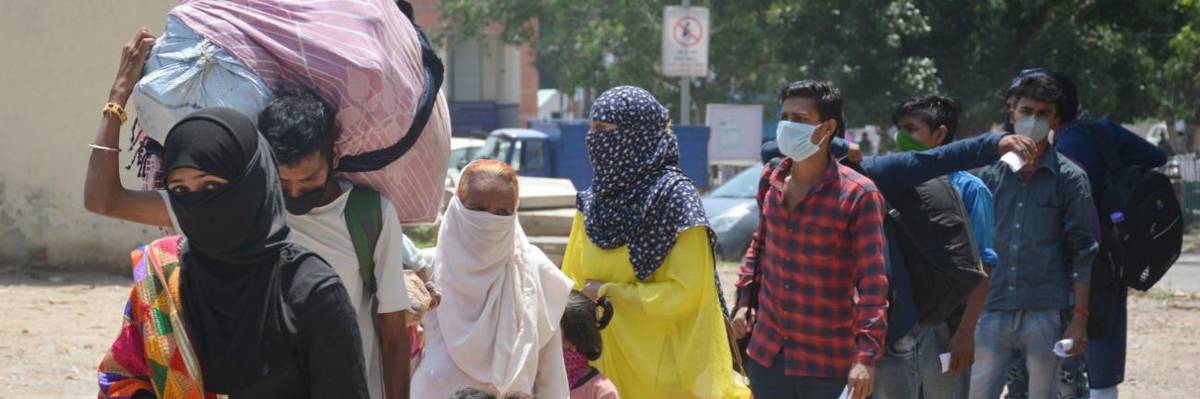
Migrants arrive to board a train for Uttar Pradesh, at Chandigarh railway station, on May 24, 2020 in Panchkula, India. (Photo: Sant Arora/Hindustan Times via Getty Images)
Research from the World Health Organization points to tens of millions of displaced people across the globe who won't currently be able to access coronavirus vaccines--leading to concerns about the ability of the international community to end the pandemic, The Guardian reported Friday.
Public health experts say that many countries are not accounting for refugees, migrants, and internally displaced people in their plans to vaccinate their populations.
The WHO reviewed 104 vaccination plans around the world, finding that more than 70% of them excluded migrants. The exclusion means more than 30 million people, including nearly five million in India, where the world's worst coronavirus outbreak is now taking place, may not have access to the vaccines.
In Indonesia, refugees are among those being "systematically excluded" from the country's vaccination program, which uses a digital ID system for recipients, journalist Jacob Kushner tweeted.
The plans also excluded about five million refugees and asylum-seekers, including 1.8 million in Colombia, and 11.8 million internally displaced people, including 2.7 million Nigerians--bringing the total number of people with no path to vaccination to more than 46 million.
The failure of governments to plan to vaccinate people who are displaced or migrating "is not an oversight," tweeted writer John Smith.
"Most of those who live in prosperous nations don't care if [displaced people] live or die and that doesn't bode well for us in the long or short term," Smith said.
The COVAX facility, which is co-led by the WHO, the Coalition for Epidemic Preparedness, and Gavi: the Vaccine Alliance, approved in March a channel of vaccine doses that will be reserved for the most vulnerable people in the world, who have no access to the life-saving vaccines.
The channel will redirect 5% of the doses allocated to COVAX to the most vulnerable people, including displaced people. The doses will be administered by NGOs including Doctors Without Borders.
COVAX estimates that 33 million people could obtain doses from the channel, but it's unclear whether or how the other 13 million displaced people counted by the WHO will be able to access the vaccines.
The United Nations' refugee agency this week called for Covid-19 vaccines to be made available to people who have been displaced, warning that fully protecting public health for the global community "means protecting refugees."
"To build back stronger from the pandemic, fair and equal access to Covid-19 vaccines is needed for everyone everywhere, including displaced people," the UNHCR said.
"As we learned from the outset of Covid-19 and all the restrictions put in place, availability of testing, and access to healthcare for coronavirus, no one is safe until everyone is safe, and that is absolutely the same for vaccination programs," Nadia Hardman, a researcher at Human Rights Watch, told The Guardian.
This country and this world are at a monumental crossroads. US voters have an opportunity to beat back the forces of fascism and confront the billionaires who are rigging the economy, our media system, and our democracy, making it increasingly impossible for ordinary people to get by. We’re not just talking about the election. We’re talking about what must be done once these fascist elements are vanquished from power. We need a bolder set of solutions than what either major party has so far been willing to offer and a working-class movement ready to fight like hell for it. Trump didn't emerge from nowhere. The conditions that fueled MAGA authoritarianism were created by decades of radical neoliberal economic policies and a corrupt political system dominated by corporate interests. They slashed taxes on the super-rich, promising that the benefits would trickle down. They said giveaways to the corporate titans would make life more affordable for the rest of us. It was all bullshit. And when a bitter, betrayed populace searches for someone to blame, right-wing demagogues have little trouble finding scapegoats. People know when they're being lied to, but you won't hear any of this from the corporate media. Only independent journalism—powered and funded by people who believe in building a better world—can deliver truly trustworthy daily news. If you share our vision, please contribute whatever you can to sustain our work. |
Research from the World Health Organization points to tens of millions of displaced people across the globe who won't currently be able to access coronavirus vaccines--leading to concerns about the ability of the international community to end the pandemic, The Guardian reported Friday.
Public health experts say that many countries are not accounting for refugees, migrants, and internally displaced people in their plans to vaccinate their populations.
The WHO reviewed 104 vaccination plans around the world, finding that more than 70% of them excluded migrants. The exclusion means more than 30 million people, including nearly five million in India, where the world's worst coronavirus outbreak is now taking place, may not have access to the vaccines.
In Indonesia, refugees are among those being "systematically excluded" from the country's vaccination program, which uses a digital ID system for recipients, journalist Jacob Kushner tweeted.
The plans also excluded about five million refugees and asylum-seekers, including 1.8 million in Colombia, and 11.8 million internally displaced people, including 2.7 million Nigerians--bringing the total number of people with no path to vaccination to more than 46 million.
The failure of governments to plan to vaccinate people who are displaced or migrating "is not an oversight," tweeted writer John Smith.
"Most of those who live in prosperous nations don't care if [displaced people] live or die and that doesn't bode well for us in the long or short term," Smith said.
The COVAX facility, which is co-led by the WHO, the Coalition for Epidemic Preparedness, and Gavi: the Vaccine Alliance, approved in March a channel of vaccine doses that will be reserved for the most vulnerable people in the world, who have no access to the life-saving vaccines.
The channel will redirect 5% of the doses allocated to COVAX to the most vulnerable people, including displaced people. The doses will be administered by NGOs including Doctors Without Borders.
COVAX estimates that 33 million people could obtain doses from the channel, but it's unclear whether or how the other 13 million displaced people counted by the WHO will be able to access the vaccines.
The United Nations' refugee agency this week called for Covid-19 vaccines to be made available to people who have been displaced, warning that fully protecting public health for the global community "means protecting refugees."
"To build back stronger from the pandemic, fair and equal access to Covid-19 vaccines is needed for everyone everywhere, including displaced people," the UNHCR said.
"As we learned from the outset of Covid-19 and all the restrictions put in place, availability of testing, and access to healthcare for coronavirus, no one is safe until everyone is safe, and that is absolutely the same for vaccination programs," Nadia Hardman, a researcher at Human Rights Watch, told The Guardian.