
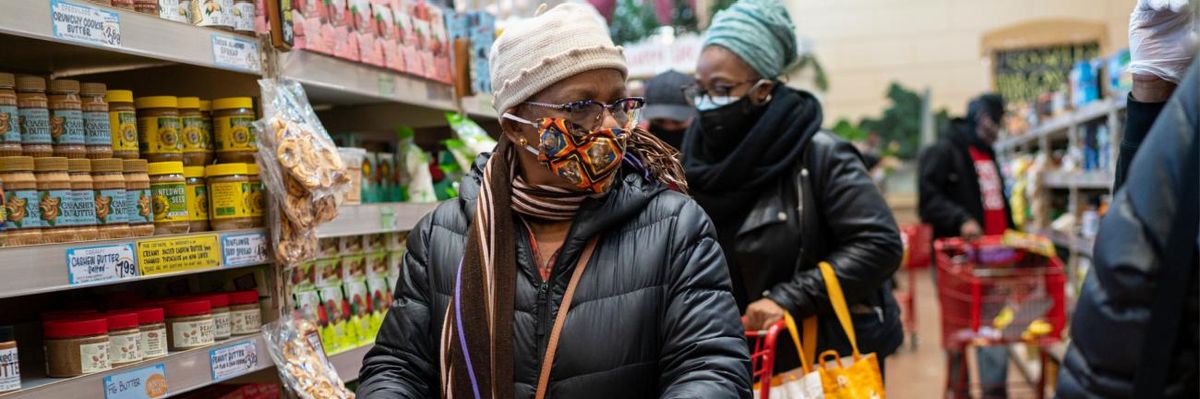
A woman wearing a mask moves her shopping cart December 3, 2020 in a Trader Joe's supermarket in New York City. (Photo: Robert Nickelsberg/Getty Images)
Third Round of Coronavirus Relief Checks Led to Largest Monthly Rise in Household Income Since 1959
"This is what happens when you opt for investing in working people over trickle-down economics."
The third round of coronavirus relief checks, which have been sent to 159 million households so far, were directly linked to an historic rise in household income, according to reporting by the Wall Street Journal.
Household income rose 21.1% in March after President Joe Biden signed the $1.9 trillion coronavirus relief package into law, following months of stonewalling by Republicans, who spent much of 2020 claiming that additional aid to help families struggling to pay for housing and other necessities was unaffordable.
The immediate rise in household income from the previous month represented the largest increase since 1959, the Journal reported, citing data from the Commerce Department's Bureau of Economic Analysis.
"This is what happens when you opt for investing in working people over trickle-down economics," said the grassroots organization Tax March.
The report follows two studies conducted last year after the first round of relief checks were shown to markedly alleviate poverty--illustrating the fact that "poverty is a policy choice," according to advocacy group People for Bernie.
The new data regarding the latest round of checks shows "the fiscal stimulus was a roaring success," tweeted CNBC reporter Carl Quintanilla.
Households were promptly able to save significantly more money following the release of the checks, with the rate of personal savings increasing from 13.9% in February to 27.6% in March, according to the Journal.
Spending rates also saw the largest month-to-month increase since last summer, rising by 4.2%.
"Stimulus checks work," tweeted Baltimore attorney Katelynn Brennan.
As NBC News reported earlier this month, a plurality of households have been spending their relief checks on groceries, rent, and other necessities. Forty-five percent of respondents to a survey by Bankrate.com said their checks went to monthly bills, while 32% said they were using them to pay down debts.Just 13% reported they were using the money for discretionary spending.
Federal Reserve Chairman Jerome Powell told reporters that while higher rates of spending could drive inflation in the coming months, "an episode of one-time price increases as the economy reopens is not the same thing as, and is not likely to lead to, persistently higher year-over-year inflation into the future."
"Indeed, it is the Fed's job to make sure that that does not happen," Powell said.
We are at a crossroads
This country and this world are at a monumental crossroads. In a few short weeks, US voters will have an opportunity to beat back the forces of fascism and confront the billionaires who are rigging the economy, our media system, and our democracy, making it increasingly impossible for ordinary people to get by. We’re not just talking about the election. We’re talking about what must be done once these fascist elements are vanquished from power. We need a bolder set of solutions than what either major party has so far been willing to offer and a working-class movement ready to fight like hell for it. Trump didn't emerge from nowhere. The conditions that fueled MAGA authoritarianism were created by decades of radical neoliberal economic policies and a corrupt political system dominated by corporate interests. They slashed taxes on the super-rich, promising that the benefits would trickle down. They said giveaways to the corporate titans would make life more affordable for the rest of us. It was all bullshit. And when a bitter, betrayed populace searches for someone to blame, right-wing demagogues have little trouble finding scapegoats. People know when they're being lied to, but you won't hear any of this from the corporate media. Only independent journalism—powered and funded by people who believe in building a better world—can deliver truly trustworthy daily news. Our Fall Campaign is underway, and we need your help. To power our newsroom through the rest of the year, we need to raise $125,000 by midnight on October 31. So if you share our vision, please contribute whatever you can to sustain our work. |
The third round of coronavirus relief checks, which have been sent to 159 million households so far, were directly linked to an historic rise in household income, according to reporting by the Wall Street Journal.
Household income rose 21.1% in March after President Joe Biden signed the $1.9 trillion coronavirus relief package into law, following months of stonewalling by Republicans, who spent much of 2020 claiming that additional aid to help families struggling to pay for housing and other necessities was unaffordable.
The immediate rise in household income from the previous month represented the largest increase since 1959, the Journal reported, citing data from the Commerce Department's Bureau of Economic Analysis.
"This is what happens when you opt for investing in working people over trickle-down economics," said the grassroots organization Tax March.
The report follows two studies conducted last year after the first round of relief checks were shown to markedly alleviate poverty--illustrating the fact that "poverty is a policy choice," according to advocacy group People for Bernie.
The new data regarding the latest round of checks shows "the fiscal stimulus was a roaring success," tweeted CNBC reporter Carl Quintanilla.
Households were promptly able to save significantly more money following the release of the checks, with the rate of personal savings increasing from 13.9% in February to 27.6% in March, according to the Journal.
Spending rates also saw the largest month-to-month increase since last summer, rising by 4.2%.
"Stimulus checks work," tweeted Baltimore attorney Katelynn Brennan.
As NBC News reported earlier this month, a plurality of households have been spending their relief checks on groceries, rent, and other necessities. Forty-five percent of respondents to a survey by Bankrate.com said their checks went to monthly bills, while 32% said they were using them to pay down debts.Just 13% reported they were using the money for discretionary spending.
Federal Reserve Chairman Jerome Powell told reporters that while higher rates of spending could drive inflation in the coming months, "an episode of one-time price increases as the economy reopens is not the same thing as, and is not likely to lead to, persistently higher year-over-year inflation into the future."
"Indeed, it is the Fed's job to make sure that that does not happen," Powell said.