SUBSCRIBE TO OUR FREE NEWSLETTER
Daily news & progressive opinion—funded by the people, not the corporations—delivered straight to your inbox.
5
#000000
#FFFFFF
To donate by check, phone, or other method, see our More Ways to Give page.
Daily news & progressive opinion—funded by the people, not the corporations—delivered straight to your inbox.
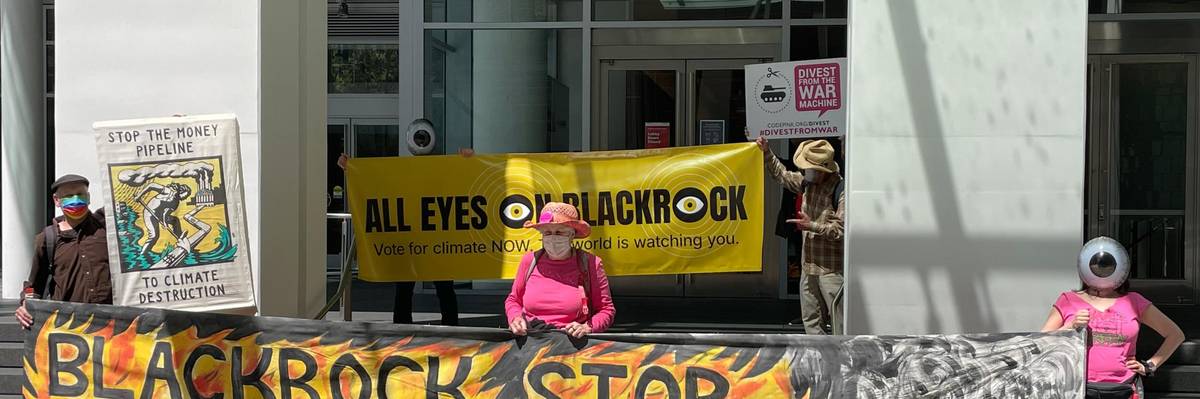
Climate activists held multiple days of protests at BlackRock offices around the world to raise awareness about about upcoming shareholder votes.
As corporations around the world prepare for annual shareholder meetings, climate activists held a series of actions leading up to and throughout the weekend in cities around the world that aimed to put "all eyes on BlackRock," the world's largest money manager, with nearly $9 trillion in assets under management.
"At the moment, BlackRock is a major part of the problem," said Robin Wells, an English teacher and activist with Fossil Free London who joined the U.K. city's demonstration, in a statement from the global network BlackRock's Big Problem.
"Today we're giving notice that we'll be watching to see if BlackRock will actually pour any water on the flames it has started," Wells said. "We're here because we can't fix our planet with promises, only action can do that."
In addition to London, activists demonstrated at BlackRock offices in Boston, Dallas, Miami, New York City, San Francisco, and Zurich.
"CEO Larry Fink talks a big game on climate, but the company is the top investor in oil, gas, and coal," noted Patrick Houston of New York Communities for Change. "As the season of shareholder annual meetings looms, all eyes are on BlackRock."
As BlackRock's Big Problem details on a webpage about this year's shareholder season:
In BlackRock's 2021 Stewardship Expectations report, the asset manager finally acknowledged that voting against management and supporting shareholder proposals often leads to positive changes at companies. In January 2021, BlackRock expanded its voting criteria and announced that it will hold directors accountable when their companies fail to address climate change in their business plans. In March, both BlackRock and Vanguard joined the Net Zero Asset Managers Initiative, a first move on climate for Vanguard.
While acknowledgments and commitments may mark a change in thinking within BlackRock and Vanguard, it is action that is needed to curb the climate crisis. So this shareholder season, as the world looks toward COP26, their default position must be to vote in favor of pro-climate shareholder resolutions and against corporate boards when a company doesn't have a clear climate transition plan.
The network is focused on eight specific votes. In the oil and gas sector, there will votes on resolutions for BP and Shell to set public targets consistent with the goals of the Paris agreement, and against ExxonMobil chairman and CEO Darren Woods as well as lead independent director Kenneth C. Frazier for failing to implement plans consistent with limiting global temperature rise to 1.5oC, the more ambitious Paris goal.
There are similar plans for financial services--votes on resolutions for Barclays and MUFG to set Paris-related targets and against Wells Fargo chairman Charles H. Noski for failing to implement plans consistent with the 1.5oC goal. There will also be a similar vote against Duke chair and CEO Lynn Good as well as independent lead director Michael G. Browning. Activists are also pushing for a resolution requesting Bunge issue a report about eliminating deforestation in its soy supply chain.
"At this point, voting with corporate management to maintain business as usual is an active choice against climate action," the network says. "If asset managers continue to choose not to vote for climate action this shareholder season, they will be actively working against progress, science, and the interests of their own clients and beneficiaries."
While protesters aimed to raise awareness about the upcoming votes, some also directed attention to the controversial Line 3 pipeline, which opponents have dubbed "a climate time bomb." The Canadian company Enbridge is trying to replace a corroding pipeline with a larger one that would carry oil from Alberta, through North Dakota and Minnesota, to Wisconsin. Construction on the project has been repeatedly halted in recent months by water protectors' direct actions in Minnesota.
"My heritage is of a people whose rights were violently violated. My future is of a planet whose climate is being devastatingly altered. BlackRock should wield its vast financial power to mitigate the climate crisis," declared 19-year-old climate justice activist Xiye Bastida of the Otomi-Toltec Nation. "It can start by divesting from Enbridge, the owner of the Line 3 pipeline, before moving to divest from all tar sands."
Last month, Sen. Elizabeth Warren (D-Mass.) questioned Treasury Secretary Janet Yellen on why the federal government hasn't deemed BlackRock "too big to fail" and subjected the firm to stricter oversight. The senator said during a hearing that "it isn't just banks that pose a risk to the economy. In 2008, two investment companies, Bear Stearns and Lehman Brothers, failed, triggering the 2008 crash."
The Biden administration faces mounting pressure to protect U.S. financial institutions and the economy from risks posed by the climate emergency as well as demands that the administration help end the flow of private finance from Wall Street to major polluters. Polling results released Monday show that a majority of U.S. voters support federal government action to prevent future climate-related economic crises.
Dear Common Dreams reader, It’s been nearly 30 years since I co-founded Common Dreams with my late wife, Lina Newhouser. We had the radical notion that journalism should serve the public good, not corporate profits. It was clear to us from the outset what it would take to build such a project. No paid advertisements. No corporate sponsors. No millionaire publisher telling us what to think or do. Many people said we wouldn't last a year, but we proved those doubters wrong. Together with a tremendous team of journalists and dedicated staff, we built an independent media outlet free from the constraints of profits and corporate control. Our mission has always been simple: To inform. To inspire. To ignite change for the common good. Building Common Dreams was not easy. Our survival was never guaranteed. When you take on the most powerful forces—Wall Street greed, fossil fuel industry destruction, Big Tech lobbyists, and uber-rich oligarchs who have spent billions upon billions rigging the economy and democracy in their favor—the only bulwark you have is supporters who believe in your work. But here’s the urgent message from me today. It's never been this bad out there. And it's never been this hard to keep us going. At the very moment Common Dreams is most needed, the threats we face are intensifying. We need your support now more than ever. We don't accept corporate advertising and never will. We don't have a paywall because we don't think people should be blocked from critical news based on their ability to pay. Everything we do is funded by the donations of readers like you. When everyone does the little they can afford, we are strong. But if that support retreats or dries up, so do we. Will you donate now to make sure Common Dreams not only survives but thrives? —Craig Brown, Co-founder |
As corporations around the world prepare for annual shareholder meetings, climate activists held a series of actions leading up to and throughout the weekend in cities around the world that aimed to put "all eyes on BlackRock," the world's largest money manager, with nearly $9 trillion in assets under management.
"At the moment, BlackRock is a major part of the problem," said Robin Wells, an English teacher and activist with Fossil Free London who joined the U.K. city's demonstration, in a statement from the global network BlackRock's Big Problem.
"Today we're giving notice that we'll be watching to see if BlackRock will actually pour any water on the flames it has started," Wells said. "We're here because we can't fix our planet with promises, only action can do that."
In addition to London, activists demonstrated at BlackRock offices in Boston, Dallas, Miami, New York City, San Francisco, and Zurich.
"CEO Larry Fink talks a big game on climate, but the company is the top investor in oil, gas, and coal," noted Patrick Houston of New York Communities for Change. "As the season of shareholder annual meetings looms, all eyes are on BlackRock."
As BlackRock's Big Problem details on a webpage about this year's shareholder season:
In BlackRock's 2021 Stewardship Expectations report, the asset manager finally acknowledged that voting against management and supporting shareholder proposals often leads to positive changes at companies. In January 2021, BlackRock expanded its voting criteria and announced that it will hold directors accountable when their companies fail to address climate change in their business plans. In March, both BlackRock and Vanguard joined the Net Zero Asset Managers Initiative, a first move on climate for Vanguard.
While acknowledgments and commitments may mark a change in thinking within BlackRock and Vanguard, it is action that is needed to curb the climate crisis. So this shareholder season, as the world looks toward COP26, their default position must be to vote in favor of pro-climate shareholder resolutions and against corporate boards when a company doesn't have a clear climate transition plan.
The network is focused on eight specific votes. In the oil and gas sector, there will votes on resolutions for BP and Shell to set public targets consistent with the goals of the Paris agreement, and against ExxonMobil chairman and CEO Darren Woods as well as lead independent director Kenneth C. Frazier for failing to implement plans consistent with limiting global temperature rise to 1.5oC, the more ambitious Paris goal.
There are similar plans for financial services--votes on resolutions for Barclays and MUFG to set Paris-related targets and against Wells Fargo chairman Charles H. Noski for failing to implement plans consistent with the 1.5oC goal. There will also be a similar vote against Duke chair and CEO Lynn Good as well as independent lead director Michael G. Browning. Activists are also pushing for a resolution requesting Bunge issue a report about eliminating deforestation in its soy supply chain.
"At this point, voting with corporate management to maintain business as usual is an active choice against climate action," the network says. "If asset managers continue to choose not to vote for climate action this shareholder season, they will be actively working against progress, science, and the interests of their own clients and beneficiaries."
While protesters aimed to raise awareness about the upcoming votes, some also directed attention to the controversial Line 3 pipeline, which opponents have dubbed "a climate time bomb." The Canadian company Enbridge is trying to replace a corroding pipeline with a larger one that would carry oil from Alberta, through North Dakota and Minnesota, to Wisconsin. Construction on the project has been repeatedly halted in recent months by water protectors' direct actions in Minnesota.
"My heritage is of a people whose rights were violently violated. My future is of a planet whose climate is being devastatingly altered. BlackRock should wield its vast financial power to mitigate the climate crisis," declared 19-year-old climate justice activist Xiye Bastida of the Otomi-Toltec Nation. "It can start by divesting from Enbridge, the owner of the Line 3 pipeline, before moving to divest from all tar sands."
Last month, Sen. Elizabeth Warren (D-Mass.) questioned Treasury Secretary Janet Yellen on why the federal government hasn't deemed BlackRock "too big to fail" and subjected the firm to stricter oversight. The senator said during a hearing that "it isn't just banks that pose a risk to the economy. In 2008, two investment companies, Bear Stearns and Lehman Brothers, failed, triggering the 2008 crash."
The Biden administration faces mounting pressure to protect U.S. financial institutions and the economy from risks posed by the climate emergency as well as demands that the administration help end the flow of private finance from Wall Street to major polluters. Polling results released Monday show that a majority of U.S. voters support federal government action to prevent future climate-related economic crises.
As corporations around the world prepare for annual shareholder meetings, climate activists held a series of actions leading up to and throughout the weekend in cities around the world that aimed to put "all eyes on BlackRock," the world's largest money manager, with nearly $9 trillion in assets under management.
"At the moment, BlackRock is a major part of the problem," said Robin Wells, an English teacher and activist with Fossil Free London who joined the U.K. city's demonstration, in a statement from the global network BlackRock's Big Problem.
"Today we're giving notice that we'll be watching to see if BlackRock will actually pour any water on the flames it has started," Wells said. "We're here because we can't fix our planet with promises, only action can do that."
In addition to London, activists demonstrated at BlackRock offices in Boston, Dallas, Miami, New York City, San Francisco, and Zurich.
"CEO Larry Fink talks a big game on climate, but the company is the top investor in oil, gas, and coal," noted Patrick Houston of New York Communities for Change. "As the season of shareholder annual meetings looms, all eyes are on BlackRock."
As BlackRock's Big Problem details on a webpage about this year's shareholder season:
In BlackRock's 2021 Stewardship Expectations report, the asset manager finally acknowledged that voting against management and supporting shareholder proposals often leads to positive changes at companies. In January 2021, BlackRock expanded its voting criteria and announced that it will hold directors accountable when their companies fail to address climate change in their business plans. In March, both BlackRock and Vanguard joined the Net Zero Asset Managers Initiative, a first move on climate for Vanguard.
While acknowledgments and commitments may mark a change in thinking within BlackRock and Vanguard, it is action that is needed to curb the climate crisis. So this shareholder season, as the world looks toward COP26, their default position must be to vote in favor of pro-climate shareholder resolutions and against corporate boards when a company doesn't have a clear climate transition plan.
The network is focused on eight specific votes. In the oil and gas sector, there will votes on resolutions for BP and Shell to set public targets consistent with the goals of the Paris agreement, and against ExxonMobil chairman and CEO Darren Woods as well as lead independent director Kenneth C. Frazier for failing to implement plans consistent with limiting global temperature rise to 1.5oC, the more ambitious Paris goal.
There are similar plans for financial services--votes on resolutions for Barclays and MUFG to set Paris-related targets and against Wells Fargo chairman Charles H. Noski for failing to implement plans consistent with the 1.5oC goal. There will also be a similar vote against Duke chair and CEO Lynn Good as well as independent lead director Michael G. Browning. Activists are also pushing for a resolution requesting Bunge issue a report about eliminating deforestation in its soy supply chain.
"At this point, voting with corporate management to maintain business as usual is an active choice against climate action," the network says. "If asset managers continue to choose not to vote for climate action this shareholder season, they will be actively working against progress, science, and the interests of their own clients and beneficiaries."
While protesters aimed to raise awareness about the upcoming votes, some also directed attention to the controversial Line 3 pipeline, which opponents have dubbed "a climate time bomb." The Canadian company Enbridge is trying to replace a corroding pipeline with a larger one that would carry oil from Alberta, through North Dakota and Minnesota, to Wisconsin. Construction on the project has been repeatedly halted in recent months by water protectors' direct actions in Minnesota.
"My heritage is of a people whose rights were violently violated. My future is of a planet whose climate is being devastatingly altered. BlackRock should wield its vast financial power to mitigate the climate crisis," declared 19-year-old climate justice activist Xiye Bastida of the Otomi-Toltec Nation. "It can start by divesting from Enbridge, the owner of the Line 3 pipeline, before moving to divest from all tar sands."
Last month, Sen. Elizabeth Warren (D-Mass.) questioned Treasury Secretary Janet Yellen on why the federal government hasn't deemed BlackRock "too big to fail" and subjected the firm to stricter oversight. The senator said during a hearing that "it isn't just banks that pose a risk to the economy. In 2008, two investment companies, Bear Stearns and Lehman Brothers, failed, triggering the 2008 crash."
The Biden administration faces mounting pressure to protect U.S. financial institutions and the economy from risks posed by the climate emergency as well as demands that the administration help end the flow of private finance from Wall Street to major polluters. Polling results released Monday show that a majority of U.S. voters support federal government action to prevent future climate-related economic crises.