SUBSCRIBE TO OUR FREE NEWSLETTER
Daily news & progressive opinion—funded by the people, not the corporations—delivered straight to your inbox.
5
#000000
#FFFFFF
To donate by check, phone, or other method, see our More Ways to Give page.
Daily news & progressive opinion—funded by the people, not the corporations—delivered straight to your inbox.
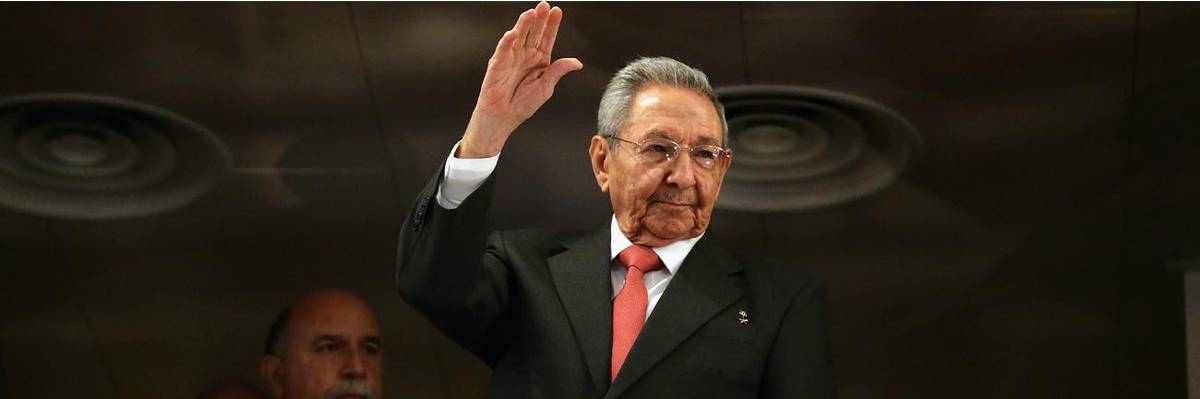
Raul Castro, seen here in 2016, announced on April 16, 2021 that he will step down from his post as first secretary of the Communist Party of Cuba. (Photo: Chip Somodevilla/Getty Images)
For the first time since the 1950s, Cuba will have a leader whose name is not Castro, as Raul Castro announced Friday that he will step down as first secretary of the country's ruling Communist Party just ahead of the 10th anniversary of his appointment.
"As long as I live I will be ready with my foot in the stirrups to defend the fatherland, the revolution, and socialism."
--Raul Castro
Castro--who has ruled Cuba since his brother Fidel resigned from the Communist Party central committee on April 19, 2011--announced his retirement during the 8th Party Conference in Havana, teleSUR reports.
"I believe fervently in the strength and exemplary nature and comprehension of my compatriots," he told the conference, "and as long as I live I will be ready with my foot in the stirrups to defend the fatherland, the revolution, and socialism."
The 89-year-old--who played a key role as a military commander in the revolution that overthrew the brutal U.S.-backed Fulgencio Batista regime in 1959--said that he has fulfilled his mission and "is confident in the future of the fatherland."
Castro leaves office after having implemented significant economic reforms, with the government recently allowing private businesses to operate in most sectors of the economy. While the government continues to repress political freedom, Cubans still enjoy social benefits unheard of in the United States, including free cradle-to-grave healthcare and education.
Under Castro, Cuba continued its globally renowned policy of international humanitarian assistance, which drew praise from then-U.S. President Barack Obama during his historic March 2016 visit to Havana. Last year, the Cuban government sent 2,000 doctors and nurses abroad to nearly two dozen nations during the coronavirus pandemic.
This year's party conference coincides with the 60th anniversary of the Bay of Pigs invasion, a failed attempt by CIA-backed Cuban exiles to destroy the revolution that ended half a century of U.S. domination. In 1898, the U.S. conquered Cuba from Spain and directly ruled the island as a colony for years before backing a series of dictators friendly to Washington and Wall Street interests.
The U.S. repeatedly tried to murder the Castros, with Raul becoming the target of the earliest-known CIA assassination plot against the brothers. The Castros survived more than 600 often outrageously outlandish assassination attempts against them, and outlasted 12 U.S. presidents. They also defiantly endured 60 years of internationally condemned U.S. economic embargo and a decades-long campaign of terror against the Cuban people.
It is widely believed that Miguel Diaz-Canal, the 60-year-old president, will replace Castro. The next Cuban leader will face an ongoing pandemic and concurrent economic crisis exacerbated by the continuing U.S. embargo, and will face internal and external pressure to enact further reforms while remaining faithful to the ideals of the revolution.
This country and this world are at a monumental crossroads. US voters have an opportunity to beat back the forces of fascism and confront the billionaires who are rigging the economy, our media system, and our democracy, making it increasingly impossible for ordinary people to get by. We’re not just talking about the election. We’re talking about what must be done once these fascist elements are vanquished from power. We need a bolder set of solutions than what either major party has so far been willing to offer and a working-class movement ready to fight like hell for it. Trump didn't emerge from nowhere. The conditions that fueled MAGA authoritarianism were created by decades of radical neoliberal economic policies and a corrupt political system dominated by corporate interests. They slashed taxes on the super-rich, promising that the benefits would trickle down. They said giveaways to the corporate titans would make life more affordable for the rest of us. It was all bullshit. And when a bitter, betrayed populace searches for someone to blame, right-wing demagogues have little trouble finding scapegoats. People know when they're being lied to, but you won't hear any of this from the corporate media. Only independent journalism—powered and funded by people who believe in building a better world—can deliver truly trustworthy daily news. If you share our vision, please contribute whatever you can to sustain our work. |
For the first time since the 1950s, Cuba will have a leader whose name is not Castro, as Raul Castro announced Friday that he will step down as first secretary of the country's ruling Communist Party just ahead of the 10th anniversary of his appointment.
"As long as I live I will be ready with my foot in the stirrups to defend the fatherland, the revolution, and socialism."
--Raul Castro
Castro--who has ruled Cuba since his brother Fidel resigned from the Communist Party central committee on April 19, 2011--announced his retirement during the 8th Party Conference in Havana, teleSUR reports.
"I believe fervently in the strength and exemplary nature and comprehension of my compatriots," he told the conference, "and as long as I live I will be ready with my foot in the stirrups to defend the fatherland, the revolution, and socialism."
The 89-year-old--who played a key role as a military commander in the revolution that overthrew the brutal U.S.-backed Fulgencio Batista regime in 1959--said that he has fulfilled his mission and "is confident in the future of the fatherland."
Castro leaves office after having implemented significant economic reforms, with the government recently allowing private businesses to operate in most sectors of the economy. While the government continues to repress political freedom, Cubans still enjoy social benefits unheard of in the United States, including free cradle-to-grave healthcare and education.
Under Castro, Cuba continued its globally renowned policy of international humanitarian assistance, which drew praise from then-U.S. President Barack Obama during his historic March 2016 visit to Havana. Last year, the Cuban government sent 2,000 doctors and nurses abroad to nearly two dozen nations during the coronavirus pandemic.
This year's party conference coincides with the 60th anniversary of the Bay of Pigs invasion, a failed attempt by CIA-backed Cuban exiles to destroy the revolution that ended half a century of U.S. domination. In 1898, the U.S. conquered Cuba from Spain and directly ruled the island as a colony for years before backing a series of dictators friendly to Washington and Wall Street interests.
The U.S. repeatedly tried to murder the Castros, with Raul becoming the target of the earliest-known CIA assassination plot against the brothers. The Castros survived more than 600 often outrageously outlandish assassination attempts against them, and outlasted 12 U.S. presidents. They also defiantly endured 60 years of internationally condemned U.S. economic embargo and a decades-long campaign of terror against the Cuban people.
It is widely believed that Miguel Diaz-Canal, the 60-year-old president, will replace Castro. The next Cuban leader will face an ongoing pandemic and concurrent economic crisis exacerbated by the continuing U.S. embargo, and will face internal and external pressure to enact further reforms while remaining faithful to the ideals of the revolution.