SUBSCRIBE TO OUR FREE NEWSLETTER
Daily news & progressive opinion—funded by the people, not the corporations—delivered straight to your inbox.
5
#000000
#FFFFFF
To donate by check, phone, or other method, see our More Ways to Give page.
Daily news & progressive opinion—funded by the people, not the corporations—delivered straight to your inbox.
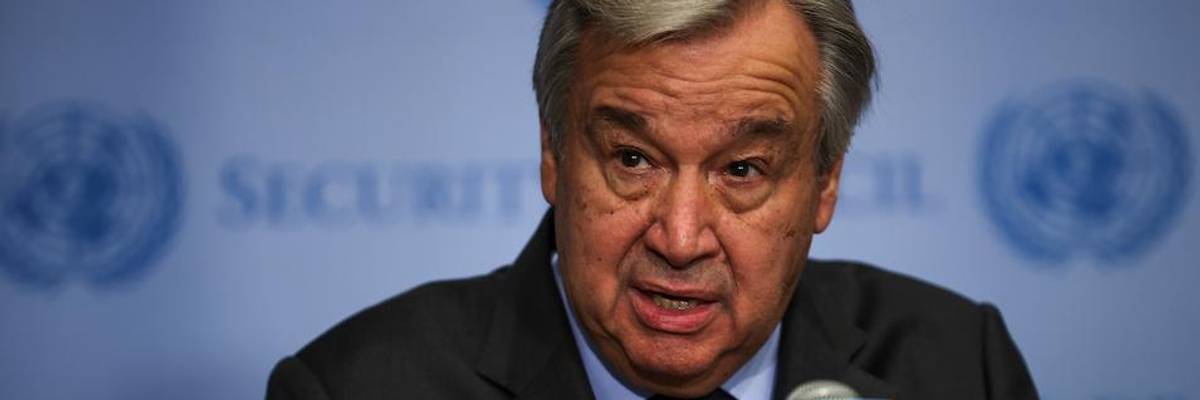
Secretary-General of United Nations Antonio Gutierrez speaks to press on the Syrian conflict at the United Nations Headquarters in New York City on March 10, 2021. (Photo: Tayfun Coskun/Anadolu Agency via Getty Images)
United Nations Secretary-General Antonio Guterres expressed support Monday for a wealth tax on those whose fortunes soared amid the coronavirus pandemic to tackle global economic inequality.
Guterres delivered the remarks at the U.N's Economic and Social Council Forum on Financing for Development. The four-day virtual and in-person event kicked off Monday.
The coronavirus pandemic has already claimed the lives of more than 3 million people and it's "far from over," said Guterres, who lamented that during the crisis "no element of our multilateral response has gone as it should."
"Advancing an equitable global response and recovery from the pandemic is putting multilateralism to the test. So far," the U.N. chief said, "it is a test we have failed."
He cited the "global vaccine gap" as one example, saying that just 10% of countries account for 75% of global vaccinations. There's a dollar figure on that inequity, said Guterres, putting "unequal access and vaccine hoarding at more than U.S. $9 trillion."
"To end the pandemic for good," said Guterres, "we need equitable access to vaccines for everyone, everywhere."
Guterres also referenced recent reports indicating that the world's wealthiest have seen their collective wealth surge by $5 trillion since the pandemic erupted last year.
"I urge governments to consider a solidarity or wealth tax on those who have profited during the pandemic, to reduce extreme inequalities," he said.
Guterres also said that debt relief for developing nations was urgently needed to advance a more equitable recovery from the pandemic.
Also of paramount importance is swift action to address the climate emergency, said Guterres. To help rein in the plantary crisis, he called on governments to set targets of net-zero emissions by 2050 through policies including "mandatory climate disclosures" and ditching fossil fuel subsidies in favor of policies to prop up renewable energy.
In the U.S., progressive lawmakers and outside groups have also called for a wealth tax on the nation's richest individuals.
"As a millionaire I know personally that our global economic system has enshrined wealth accumulation for the few--to the detriment of ordinary people in every country. We all deserve more than a pre-Covid path to recovery," Morris Pearl, chair of Patriotic Millionaires and former managing director at BlackRock, said in a statement this month.
"Taxing wealth has to be a key, central policy for all governments," said Pearl, "if we want to build beyond the skewed and faulty economic system we previously had."
Dear Common Dreams reader, It’s been nearly 30 years since I co-founded Common Dreams with my late wife, Lina Newhouser. We had the radical notion that journalism should serve the public good, not corporate profits. It was clear to us from the outset what it would take to build such a project. No paid advertisements. No corporate sponsors. No millionaire publisher telling us what to think or do. Many people said we wouldn't last a year, but we proved those doubters wrong. Together with a tremendous team of journalists and dedicated staff, we built an independent media outlet free from the constraints of profits and corporate control. Our mission has always been simple: To inform. To inspire. To ignite change for the common good. Building Common Dreams was not easy. Our survival was never guaranteed. When you take on the most powerful forces—Wall Street greed, fossil fuel industry destruction, Big Tech lobbyists, and uber-rich oligarchs who have spent billions upon billions rigging the economy and democracy in their favor—the only bulwark you have is supporters who believe in your work. But here’s the urgent message from me today. It's never been this bad out there. And it's never been this hard to keep us going. At the very moment Common Dreams is most needed, the threats we face are intensifying. We need your support now more than ever. We don't accept corporate advertising and never will. We don't have a paywall because we don't think people should be blocked from critical news based on their ability to pay. Everything we do is funded by the donations of readers like you. When everyone does the little they can afford, we are strong. But if that support retreats or dries up, so do we. Will you donate now to make sure Common Dreams not only survives but thrives? —Craig Brown, Co-founder |
United Nations Secretary-General Antonio Guterres expressed support Monday for a wealth tax on those whose fortunes soared amid the coronavirus pandemic to tackle global economic inequality.
Guterres delivered the remarks at the U.N's Economic and Social Council Forum on Financing for Development. The four-day virtual and in-person event kicked off Monday.
The coronavirus pandemic has already claimed the lives of more than 3 million people and it's "far from over," said Guterres, who lamented that during the crisis "no element of our multilateral response has gone as it should."
"Advancing an equitable global response and recovery from the pandemic is putting multilateralism to the test. So far," the U.N. chief said, "it is a test we have failed."
He cited the "global vaccine gap" as one example, saying that just 10% of countries account for 75% of global vaccinations. There's a dollar figure on that inequity, said Guterres, putting "unequal access and vaccine hoarding at more than U.S. $9 trillion."
"To end the pandemic for good," said Guterres, "we need equitable access to vaccines for everyone, everywhere."
Guterres also referenced recent reports indicating that the world's wealthiest have seen their collective wealth surge by $5 trillion since the pandemic erupted last year.
"I urge governments to consider a solidarity or wealth tax on those who have profited during the pandemic, to reduce extreme inequalities," he said.
Guterres also said that debt relief for developing nations was urgently needed to advance a more equitable recovery from the pandemic.
Also of paramount importance is swift action to address the climate emergency, said Guterres. To help rein in the plantary crisis, he called on governments to set targets of net-zero emissions by 2050 through policies including "mandatory climate disclosures" and ditching fossil fuel subsidies in favor of policies to prop up renewable energy.
In the U.S., progressive lawmakers and outside groups have also called for a wealth tax on the nation's richest individuals.
"As a millionaire I know personally that our global economic system has enshrined wealth accumulation for the few--to the detriment of ordinary people in every country. We all deserve more than a pre-Covid path to recovery," Morris Pearl, chair of Patriotic Millionaires and former managing director at BlackRock, said in a statement this month.
"Taxing wealth has to be a key, central policy for all governments," said Pearl, "if we want to build beyond the skewed and faulty economic system we previously had."
United Nations Secretary-General Antonio Guterres expressed support Monday for a wealth tax on those whose fortunes soared amid the coronavirus pandemic to tackle global economic inequality.
Guterres delivered the remarks at the U.N's Economic and Social Council Forum on Financing for Development. The four-day virtual and in-person event kicked off Monday.
The coronavirus pandemic has already claimed the lives of more than 3 million people and it's "far from over," said Guterres, who lamented that during the crisis "no element of our multilateral response has gone as it should."
"Advancing an equitable global response and recovery from the pandemic is putting multilateralism to the test. So far," the U.N. chief said, "it is a test we have failed."
He cited the "global vaccine gap" as one example, saying that just 10% of countries account for 75% of global vaccinations. There's a dollar figure on that inequity, said Guterres, putting "unequal access and vaccine hoarding at more than U.S. $9 trillion."
"To end the pandemic for good," said Guterres, "we need equitable access to vaccines for everyone, everywhere."
Guterres also referenced recent reports indicating that the world's wealthiest have seen their collective wealth surge by $5 trillion since the pandemic erupted last year.
"I urge governments to consider a solidarity or wealth tax on those who have profited during the pandemic, to reduce extreme inequalities," he said.
Guterres also said that debt relief for developing nations was urgently needed to advance a more equitable recovery from the pandemic.
Also of paramount importance is swift action to address the climate emergency, said Guterres. To help rein in the plantary crisis, he called on governments to set targets of net-zero emissions by 2050 through policies including "mandatory climate disclosures" and ditching fossil fuel subsidies in favor of policies to prop up renewable energy.
In the U.S., progressive lawmakers and outside groups have also called for a wealth tax on the nation's richest individuals.
"As a millionaire I know personally that our global economic system has enshrined wealth accumulation for the few--to the detriment of ordinary people in every country. We all deserve more than a pre-Covid path to recovery," Morris Pearl, chair of Patriotic Millionaires and former managing director at BlackRock, said in a statement this month.
"Taxing wealth has to be a key, central policy for all governments," said Pearl, "if we want to build beyond the skewed and faulty economic system we previously had."