

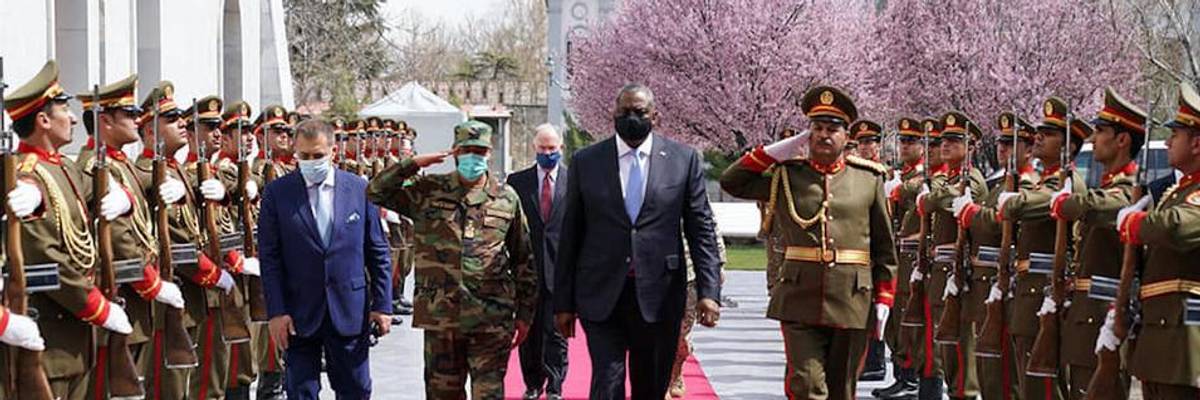
U.S. Defense Secretary Lloyd Austin made a surprise visit to Afghanistan on March 21, 2021. He met with U.S. troops and Afghan President Ashraf Ghani to discuss the timeline for an American withdrawal from the war-torn nation. (Photo: Afghan presidency/handout/Andalou Agency via Getty Images)
Calls Grow for Biden to Fully Withdraw US Troops From Afghanistan by May 1
"If Biden chooses to stay, every dead soldier, every family broken, and every opportunity wasted to build back better at home will rest on his shoulders and taint his legacy."
As President Joe Biden mulls missing the May 1 deadline for withdrawing U.S. troops from Afghanistan, he faces growing calls from voices across the political spectrum to stick to the date set by his predecessor and end the longest war in American history.
"The unilateral decision to blow past the May withdrawal deadline will destroy an already beleaguered peace process and Washington will find itself drawn back into a violent counterinsurgency."
--Trita Parsi and Adam Weinstein,
The Quincy Institute
Last week, Biden told ABC News that it would be "tough" for the U.S. to meet the May 1 withdrawal deadline set last February during negotiations between the administration of former President Donald Trump and the Taliban.
"We're in consultation with our allies as well as the government and that decision is in process now," Biden said, adding that if the U.S. pullout was delayed, it wouldn't be by "a lot longer."
The president also criticized the agreement between the Trump administration and the Taliban as "not a very solidly negotiated deal."
While critics have warned that the deal won't remove all American forces from the war-torn nation and that airstrikes and other operations could continue, the agreement is the closest the U.S. has come to ending a conflict that has now spanned four presidential administrations and multiple generations over almost the entire 21st century.
The day after Biden's ABC interview, Reps. Barbara Lee (D-Calif.)--the only member of Congress to vote against the 2001 authorization of the Afghanistan war--and Ken Buck (R-Colo.) sent a letter to the president urging him to adhere to the deadline.
"We believe that a decision to extend the military mission beyond the withdrawal deadline of May 1 will put U.S. troops at increased and unnecessary risk and fail to advance the goals of peace and justice in Afghanistan," they wrote.
The lawmakers' concerns have been widely echoed by expert observers. As Deirdre Shesgreen noted last week in USA Today, the war has cost the lives of at least 38,000 Afghan civilians, more than 2,300 American troops, and over $2 trillion, with a general consensus among military and other experts that there is no path to U.S. victory.
In a separate opinion piece published Tuesday in USA Today, Bonnie Kristian, a fellow at the libertarian-leaning think tank Defense Priorities, wrote that the "U.S. withdrawal from Afghanistan will never be smooth, but keeping this deal is the best foreseeable option."
"It stands the greatest chance of retaining some degree of Taliban cooperation," argued Kristian. "It gives Biden a unique political opportunity. And, crucially, it extricates the United States from a disastrously counterproductive intervention that will never succeed."
"If the Biden administration jettisons the May 1 agreement, the Taliban will use that betrayal to justify more violence, chaos, and perhaps even total rejection of diplomacy," she added. "It is no exaggeration to say canceling this deadline could lead to a U.S. presence in Afghanistan essentially unchanged (or even expanded) by the end of Biden's term. This is not an acceptable risk, which means May 1 is our date to bring all our troops home."
Trita Parsi, executive vice president at the Quincy Institute for Responsible Statecraft, a progressive think tank, agrees. Writing for Time on Tuesday, Parsi, along with Quincy fellow and Afghanistan war veteran Adam Weinstein, argued that "Afghanistan is likely to spiral into more violence" whether the Biden meets the May 1 deadline or not.
"The only variable he can control is whether American soldiers will be the target of that violence or be safe at home with their families," they wrote.
Taking issue with a report published last month by the congressionally mandated Afghanistan Study Group which recommended leaving U.S. troops in Afghanistan after May 1, Parsi and Weinstein asserted that "the unilateral decision to blow past the May withdrawal deadline will destroy an already beleaguered peace process and Washington will find itself drawn back into a violent counterinsurgency."
"It will annul the U.S.-Taliban agreement, which, despite its flaws and failure to bring peace to Afghans, led to a year without a single U.S. combat death, and leave President Biden to once again await American caskets at Dover Air Force Base," they wrote.
"If Biden chooses to stay, every dead soldier, every family broken, and every opportunity wasted to build back better at home will rest on his shoulders and taint his legacy," Parsi and Weinstein concluded. "America's endless war in Afghanistan will become Biden's war."
The women-led peace group CodePink put it more succinctly, tweeting recently that "you can't bomb for peace."
We are at a crossroads
This country and this world are at a monumental crossroads. In a few short weeks, US voters will have an opportunity to beat back the forces of fascism and confront the billionaires who are rigging the economy, our media system, and our democracy, making it increasingly impossible for ordinary people to get by. We’re not just talking about the election. We’re talking about what must be done once these fascist elements are vanquished from power. We need a bolder set of solutions than what either major party has so far been willing to offer and a working-class movement ready to fight like hell for it. Trump didn't emerge from nowhere. The conditions that fueled MAGA authoritarianism were created by decades of radical neoliberal economic policies and a corrupt political system dominated by corporate interests. They slashed taxes on the super-rich, promising that the benefits would trickle down. They said giveaways to the corporate titans would make life more affordable for the rest of us. It was all bullshit. And when a bitter, betrayed populace searches for someone to blame, right-wing demagogues have little trouble finding scapegoats. People know when they're being lied to, but you won't hear any of this from the corporate media. Only independent journalism—powered and funded by people who believe in building a better world—can deliver truly trustworthy daily news. Our Fall Campaign is underway, and we need your help. To power our newsroom through the rest of the year, we need to raise $125,000 by midnight on October 31. So if you share our vision, please contribute whatever you can to sustain our work. |
As President Joe Biden mulls missing the May 1 deadline for withdrawing U.S. troops from Afghanistan, he faces growing calls from voices across the political spectrum to stick to the date set by his predecessor and end the longest war in American history.
"The unilateral decision to blow past the May withdrawal deadline will destroy an already beleaguered peace process and Washington will find itself drawn back into a violent counterinsurgency."
--Trita Parsi and Adam Weinstein,
The Quincy Institute
Last week, Biden told ABC News that it would be "tough" for the U.S. to meet the May 1 withdrawal deadline set last February during negotiations between the administration of former President Donald Trump and the Taliban.
"We're in consultation with our allies as well as the government and that decision is in process now," Biden said, adding that if the U.S. pullout was delayed, it wouldn't be by "a lot longer."
The president also criticized the agreement between the Trump administration and the Taliban as "not a very solidly negotiated deal."
While critics have warned that the deal won't remove all American forces from the war-torn nation and that airstrikes and other operations could continue, the agreement is the closest the U.S. has come to ending a conflict that has now spanned four presidential administrations and multiple generations over almost the entire 21st century.
The day after Biden's ABC interview, Reps. Barbara Lee (D-Calif.)--the only member of Congress to vote against the 2001 authorization of the Afghanistan war--and Ken Buck (R-Colo.) sent a letter to the president urging him to adhere to the deadline.
"We believe that a decision to extend the military mission beyond the withdrawal deadline of May 1 will put U.S. troops at increased and unnecessary risk and fail to advance the goals of peace and justice in Afghanistan," they wrote.
The lawmakers' concerns have been widely echoed by expert observers. As Deirdre Shesgreen noted last week in USA Today, the war has cost the lives of at least 38,000 Afghan civilians, more than 2,300 American troops, and over $2 trillion, with a general consensus among military and other experts that there is no path to U.S. victory.
In a separate opinion piece published Tuesday in USA Today, Bonnie Kristian, a fellow at the libertarian-leaning think tank Defense Priorities, wrote that the "U.S. withdrawal from Afghanistan will never be smooth, but keeping this deal is the best foreseeable option."
"It stands the greatest chance of retaining some degree of Taliban cooperation," argued Kristian. "It gives Biden a unique political opportunity. And, crucially, it extricates the United States from a disastrously counterproductive intervention that will never succeed."
"If the Biden administration jettisons the May 1 agreement, the Taliban will use that betrayal to justify more violence, chaos, and perhaps even total rejection of diplomacy," she added. "It is no exaggeration to say canceling this deadline could lead to a U.S. presence in Afghanistan essentially unchanged (or even expanded) by the end of Biden's term. This is not an acceptable risk, which means May 1 is our date to bring all our troops home."
Trita Parsi, executive vice president at the Quincy Institute for Responsible Statecraft, a progressive think tank, agrees. Writing for Time on Tuesday, Parsi, along with Quincy fellow and Afghanistan war veteran Adam Weinstein, argued that "Afghanistan is likely to spiral into more violence" whether the Biden meets the May 1 deadline or not.
"The only variable he can control is whether American soldiers will be the target of that violence or be safe at home with their families," they wrote.
Taking issue with a report published last month by the congressionally mandated Afghanistan Study Group which recommended leaving U.S. troops in Afghanistan after May 1, Parsi and Weinstein asserted that "the unilateral decision to blow past the May withdrawal deadline will destroy an already beleaguered peace process and Washington will find itself drawn back into a violent counterinsurgency."
"It will annul the U.S.-Taliban agreement, which, despite its flaws and failure to bring peace to Afghans, led to a year without a single U.S. combat death, and leave President Biden to once again await American caskets at Dover Air Force Base," they wrote.
"If Biden chooses to stay, every dead soldier, every family broken, and every opportunity wasted to build back better at home will rest on his shoulders and taint his legacy," Parsi and Weinstein concluded. "America's endless war in Afghanistan will become Biden's war."
The women-led peace group CodePink put it more succinctly, tweeting recently that "you can't bomb for peace."