SUBSCRIBE TO OUR FREE NEWSLETTER
Daily news & progressive opinion—funded by the people, not the corporations—delivered straight to your inbox.
5
#000000
#FFFFFF
To donate by check, phone, or other method, see our More Ways to Give page.


Daily news & progressive opinion—funded by the people, not the corporations—delivered straight to your inbox.

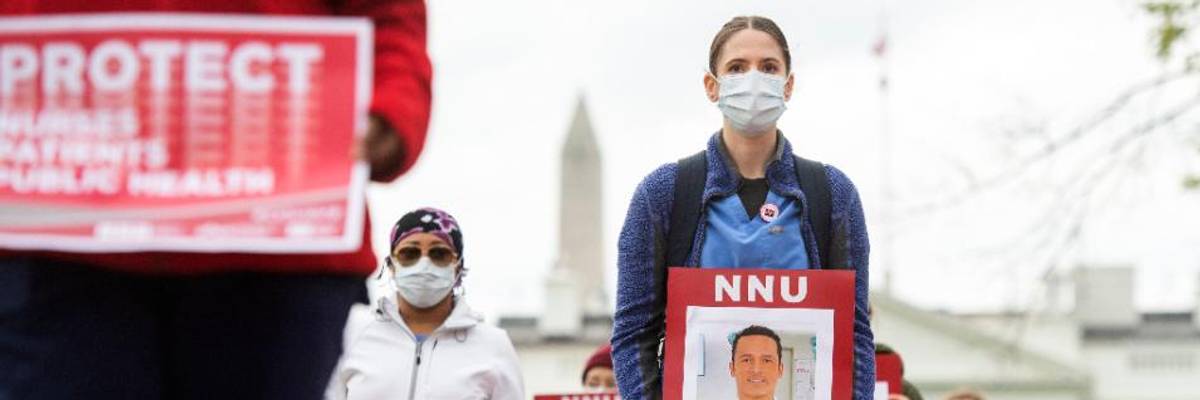
Registered nurses conduct a demonstration in Lafayette Park to read aloud names of healthcare providers who have contracted Covid-19 and died as a result of treating infected patients on Tuesday, April 21, 2020. (Photo: Tom Williams/CQ-Roll Call, Inc. via Getty Images)
A new report released Tuesday morning by consumer advocacy group Public Citizen makes the case that the United States' fragmented for-profit healthcare system hampered the nation's coronavirus response "at every turn," resulting in millions of Covid-19 infections and hundreds of thousands of deaths that likely would have been prevented under a Medicare for All system.
Titled Unprepared for Covid-19: How the Pandemic Makes the Case for Medicare for All, the white paper builds off a recent analysis showing that around 40% of U.S. Covid-19 infections and 33% of virus deaths are associated with uninsurance, which was high before the pandemic and soared last year as mass layoffs threw millions off their employer-provided coverage. The growing uninsured rate has hit frontline workers particularly hard.
"The reality is that our for-profit healthcare system put the U.S. at a dangerous disadvantage and hindered rapid response," Public Citizen's new report reads. "It has also meant millions of Americans have contracted Covid-19 unnecessarily and hundreds of thousands of deaths could have been prevented."
"Under Medicare for All, everyone would have consistent coverage regardless of their employment status or employer," the report continues. "And because Americans would have their choice of providers, instead of facing the narrow networks their employers choose for them, they would face fewer challenges getting care, especially during a pandemic where some hospitals and providers are overwhelmed by demand."
If the U.S. had in place a single-payer system that provided everyone in the country with comprehensive healthcare for free at the point of service--as proposed by supporters of Medicare for All--"the U.S. would finally be able to ensure sufficient funding for public health, including future pandemics," and "the nation could finally begin addressing massive health disparities in a comprehensive way," the paper argues.
"As the pandemic has shown, everyone depends on the healthcare system throughout their lives," the paper adds. "Whether we face a public health emergency like a global pandemic or simply need to meet routine medical needs, Medicare for All would ensure necessary treatments are available to everyone regardless of their ability to pay."
Eagan Kemp, Public Citizen's healthcare policy advocate and the author of the new report, said in a statement that the "pandemic has shown how wide the gaps in our healthcare system remain and how easy it is for families to fall through them."
"We need to be prepared for the next pandemic, and we can't be under the current for-profit system. The time has come for a healthcare system that guarantees healthcare for everyone in the U.S.," Kemp said. "The time has come for Medicare for All."
Public Citizen's white paper comes a day before Reps. Pramila Jayapal (D-Wash.) and Debbie Dingell (D-Mich.) are set to introduce the Medicare for All Act of 2021, which is expected to broadly resemble single-payer legislation that the Washington Democrat sponsored in 2019.
That bill, as Common Dreams reported at the time, proposed a two-year transition to a Medicare for All system that would provide dental, vision, reproductive health, mental health, long-term care, and other services with no out-of-pocket costs attached.
"The state of our healthcare system is absolutely atrocious," Jayapal told reporters on the eve of the bill's release just over two years ago. "How is it possible that the United States, the richest country in the world, is the only major country that does not guarantee healthcare to our residents?"
The case for Medicare for All, as Public Citizen argues in its new report, has only grown stronger since 2019, with the coronavirus pandemic further exposing the private system's fundamental and deadly flaws as well as the rapacity of the insurance and pharmaceutical industries.
"The Covid-19 pandemic showed just how greedy private insurers are, as they were reporting record profits because they were paying out far less in claims due to millions of Americans delaying care," Kemp writes. "This disparity highlights just how little value insurers are bringing to the healthcare system despite how much they cost consumers and the healthcare system in general."
While Congress recently approved a significant expansion of Affordable Care Act subsidies with the goal of helping more people afford insurance in the marketplace, Kemp contends that "the scope of the reforms are limited and so Americans will continue to struggle without a comprehensive solution like Medicare for All."
"Under Medicare for All," Kemp concludes, "our healthcare system would focus on health and wellbeing instead of generating profit and revenue for wealthy insurers."
Dear Common Dreams reader, It’s been nearly 30 years since I co-founded Common Dreams with my late wife, Lina Newhouser. We had the radical notion that journalism should serve the public good, not corporate profits. It was clear to us from the outset what it would take to build such a project. No paid advertisements. No corporate sponsors. No millionaire publisher telling us what to think or do. Many people said we wouldn't last a year, but we proved those doubters wrong. Together with a tremendous team of journalists and dedicated staff, we built an independent media outlet free from the constraints of profits and corporate control. Our mission has always been simple: To inform. To inspire. To ignite change for the common good. Building Common Dreams was not easy. Our survival was never guaranteed. When you take on the most powerful forces—Wall Street greed, fossil fuel industry destruction, Big Tech lobbyists, and uber-rich oligarchs who have spent billions upon billions rigging the economy and democracy in their favor—the only bulwark you have is supporters who believe in your work. But here’s the urgent message from me today. It's never been this bad out there. And it's never been this hard to keep us going. At the very moment Common Dreams is most needed, the threats we face are intensifying. We need your support now more than ever. We don't accept corporate advertising and never will. We don't have a paywall because we don't think people should be blocked from critical news based on their ability to pay. Everything we do is funded by the donations of readers like you. When everyone does the little they can afford, we are strong. But if that support retreats or dries up, so do we. Will you donate now to make sure Common Dreams not only survives but thrives? —Craig Brown, Co-founder |
A new report released Tuesday morning by consumer advocacy group Public Citizen makes the case that the United States' fragmented for-profit healthcare system hampered the nation's coronavirus response "at every turn," resulting in millions of Covid-19 infections and hundreds of thousands of deaths that likely would have been prevented under a Medicare for All system.
Titled Unprepared for Covid-19: How the Pandemic Makes the Case for Medicare for All, the white paper builds off a recent analysis showing that around 40% of U.S. Covid-19 infections and 33% of virus deaths are associated with uninsurance, which was high before the pandemic and soared last year as mass layoffs threw millions off their employer-provided coverage. The growing uninsured rate has hit frontline workers particularly hard.
"The reality is that our for-profit healthcare system put the U.S. at a dangerous disadvantage and hindered rapid response," Public Citizen's new report reads. "It has also meant millions of Americans have contracted Covid-19 unnecessarily and hundreds of thousands of deaths could have been prevented."
"Under Medicare for All, everyone would have consistent coverage regardless of their employment status or employer," the report continues. "And because Americans would have their choice of providers, instead of facing the narrow networks their employers choose for them, they would face fewer challenges getting care, especially during a pandemic where some hospitals and providers are overwhelmed by demand."
If the U.S. had in place a single-payer system that provided everyone in the country with comprehensive healthcare for free at the point of service--as proposed by supporters of Medicare for All--"the U.S. would finally be able to ensure sufficient funding for public health, including future pandemics," and "the nation could finally begin addressing massive health disparities in a comprehensive way," the paper argues.
"As the pandemic has shown, everyone depends on the healthcare system throughout their lives," the paper adds. "Whether we face a public health emergency like a global pandemic or simply need to meet routine medical needs, Medicare for All would ensure necessary treatments are available to everyone regardless of their ability to pay."
Eagan Kemp, Public Citizen's healthcare policy advocate and the author of the new report, said in a statement that the "pandemic has shown how wide the gaps in our healthcare system remain and how easy it is for families to fall through them."
"We need to be prepared for the next pandemic, and we can't be under the current for-profit system. The time has come for a healthcare system that guarantees healthcare for everyone in the U.S.," Kemp said. "The time has come for Medicare for All."
Public Citizen's white paper comes a day before Reps. Pramila Jayapal (D-Wash.) and Debbie Dingell (D-Mich.) are set to introduce the Medicare for All Act of 2021, which is expected to broadly resemble single-payer legislation that the Washington Democrat sponsored in 2019.
That bill, as Common Dreams reported at the time, proposed a two-year transition to a Medicare for All system that would provide dental, vision, reproductive health, mental health, long-term care, and other services with no out-of-pocket costs attached.
"The state of our healthcare system is absolutely atrocious," Jayapal told reporters on the eve of the bill's release just over two years ago. "How is it possible that the United States, the richest country in the world, is the only major country that does not guarantee healthcare to our residents?"
The case for Medicare for All, as Public Citizen argues in its new report, has only grown stronger since 2019, with the coronavirus pandemic further exposing the private system's fundamental and deadly flaws as well as the rapacity of the insurance and pharmaceutical industries.
"The Covid-19 pandemic showed just how greedy private insurers are, as they were reporting record profits because they were paying out far less in claims due to millions of Americans delaying care," Kemp writes. "This disparity highlights just how little value insurers are bringing to the healthcare system despite how much they cost consumers and the healthcare system in general."
While Congress recently approved a significant expansion of Affordable Care Act subsidies with the goal of helping more people afford insurance in the marketplace, Kemp contends that "the scope of the reforms are limited and so Americans will continue to struggle without a comprehensive solution like Medicare for All."
"Under Medicare for All," Kemp concludes, "our healthcare system would focus on health and wellbeing instead of generating profit and revenue for wealthy insurers."
A new report released Tuesday morning by consumer advocacy group Public Citizen makes the case that the United States' fragmented for-profit healthcare system hampered the nation's coronavirus response "at every turn," resulting in millions of Covid-19 infections and hundreds of thousands of deaths that likely would have been prevented under a Medicare for All system.
Titled Unprepared for Covid-19: How the Pandemic Makes the Case for Medicare for All, the white paper builds off a recent analysis showing that around 40% of U.S. Covid-19 infections and 33% of virus deaths are associated with uninsurance, which was high before the pandemic and soared last year as mass layoffs threw millions off their employer-provided coverage. The growing uninsured rate has hit frontline workers particularly hard.
"The reality is that our for-profit healthcare system put the U.S. at a dangerous disadvantage and hindered rapid response," Public Citizen's new report reads. "It has also meant millions of Americans have contracted Covid-19 unnecessarily and hundreds of thousands of deaths could have been prevented."
"Under Medicare for All, everyone would have consistent coverage regardless of their employment status or employer," the report continues. "And because Americans would have their choice of providers, instead of facing the narrow networks their employers choose for them, they would face fewer challenges getting care, especially during a pandemic where some hospitals and providers are overwhelmed by demand."
If the U.S. had in place a single-payer system that provided everyone in the country with comprehensive healthcare for free at the point of service--as proposed by supporters of Medicare for All--"the U.S. would finally be able to ensure sufficient funding for public health, including future pandemics," and "the nation could finally begin addressing massive health disparities in a comprehensive way," the paper argues.
"As the pandemic has shown, everyone depends on the healthcare system throughout their lives," the paper adds. "Whether we face a public health emergency like a global pandemic or simply need to meet routine medical needs, Medicare for All would ensure necessary treatments are available to everyone regardless of their ability to pay."
Eagan Kemp, Public Citizen's healthcare policy advocate and the author of the new report, said in a statement that the "pandemic has shown how wide the gaps in our healthcare system remain and how easy it is for families to fall through them."
"We need to be prepared for the next pandemic, and we can't be under the current for-profit system. The time has come for a healthcare system that guarantees healthcare for everyone in the U.S.," Kemp said. "The time has come for Medicare for All."
Public Citizen's white paper comes a day before Reps. Pramila Jayapal (D-Wash.) and Debbie Dingell (D-Mich.) are set to introduce the Medicare for All Act of 2021, which is expected to broadly resemble single-payer legislation that the Washington Democrat sponsored in 2019.
That bill, as Common Dreams reported at the time, proposed a two-year transition to a Medicare for All system that would provide dental, vision, reproductive health, mental health, long-term care, and other services with no out-of-pocket costs attached.
"The state of our healthcare system is absolutely atrocious," Jayapal told reporters on the eve of the bill's release just over two years ago. "How is it possible that the United States, the richest country in the world, is the only major country that does not guarantee healthcare to our residents?"
The case for Medicare for All, as Public Citizen argues in its new report, has only grown stronger since 2019, with the coronavirus pandemic further exposing the private system's fundamental and deadly flaws as well as the rapacity of the insurance and pharmaceutical industries.
"The Covid-19 pandemic showed just how greedy private insurers are, as they were reporting record profits because they were paying out far less in claims due to millions of Americans delaying care," Kemp writes. "This disparity highlights just how little value insurers are bringing to the healthcare system despite how much they cost consumers and the healthcare system in general."
While Congress recently approved a significant expansion of Affordable Care Act subsidies with the goal of helping more people afford insurance in the marketplace, Kemp contends that "the scope of the reforms are limited and so Americans will continue to struggle without a comprehensive solution like Medicare for All."
"Under Medicare for All," Kemp concludes, "our healthcare system would focus on health and wellbeing instead of generating profit and revenue for wealthy insurers."