

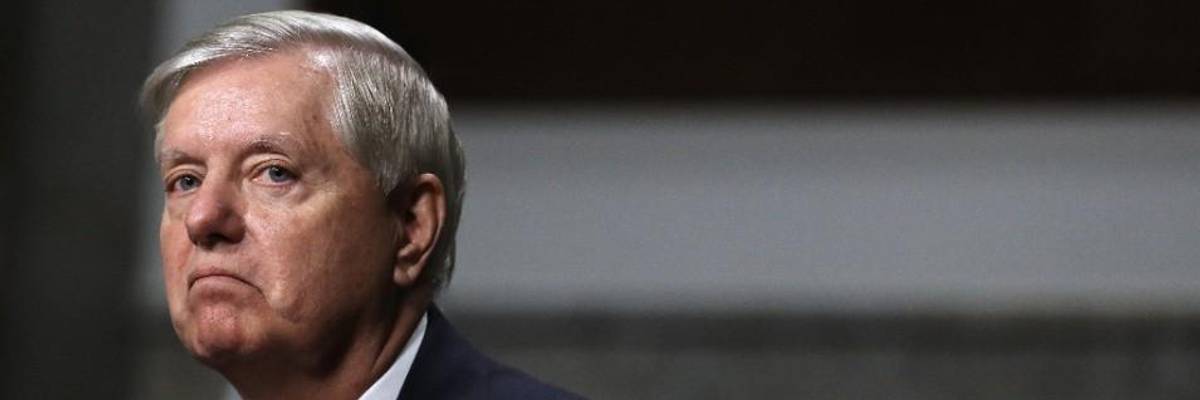
Senate Judiciary Committee Chairman Lindsey Graham (R-S.C.) presides over a hearing about the influence of social media companies on the 2020 election on November 17, 2020 in Washington, D.C. (Photo: Chip Somodevilla/Getty Images)
Lindsey Graham Under Fire for Latest Blockade of Merrick Garland's Senate Confirmation
"If Sen. Graham refuses to work in good faith to quickly confirm President Biden's highly qualified nominees, then it's time for him to step aside and let more serious legislators get to work."
Republican Sen. Lindsey Graham was accused Tuesday of exercising "the last vestiges of power" by obstructing--again--Senate confirmation of Merrick Garland.
President Joe Biden last month tapped Garland--whose 2016 nomination to the U.S. Supreme Court was blocked by the then-Republican controlled Senate--to be U.S. attorney general.
Graham (R-S.C.) is able to exert the control over the new nomination even though his party no longer controls the chamber, as Politico explained Monday:
The dispute over Garland's confirmation hearing is the latest complication of the 50-50 Senate. While Democrats control the Senate, party leaders have yet to finalize an organizing resolution that will determine the committees for the upper chamber. Until the organizing resolution is approved, Republicans like Graham still hold committee gavels from the previous Congress.
As such, Graham still chairs the Senate Judiciary Committee; Democratic Sen. Dick Durbin of Illinois is the committee's incoming chair.
In a letter to Graham on Monday, Durbin wrote that "there is simply no justification for delaying Judge Garland's hearing any further." Durbin called for a hearing on February 8, a timing he said would align with Republican requests that the hearing not coincide with former President Donald Trump's impeachment trial.
Durbin wrote, in part:
On January 6, then-President-elect Biden alerted both Democratic and Republican committee members and staff that he would nominate Judge Garland as the nation's next attorney general. Given the attorney general's role as the nation's top law enforcement officer, this committee should promptly consider attorney general nominees as a general practice. But the events of January 6--when armed insurrectionists attacked the Capitol, killed Officer Brian Sicknick, injured dozens of other law enforcement officers, and threatened the lives of lawmakers and staff--made even clearer the need to quickly process Judge Garland's nomination.
Graham rejected the request.
Responding to Durbin, Graham asserted that the request was "highly unusual" and that Democrats want to "rush through Judge Garland's hearing" while the impeachment trial "requires the Senate's complete focus."
"Democrats do not get to score political points in an unprecedented act of political theater on one hand while also trying to claim the mantle of good government on the other," said Graham.
Writing at MaddowBlog, Steve Benen pointed to Republican senators' "unprecedented blockade" on Garland's Supreme Court nomination five years ago, and how Graham joined that effort, "refusing to even give Garland the courtesy of a meeting."
And now, Benen wrote, "the GOP senator is managing to mishandle a Garland nomination for the second time." Benen suggested Graham "apparently has a knack for leaving Merrick Garland hanging."
Graham's fresh blockade also drew criticism from Mairead Lynn, spokesperson for the government watchdog group Accountable.US's Senate War Room campaign.
"Since apparently it wasn't enough for Senate Republicans to refuse Merrick Garland a hearing when he was nominated to the Supreme Court--now they are delaying his hearing to head up the Justice Department," Lynn said in a statement.
She blamed Republicans who "sat on their hands during the lame-duck" for the chamber being behind on Biden's agenda and called it "ridiculous that Sen. Graham is now holding onto the last vestiges of power to delay the confirmation of the administration's top law enforcement official."
"It's well past time for this obstruction to end," Lynn said, "and if Sen. Graham refuses to work in good faith to quickly confirm President Biden's highly qualified nominees, then it's time for him to step aside and let more serious legislators get to work."
We are at a crossroads
This country and this world are at a monumental crossroads. In a few short weeks, US voters will have an opportunity to beat back the forces of fascism and confront the billionaires who are rigging the economy, our media system, and our democracy, making it increasingly impossible for ordinary people to get by. We’re not just talking about the election. We’re talking about what must be done once these fascist elements are vanquished from power. We need a bolder set of solutions than what either major party has so far been willing to offer and a working-class movement ready to fight like hell for it. Trump didn't emerge from nowhere. The conditions that fueled MAGA authoritarianism were created by decades of radical neoliberal economic policies and a corrupt political system dominated by corporate interests. They slashed taxes on the super-rich, promising that the benefits would trickle down. They said giveaways to the corporate titans would make life more affordable for the rest of us. It was all bullshit. And when a bitter, betrayed populace searches for someone to blame, right-wing demagogues have little trouble finding scapegoats. People know when they're being lied to, but you won't hear any of this from the corporate media. Only independent journalism—powered and funded by people who believe in building a better world—can deliver truly trustworthy daily news. Our Fall Campaign is underway, and we need your help. To power our newsroom through the rest of the year, we need to raise $125,000 by midnight on October 31. So if you share our vision, please contribute whatever you can to sustain our work. |
Republican Sen. Lindsey Graham was accused Tuesday of exercising "the last vestiges of power" by obstructing--again--Senate confirmation of Merrick Garland.
President Joe Biden last month tapped Garland--whose 2016 nomination to the U.S. Supreme Court was blocked by the then-Republican controlled Senate--to be U.S. attorney general.
Graham (R-S.C.) is able to exert the control over the new nomination even though his party no longer controls the chamber, as Politico explained Monday:
The dispute over Garland's confirmation hearing is the latest complication of the 50-50 Senate. While Democrats control the Senate, party leaders have yet to finalize an organizing resolution that will determine the committees for the upper chamber. Until the organizing resolution is approved, Republicans like Graham still hold committee gavels from the previous Congress.
As such, Graham still chairs the Senate Judiciary Committee; Democratic Sen. Dick Durbin of Illinois is the committee's incoming chair.
In a letter to Graham on Monday, Durbin wrote that "there is simply no justification for delaying Judge Garland's hearing any further." Durbin called for a hearing on February 8, a timing he said would align with Republican requests that the hearing not coincide with former President Donald Trump's impeachment trial.
Durbin wrote, in part:
On January 6, then-President-elect Biden alerted both Democratic and Republican committee members and staff that he would nominate Judge Garland as the nation's next attorney general. Given the attorney general's role as the nation's top law enforcement officer, this committee should promptly consider attorney general nominees as a general practice. But the events of January 6--when armed insurrectionists attacked the Capitol, killed Officer Brian Sicknick, injured dozens of other law enforcement officers, and threatened the lives of lawmakers and staff--made even clearer the need to quickly process Judge Garland's nomination.
Graham rejected the request.
Responding to Durbin, Graham asserted that the request was "highly unusual" and that Democrats want to "rush through Judge Garland's hearing" while the impeachment trial "requires the Senate's complete focus."
"Democrats do not get to score political points in an unprecedented act of political theater on one hand while also trying to claim the mantle of good government on the other," said Graham.
Writing at MaddowBlog, Steve Benen pointed to Republican senators' "unprecedented blockade" on Garland's Supreme Court nomination five years ago, and how Graham joined that effort, "refusing to even give Garland the courtesy of a meeting."
And now, Benen wrote, "the GOP senator is managing to mishandle a Garland nomination for the second time." Benen suggested Graham "apparently has a knack for leaving Merrick Garland hanging."
Graham's fresh blockade also drew criticism from Mairead Lynn, spokesperson for the government watchdog group Accountable.US's Senate War Room campaign.
"Since apparently it wasn't enough for Senate Republicans to refuse Merrick Garland a hearing when he was nominated to the Supreme Court--now they are delaying his hearing to head up the Justice Department," Lynn said in a statement.
She blamed Republicans who "sat on their hands during the lame-duck" for the chamber being behind on Biden's agenda and called it "ridiculous that Sen. Graham is now holding onto the last vestiges of power to delay the confirmation of the administration's top law enforcement official."
"It's well past time for this obstruction to end," Lynn said, "and if Sen. Graham refuses to work in good faith to quickly confirm President Biden's highly qualified nominees, then it's time for him to step aside and let more serious legislators get to work."