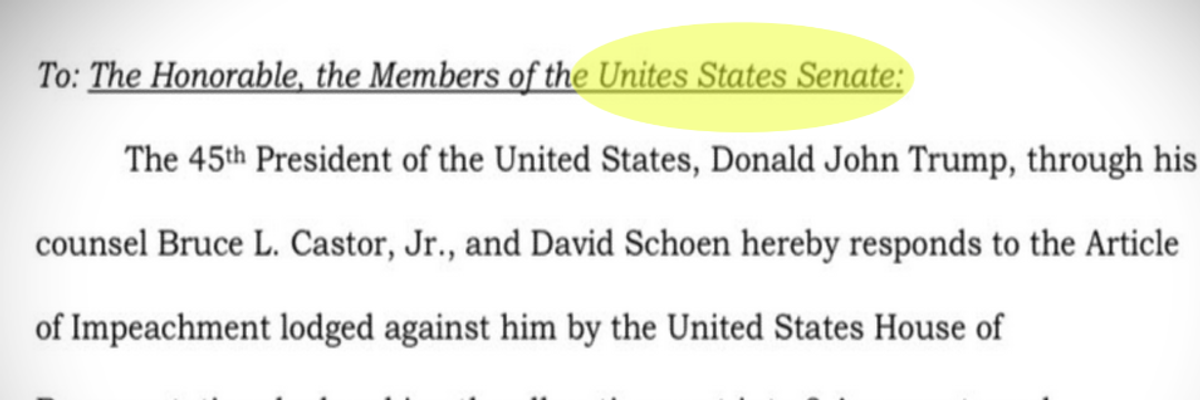
Critics said a Feburary 2, 2021 filing by former President Donald Trump's attorneys in response to House impeachment managers' pretrial brief contained errors of both the spelling and legal variety. (Image: screenshot)
Critics Lambaste Errors--Both Spelling and Legal--in Trump Impeachment Defense Filing
"Lawyers are paid to make the best case they can for their clients. If this is Trump's best case, he's lucky that nearly half the jurors who will evaluate it are already firmly in his camp."
The defense team for former President Donald Trump's impending impeachment trial was widely mocked Tuesday for issuing a response to the House of Representatives' article of impeachment that contained both spelling and--according to critics--legal mistakes.
One spelling error that sparked a flurry of comments on Twitter came in the very beginning of Trump's response (pdf), which is addressed to the "The Honorable, the Members of the Unites States Senate."
Typos have plagued numerous legal documents filed by Trump's (former) attorneys in a string of losing cases seeking to overturn the results of the 2020 presidential election. One filing by lawyer Sidney Powell even misspelled "district" twice in the same heading.
Trump--whose own tweets routinely contained spelling errors, including the infamous "covfefe"--reportedly called Powell's errors "very embarrassing" during a heated White House strategy meeting in December. During that same meeting, White House staff secretary Derek Lyons brought up a more important point in relation to the effort to reverse the election results.
"You've brought 60 cases," Lyons reportedly told Powell. "And you've lost every case you've had!"
And so while many Twitter users once again lambasted spelling errors on Trump's latest legal document, other observers focused their criticism on what they said were its legal mistakes, even if some of them managed to get in digs at both simultaneously.
"If you're curious about the actual substance of the document, it's of the same quality" as the spelling, tweeted Washington Post national correspondent Philip Bump, linking to his analysis of Trump's defense.
"As expected, the document's evaluation of Trump's actions surrounding the violent invasion of the U.S. Capitol on [January] 6 includes a defense of his claims that the 2020 presidential election was marred by voter fraud," Bump wrote for the Post.
Absent that "Big Lie," as the House impeachment managers called the fraud claims in their Tuesday pretrial brief, "there's no rally at the White House that morning and no crowd of people milling around who would then overrun the Capitol," according to Bump.
Bump and others, including Marc E. Elias, an attorney and founder of the progressive advocacy group Democracy Docket, lambasted the Trump document's assertion that "under the convenient guise of Covid-19 pandemic 'safeguards' states election laws and procedures were changed by local politicians or judges without the necessary approvals from state legislatures."
Another central argument of Trump's trial defense involves the former president's right to free speech. However, critics were quick to note that there are well-established limits on First Amendment speech, and that no one has the right to incite violence with their words:
"Lawyers are paid to make the best case they can for their clients," Bump concluded. "If this is Trump's best case, he's lucky that nearly half the jurors who will evaluate it are already firmly in his camp."
In the end, the fact that 45 Republican senators are likely to vote to acquit Trump may indeed matter more than any errors--typographical, legal, or otherwise--his defense may make.
We are at a crossroads
This country and this world are at a monumental crossroads. In a few short weeks, US voters will have an opportunity to beat back the forces of fascism and confront the billionaires who are rigging the economy, our media system, and our democracy, making it increasingly impossible for ordinary people to get by. We’re not just talking about the election. We’re talking about what must be done once these fascist elements are vanquished from power. We need a bolder set of solutions than what either major party has so far been willing to offer and a working-class movement ready to fight like hell for it. Trump didn't emerge from nowhere. The conditions that fueled MAGA authoritarianism were created by decades of radical neoliberal economic policies and a corrupt political system dominated by corporate interests. They slashed taxes on the super-rich, promising that the benefits would trickle down. They said giveaways to the corporate titans would make life more affordable for the rest of us. It was all bullshit. And when a bitter, betrayed populace searches for someone to blame, right-wing demagogues have little trouble finding scapegoats. People know when they're being lied to, but you won't hear any of this from the corporate media. Only independent journalism—powered and funded by people who believe in building a better world—can deliver truly trustworthy daily news. Our Fall Campaign is underway, and we need your help. To power our newsroom through the rest of the year, we need to raise $125,000 by midnight on October 31. So if you share our vision, please contribute whatever you can to sustain our work. |
The defense team for former President Donald Trump's impending impeachment trial was widely mocked Tuesday for issuing a response to the House of Representatives' article of impeachment that contained both spelling and--according to critics--legal mistakes.
One spelling error that sparked a flurry of comments on Twitter came in the very beginning of Trump's response (pdf), which is addressed to the "The Honorable, the Members of the Unites States Senate."
Typos have plagued numerous legal documents filed by Trump's (former) attorneys in a string of losing cases seeking to overturn the results of the 2020 presidential election. One filing by lawyer Sidney Powell even misspelled "district" twice in the same heading.
Trump--whose own tweets routinely contained spelling errors, including the infamous "covfefe"--reportedly called Powell's errors "very embarrassing" during a heated White House strategy meeting in December. During that same meeting, White House staff secretary Derek Lyons brought up a more important point in relation to the effort to reverse the election results.
"You've brought 60 cases," Lyons reportedly told Powell. "And you've lost every case you've had!"
And so while many Twitter users once again lambasted spelling errors on Trump's latest legal document, other observers focused their criticism on what they said were its legal mistakes, even if some of them managed to get in digs at both simultaneously.
"If you're curious about the actual substance of the document, it's of the same quality" as the spelling, tweeted Washington Post national correspondent Philip Bump, linking to his analysis of Trump's defense.
"As expected, the document's evaluation of Trump's actions surrounding the violent invasion of the U.S. Capitol on [January] 6 includes a defense of his claims that the 2020 presidential election was marred by voter fraud," Bump wrote for the Post.
Absent that "Big Lie," as the House impeachment managers called the fraud claims in their Tuesday pretrial brief, "there's no rally at the White House that morning and no crowd of people milling around who would then overrun the Capitol," according to Bump.
Bump and others, including Marc E. Elias, an attorney and founder of the progressive advocacy group Democracy Docket, lambasted the Trump document's assertion that "under the convenient guise of Covid-19 pandemic 'safeguards' states election laws and procedures were changed by local politicians or judges without the necessary approvals from state legislatures."
Another central argument of Trump's trial defense involves the former president's right to free speech. However, critics were quick to note that there are well-established limits on First Amendment speech, and that no one has the right to incite violence with their words:
"Lawyers are paid to make the best case they can for their clients," Bump concluded. "If this is Trump's best case, he's lucky that nearly half the jurors who will evaluate it are already firmly in his camp."
In the end, the fact that 45 Republican senators are likely to vote to acquit Trump may indeed matter more than any errors--typographical, legal, or otherwise--his defense may make.