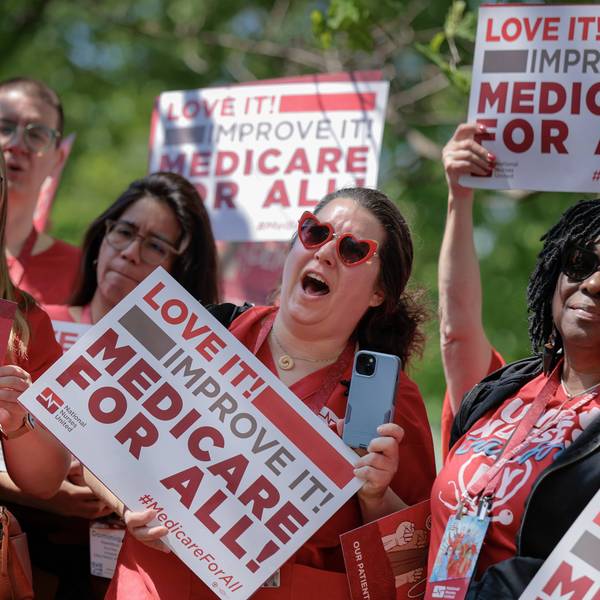
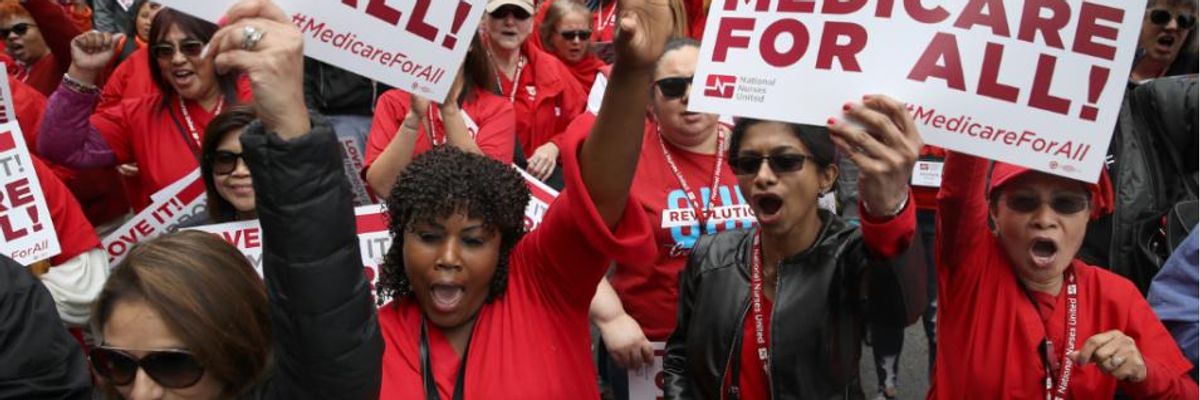
The barriers to Medicare for All, wrote Matt Bruenig of the People's Policy Project, "are not technical deficiencies or costs, but rather political opposition from Republicans and conservative Democrats who would rather spend more money to provide less health care."
'Seems Like a Good Policy!' CBO Shows Medicare for All Could Cover Everyone for $650 Billion Less Per Year
The analysis shows that administrative costs under a single-payer healthcare system "will be lower than what even the most rabid Medicare for All supporters have traditionally claimed."
The Congressional Budget Office on Thursday released a report examining the costs associated with universal healthcare proposals based on Medicare's fee-for-service program. The report found that implementing a single-payer health insurance program in the United States would not only guarantee coverage for every person in the country but also reduce overall healthcare spending nationwide.
"A large share of Medicare administrative costs are tied up in tasks like eligibility determination... that would no longer exist in a Medicare for All system."
--Matt Bruenig, People's Policy Project
In the words of researcher Matt Bruenig--founder and president of the progressive think tank People's Policy Project who called the CBO's working paper (pdf) on the topic "more exhaustive than any other recent study on the subject"--the new analysis shows that administrative costs under a single-payer healthcare system "will be lower than what even the most rabid Medicare for All supporters have traditionally claimed."
Bruenig states, "Modeling the cost of a single-payer program is relatively straightforward. You begin with the status quo healthcare system and then make educated guesses about the following questions:
- How many more units of healthcare services will be demanded and supplied when price barriers are removed?
- How much more efficient will health insurance administration be after the enrollment and payment systems are radically simplified?
- How much money will be saved by reducing the payment rates for healthcare providers and drug companies?"
In its analysis, the CBO looked at several distinct single-payer designs and determined that four such systems--fully implemented by 2030--would save anywhere from $42 billion to $743 billion that year alone.
"Never let a politician ask: 'How will we pay for it?'" tweeted Democratic Socialists of America for Medicare for All.
Bruenig explained that the CBO option that most closely resembles current Medicare for All proposals is the one based on low payment rates and low-cost sharing, which would generate $650 billion in savings in 2030.
He noted that if long-term support and services were added to that option, as many current Medicare for All proposals do, savings would fall to about $300 billion.
What Bruenig found most noteworthy is the CBO's findings on administrative costs:
Medicare for All advocates have historically pointed towards the 2% administrative costs of traditional Medicare as what we should expect in a Medicare for All system. Critics of this view have typically argued, among other things, that Medicare's low administrative costs are a mirage driven by the fact that their per-enrollee administrative costs are being divided by disproportionately large per-enrollee healthcare utilization.
This rebuttal never really made any sense. Private Medicare Advantage plans have a similarly sick and elderly enrollment population, but manage to spend a whopping 13.7% of their revenue on administrative expenses. The CBO's analysis, which starts with the current Medicare administrative costs and then determines how each element of those costs would go up or down in a single-payer system, seems to put this claim to bed once and for all.
Indeed, the CBO finds that the current Medicare administrative costs that are often touted by advocates are actually higher than the administrative costs you would expect in a single-payer system because a large share of those costs are tied up in tasks like eligibility determination and collection of Medicare Part B premiums that would no longer exist in a Medicare for All system.
What this means, Bruenig said, is that other studies estimating the effects of a single-payer system on administrative costs are "missing hundreds of billions of dollars of savings per year."
"Overall," he continued, "the study confirms what serious Medicare for All analysts have known for some time now: It is possible to provide high-quality public health insurance to every person in the country while also saving money overall on health spending."
Bruenig added that "the barriers to the policy are not technical deficiencies or costs, but rather political opposition from Republicans and conservative Democrats who would rather spend more money to provide less healthcare."
We are at a crossroads
This country and this world are at a monumental crossroads. In a few short weeks, US voters will have an opportunity to beat back the forces of fascism and confront the billionaires who are rigging the economy, our media system, and our democracy, making it increasingly impossible for ordinary people to get by. We’re not just talking about the election. We’re talking about what must be done once these fascist elements are vanquished from power. We need a bolder set of solutions than what either major party has so far been willing to offer and a working-class movement ready to fight like hell for it. Trump didn't emerge from nowhere. The conditions that fueled MAGA authoritarianism were created by decades of radical neoliberal economic policies and a corrupt political system dominated by corporate interests. They slashed taxes on the super-rich, promising that the benefits would trickle down. They said giveaways to the corporate titans would make life more affordable for the rest of us. It was all bullshit. And when a bitter, betrayed populace searches for someone to blame, right-wing demagogues have little trouble finding scapegoats. People know when they're being lied to, but you won't hear any of this from the corporate media. Only independent journalism—powered and funded by people who believe in building a better world—can deliver truly trustworthy daily news. Our Fall Campaign is underway, and we need your help. To power our newsroom through the rest of the year, we need to raise $125,000 by midnight on October 31. So if you share our vision, please contribute whatever you can to sustain our work. |
The Congressional Budget Office on Thursday released a report examining the costs associated with universal healthcare proposals based on Medicare's fee-for-service program. The report found that implementing a single-payer health insurance program in the United States would not only guarantee coverage for every person in the country but also reduce overall healthcare spending nationwide.
"A large share of Medicare administrative costs are tied up in tasks like eligibility determination... that would no longer exist in a Medicare for All system."
--Matt Bruenig, People's Policy Project
In the words of researcher Matt Bruenig--founder and president of the progressive think tank People's Policy Project who called the CBO's working paper (pdf) on the topic "more exhaustive than any other recent study on the subject"--the new analysis shows that administrative costs under a single-payer healthcare system "will be lower than what even the most rabid Medicare for All supporters have traditionally claimed."
Bruenig states, "Modeling the cost of a single-payer program is relatively straightforward. You begin with the status quo healthcare system and then make educated guesses about the following questions:
- How many more units of healthcare services will be demanded and supplied when price barriers are removed?
- How much more efficient will health insurance administration be after the enrollment and payment systems are radically simplified?
- How much money will be saved by reducing the payment rates for healthcare providers and drug companies?"
In its analysis, the CBO looked at several distinct single-payer designs and determined that four such systems--fully implemented by 2030--would save anywhere from $42 billion to $743 billion that year alone.
"Never let a politician ask: 'How will we pay for it?'" tweeted Democratic Socialists of America for Medicare for All.
Bruenig explained that the CBO option that most closely resembles current Medicare for All proposals is the one based on low payment rates and low-cost sharing, which would generate $650 billion in savings in 2030.
He noted that if long-term support and services were added to that option, as many current Medicare for All proposals do, savings would fall to about $300 billion.
What Bruenig found most noteworthy is the CBO's findings on administrative costs:
Medicare for All advocates have historically pointed towards the 2% administrative costs of traditional Medicare as what we should expect in a Medicare for All system. Critics of this view have typically argued, among other things, that Medicare's low administrative costs are a mirage driven by the fact that their per-enrollee administrative costs are being divided by disproportionately large per-enrollee healthcare utilization.
This rebuttal never really made any sense. Private Medicare Advantage plans have a similarly sick and elderly enrollment population, but manage to spend a whopping 13.7% of their revenue on administrative expenses. The CBO's analysis, which starts with the current Medicare administrative costs and then determines how each element of those costs would go up or down in a single-payer system, seems to put this claim to bed once and for all.
Indeed, the CBO finds that the current Medicare administrative costs that are often touted by advocates are actually higher than the administrative costs you would expect in a single-payer system because a large share of those costs are tied up in tasks like eligibility determination and collection of Medicare Part B premiums that would no longer exist in a Medicare for All system.
What this means, Bruenig said, is that other studies estimating the effects of a single-payer system on administrative costs are "missing hundreds of billions of dollars of savings per year."
"Overall," he continued, "the study confirms what serious Medicare for All analysts have known for some time now: It is possible to provide high-quality public health insurance to every person in the country while also saving money overall on health spending."
Bruenig added that "the barriers to the policy are not technical deficiencies or costs, but rather political opposition from Republicans and conservative Democrats who would rather spend more money to provide less healthcare."