

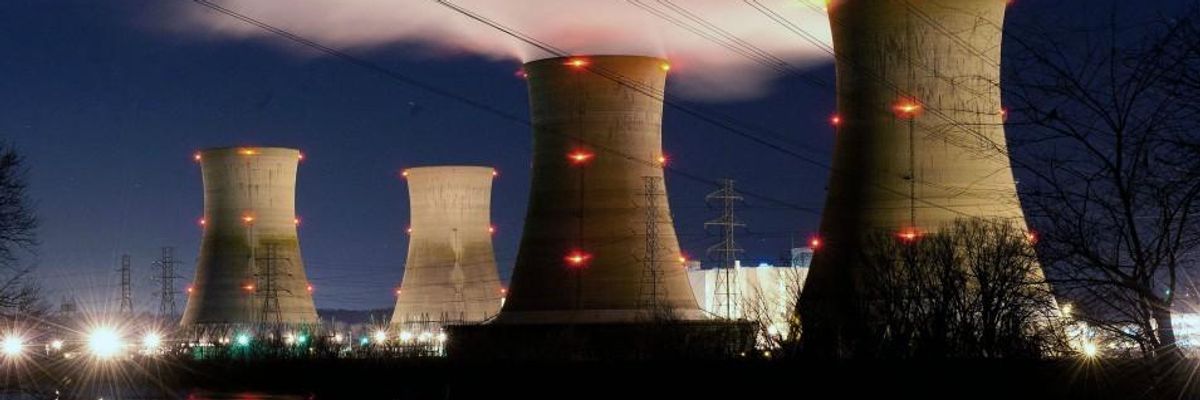
The Three Mile Island Nuclear Plant is seen in the early morning hours March 28, 2011 in Middletown, Pennsylvania. (Photo: Jeff Fusco/Getty Images)
'Dead-End for Climate': Coalition Denounces Senate Bill to Fund Nuclear Industry Bailout
"Instead of propping up the nuclear energy industry, Congress should be driving the transition to truly renewable energy.”
A coalition of over 100 groups on Tuesday told U.S. senators that nuclear power is a false solution to the climate crisis as they urged lawmakers to reject proposed legislation that would "put short-sighted economic interests ahead of human lives, racial justice, the health of our environment, and safe drinking water."
"This bill misdirects our investment away from technologies that will speed the deployment of renewables and into an industry that is already being propped up by rate-payer subsidies."
--Mitch Jones, Food & Water WatchThe measure in question is the American Nuclear Infrastructure Act of 2020. Introduced in November by Sen. John Barrasso (R-Wyo.) along with Sens. Sheldon Whitehouse (D-R.I.), Mike Crapo (R-Idaho), and Cory Booker (D-N.J.), the legislation seeks to "eestablish United States global leadership in nuclear energy, revitalize domestic nuclear energy supply chain infrastructure, support the licensing of advanced nuclear technologies, and improve the regulation of nuclear energy, and for other purposes."
The proposed legislation, S. 4897, advanced at a Senate Environment and Public Works hearing Wednesday.
According to Mitch Jones, policy director at Food & Water Watch, "This bill misdirects our investment away from technologies that will speed the deployment of renewables and into an industry that is already being propped up by rate-payer subsidies"
"Instead of propping up the nuclear energy industry," Jones continued, "Congress should be driving the transition to truly renewable energy."
Food & Water Watch is among the signatories to the new letter that outlines the groups' opposition to S. 4897, including that it fails to address multiple long-standing problems with nuclear technology and stands to worsen already existing crises.
The letter cites as one example the mandate for the establishment of a national uranium reserve, which means more uranium mining. But the groups say the legislation would not require mitigation of the environmental harms of uranium mining, and, while "the bill does restrict procurement of uranium for the reserve from mines that are not located on Indigenous peoples' lands, it does not prohibit mining on those lands entirely."
"Neither does the bill prohibit procurement of uranium for the reserve quota from mines and mills that impact other environmental justice communities," the letter says.
The letter further notes that there are already 15,000 abandoned uranium mines--a situation the groups declare a "national crisis"--and while legislation includes $1 billion for cleanup on Indigenous land, that amount doesn't adequately match the scale of the problem.
"We need to invest in a transition to efficient, renewable, clean energy technologies that can scale up as rapidly as possible, as affordably as possible, to reduce emissions as aggressively as possible. Nuclear energy does not meet any of these criteria," the letter adds, pointing to the fact that there have been dozens of canceled or shelved new nuclear reactors over the past several decades.
The groups also said the legislation's "provisions to curtail environmental and licensing reviews are short-sighted, reducing up-front costs while short-circuiting democratic protections against nuclear safety and environmental impacts. "
The directive for the Treasury to give an economic lifeline to reactors also came in for criticism, as taxpayers could be "fleeced to pay uneconomical subsidies when cheaper alternatives and more strategic investments are available."
Additional problems are that S. 4897 would contribute to nuclear weapons proliferation "by commercializing technologies for higher-grade enrichment and plutonium processing" and amplify nuclear disaster risks.
The "Nuclear Regulatory Commission (NRC) has adopted regulations making it optional--not required--to address verified vulnerabilities to flooding and earthquakes," the groups wrote, and accused the commission of having "canceled hundreds of required, scheduled safety inspections, security drills, and emergency preparedness exercises, for up to two years."
"If President-elect Biden wants to build back better, he needs to take a bailout for the decrepit nuclear industry off the table."
--Lukas Ross, Friends of the Earth"We cannot perpetuate false solutions to the climate crisis that perpetuate our reliance on dirty energy industries, and have any hope of ending the climate and environmental justice crises those industries bring about," the groups said.
Tim Judson, executive director of the Nuclear Information and Resource Service--an original signatory to the letter with Friends of the Earth (FOE)--said reasons for senators to reject the proposed measure are clear.
"Nuclear power is a dead-end for climate and environmental justice," Judson said in a statement.
"The last thing we need is for Congress to waste time and money to make those problems worse, as this bill would do," he added. "Clean, safe, affordable renewable energy solutions are here, now."
At Wednesday's committee hearing, Sen. Ed Markey (D-Mass.) said S. 4897 would be "a bad deal for the country, the climate, and our environmental injustice communities," ignores the fact that renewable sources are "supercharging our electric grid," and would enable "selling off a clean energy future."
The Democratic senator's remarks were welcomed by FOE program manager Lukas Ross, who said in a statement to Common Dreams, "We are immensely grateful to Senator Markey for standing firm against the nuclear industry's bailout demands."
Though the legislation moved forward Wednesday, Ross said that "the fight isn't over and we fully intend to keep this proposal from finding its way into future energy and infrastructure bills."
"If President-elect Biden wants to build back better," Ross added, "he needs to take a bailout for the decrepit nuclear industry off the table."
We are at a crossroads
This country and this world are at a monumental crossroads. In a few short weeks, US voters will have an opportunity to beat back the forces of fascism and confront the billionaires who are rigging the economy, our media system, and our democracy, making it increasingly impossible for ordinary people to get by. We’re not just talking about the election. We’re talking about what must be done once these fascist elements are vanquished from power. We need a bolder set of solutions than what either major party has so far been willing to offer and a working-class movement ready to fight like hell for it. Trump didn't emerge from nowhere. The conditions that fueled MAGA authoritarianism were created by decades of radical neoliberal economic policies and a corrupt political system dominated by corporate interests. They slashed taxes on the super-rich, promising that the benefits would trickle down. They said giveaways to the corporate titans would make life more affordable for the rest of us. It was all bullshit. And when a bitter, betrayed populace searches for someone to blame, right-wing demagogues have little trouble finding scapegoats. People know when they're being lied to, but you won't hear any of this from the corporate media. Only independent journalism—powered and funded by people who believe in building a better world—can deliver truly trustworthy daily news. Our Fall Campaign is underway, and we need your help. To power our newsroom through the rest of the year, we need to raise $125,000 by midnight on October 31. So if you share our vision, please contribute whatever you can to sustain our work. |
A coalition of over 100 groups on Tuesday told U.S. senators that nuclear power is a false solution to the climate crisis as they urged lawmakers to reject proposed legislation that would "put short-sighted economic interests ahead of human lives, racial justice, the health of our environment, and safe drinking water."
"This bill misdirects our investment away from technologies that will speed the deployment of renewables and into an industry that is already being propped up by rate-payer subsidies."
--Mitch Jones, Food & Water WatchThe measure in question is the American Nuclear Infrastructure Act of 2020. Introduced in November by Sen. John Barrasso (R-Wyo.) along with Sens. Sheldon Whitehouse (D-R.I.), Mike Crapo (R-Idaho), and Cory Booker (D-N.J.), the legislation seeks to "eestablish United States global leadership in nuclear energy, revitalize domestic nuclear energy supply chain infrastructure, support the licensing of advanced nuclear technologies, and improve the regulation of nuclear energy, and for other purposes."
The proposed legislation, S. 4897, advanced at a Senate Environment and Public Works hearing Wednesday.
According to Mitch Jones, policy director at Food & Water Watch, "This bill misdirects our investment away from technologies that will speed the deployment of renewables and into an industry that is already being propped up by rate-payer subsidies"
"Instead of propping up the nuclear energy industry," Jones continued, "Congress should be driving the transition to truly renewable energy."
Food & Water Watch is among the signatories to the new letter that outlines the groups' opposition to S. 4897, including that it fails to address multiple long-standing problems with nuclear technology and stands to worsen already existing crises.
The letter cites as one example the mandate for the establishment of a national uranium reserve, which means more uranium mining. But the groups say the legislation would not require mitigation of the environmental harms of uranium mining, and, while "the bill does restrict procurement of uranium for the reserve from mines that are not located on Indigenous peoples' lands, it does not prohibit mining on those lands entirely."
"Neither does the bill prohibit procurement of uranium for the reserve quota from mines and mills that impact other environmental justice communities," the letter says.
The letter further notes that there are already 15,000 abandoned uranium mines--a situation the groups declare a "national crisis"--and while legislation includes $1 billion for cleanup on Indigenous land, that amount doesn't adequately match the scale of the problem.
"We need to invest in a transition to efficient, renewable, clean energy technologies that can scale up as rapidly as possible, as affordably as possible, to reduce emissions as aggressively as possible. Nuclear energy does not meet any of these criteria," the letter adds, pointing to the fact that there have been dozens of canceled or shelved new nuclear reactors over the past several decades.
The groups also said the legislation's "provisions to curtail environmental and licensing reviews are short-sighted, reducing up-front costs while short-circuiting democratic protections against nuclear safety and environmental impacts. "
The directive for the Treasury to give an economic lifeline to reactors also came in for criticism, as taxpayers could be "fleeced to pay uneconomical subsidies when cheaper alternatives and more strategic investments are available."
Additional problems are that S. 4897 would contribute to nuclear weapons proliferation "by commercializing technologies for higher-grade enrichment and plutonium processing" and amplify nuclear disaster risks.
The "Nuclear Regulatory Commission (NRC) has adopted regulations making it optional--not required--to address verified vulnerabilities to flooding and earthquakes," the groups wrote, and accused the commission of having "canceled hundreds of required, scheduled safety inspections, security drills, and emergency preparedness exercises, for up to two years."
"If President-elect Biden wants to build back better, he needs to take a bailout for the decrepit nuclear industry off the table."
--Lukas Ross, Friends of the Earth"We cannot perpetuate false solutions to the climate crisis that perpetuate our reliance on dirty energy industries, and have any hope of ending the climate and environmental justice crises those industries bring about," the groups said.
Tim Judson, executive director of the Nuclear Information and Resource Service--an original signatory to the letter with Friends of the Earth (FOE)--said reasons for senators to reject the proposed measure are clear.
"Nuclear power is a dead-end for climate and environmental justice," Judson said in a statement.
"The last thing we need is for Congress to waste time and money to make those problems worse, as this bill would do," he added. "Clean, safe, affordable renewable energy solutions are here, now."
At Wednesday's committee hearing, Sen. Ed Markey (D-Mass.) said S. 4897 would be "a bad deal for the country, the climate, and our environmental injustice communities," ignores the fact that renewable sources are "supercharging our electric grid," and would enable "selling off a clean energy future."
The Democratic senator's remarks were welcomed by FOE program manager Lukas Ross, who said in a statement to Common Dreams, "We are immensely grateful to Senator Markey for standing firm against the nuclear industry's bailout demands."
Though the legislation moved forward Wednesday, Ross said that "the fight isn't over and we fully intend to keep this proposal from finding its way into future energy and infrastructure bills."
"If President-elect Biden wants to build back better," Ross added, "he needs to take a bailout for the decrepit nuclear industry off the table."