

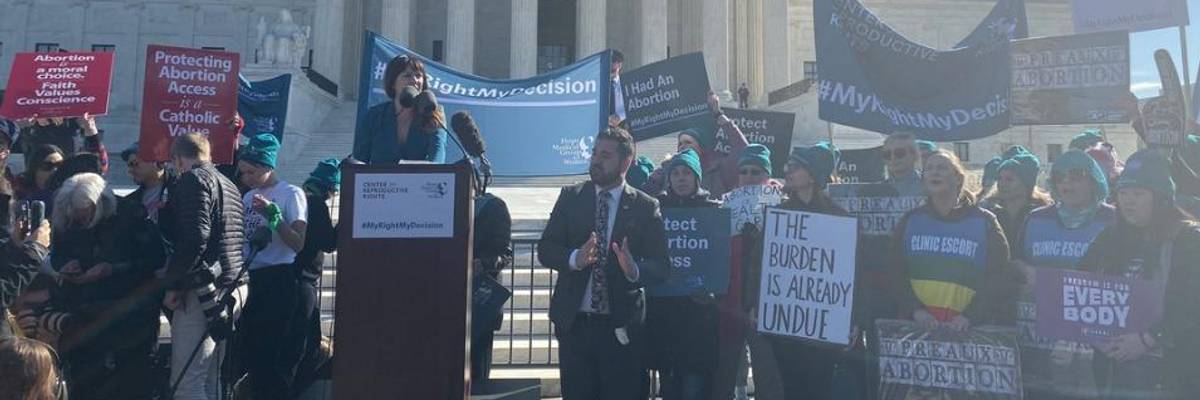
Hundreds of demonstrators assembled outside the U.S. Supreme Court Wednesday as the nine justices heard their first abortion rights case since President Donald Trump's two appointees joined the Supreme Court. (Photo: Center for Reproductive Rights/Twitter)
Pro-Choice Advocates Demand Reproductive Justice as Supreme Court Hears First Abortion Case With Trump Appointees on Bench
"We refuse to allow judges who know nothing about us and politicians who care little about us to control our reproduction."
Hundreds of demonstrators assembled on the steps of the U.S. Supreme Court Wednesday as arguments were heard in an abortion-related case for the first time since President Donald Trump's two appointees joined the court.
" Abortion rights are human rights," said Rep. Ayanna Pressley (D-Mass.) at the demonstration. "Abortion care is health care. Reproductive justice is economic justice. And reproductive justice is racial justice."
The case of June Medical Services vs. Russo centers on a question the Supreme Court answered in 2016 regarding a Texas case: whether a state can require doctors at an abortion clinic to have admitting privileges at a local hospital in order to provide abortion case.
In 2016, the court ruled that such requirements placed an "undue burden" on patients seeking abortion care and that they served no legitimate medical purpose. The Supreme Court is now hearing the June Medical Services case, involving a clinic in Louisiana, following an appeals court decision allowing the requirement--one of several TRAP (Targeted Restrictions on Abortion Providers) laws pushed by anti-choice groups.
If the court rules that the requirements can be used in Louisiana, the 2016 case regarding the Texas clinic could be overturned.
"We should not have to refight legal battles that we've already won, but states like Louisiana are in open defiance of the Constitution and the Supreme Court's rulings," said Nancy Northrup, president and CEO of the Center for Reproductive Rights, which is arguing the case. "It's alarming and unacceptable that in 2020, some states are still hell bent on denying women access to reproductive healthcare. Once again, the court must step in to block these clinic shutdown laws and ensure that the promise of Roe v. Wade is realized for all women."
At the protest, pro-choice advocates carried signs reading "Trust women" and "Women's bodies are more regulated than guns." On social media, supporters highlighted the demonstration using the hashtag #MyRightMyDecision.
Slate reported that during the justices' questioning, Louisiana Solicitor General Elizabeth Murrill was inundated with questions from the court's liberal wing "that she simply could not answer honestly without undermining her own argument."
As Mark Joseph Stern wrote, Justice Ruth Bader Ginsburg asked Murrill why doctors would need admitting privileges at a nearby hospital considering most women undergo medical, rather than surgical, abortions at home after visiting the clinic, or return home shortly after receiving care:
"If the woman has a problem," Ginsburg said, "it will be her local hospital that she will need to go to for the care, not something 30 miles from the clinic." Murrill claimed that the 30-mile limit ensures "continuity of care." But, as Justice Sonia Sotomayor reiterated, that is simply not true for the many patients who go home after going to the clinic.
Attorneys for the Center for Reproductive Rights told BuzzFeed News they were "cautiously optimistic" about the case.
"We have always argued the case that there should be a broad majority on the court to recognize that there is no difference between this case and the case the Supreme Court decided only four years ago, and it seems like that's true," attorney T.J. Tu told BuzzFeed.
We are at a crossroads
This country and this world are at a monumental crossroads. In a few short weeks, US voters will have an opportunity to beat back the forces of fascism and confront the billionaires who are rigging the economy, our media system, and our democracy, making it increasingly impossible for ordinary people to get by. We’re not just talking about the election. We’re talking about what must be done once these fascist elements are vanquished from power. We need a bolder set of solutions than what either major party has so far been willing to offer and a working-class movement ready to fight like hell for it. Trump didn't emerge from nowhere. The conditions that fueled MAGA authoritarianism were created by decades of radical neoliberal economic policies and a corrupt political system dominated by corporate interests. They slashed taxes on the super-rich, promising that the benefits would trickle down. They said giveaways to the corporate titans would make life more affordable for the rest of us. It was all bullshit. And when a bitter, betrayed populace searches for someone to blame, right-wing demagogues have little trouble finding scapegoats. People know when they're being lied to, but you won't hear any of this from the corporate media. Only independent journalism—powered and funded by people who believe in building a better world—can deliver truly trustworthy daily news. Our Fall Campaign is underway, and we need your help. To power our newsroom through the rest of the year, we need to raise $125,000 by midnight on October 31. So if you share our vision, please contribute whatever you can to sustain our work. |
Hundreds of demonstrators assembled on the steps of the U.S. Supreme Court Wednesday as arguments were heard in an abortion-related case for the first time since President Donald Trump's two appointees joined the court.
" Abortion rights are human rights," said Rep. Ayanna Pressley (D-Mass.) at the demonstration. "Abortion care is health care. Reproductive justice is economic justice. And reproductive justice is racial justice."
The case of June Medical Services vs. Russo centers on a question the Supreme Court answered in 2016 regarding a Texas case: whether a state can require doctors at an abortion clinic to have admitting privileges at a local hospital in order to provide abortion case.
In 2016, the court ruled that such requirements placed an "undue burden" on patients seeking abortion care and that they served no legitimate medical purpose. The Supreme Court is now hearing the June Medical Services case, involving a clinic in Louisiana, following an appeals court decision allowing the requirement--one of several TRAP (Targeted Restrictions on Abortion Providers) laws pushed by anti-choice groups.
If the court rules that the requirements can be used in Louisiana, the 2016 case regarding the Texas clinic could be overturned.
"We should not have to refight legal battles that we've already won, but states like Louisiana are in open defiance of the Constitution and the Supreme Court's rulings," said Nancy Northrup, president and CEO of the Center for Reproductive Rights, which is arguing the case. "It's alarming and unacceptable that in 2020, some states are still hell bent on denying women access to reproductive healthcare. Once again, the court must step in to block these clinic shutdown laws and ensure that the promise of Roe v. Wade is realized for all women."
At the protest, pro-choice advocates carried signs reading "Trust women" and "Women's bodies are more regulated than guns." On social media, supporters highlighted the demonstration using the hashtag #MyRightMyDecision.
Slate reported that during the justices' questioning, Louisiana Solicitor General Elizabeth Murrill was inundated with questions from the court's liberal wing "that she simply could not answer honestly without undermining her own argument."
As Mark Joseph Stern wrote, Justice Ruth Bader Ginsburg asked Murrill why doctors would need admitting privileges at a nearby hospital considering most women undergo medical, rather than surgical, abortions at home after visiting the clinic, or return home shortly after receiving care:
"If the woman has a problem," Ginsburg said, "it will be her local hospital that she will need to go to for the care, not something 30 miles from the clinic." Murrill claimed that the 30-mile limit ensures "continuity of care." But, as Justice Sonia Sotomayor reiterated, that is simply not true for the many patients who go home after going to the clinic.
Attorneys for the Center for Reproductive Rights told BuzzFeed News they were "cautiously optimistic" about the case.
"We have always argued the case that there should be a broad majority on the court to recognize that there is no difference between this case and the case the Supreme Court decided only four years ago, and it seems like that's true," attorney T.J. Tu told BuzzFeed.