SUBSCRIBE TO OUR FREE NEWSLETTER
Daily news & progressive opinion—funded by the people, not the corporations—delivered straight to your inbox.
5
#000000
#FFFFFF
To donate by check, phone, or other method, see our More Ways to Give page.
Daily news & progressive opinion—funded by the people, not the corporations—delivered straight to your inbox.
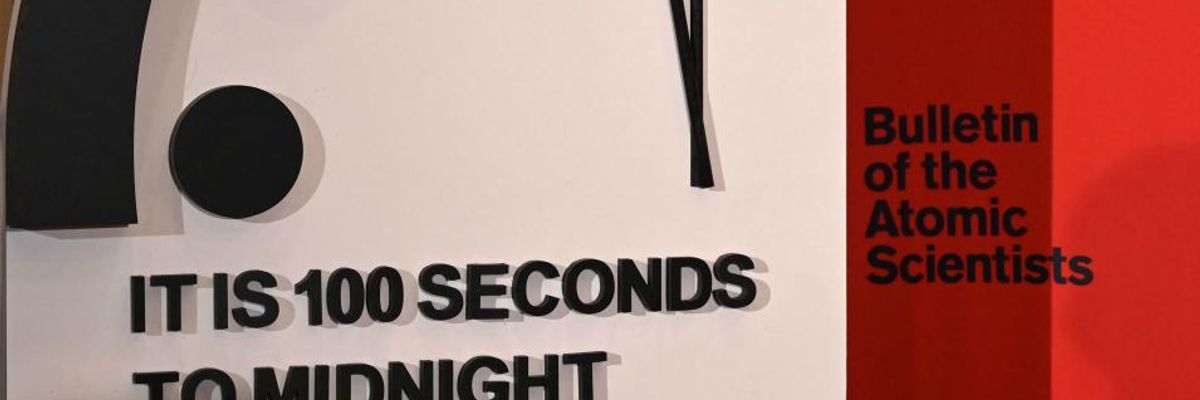
The Doomsday Clock reads 100 seconds to midnight--a decision made by the Bulletin of Atomic Scientists--during an announcement at the National Press Club in Washington, D.C. on Jan. 23, 2020. (Photo: Eva Hambach/AFP via Getty Images)
"The Doomsday Clock now stands at 100 seconds to midnight, the most dangerous situation that humanity has ever faced. Now is the time to come together--to unite and to act."
"Humanity continues to face two simultaneous existential dangers--nuclear war and climate change--that are compounded by a threat multiplier, cyber-enabled information warfare, that undercuts society's ability to respond."
--Bulletin of Atomic Scientist
So said Mary Robinson, chair of The Elders, in a statement from the Bulletin of Atomic Scientists on Thursday announcing a historic update to the clock, a decades-old symbol for potential global catastrophe.
Robinson, the former president of Ireland and United Nations high commissioner for human rights, urged world leaders "to join us in 2020 as we work to pull humanity back from the brink."
After the atomic bombings of Hiroshima and Nagasaki in 1945, the Bulletin was founded by University of Chicago scientists who had been involved with the Manhattan Project. Two years later, the group introduced the Doomsday Clock, set at seven minutes to midnight. Midnight represented potential apocalypse based on global nuclear dangers--the closer the hands are to midnight, the higher the threat.
Since 1947, the clock's hands have moved both closer to and further from midnight, reaching 17 minutes to midnight in 1991. In 2018, the hands hit two minutes to midnight for the first time since 1953, after the United States and the Soviet Union tested thermonuclear weapons. Last year, the clock stayed there, and Bulletin president and CEO Rachel Bronson welcomed the world to "the new abnormal."
For more than a decade, the Doomsday Clock's setting has reflected the threat posed by nuclear weaponry as well as the human-caused climate crisis. The 2020 statement explained that "humanity continues to face two simultaneous existential dangers--nuclear war and climate change--that are compounded by a threat multiplier, cyber-enabled information warfare, that undercuts society's ability to respond."
"It is 100 seconds to midnight. We are now expressing how close the world is to catastrophe in seconds--not hours, or even minutes," Bronson said Thursday. "It is the closest to Doomsday we have ever been in the history of the Doomsday Clock. We now face a true emergency--an absolutely unacceptable state of world affairs that has eliminated any margin for error or further delay."
Along with highlighting growing concerns about how "sophisticated, technology-propelled propaganda" is undermining global efforts to address the two key existential threats, this year's statement slammed world leaders for "not responding appropriately to reduce this threat level and counteract the hollowing-out of international political institutions, negotiations, and agreements that aim to contain it."
As the Bulletin put it:
Faced with this daunting threat landscape and a new willingness of political leaders to reject the negotiations and institutions that can protect civilization over the long term, the Bulletin of the Atomic Scientists Science and Security Board today moves the Doomsday Clock 20 seconds closer to midnight--closer to apocalypse than ever. In so doing, board members are explicitly warning leaders and citizens around the world that the international security situation is now more dangerous than it has ever been, even at the height of the Cold War.
Referencing "the new abnormal" introduced last year, the 2020 statement warned, "This dangerous situation remains--and continues to deteriorate." The Bulletin declared that "the need for emergency action is urgent." On the nuclear front, global leaders were urged to reinstate treaties, cut countries' arsenals, limit modernization programs, and "start talks on cyber warfare, missile defenses, the militarization of space, hypersonic technology, and the elimination of battlefield nuclear weapons."
More generally, the Bulletin called for "multilateral discussions aimed at establishing norms of behavior, both domestic and international, that discourage and penalize the misuse of science," emphasizing that "focused attention is needed to prevent information technology from undermining public trust in political institutions, in the media, and in the existence of objective reality itself."
In terms of climate action, the Bulletin urged all countries remain committed to the landmark 2015 Paris agreement. The statement noted that meeting the goals of that accord will require industrialized countries "to curb emissions rapidly, going beyond their initial, inadequate pledges and supporting developing countries so they can leapfrog the entrenched, fossil fuel-intensive patterns."
While the Bulletin broadly encouraged citizens across the globe to pressure their governments to pursue bold policies to avert climate catastrophe, it drew specific attention to the United States, pointing out that in November 2019, President Donald Trump fulfilled his longtime promise to begin the lengthy process of withdrawing the U.S. from the Paris agreement.
During a press conference in Washington, D.C. to announce the Doomsday Clock update Thursday, former U.N. Secretary-General Ban Ki-moon expressed disappointment in global leaders for failing to address these two crises. Ban, now deputy chair of The Elders, warned of the dangers of isolationist policies but also framed the clock's shift as an opportunity for policymakers worldwide to recommit to multilateralism.
Jerry Brown, the current executive chair of the Bulletin, also spoke at the press conference Thursday. He criticized Trump for delivering a speech--at the World Economic Forum's summit for the global elite in Davos, Switzerland--that called for rejecting "alarmists" and "perennial prophets of doom," along with their "predictions of the apocalypse."
Brown, a former Democratic governor of California, also said that U.S. politicians from both major parties have not adequately worked to combat the nuclear and climate threats, and decried "vast, deep, and pervasive complacency" on a societal level.
After summarizing the Bulletin's warnings in a statement Thursday, Brown concluded: "If there's ever a time to wake up, it's now."
This country and this world are at a monumental crossroads. US voters have an opportunity to beat back the forces of fascism and confront the billionaires who are rigging the economy, our media system, and our democracy, making it increasingly impossible for ordinary people to get by. We’re not just talking about the election. We’re talking about what must be done once these fascist elements are vanquished from power. We need a bolder set of solutions than what either major party has so far been willing to offer and a working-class movement ready to fight like hell for it. Trump didn't emerge from nowhere. The conditions that fueled MAGA authoritarianism were created by decades of radical neoliberal economic policies and a corrupt political system dominated by corporate interests. They slashed taxes on the super-rich, promising that the benefits would trickle down. They said giveaways to the corporate titans would make life more affordable for the rest of us. It was all bullshit. And when a bitter, betrayed populace searches for someone to blame, right-wing demagogues have little trouble finding scapegoats. People know when they're being lied to, but you won't hear any of this from the corporate media. Only independent journalism—powered and funded by people who believe in building a better world—can deliver truly trustworthy daily news. If you share our vision, please contribute whatever you can to sustain our work. |
"The Doomsday Clock now stands at 100 seconds to midnight, the most dangerous situation that humanity has ever faced. Now is the time to come together--to unite and to act."
"Humanity continues to face two simultaneous existential dangers--nuclear war and climate change--that are compounded by a threat multiplier, cyber-enabled information warfare, that undercuts society's ability to respond."
--Bulletin of Atomic Scientist
So said Mary Robinson, chair of The Elders, in a statement from the Bulletin of Atomic Scientists on Thursday announcing a historic update to the clock, a decades-old symbol for potential global catastrophe.
Robinson, the former president of Ireland and United Nations high commissioner for human rights, urged world leaders "to join us in 2020 as we work to pull humanity back from the brink."
After the atomic bombings of Hiroshima and Nagasaki in 1945, the Bulletin was founded by University of Chicago scientists who had been involved with the Manhattan Project. Two years later, the group introduced the Doomsday Clock, set at seven minutes to midnight. Midnight represented potential apocalypse based on global nuclear dangers--the closer the hands are to midnight, the higher the threat.
Since 1947, the clock's hands have moved both closer to and further from midnight, reaching 17 minutes to midnight in 1991. In 2018, the hands hit two minutes to midnight for the first time since 1953, after the United States and the Soviet Union tested thermonuclear weapons. Last year, the clock stayed there, and Bulletin president and CEO Rachel Bronson welcomed the world to "the new abnormal."
For more than a decade, the Doomsday Clock's setting has reflected the threat posed by nuclear weaponry as well as the human-caused climate crisis. The 2020 statement explained that "humanity continues to face two simultaneous existential dangers--nuclear war and climate change--that are compounded by a threat multiplier, cyber-enabled information warfare, that undercuts society's ability to respond."
"It is 100 seconds to midnight. We are now expressing how close the world is to catastrophe in seconds--not hours, or even minutes," Bronson said Thursday. "It is the closest to Doomsday we have ever been in the history of the Doomsday Clock. We now face a true emergency--an absolutely unacceptable state of world affairs that has eliminated any margin for error or further delay."
Along with highlighting growing concerns about how "sophisticated, technology-propelled propaganda" is undermining global efforts to address the two key existential threats, this year's statement slammed world leaders for "not responding appropriately to reduce this threat level and counteract the hollowing-out of international political institutions, negotiations, and agreements that aim to contain it."
As the Bulletin put it:
Faced with this daunting threat landscape and a new willingness of political leaders to reject the negotiations and institutions that can protect civilization over the long term, the Bulletin of the Atomic Scientists Science and Security Board today moves the Doomsday Clock 20 seconds closer to midnight--closer to apocalypse than ever. In so doing, board members are explicitly warning leaders and citizens around the world that the international security situation is now more dangerous than it has ever been, even at the height of the Cold War.
Referencing "the new abnormal" introduced last year, the 2020 statement warned, "This dangerous situation remains--and continues to deteriorate." The Bulletin declared that "the need for emergency action is urgent." On the nuclear front, global leaders were urged to reinstate treaties, cut countries' arsenals, limit modernization programs, and "start talks on cyber warfare, missile defenses, the militarization of space, hypersonic technology, and the elimination of battlefield nuclear weapons."
More generally, the Bulletin called for "multilateral discussions aimed at establishing norms of behavior, both domestic and international, that discourage and penalize the misuse of science," emphasizing that "focused attention is needed to prevent information technology from undermining public trust in political institutions, in the media, and in the existence of objective reality itself."
In terms of climate action, the Bulletin urged all countries remain committed to the landmark 2015 Paris agreement. The statement noted that meeting the goals of that accord will require industrialized countries "to curb emissions rapidly, going beyond their initial, inadequate pledges and supporting developing countries so they can leapfrog the entrenched, fossil fuel-intensive patterns."
While the Bulletin broadly encouraged citizens across the globe to pressure their governments to pursue bold policies to avert climate catastrophe, it drew specific attention to the United States, pointing out that in November 2019, President Donald Trump fulfilled his longtime promise to begin the lengthy process of withdrawing the U.S. from the Paris agreement.
During a press conference in Washington, D.C. to announce the Doomsday Clock update Thursday, former U.N. Secretary-General Ban Ki-moon expressed disappointment in global leaders for failing to address these two crises. Ban, now deputy chair of The Elders, warned of the dangers of isolationist policies but also framed the clock's shift as an opportunity for policymakers worldwide to recommit to multilateralism.
Jerry Brown, the current executive chair of the Bulletin, also spoke at the press conference Thursday. He criticized Trump for delivering a speech--at the World Economic Forum's summit for the global elite in Davos, Switzerland--that called for rejecting "alarmists" and "perennial prophets of doom," along with their "predictions of the apocalypse."
Brown, a former Democratic governor of California, also said that U.S. politicians from both major parties have not adequately worked to combat the nuclear and climate threats, and decried "vast, deep, and pervasive complacency" on a societal level.
After summarizing the Bulletin's warnings in a statement Thursday, Brown concluded: "If there's ever a time to wake up, it's now."