SUBSCRIBE TO OUR FREE NEWSLETTER
Daily news & progressive opinion—funded by the people, not the corporations—delivered straight to your inbox.
5
#000000
#FFFFFF
To donate by check, phone, or other method, see our More Ways to Give page.
Daily news & progressive opinion—funded by the people, not the corporations—delivered straight to your inbox.
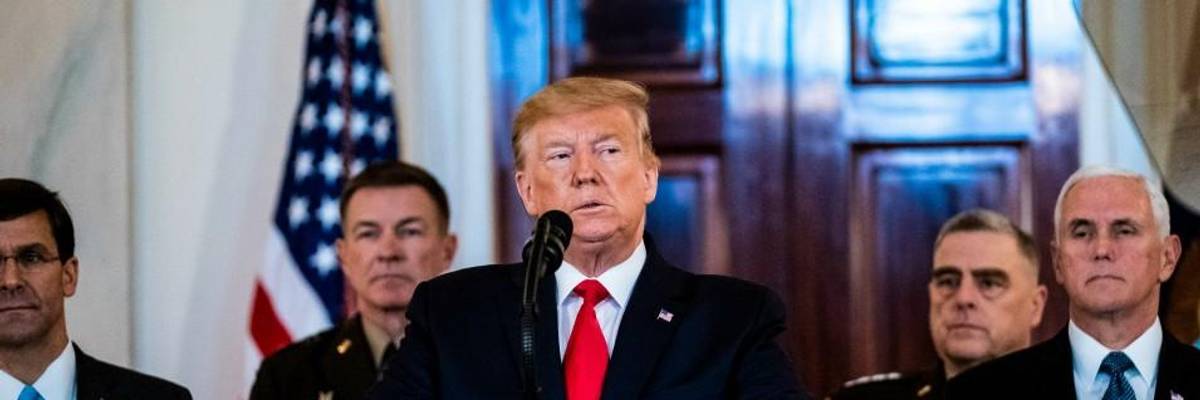
President Donald Trump address to the nation from the Grand Foyer at the White House on Wednesday, January 8, 2020 in Washington, D.C. (Photo: Jabin Botsford/The Washington Post via Getty Images)
The Trump administration reportedly tried and failed to assassinate a senior Iranian military official in Yemen on the same day it killed Gen. Qasem Soleimani with a drone strike in Baghdad last week, nearly sparking a full-blown regional war.
The Washington Post reported Friday that U.S. forces carried out a "top secret mission" targeting Abdul Reza Shahlai, a high-level commander of Iran's Quds Force. According to the Post, the U.S. launched a strike against Shahlai in Yemen but it was unsuccessful for unknown reasons.
According to the Post:
The Trump administration views Shahlai as a particularly potent adversary.
The State Department offered a $15 million reward last month for information leading to Shahlai and the disruption of [the Islamic Revolutionary Guard Corps'] financial mechanisms. The announcement said that Shahlai is based in Yemen and has a "long history of involvement in attacks targeting the U.S. and our allies, including in the 2011 plot against the Saudi ambassador" at an Italian restaurant in Washington.
Critics said the Post reporting undermines the Trump administration's claim that it assassinated Soleimani due to an "imminent threat" to American interests--and indicates the general's killing was part of what was meant to be a far more sweeping effort to damage the Islamic Revolutionary Guard Corps (IRGC).
"This suggests a mission with a longer planning horizon and a larger objective, and it really does call into question why there was an attempt to explain this publicly on the basis of an imminent threat," Suzanne Maloney, an Iran scholar at the Brookings Institution think tank, told the Post.
The Post reported that the strikes on Soleimani and Shahlai were approved at around the same time but the latter was not disclosed because "it did not go according to plan." One senior official told the Post that Shahlai "may be targeted in the future."
"If we had killed him, we'd be bragging about it that same night," another official told the Post, referring to the night the U.S. assassinated Soleimani.
News of an attempted second U.S. strike comes after legal experts and members of Congress condemned the assassination of Soleimani as a violation of both U.S. and international law. On Thursday night, the House of Representatives passed a War Powers Resolution aimed at barring Trump from taking military action against Iran without congressional approval.
"Congress has not authorized military action against Iran," Matt Duss, foreign policy adviser for Sen. Bernie Sanders (I-Vt.), tweeted in response to the Post story. "This is a completely lawless president."
Rep. Ro Khanna (D-Calif.), a vocal critic of the Trump administration's hawkish Iran policies, said "Congress needs answers" to serious questions raised by the new reporting.
"What was the full extent of the Trump administration's plans to kill Iranian officials?" Khanna tweeted. "How does the attempted killing in Yemen have anything to do with an imminent threat?"
This country and this world are at a monumental crossroads. US voters have an opportunity to beat back the forces of fascism and confront the billionaires who are rigging the economy, our media system, and our democracy, making it increasingly impossible for ordinary people to get by. We’re not just talking about the election. We’re talking about what must be done once these fascist elements are vanquished from power. We need a bolder set of solutions than what either major party has so far been willing to offer and a working-class movement ready to fight like hell for it. Trump didn't emerge from nowhere. The conditions that fueled MAGA authoritarianism were created by decades of radical neoliberal economic policies and a corrupt political system dominated by corporate interests. They slashed taxes on the super-rich, promising that the benefits would trickle down. They said giveaways to the corporate titans would make life more affordable for the rest of us. It was all bullshit. And when a bitter, betrayed populace searches for someone to blame, right-wing demagogues have little trouble finding scapegoats. People know when they're being lied to, but you won't hear any of this from the corporate media. Only independent journalism—powered and funded by people who believe in building a better world—can deliver truly trustworthy daily news. If you share our vision, please contribute whatever you can to sustain our work. |
The Trump administration reportedly tried and failed to assassinate a senior Iranian military official in Yemen on the same day it killed Gen. Qasem Soleimani with a drone strike in Baghdad last week, nearly sparking a full-blown regional war.
The Washington Post reported Friday that U.S. forces carried out a "top secret mission" targeting Abdul Reza Shahlai, a high-level commander of Iran's Quds Force. According to the Post, the U.S. launched a strike against Shahlai in Yemen but it was unsuccessful for unknown reasons.
According to the Post:
The Trump administration views Shahlai as a particularly potent adversary.
The State Department offered a $15 million reward last month for information leading to Shahlai and the disruption of [the Islamic Revolutionary Guard Corps'] financial mechanisms. The announcement said that Shahlai is based in Yemen and has a "long history of involvement in attacks targeting the U.S. and our allies, including in the 2011 plot against the Saudi ambassador" at an Italian restaurant in Washington.
Critics said the Post reporting undermines the Trump administration's claim that it assassinated Soleimani due to an "imminent threat" to American interests--and indicates the general's killing was part of what was meant to be a far more sweeping effort to damage the Islamic Revolutionary Guard Corps (IRGC).
"This suggests a mission with a longer planning horizon and a larger objective, and it really does call into question why there was an attempt to explain this publicly on the basis of an imminent threat," Suzanne Maloney, an Iran scholar at the Brookings Institution think tank, told the Post.
The Post reported that the strikes on Soleimani and Shahlai were approved at around the same time but the latter was not disclosed because "it did not go according to plan." One senior official told the Post that Shahlai "may be targeted in the future."
"If we had killed him, we'd be bragging about it that same night," another official told the Post, referring to the night the U.S. assassinated Soleimani.
News of an attempted second U.S. strike comes after legal experts and members of Congress condemned the assassination of Soleimani as a violation of both U.S. and international law. On Thursday night, the House of Representatives passed a War Powers Resolution aimed at barring Trump from taking military action against Iran without congressional approval.
"Congress has not authorized military action against Iran," Matt Duss, foreign policy adviser for Sen. Bernie Sanders (I-Vt.), tweeted in response to the Post story. "This is a completely lawless president."
Rep. Ro Khanna (D-Calif.), a vocal critic of the Trump administration's hawkish Iran policies, said "Congress needs answers" to serious questions raised by the new reporting.
"What was the full extent of the Trump administration's plans to kill Iranian officials?" Khanna tweeted. "How does the attempted killing in Yemen have anything to do with an imminent threat?"