SUBSCRIBE TO OUR FREE NEWSLETTER
Daily news & progressive opinion—funded by the people, not the corporations—delivered straight to your inbox.
5
#000000
#FFFFFF
To donate by check, phone, or other method, see our More Ways to Give page.
Daily news & progressive opinion—funded by the people, not the corporations—delivered straight to your inbox.
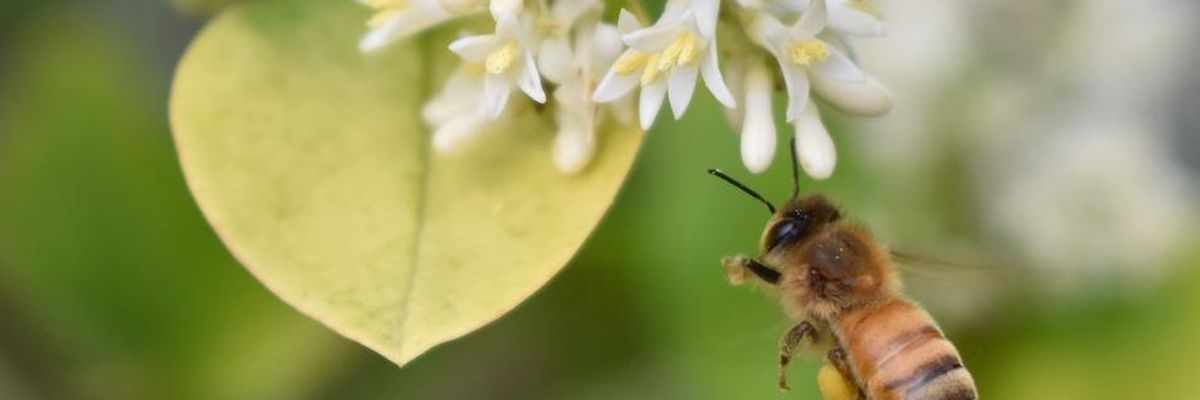
Honeybees, essential pollinators, are under threat due to a new Trump administration rule allowing widespread use of a dangerous pesticide. (Photo: OlinE/pixabay)
A pair of environmental groups on Tuesday filed suit against the President Donald Trump administration over the Environmental Protection Agency's recent approval of expanded use of the bee-killing pesticide sulfoxaflor across 200 million acres in 12 states.
The Center for Food Safety and the Center for Biological Diversity filed the suit (pdf) in the U.S. Ninth Circuit Court of Appeals against the EPA and agency administrator Andrew Wheeler.
In a statement, George Kimbrell, legal director at the Center for Food Safety, said the decision to allow the pesticide was "pure pro-pesticide politics."
"Trump's EPA can't justify throwing our already imperiled pollinators under the bus," said Kimbrell. "That's why the agency offered no chance for the public or independent researchers to comment. And that's why we're suing them."
According to a press release announcing the litigation:
Today's lawsuit, filed in the 9th Circuit Court of Appeals, contends that before approving the sweeping new uses of sulfoxaflor, the EPA failed in its legal duty to compile "substantial evidence" required under the Federal Insecticide, Fungicide, and Rodenticide Act. FIFRA, as it's known, is the federal law underpinning the U.S. system of pesticide regulation, designed to protect applicators, consumers, and the environment.
The EPA also violated its duty to ensure that its approval of sulfoxaflor doesn't jeopardize the continued existence of endangered species by consulting on the effects of its actions with wildlife experts at the U.S. Fish and Wildlife Service and National Marine Fisheries Service.
....
Under the new approval, sulfoxaflor can be used on alfalfa, cacao, corn, cotton, grains, pineapple, sorghum, soybeans, and strawberries as well as on tree plantations, ornamental crops, and citrus orchards.
As Common Dreams reported on July 8, the EPA made the decision to allow use of the pesticide on June 20 and the Trump administration followed up in early July by announcing a halt on the collection of data on declining honey bee populations.
The consequences of such a move could be disastrous for the environment. Bees are important pollinators, and their population has declined in recent years.
According to reporting from HuffPost:
The number of honey bee hives, vital to pollinating crops for the agricultural industry and other plants for wildlife, plummeted from 6 million in 1947 to 2.4 million in 2008. The worst honeybee hive loss on record occurred last winter as beekeepers reported a 40% loss of their colonies over the year.
In Brazil, as Common Dreams reported earlier Tuesday, use of pesticides has led to the deaths of at least half a billion bees.
Lori Ann Burd, the director of the environmental health program at the Center for Biological Diversity, said in a statement that the approval of the pesticide was a terrible mistake, "even for Trump's EPA."
"While leading scientists and countries across the globe are calling for eliminating harmful neonicotinoid pesticides like sulfoxaflor, Team Trump is cheerfully promoting its use like a corporate PR firm," said Burd. "It's nauseating."
Dear Common Dreams reader, It’s been nearly 30 years since I co-founded Common Dreams with my late wife, Lina Newhouser. We had the radical notion that journalism should serve the public good, not corporate profits. It was clear to us from the outset what it would take to build such a project. No paid advertisements. No corporate sponsors. No millionaire publisher telling us what to think or do. Many people said we wouldn't last a year, but we proved those doubters wrong. Together with a tremendous team of journalists and dedicated staff, we built an independent media outlet free from the constraints of profits and corporate control. Our mission has always been simple: To inform. To inspire. To ignite change for the common good. Building Common Dreams was not easy. Our survival was never guaranteed. When you take on the most powerful forces—Wall Street greed, fossil fuel industry destruction, Big Tech lobbyists, and uber-rich oligarchs who have spent billions upon billions rigging the economy and democracy in their favor—the only bulwark you have is supporters who believe in your work. But here’s the urgent message from me today. It's never been this bad out there. And it's never been this hard to keep us going. At the very moment Common Dreams is most needed, the threats we face are intensifying. We need your support now more than ever. We don't accept corporate advertising and never will. We don't have a paywall because we don't think people should be blocked from critical news based on their ability to pay. Everything we do is funded by the donations of readers like you. When everyone does the little they can afford, we are strong. But if that support retreats or dries up, so do we. Will you donate now to make sure Common Dreams not only survives but thrives? —Craig Brown, Co-founder |
A pair of environmental groups on Tuesday filed suit against the President Donald Trump administration over the Environmental Protection Agency's recent approval of expanded use of the bee-killing pesticide sulfoxaflor across 200 million acres in 12 states.
The Center for Food Safety and the Center for Biological Diversity filed the suit (pdf) in the U.S. Ninth Circuit Court of Appeals against the EPA and agency administrator Andrew Wheeler.
In a statement, George Kimbrell, legal director at the Center for Food Safety, said the decision to allow the pesticide was "pure pro-pesticide politics."
"Trump's EPA can't justify throwing our already imperiled pollinators under the bus," said Kimbrell. "That's why the agency offered no chance for the public or independent researchers to comment. And that's why we're suing them."
According to a press release announcing the litigation:
Today's lawsuit, filed in the 9th Circuit Court of Appeals, contends that before approving the sweeping new uses of sulfoxaflor, the EPA failed in its legal duty to compile "substantial evidence" required under the Federal Insecticide, Fungicide, and Rodenticide Act. FIFRA, as it's known, is the federal law underpinning the U.S. system of pesticide regulation, designed to protect applicators, consumers, and the environment.
The EPA also violated its duty to ensure that its approval of sulfoxaflor doesn't jeopardize the continued existence of endangered species by consulting on the effects of its actions with wildlife experts at the U.S. Fish and Wildlife Service and National Marine Fisheries Service.
....
Under the new approval, sulfoxaflor can be used on alfalfa, cacao, corn, cotton, grains, pineapple, sorghum, soybeans, and strawberries as well as on tree plantations, ornamental crops, and citrus orchards.
As Common Dreams reported on July 8, the EPA made the decision to allow use of the pesticide on June 20 and the Trump administration followed up in early July by announcing a halt on the collection of data on declining honey bee populations.
The consequences of such a move could be disastrous for the environment. Bees are important pollinators, and their population has declined in recent years.
According to reporting from HuffPost:
The number of honey bee hives, vital to pollinating crops for the agricultural industry and other plants for wildlife, plummeted from 6 million in 1947 to 2.4 million in 2008. The worst honeybee hive loss on record occurred last winter as beekeepers reported a 40% loss of their colonies over the year.
In Brazil, as Common Dreams reported earlier Tuesday, use of pesticides has led to the deaths of at least half a billion bees.
Lori Ann Burd, the director of the environmental health program at the Center for Biological Diversity, said in a statement that the approval of the pesticide was a terrible mistake, "even for Trump's EPA."
"While leading scientists and countries across the globe are calling for eliminating harmful neonicotinoid pesticides like sulfoxaflor, Team Trump is cheerfully promoting its use like a corporate PR firm," said Burd. "It's nauseating."
A pair of environmental groups on Tuesday filed suit against the President Donald Trump administration over the Environmental Protection Agency's recent approval of expanded use of the bee-killing pesticide sulfoxaflor across 200 million acres in 12 states.
The Center for Food Safety and the Center for Biological Diversity filed the suit (pdf) in the U.S. Ninth Circuit Court of Appeals against the EPA and agency administrator Andrew Wheeler.
In a statement, George Kimbrell, legal director at the Center for Food Safety, said the decision to allow the pesticide was "pure pro-pesticide politics."
"Trump's EPA can't justify throwing our already imperiled pollinators under the bus," said Kimbrell. "That's why the agency offered no chance for the public or independent researchers to comment. And that's why we're suing them."
According to a press release announcing the litigation:
Today's lawsuit, filed in the 9th Circuit Court of Appeals, contends that before approving the sweeping new uses of sulfoxaflor, the EPA failed in its legal duty to compile "substantial evidence" required under the Federal Insecticide, Fungicide, and Rodenticide Act. FIFRA, as it's known, is the federal law underpinning the U.S. system of pesticide regulation, designed to protect applicators, consumers, and the environment.
The EPA also violated its duty to ensure that its approval of sulfoxaflor doesn't jeopardize the continued existence of endangered species by consulting on the effects of its actions with wildlife experts at the U.S. Fish and Wildlife Service and National Marine Fisheries Service.
....
Under the new approval, sulfoxaflor can be used on alfalfa, cacao, corn, cotton, grains, pineapple, sorghum, soybeans, and strawberries as well as on tree plantations, ornamental crops, and citrus orchards.
As Common Dreams reported on July 8, the EPA made the decision to allow use of the pesticide on June 20 and the Trump administration followed up in early July by announcing a halt on the collection of data on declining honey bee populations.
The consequences of such a move could be disastrous for the environment. Bees are important pollinators, and their population has declined in recent years.
According to reporting from HuffPost:
The number of honey bee hives, vital to pollinating crops for the agricultural industry and other plants for wildlife, plummeted from 6 million in 1947 to 2.4 million in 2008. The worst honeybee hive loss on record occurred last winter as beekeepers reported a 40% loss of their colonies over the year.
In Brazil, as Common Dreams reported earlier Tuesday, use of pesticides has led to the deaths of at least half a billion bees.
Lori Ann Burd, the director of the environmental health program at the Center for Biological Diversity, said in a statement that the approval of the pesticide was a terrible mistake, "even for Trump's EPA."
"While leading scientists and countries across the globe are calling for eliminating harmful neonicotinoid pesticides like sulfoxaflor, Team Trump is cheerfully promoting its use like a corporate PR firm," said Burd. "It's nauseating."