5
#000000
#FFFFFF
To donate by check, phone, or other method, see our More Ways to Give page.
Daily news & progressive opinion—funded by the people, not the corporations—delivered straight to your inbox.

Welcome to exceptional America's latest clusterfuck, wherein "the whole rust-bucket empire" is raining tech outages and other debacles and befuddled MAGA clowns and their imbecile rapist despot have no clue what broke the sky or anything else - maybe routers, switches, measles, Biden, Iran, Black people, trans people, copper wires, immigrants, the ICC, "extraordinary circumstances," or SI, aka Super Incompetence - but if you give them $50 billion they'll fix it. Or not.
Yes, Blue Wave, all good. But for now we are trapped in the apocalyptic timeline that occurs when too many racist, gullible, ill-informed dimwits elect a reality-show president who hires inept hacks who "say nice things about him on Fox News" and they all believe that whatever ensues - diarrhea lettuce, Tylenol autism, banks crashing, parking lot airports, drunken Nazis war crime-ing, pandering to dictators, and now "the week the machines quit" - is somebody else's problem. Add the advent of late-stage capitalism's newest brilliant idea - unregulated, potentially-humanity-destroying AI - and, Dr. Google reports, "The era of autonomous attacks has arrived."
First came last week's ground stop - over 6,000 flights scrapped, 10,000 delayed, 1.5 million travelers stranded, thousands stuck on runways eating pretzels for five hours - in a country that long ago took "one giant leap for mankind." After Trump got last year's big hideous bill passed and its $12.5 billion for "the most advanced air traffic control system on Earth - many decades (will) go by before this one gets obsolete" - we got a former plumber from Oklahoma with anger issues who voted against Biden's $10 billion FAA bill and a washed-up was MTV's The Real World: Boston trying to "explain" why the world's richest country's planes were all laid low.
Citing vague "extraordinary circumstances and safety," Transportation Guy Sean Duffy and Homeland Security Guy with two first names Markwayne Mullin - but no FAA guy - jabbered word salad about overloaded routers, faulty upgrades, copper wire swapped for fiber wire. They said "we're built to handle crises" and nobody was in danger but it was a miracle nobody died. They said it def wasn't the fault of their new $875 million AI system SMART overloading the old routers with data though AI is known for overloading old routers and besides the new system "isn't plugged in" - this from the wizards who named their brand new air traffic control system....Brand New Air Traffic Control System.
Duffy, in a Star Trekky outfit, declared, "This is an emergency. This is bipartisan. This is American." Also, "Trump is a builder, and he's going to deliver for the American people," a novel idea. He demanded $30 billion, then $50 billion to fix what's not yet diagnosed as cohorts spend billions on an illegal war and monstrous ballroom nobody wants. Response to why he's begging for money when his party runs everything: What network are you from? Why they're doing upgrades on a busy weekend: There will be a reevaluation of when we do the work. Could this be cyber warfare or other “nefarious” activity? "We don't believe so," but chainsaw-wielding DOGE fired everyone who looks for it so who knows.
Focusing on the important stuff, Mullin berated a reporter who used "AI" - "We call it SI around here" - before adding it wasn't an "SI attack," which is not a thing. He and Duffy contradicted each other, spilling the beans on what experts warn are the dangers of rushing to launch SMART without safety evaluations to avoid the kind of breakdown that just happened. On Sunday, Duffy went on all the TV news shows, hilariously denouncing "partisanship" while blaming "prior administrations" and ignoring Trump's prompt freezing of Biden's $25 billion to modernize the FAA. Still, he insisted, Trump "loves the airspace." Mullin chimed in, "This is what the leadership of President Trump looks like." LOL.
Many called bullshit; one report said of about 60 air traffic controllers interviewed, “None of them are buying what they said.” The head of the union representing over 11,000 FAA workers, who earlier charged DOGE with recklessly firing hundreds of essential workers, said they'd been replaced by contractors and weren’t involved in per-protocol upgrades or risk assessment. Dems want to investigate aviation "disarray," from the latest fiasco to chronic air-traffic controller shortages, communication breakdowns, where money's spent, and staff purges and funding cuts to cybersecurity and infrastructure Even MTG blasted the "shakedown for more money (as) the biggest fuck you to the American people."
Meanwhile, Duffy claimed the stable genius was "fully engaged" during the days of travel mayhem. Translation: He was huddled in the Oval Office babbling about movies with Jon Voight. He was "having many meetings on many subjects," and posting 13 times about the golf course he wants to fix up so "all over the world it will be acclaimed as the Best Golf Course anywhere" in a D.C. where "the people are happy and safe again!" He was insisting, “I don’t take any responsibility” for breaking air travel and Duffy/Mullin "acted incredibly, everybody was safe, nobody was hurt, no crashes, no nothing." He was proclaiming, "We need Congress to give us the money, FAST!"
He was also crudely assailing Yamiche Alcindor, a black female NBC reporter, for asking why he spends so much time on absurd, obscene vanity projects when the airline system is crumbling. "Lookit the White House - it's flawless," he raged. "Listen to me. I know you don't see dirt (where) you come from," but they had 18 broken windows and plaster falling off and he had "a responsibility" to put it "in decent shape." When she asked why not fund infrastructure, the "president" who's grifted $62 million in Nvidia stock yelled she was "so pathetic." "This doesn't cost money. This is peanuts. And I pay for it," he shrieked "This is called talent. You don’t have talent." Nothing to see here.
Except everything is breaking, and neither he nor his bumblers have a clue what to do about it. We've seen a cascading catastrophe of high-profile tech and other failures that together expose the complexity, fragility, mystery of vast systems we depend on daily, and of the expertise we desperately need - and possibly lack - to keep them afloat. The day before the airlines broke, a global Microsoft outage disrupted email and other basic online tools in over 70 countries, plunging millions of businesses and people into "a virtual snow day." The fail led to one of the first iterations of corporate-speak pleading to, "Please be patient. We are working to resolve this as quickly as possible.”
Many more followed. On Monday, America's behemoth JPMorganChase, with 86 million customers, said its systems were down due to a software bug; they later said there was no evidence of "unusual malicious activity," other than, you know, capitalism. On Tuesday, brokerage firm Charles Schwab, with $13 trillion of other people’s money, greeted customers who might want some of it with an “Internal Server Error"; they later described a “webpage loading issue." MInutes later, Equinor, one of Europes largest oil and gas producers, said it was under cyberattack. Soon after, Apple Pay shut down across the U.S., taking iCloud, App Store, Apple Music et al with it; no explanation was offered.
There was another short-lived outage at United Airlines, with 416 delayed flights, and then another. The NSA issued a "code yellow" when a highly classified network used for internal national security communications went down after experiencing “temporary degradation” during a routine maintenance; they said the system is built with "multiple layers of redundancy" to keep basic operations running. Experts said without more data it's hard to know if any of these fails constitute a cyber attack, but so many major outages in mere days "look suspiciously like what we'd expect one to look like." The consensus: “There’s a lot of weird stuff going on." So sure, let's keep building data centers.
Not all the dystopian weirdness, of course, is technology-related. Thanks to Sec. Brainworm, measles is no longer deemed "eliminated" in America, which now feels so scary that half of Trump's high-end flunkies - Miller, Hegseth, Rubio, previously Noem and Bondi - are moving onto military bases, building their own Green Zones safely away from the people they're supposed to be serving. Online sages speculate the latest refugee from reality, $700-million Treasury Secretary Scott Bessent, is running scared from struggling Americans wondering where all their money's gone; Hegseth's move is said to prove he's firing so many generals because they need the houses.
In fact, the supremely incompetent Hegseth can claim his own micro clusterfuck. The Pentagon just failed its ninth consecutive audit even while it asks Congress for a record, "gobsmacking" $1.5 trillion. He's being sued by Ecuadorian survivors of a boat strike; the U.S. Coast Guard, wearing camo on a boat, cuffed them at gunpoint. In a harrowing 60 Minutes interview, a survivor of the Iran drone attack on a U.S. base in Kuwait that killed six American soldiers charged higher-ups repeatedly ignored warnings the makeshift base - marked on a list of Iran's targets - was so unprotected it was like "a trailer park"; the survivor has filed a formal whistleblower complaint with Congress.
Pete is such an arrogant putz he stepped up to cheerlead Marco Rubio when he defended the killings in the Caribbean, ripped a "fake" ICC for claiming they violate international law, and charged - exquisite pot/kettle - the Court has appointed themselves "judge, jury and executioner (who) supersede the laws of sovereign states." Hegseth's bombast: "Stop quoting laws to MEN WITH SWORDS." Iran's Foreign Minister's masterful response: "That quote was uttered by a Roman general whose final campaign ended in crushing defeat...He was beheaded after fleeing the battlefield. A better maxim: 'Those who cannot remember the past are condemned to repeat it.'"
Cue a cartoon president, now cavorting with autocrats in Asia, who "reviewed a week in which Americans couldn’t fly, bank, email or pay for groceries with their phones, and concluded that stuff happens." Asked about the outages at Chase et al, the jerk who said only he could keep America safe said, "It's going to be very much under control." Asked if he's concerned about these rippling calamities, he said, "No. It's life. When you're big and powerful and have all the money, things like this happen. It's fine." Even Fox' Jesse Watters is perturbed by the "eerie" series of glitches: “The government’s telling us everything’s fine. It doesn’t seem like it...There needs to be a plan."
Alas, if we're facing Armageddon, it's with MAGA clowns in charge. Vonnegut-esque Markwayne Mullin, whose reviews to date range from "an idiot" to “a gym teacher subbing in for health class," insists, "The homeland is very secure." He also said of outages whose causes remain unknown, "I can tell you with complete certainty we are not under attack." He later amended his certainty to 98% after talking to a guy who's "very smart with tech" who said "it's the SI because these programs aren't designed to work as fast as SI (and) it causes a system to be overran." He also ungrammatically defended taking a government plane to Louisiana amidst airline turmoil to watch a football game with, “We would have never went if the airways weren’t open." Sigh.
His reality-TV bestie Sean Duffy, meanwhile, was silent for hours after an Amtrak train from D.C. to New York struck and killed a man in Maryland, train service around D.C. was halted, and thousands more travelers were again left stranded, this time in a station Duffy earlier insisted putting under his own department's control to "help make this city safe and beautiful." On Fox, he again blamed Biden for the airline bedlam, specifically his focus on woke issues like the name cockpit; he made the same claim after a 2025 plane crash in DC killed 67 people. JD also went on Fox to blame the airline mess on Dems and - more pot/kettle! - their "ridiculous obsession with men in women's sports."
The common cause of so much havoc, writes Jonathan Larsen, is in large part unbridled capitalism, which exists to make money, not safeguard us. "A lot of the systems that are failing are bad systems," he notes, including unbridled capitalism's "life in the name of economic growth." "If our systems are falling to their knees, that poses risks, but it’s also an opportunity to choose what stands up," he writes. "On Election Day, thousands of systems of human organizing beat the system (of) oligarchs spending millions...one sign of a growing hunger for, and power of, human-based systems." On Tuesday, FEMA aired an Emergency Alert System warning: "It is only a test." Frazzled America: "We don't trust you."
- YouTube www.youtube.com

As the Trump administration and members of Congress on both sides of the aisle push to speed up data center development—against the wishes of the vast majority of Americans, according to recent polling—a coalition of more than 100 conservation and advocacy groups urged two top administration officials on Wednesday to impose an immediate moratorium on the facilities on public lands, arguing that "fundamental threshold issues" must be resolved before such development.
According to US Bureau of Land Management (BLM) records, at least 17 data center campuses and 13 related infrastructure projects—including transmission lines and access roads—have been proposed across more than 24,000 acres of federal land in Arizona, Idaho, Nevada, Oregon, Utah, and Wyoming.
Those projects have been proposed without determining "whether this new industrial use is legally authorized on public lands and, even if it is, whether large-scale data centers are an appropriate use of America’s public lands," wrote the coalition of 115 groups to Interior Secretary Doug Burgum and Agriculture Secretary Brooke Rollins on Wednesday.
"There is no comprehensive federal policy addressing these questions, no meaningful public process examining the consequences of this new use, and no adequate framework for addressing enormous demands on water and energy, impacts to wildlife and cultural resources, or effects on tribal nations and nearby communities," added the groups, including Defenders of Wildlife, the Sierra Club, Montana Conservation Voters, and Public Employees for Environmental Responsibility (PEER).
The letter follows recent reporting by ProPublica that showed Burgum has up to $64 million invested in artificial intelligence companies, many of which are pushing for the expansion of data centers to power their technology, while hundreds of President Donald Trump's political appointees also have significant financial ties to the industry.
More than 320 officials appointed by Trump have ties to Google parent company Alphabet, which plans to spend nearly $200 billion this year on the data center build-out. More than 240 of them have investments or other financial ties to Meta Platforms, which is also developing data centers.
“The Trump administration is treating America’s public lands like a line item in their own investment portfolio, and conflicted Data Center Doug Burgum, who has tens of millions invested in the speculative AI data center build-out, is leading the charge," said Jayson O'Neill, a spokesperson for Save Our Parks. "This administration and Burgum will continue to use their power to give away our public lands to AI data center developers unless Congress steps in to block it.”
The coalition called a moratorium on data centers on public lands "the minimum responsible step."
"It would give tribal nations, communities, lawmakers, and the public an opportunity to understand what is being proposed and to weigh in on whether commercial data centers are compatible with public land laws, purposes, and values. It would also allow for full examination of environmental impacts, cumulative demands on water and energy, and the consequences of transforming shared public lands into industrial sites."
Public support for data centers has plummeted amid reporting on their massive consumption of energy and water and their contributions to climate pollution.
Last week, the Interior Department released a five-year plan that includes potentially selling off public lands—a proposal, O'Neill told ProPublica on Tuesday, to "sell off what’s left to AI data center developers and [Burgum's] extractive resource buddies.”
According to More Than Just Parks, projects already proposed for public lands include:
A dozen Democrats in Congress are pushing to limit or ban data centers on or near public lands, according to reporting by ProPublica on Tuesday, with some citing the reports on Trump administration officials' ties to the AI industry.
Rep. Rashida Tlaib (D-Mich.) told the outlet she would "continue building the coalition" for the No AI Data Centers on Federal Lands Act, which she introduced in July in the Republican-controlled Congress. Democrats are set to take control of the US House of Representatives and the Senate in January.
“The American people expect public lands to be managed for the benefit of everyone, not a handful of corporations," said Jose Witt, Nevada state director for the Wilderness Society. "These are the places we hike, hunt, and connect with the natural world, yet the administration is poised to dramatically reshape how public lands are used to benefit big tech and the data center industry. The recent election made clear that Americans want a check on data center development, and we urge the administration and Congress to pause data center construction on public lands so we can fully assess the impacts and give the public a real say.”
The coalition wrote to Burgum and Rollins two days after 21 members of the Democratic caucus in the Senate voted to end debate on the Bipartisan American Affordability and Jobs Act, which would speed up the federal permitting process for data centers and fossil fuel projects. Advocates have warned that the bill's changes to federal law would open up public lands for the facilities.
"America’s public lands belong to all of us," reads the Wednesday letter. "They provide places to hunt, fish, hike, camp, and connect with nature; protect clean water, wildlife habitat, cultural resources, and landscapes important to tribal nations; and preserve opportunities and experiences that cannot simply be recreated once they are lost. These shared lands should not be sacrificed to an unprecedented wave of industrial development without a national conversation about whether that development belongs there in the first place."

Families who have spent 2026 trying to keep up with soaring prices at the gas pump and grocery store, as well as the rising healthcare costs that have resulted from the Republican Party's Medicaid cuts and ripping away of Affordable Care Act subsidies, may be looking forward to the Black Friday and Cyber Monday deals that typically follow Thanksgiving, hoping to save money on holiday gifts and other purchases.
A new analysis by the think tank Groundwork Collaborative warns that they should look beyond Amazon for those savings.
The group examined more than 350 products included on Amazon's pages promoting what the $2.8 trillion e-commerce giant called its "best" deals in the 2024 and 2025 holiday seasons, and found that hundreds of the items were either just as expensive as they'd been weeks before the "deals" were announced—or even pricier than they'd previously been listed.
Nearly 30% of the products were priced the same or higher during the Black Friday and Cyber Monday events than they were in the month leading up to the "sales," and 60% were just as expensive as they'd been 90 days earlier.
Even worse for people who wait until Black Friday and Cyber Monday to make big purchases, 1 in 10 of the products listed on the pages were more expensive during the so-called sales than they had been in the months leading up to the holiday season—sometimes significantly so—even though Amazon advertised the two traditional holiday shopping days as ones when users would find “some of the lowest prices of the year."
An Apple Watch Series 10 was listed at $679.99 during Amazon's Black Friday 2025 sale—13% more than customers had paid for the same product nearly a month earlier, when it was priced at $602.
Those looking for women's rain boots from the brand Hunter paid $126.99 for the boots during the sale, but they would have been charged just $79.97 if they had bought them nine days earlier. Waiting for what Worldwide Amazon Stores CEO Doug Herrington called "incredible Black Friday Week and Cyber Monday deals” with “deep discounts" would cost a customer 59% more.
Similarly, shoppers hoping to take advantage of Cyber Monday in 2025 were told they were getting a low price when they paid $179.98 for a pair of men's UGG boots—but that was a whopping 83% more than they would have paid less than a month before the sale event, when it cost less than $99.
In addition to examining Amazon's deal pages from the past two years—which the company removed from its website after learning that Groundwork Collaborative's analysis was underway, but which the group accessed through archived versions—the organization analyzed how many days before the sales the product was selling at the sale price or cheaper, how much more so-called "deals" were than previous prices on average, and whether "same or worse deals" were more common in some product categories than others.
More than 40% of toys and games had "same or worse deals," as well as more than 38% of electronics and 37% of household goods.
Groundwork Collaborative, which has extensively studied how corporations use deceptive pricing tactics and other ploys to boost their profits at the expense of families who are already struggling to afford necessities under President Donald Trump's economic policies, emphasized that Amazon customers "aren’t shopping these marquee annual sale events for the excitement alone; they are increasingly looking to these events to offset rising prices."
"Over the past few years, consumers have faced steep price hikes on essential goods and services, including groceries, rent, electricity, and healthcare," reads the report. "Household savings diminished as prices climbed. These cost-of-living pressures have caused more consumers to plan around sale events, saving up and delaying purchases for weeks in anticipation of the sales. It is no surprise that more consumers planned to participate in sale events in recent holiday shopping seasons than in the past, strategically planning their spending to take advantage of discounts."
This year, according to polling, 70% of Americans are planning to take advantage of Black Friday and Cyber Monday sales, up from 64% last year.
“Millions of Americans wait all year for Black Friday and Cyber Monday to score the biggest bargains on stocking stuffers and household staples," said Lindsay Owens, president and CEO of Groundwork and a co-author of the report. "Shoppers trust that the deals advertised to them deliver real savings because Amazon promotes them that way. But it turns out that these major sales aren’t all they’re cracked up to be. Instead, our investigation reveals that shoppers who wait for these major sale events may be playing rip-off roulette."
In a statement, Amazon objected to Groundwork Collaborative's methodology and accused the group of ignoring "some deals" and incorrectly using "List Prices on Amazon to establish comparison prices from the prior 30 days—even though List Prices generally reflect the manufacturer's suggested retail price." It accused the group of using a "cherry-picked, unrepresentative sample," inaccurate prices in the research, and analyzing "products that were never deals."
The report notes that a number of states have laws to prevent companies from falsely advertising deals or discounts where none exist. In California, a former price must have been the prevailing market price within the three months before a sale is advertised, and in New Jersey, a former price "is treated as fictitious unless substantiated by a substantial number of actual sales within the prior 60 days, actively offered on at least 28 of the most recent 90 days, or a cost-plus-markup basis."
The group called on federal and state regulators to start cracking down on Amazon's deception "by enforcing the laws already on the books," to keep millions of Americans from overpaying on goods marketed as bargains.
Regulators "must also broaden their definition of deceptive discount advertising to cover a retailer’s failure to prominently disclose that consumers could have gotten a better price leading up to the sale," reads the report.
Owens said that "shoppers deserve to know they can trust every deal Amazon promises them. If Amazon can’t deliver that basic promise, lawmakers should hold them accountable.”
This article has been updated to include a statement from Amazon.

The stock market debut of artificial intelligence giant Anthropic on Thursday was met with protests outside the Nasdaq MarketSite in Times Square, where demonstrators gathered to voice their opposition to unchecked AI and the "tech oligarchs" benefiting most from the Wall Street frenzy.
Several people were arrested at the "Stop Tech Oligarchs" demonstrations, organizers said, as Anthropic briefly hit a $2 trillion valuation in its trading debut. One protester arrested outside the Nasdaq building said in a statement that "our demand is clear: Freeze reckless AI development and don’t bail out Big Tech when their bubble inevitably pops."
Anthropic's record-shattering IPO served to spotlight the lack of safeguards around the rapidly advancing AI industry and the extreme wealth a small group of investors and executives are accumulating thanks to a technology that poses potentially massive threats to workers, the environment, and the future of humanity.
"Calling yourself a public benefit corporation doesn’t make the pressure to deliver profits disappear. And workers’ livelihoods, our children’s safety, and the public’s ability to control this technology cannot depend on whether doing the right thing helps the stock price,” Shaunna Thomas, executive director of Guardrails Action, said in a statement Thursday. “A trillion-dollar valuation is not a plan for the rest of us. We need leaders willing to rein in the power these companies have, make them pay for the harm they cause, give workers bargaining power over how AI is used, and ensure everyone shares in the wealth it creates.”
Jose Gonzalez, an activist with Stop Funding Billionaires and New York Communities for Change, warned that "teachers, firefighters, and civil servants will pay for that loss" if—and perhaps when—the AI bubble bursts.
"Institutional investors, like pension funds, hold billions of dollars in investments for many average investors, who count on that money for their retirements," said Gonzalez. "Those funds will be invested in the AI bubble. Anthropic counts on that investment to sway the market. Those average investors are not protected from that drop in value."
The Stop Funding Billionaires campaign, which helped organize Thursday's protests, noted that "Wall Street has already rewritten financial rules so that newly public, large AI companies can be fast-tracked into workers’ pensions and 401(k)s—meaning working people’s money is being set up to prop up AI corporations."
"Pre-IPO investors and insiders will be able to cash out, while working people’s retirement money in slower-moving index funds will be left exposed to the losses," the campaign said. "This reality, which echoes the dot-com bubble of the 1990s and the 2008 housing crisis, is triggering grave concern amongst the general public."
Insiders, meanwhile, are reaping a windfall.
"Each of Anthropic's co-founders is now worth about $20 billion, based on their stock holdings and the $83-per-share price of its record-setting initial stock offering," CBS News reported Thursday. "Their individual wealth, at least on paper, will put them in the same ranks as Rupert Murdoch and his family, worth a combined $20 billion, and famed inventor James Dyson, who is worth $19.9 billion, according to the Bloomberg Billionaires Index."

While far-right figures hurled more Islamophobia at New York City Mayor Zohran Mamdani this week, civil rights advocates cheered his decisions to disband an abusive police unit and endorse a related bill from City Council member Chi Ossé.
In a video filmed with Ossé, Mamdani announced Monday that he was delivering on his campaign promise to disband the New York Police Department's Strategic Response Group. The NYPD's SRG "was tasked with both counterterrorism enforcement and protest response," the mayor said. "Those are not the same, and they should be separated."
The democratic socialist mayor also backed Ossé's Communities United to Reject Brutality (CURB) Act, intended to regulate the NYPD's response to events protected by the First Amendment to the US Constitution, including protests. The council member stressed that "government has a responsibility to both protect New Yorkers' constitutional rights and keep our communities safe."
The video goes on to lay out reforms, which Mamdani and NYPD Commissioner Jessica Tisch also explained in a joint statement:
The reforms—the development of which began in January—establish a first-of-its-kind, civilian-led Community Dialogue and De-escalation Division (CDDD) within the Mayor's Office of Community Safety and improve the NYPD's protest response through a specialized dialogue team, the First Amendment Support Team (FAST), within the department's Community Affairs Bureau. The two teams will work in close coordination to prepare for and respond to First Amendment activities.
The CDDD will not have weapons or arrest powers. FAST will consist of 30 uniformed officers trained in communication and de-escalation. The NYPD will also establish a new Patrol Support Division (PSD), a unit within the NYPD’s Patrol Services Bureau, with vetted officers who will spend most of their time on patrol-related duties and receive specialized crowd management training to support responses to demonstrations.
The reforms also establish significant new restrictions on the tactics and weapons all officers can use during First Amendment activities, including a formal prohibition on kettling, long guns, and tear gas. Pepper spray will not be used as a crowd-management tool, and long-range acoustic devices will be limited to 90 decibels. Officers will also be prohibited from using bicycles as weapons except when necessary to prevent death or physical injury to themselves or another person.
Mamdani—who was sworn in at the beginning of this year following a historic victory last November—has faced criticism for retaining Tisch and pressure to actually deliver the bold policies on which he campaigned. Monday's announcements were welcomed as wins for the progressive movement that made him mayor of the nation's most populous city.
While some Republicans in Congress and other critics—such as Laura Loomer, a key ally of President Donald Trump—called the Muslim mayor a "jihadist," made references to former Iraqi leader Saddam Hussein and the 9/11 terrorist attacks, and invited members of the notorious police unit to Florida, Legal Defense Fund (LDF) president and director-counsel Janai Nelson said that "for far too long, this unit terrorized lawful protesters exercising their First Amendment rights and violated civil rights laws. The disbandment of SRG is an important victory for public safety and criminal justice advocates that will make all New Yorkers safer."
"SRG has left a devastating wake of harm and trauma borne by New York residents, particularly its Black residents, whom officers were sworn to protect and who have also been forced to fund the unit through taxpayer dollars, including payment of the unit's police misconduct settlements. No New Yorker should have to pay for the very police units that are violating their constitutional rights," Nelson emphasized. "The mayor’s prohibitions on historically dangerous policing tactics are also an important step in the right direction."
"Given the long history of police brutality in New York City, LDF will remain vigilant in its scrutiny of officers' constitutional compliance under the new framework," she vowed. "The activities of the Patrol Support Division must not repeat the mistakes of the SRG. Curtailing the aggressive and racially discriminatory behavior of NYPD officers who police protests is paramount. We trust that the Mamdani administration shares these priorities and look forward to continuing to work with the administration to ensure the protection of New Yorkers' constitutional rights, so Black, brown, and all people can freely protest and express themselves without undue police interference."
The diverse CURB Coalition—whose dozens of member groups include the Center for Constitutional Rights, Immigrant Defense Project, Legal Aid Society, Muslim Community Network, Planned Parenthood of Greater New York, Transgender Law Center, and the city's chapters of the ACLU, Democratic Socialists of America, and Jewish Voice for Peace—similarly praised the disbandment as "an important step toward protecting New Yorkers' right to protest."
"We also know that disbanding the SRG alone is not enough to ensure that New Yorkers are protected from abusive protest policing. These reforms must be made permanent and enforceable through law," the coalition argued. "The SRG’s history of suppressing dissent, escalating tensions, and injuring protesters underscores why meaningful, lasting reform is urgently needed."
In anticipation of Mamdani's moves, City & State New York reported last week that Ossé's bill "hasn't yet had a hearing, and has faced quiet opposition from Council Speaker Julie Menin and members aligned with her... Several sources told City & State that Menin remains opposed to the bill and Council member Oswald Feliz, chair of the council's Public Safety Committee, won't allow it to advance for a hearing."
The CURB Coalition specifically called out Menin in its demand that the council "immediately" set up a hearing and vote on the bill, which it described as "essential to ensuring that the abuses associated with the SRG are not repeated under a different name or a future administration."
"We also remain concerned about the creation of a new patrol unit tasked with protest policing, however limited its stated scope," the coalition continued. "Without codifying strong, enforceable guardrails into the law, there is a risk that the same harmful practices could persist."
"Our concerns underscore the need for the CURB Act to ensure that meaningful protections and accountability apply to all future NYPD units tasked with policing protest," the coalition added. "New Yorkers deserve lasting protections for their right to protest that are not subject to the priorities of any one administration. The City Council must pass the CURB Act."

Thousands of Palestinians have been forced to flee for their lives after Israeli forces launched a new ground assault on central Gaza on Wednesday, advancing past the so-called "yellow line" despite last year's ceasefire agreement.
Since the agreement was signed last October, Israel has gradually expanded its control over Gaza in violation of the deal's terms and killed over 1,600 Palestinians in near-daily strikes. Its surprise attack on Wednesday, which saw tanks rolling into areas near the Bureij and Nuseirat refugee camps beyond the ceasefire line, is its first ground incursion into this area since the agreement went into effect.
At least three Palestinians were killed in Israeli attacks across central Gaza, according to medical officials. Meanwhile, Middle East Eye reported that at least two people were wounded by "indiscriminate fire" near the Nuseirat refugee camp as scores of residents fled the area.
The Israeli army said it was targeting "terrorist infrastructure" in residential areas where many Palestinian families and displaced residents live. In a message posted on social media after the assault had already begun, Israel’s Coordinator of Government Activities in the Territories told residents to "stay away from the area where our forces are operating" until further updates were given.
In a statement Wednesday, Gaza's Ministry of Social Development warned that the assault posed a "direct threat to the lives of tens of thousands of displaced people, forcibly driving them toward new waves of displacement." It added that the "continuation of military operations in the vicinity of populated areas and shelters" was "a grave violation of international humanitarian law and a direct threat to the social protection system."
The Palestinian militant group Hamas decried the new assault as "a serious development and a flagrant violation of the ceasefire agreement," adding that "forced evacuation orders and the displacement of thousands of residents from their areas under threat and bombardment constitute a new crime against civilians and a blatant violation of international humanitarian law."
Israeli Defense Minister Israel Katz indicated on Wednesday that the military intended to maintain its territorial control in Gaza, saying that in the event of further escalation, it was prepared to "maneuver and seize additional territory, while evacuating residents and destroying terrorist infrastructure on the ground, turning these areas into permanent parts of Israel’s security zones in the north and south."
Katz said this policy was supported by Israeli Prime Minister Benjamin Netanyahu, who in May directed the military to seize at least 70% of Gaza, up from the 53% it was supposed to control temporarily under the original ceasefire agreement.
Despite the ceasefire's requirement that Israel eventually hand territorial control back to Palestinians, Netanyahu said in September that Israel was "not withdrawing" from the territory it controls. He said Israel controlled 60% of Gaza and that "there is still more to come."
Finance Minister Bezalel Smotrich has called for Israel to fully annex territory “at least as far as the yellow line in Gaza,” rather than merely maintain it as a military buffer zone. He has also advocated repopulating the exclave with Israeli settlers.
Wednesday's assault followed several other attacks over the past week, including some on civilian areas, which killed at least 37 Palestinians. Those attacks included an attack on Nasser Hospital in Khan Younis on November 12, which killed six people, including a surgeon.
On Tuesday, Israeli forces killed at least four Palestinians, including 6-year-old Eyas Ahmed al-Namnam, who was shot near his displaced family's tent east of Deir al-Balah in central Gaza.
Another child, 11-year-old Mansour Khader Nabhan, died Wednesday at al-Shifa Hospital after being critically injured when an Israeli drone dropped an explosive on civilians in Bir al-Naaja, west of Jabalia, in northern Gaza.
In a report to the United Nations Security Council, the Gaza Board of Peace, created by US President Donald Trump, criticized Israel's continued attacks and restrictions on critical aid needed for recovery from devastating floods and warned that Israel's actions were causing the ceasefire to collapse.
“The distance between what has been agreed and what is happening on the ground nonetheless remains the principal risk to the process,” the board said. "Restrictions imposed by Israel on the entry of supplies and equipment, compounded by funding shortfalls, continued to impede preparedness and response efforts."
“A ceasefire that delivers nothing visible cannot be sustained indefinitely,” the report said. “Should it collapse, there would be no road map to return to, no administration to deploy, and no enabling environment to rebuild.”
As the world commemorated three years since the start of Israel's genocidal war in Gaza, which has killed more than 74,000 Palestinians, including more than 21,000 children, according to official estimates, 100 humanitarian organizations warned last month that Israel's continued attacks, restrictions on humanitarian aid, and advances deeper into Gaza had become normalized despite last year's ceasefire agreement.
“A ceasefire is meaningless if children are still being killed and families are still unable to rebuild their lives," said Inger Ashing, the CEO of Save the Children. "Since the ceasefire was announced, nearly one child has been killed every day."
Sarah Sanbar, the acting Israel and Palestine researcher at Human Rights Watch, said, "The outside world may be under a dangerous illusion that life in Gaza is returning to normal, but reality tells a very different story."
"There is nothing normal," she added, "about living in a tent under bombardment, without enough food or drinking water for your family.”
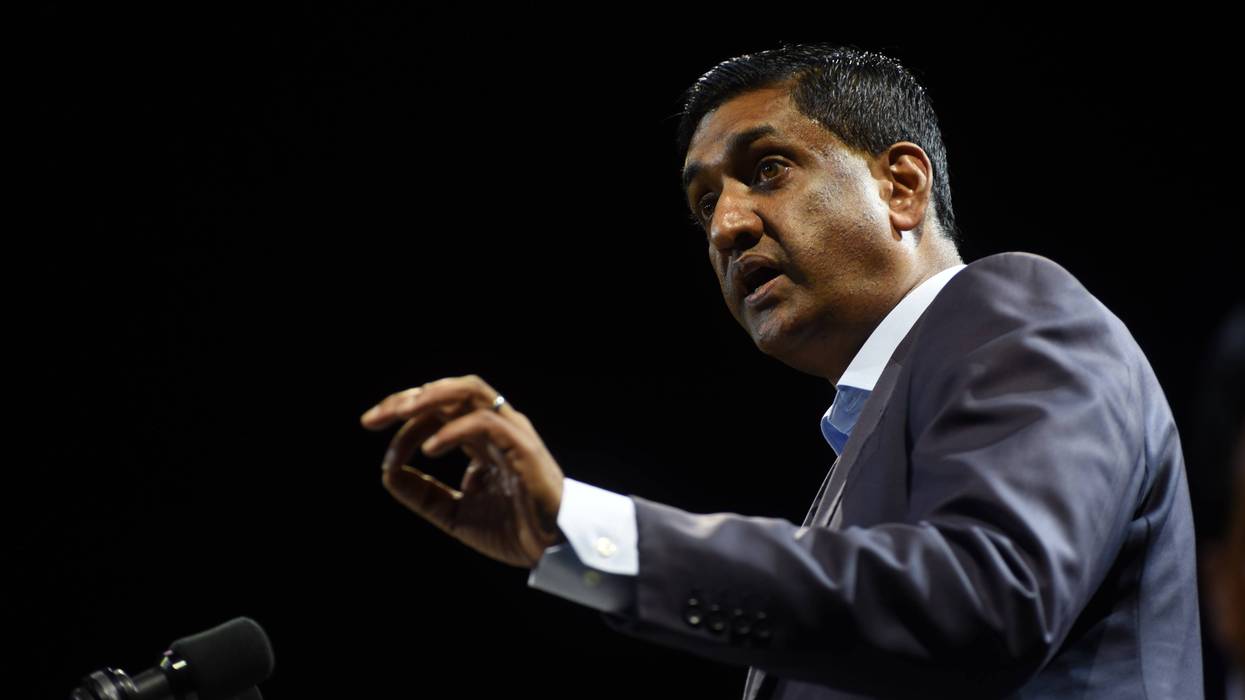
Rep. Ro Khanna pointed fingers at President Donald Trump's administration for being caught flat-footed by the outages and not explaining their cause to voters.
With a number of outages hitting American aviation systems and banks over the last week, Rep. Ro Khanna took to social media to explain what's been going on.
In a video posted on Thursday, the California Democrat pointed to the recent release of a Chinese open-source artificial intelligence model called GLM 5.3, which he noted "does not have safeguards and can be used to have cyberattacks," which has led to many institutions rushing to upgrade their systems.
"The rate of patching... has increased dramatically since GLM 5.3 was released," he said. "When you have this increasing in patching, you have many more chances for outages. That's why we're seeing all of these outages across the country."
There is a cloud of confusion about the tech outages.Here is what’s really going on: https://t.co/vH8is7o3oT
— Ro Khanna (@RoKhanna) November 19, 2026
Khanna pointed fingers at President Donald Trump's administration for being caught flat-footed by the outages and not explaining their cause to voters.
"The president of the United States needs to direct... [the Cyber Infrastructure Agency] to take charge," Khanna said. "That agency has been totally cut. They need to restaff it, they need to have a director... and that director needs to coordinate with all of the companies and agencies to have a plan for how we increase our patching."
Khanna then said either the president or one of his deputies should give daily briefings updating the country about cybersecurity threats, while also gathering a broad coalition of government, business, and technology leaders to "upgrade our patching system against the increased AI threat."
"This is not a time for slogans," Khanna said. "This is not a time for politics. It's a time that we actually understand the issue and provide leadership."
Khanna's claims about GLM 5.3 being the primary driver of system upgrades mirrored an analysis published earlier in the week by investment firm Bridgewater Associates.
As reported by MarketWatch on Thursday, Bridgewater's analysis found that a surge in cyberattacks coincided with the release of GLM 5.3, which is far cheaper to use compared to AI models developed by OpenAI and Anthropic.
"We are in the middle of an arms race where malicious actors are using agents to find exploitable bugs and defenders are using agents to preemptively find and patch vulnerabilities," the firm explained. "While models have significantly accelerated work on both sides of the ledger, the defenders have the much heavier burden of patching all bugs before they can be exploited."
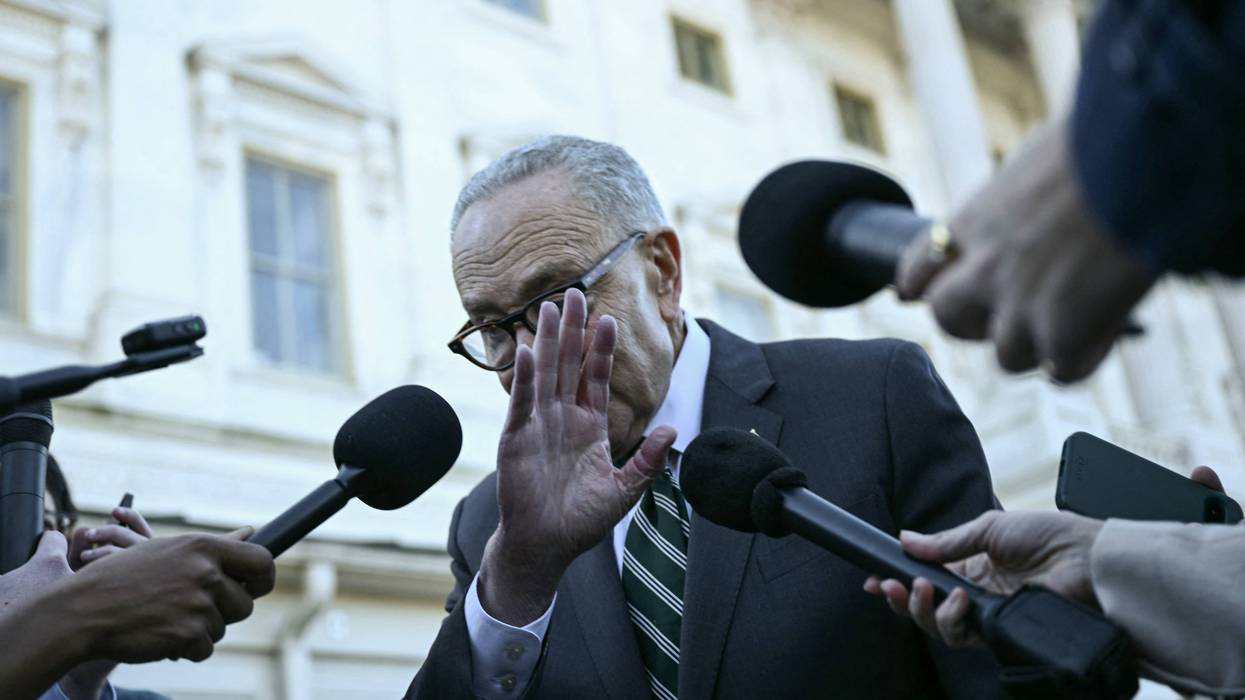
"An outright majority wants another Senate leader, and Van Hollen gets more support when named as an alternative."
Only around 1 in 6 Democratic voters want Senate Minority Leader Chuck Schumer to remain their party’s leader in the upper chamber of Congress, according to a new poll released Friday, as the longtime incumbent faces a leadership challenge from progressive Sen. Chris Van Hollen following the midterm elections.
The survey of 800 Democrats and Democratic-leaning adults, conducted by Verasight for Labyrinth Insights from November 11-16, found that 17% supported Schumer (D-NY) for majority leader, while 57% wanted someone else, and 26% were unsure who they preferred to lead the upper chamber.
The findings reflect widespread dissatisfaction with the party’s leadership, even after Democrats' midterm "blue tsunami." And it isn't just progressives who want change: Among respondents who voted for former Vice President Kamala Harris in 2024, 61% said they favor a different Senate leader.
Opposition to Schumer—who was first elected to Congress when Jimmy Carter was still president—was particularly strong among younger Democrats, with 57% of respondents ages 18-29 saying they wanted to replace him, compared with just 10% who wanted him to stay.
The poll also affirmed voters' frustration with corporate Democrats. Asked whether party leaders have been too friendly toward big corporations, 42% said they were, compared with 33% who said the party's approach was about right, and just 6% who thought Democrats were not friendly enough.
Van Hollen (D-Md.) has won the support of voters seeking change—especially progressives—with positions like backing Medicare for All, restricting US military aid to Israel, and ending congressional funding for President Donald Trump's illegal war of choice against Iran.
In a head-to-head matchup, the survey found that Van Hollen led Schumer 36% to 19%, although 45% of respondents said they were undecided.
"For Schumer, these findings go beyond weak enthusiasm: An outright majority wants another Senate leader, and Van Hollen gets more support when named as an alternative," Labyrinth Insights said, adding that "lack of affirmative support demonstrates that the party’s supporters want meaningful change."
The poll's findings follow a separate survey by Data for Progress, which found that 53% of Democrats and Democratic-leaning independent voters wanted a new Senate leader, compared with 42% who wanted Schumer to remain.

"It's OK," one observer said sardonically, "trickle-down economics will save the day."
A prominent private investment firm CEO and former White House adviser said the founders and employees of the artificial intelligence company Anthropic are collectively worth more than the bottom third of US households following Thursday's initial public offering, an eye-popping example of the country's widening wealth inequality amid the AI boom.
In a social media post, Willett Advisors chair and CEO Steven Rattner highlighted figures claiming that approximately 5,300 Anthropic founders and employees collectively hold an estimated $433 billion in wealth, slightly exceeding the $432 billion he said is held by more than 45 million least wealthy US households.
Rattner's figures are drawn from Anthropic's initial public offering (IPO) documents and the US Federal Reserve's 2025 Survey of Consumer Finances.
The numbers from Rattner—who served as lead adviser to the Presidential Task Force on the Auto Industry during the Obama administration—reflect the value of company equity, not necessarily cash or other wealth that employees can immediately access.
San Francisco-based Anthropic, which developed the Claude chatbot, went public Thursday in what is being called the largest IPO in US history. Shares closed at $97.17, more than 17% above their $83 offering price, giving the company a market capitalization of approximately $1.75 trillion.
Earlier Thursday, CBS News estimated that Anthropic’s seven co-founders were each worth approximately $20 billion, while CNBC said Anthropic's blockbuster IPO will also make thousands of current and former Anthropic employees instant multimillionaires.
Progressive commentator Matt Stoller called the IPO "a giant payoff to a set of stakeholders for allowing them to steal the copyrights of millions of people" and "a huge theft of wealth."
Gaby Del Valle, a policy reporter at The Verge, said, "If you're a newly minted Anthropic multimillionaire, may I suggest building a library or perhaps becoming a patron of the arts."
"Do NOT talk to me about shrimp welfare, I don't wanna hear it," she added, referring to the humane seafood initiative largely funded by billionaire Facebook co-founder Dustin Moskovitz and his wife, Cari Tuna.
Del Valle wasn't the only one who turned to humor in the face of such a staggering statistic.
Responding to Rattner's post, Bland Labs founder Joshua Collin sardonically quipped on social media, "It's OK, trickle-down economics will save the day."

One tracker estimates US families have paid an extra $89 billion for gasoline and over $73 billion for diesel—or $1,237.98 per household.
While experts have warned that US President Donald Trump's illegal war on Iran "will cost hundreds of billions of dollars, and very possibly trillions," as one economist put it in May, a Pentagon official on Thursday shared an estimate of just $48.3 billion—a figure that doesn't account for various impacts, including the global surge in fuel prices.
Authur Miller is deputy comptroller for budget and appropriations affairs at the US Department of Defense, but Trump has nominated him to be assistant secretary of the Navy for financial management and comptroller. During a Senate Armed Services Committee hearing on his nomination and others, Sen. Richard Blumenthal (D-Conn.) inquired about the cost of the war.
"As of November 13, it was $48.3 billion," Miller told Blumenthal, who then asked for clarification about what that includes. The deputy comptroller said the figure accounts for "munitions, equipment replacement costs, and operational cost," but not damage to US bases—for which the Pentagon official said he did not have an estimate, but said he would seek one from the department.
That figure also does not include the cost of providing healthcare to members of the US military injured in the conflict—which Trump and Israeli Prime Minister Benjamin Netanyahu launched in late February—or the impact on consumers around the world, who are paying the price for Iran's retaliatory restrictions on the Strait of Hormuz, a key shipping route, including for fuel.
The Climate Solutions Lab at Brown University estimates that in the United States alone, consumers have paid an extra $162.2 billion for fuel, including nearly $89 billion for gasoline and over $73 billion for diesel—or $1,237.98 per household. The deeply unpopular war is also driving up grocery prices, as Americans also struggle to afford healthcare, housing, and more.
While consumers have paid more at the pump, fossil fuel giants have recorded record profits, benefiting those invested in them—including Trump.
The new war cost estimate came just days after the Pentagon failed its ninth straight audit, and as a new Government Accountability Office report sounded the alarm about department leadership not ensuring the United States has "a reliable supply of munitions, including bombs, missiles, and torpedoes."
As The Washington Post reported:
Trump, Defense Secretary Pete Hegseth, and other senior US officials have repeatedly disputed media reports detailing how the Iran War—initiated by the Trump administration in concert with Israel—has depleted the US military's stockpile of Tomahawk cruise missiles, Patriot interceptors, and other advanced munitions.
The GAO's director, Diana Moldafsky, said in an email to The Washington Post that her office's research found that the Iran War exacerbated munitions shortfalls. She called them "persistent" in recent years. The Pentagon did not dispute the GAO's findings when presented with them, she said.
A White House spokeswoman, Anna Kelly, downplayed the findings, saying in a statement that the US military "has more than enough munitions, ammo, and stockpiles to serve all of President Trump's strategic goals and beyond."
The war helped fuel the "blue tsunami" in the midterm elections earlier this month, but Democrats won't retake control of both chambers of Congress until early January. In the meantime, Trump's Republicans refuse to force an end to the unauthorized assault, including by blocking a war powers resolution in a Thursday Senate vote.
All Republicans but Sens. Susan Collins (Maine), Lisa Murkowski (Alaska), and Rand Paul (Ky.) voted with pro-Israel Democratic Sen. John Fetterman (Pa.) to block H.Con.Res.93, which passed the US House of Representatives in September. The vote was 48-51, with Sen. Chris Murphy (D-Conn.) not voting, as he is still recovering from a stroke.
The Hill noted that retiring Sen. Thom Tillis (R-NC), who voted for a war powers resolution in September, voted against the measure on Thursday.
"I've supported some. I mean, you do know resolutions differ from each one. This one doesn't go to the president, so it's just a statement from Congress," Tillis said. "I've made that statement. I don't need to vote on a Democrat resolution to make that statement."
With a potential government shutdown looming, some Democrats on Capitol Hill have called for defunding the war effort.
"Ahead of the December 11 government funding deadline, Congress faces the task of approving a funding package to maintain government operations," Reps. Ro Khanna (D-Calif.) and Yassamin Ansari (D-Ariz.) said in a joint statement Wednesday. "Congress must use its constitutional power of the purse to ensure that not another cent of taxpayer money goes toward prolonging this war.”

"The US government should defend the deep, not fast-track its destruction," said one opponent.
Flouting a federal judge's recent finding that the Trump administration's approval of deep-sea mining lease sales violated the Endangered Species Act, the US government on Thursday opened more than 31 million acres of ocean floor near American Samoa to potential mineral exploration that opponents say will devastate marine habitats.
The deep-sea mining lease auction—held by the Department of the Interior's Marine Minerals Administration—marks a major step in President Donald Trump's push to accelerate seabed extraction of minerals including nickel, cobalt, copper, and manganese, which are used in batteries, electronics, and other critical products.
The Associated Press reported that the auction covered two areas of seabed, each spanning millions of acres northeast of American Samoa's Manua Islands. Startup Wetstone US Ventures, the only firm to submit bids, won both leases at the $3 million minimum threshold.
"This is the first time the United States has held an offshore critical minerals lease sale in the Pacific and a historic step for America's energy and mineral security," Interior Secretary Doug Burgum said in a statement. "Today's sale opens a path to learn more about the resources off the coast of American Samoa and assess whether they could contribute to a more reliable domestic supply."
The 20-year leases authorize surveys and other exploratory activities, not commercial extraction, which would require additional approval before mining could begin.
However, the auction and the administration's wider deep-sea mining policy have drawn opposition from environmental organizations, marine scientists, and Pacific Island communities concerned about potentially irreversible damage to fragile marine ecosystems and traditional ways of life.
“These lease sales will open the floodgates to the exploitation of our deep seas,” Oceana Defense Campaign manager Julia Singer said in a statement. “The message from American Samoa, and people across the United States, could not be clearer: Stop deep-sea mining before it starts."
"Thousands of scientists, local leaders, and community members have warned of the danger that deep-sea mining poses, yet the Trump administration is continuing to ignore widespread opposition to this proposal," Singer added. "The US government should defend the deep, not fast-track its destruction.”
The lease sale proceeded despite a Monday ruling by US District Judge Jill Otake in Hawaii that invalidated the government's environmental review of the proposed leases. Otake—a Trump appointee—found that the National Marine Fisheries Service (NMFS) violated the Endangered Species Act (ESA) by reviewing only the sale of the leases and not any potential subsequent mining activity.
"The court’s conclusion that NMFS’ acceptance of the limited definition of agency action was arbitrary and capricious also ensures that the purpose of the ESA—to prevent harm to vulnerable species—is served," Otake wrote in her 41-page ruling. "As extinction is permanent, caution and foresight before acting are necessary and 'caution can only be exercised if the agency takes a look at all the possible ramifications of the agency action.'"
“The message from American Samoa, and people across the United States, could not be clearer: Stop deep-sea mining before it starts."
Thursday's auction took place at the Ventura County Fire Department headquarters in Thousand Oaks, California, where dozens of demonstrators rallied outside.
“We had hoped it would never come to this,” said Sabrina Suluai-Mahuka, founder of the American Samoan youth environmental organization Finafinau. "Yet here we are, watching our ocean being auctioned to the highest bidder. As a mother, I cannot accept that my daughter's future, and the futures of generations yet to be born, are being treated as accseptable risks for an industry we never asked for."
Arlo Hemphill, Oceans Are Life campaign lead at Greenpeace USA, said: “The US just gave the deep-sea mining industry its first foothold in US waters after a court found it failed to consider the full scope of potential harm to endangered species. The industry will push to move from surveys to exploration to extraction, putting profits ahead of marine life and trampling the culture, livelihood, and objections of communities that have said no again and again."
"Once mining strips away habitat that took millions of years to form, no amount of money can bring it back," Hemphill added. "Congress should press the administration to suspend these leases before work begins.”
David Henkin, deputy managing attorney at Earthjustice, said Otake's ruling made Thursday's auction illegal because the government must comply with the ESA prior to any lease sale.
“We will use the full extent of the law to vigorously push for the leases to be voided,” he said.
Three separate lawsuits are challenging the Trump administration's deep-sea mining plans, including one brought by the Samoan council of chiefs Faleula o le Manu'atele, which questions the federal government's authority to lease waters surrounding the islands.
Meanwhile, a study published last week in the peer-reviewed journal Scientific Reports found that polymetallic nodules—the rock-like formations coveted by mining companies for their valuable mineral content—are important habitats for tiny organisms living inside their crevices.
“Our findings point out that commercial mining may result in an irreversible loss of undescribed and unique biodiversity associated with nodules,” said Sabine Gollner, a professor at the Royal Netherlands Institute for Sea Research and study co-author. “This needs to be considered in the environmental management of deep-sea mining.”
In an October opinion piece for Common Dreams, Suluai-Mahuka said the ocean is central to her people's identity and traditions.
"Our history and our culture are tied to this ocean," she wrote. "Yet, none of this was valued by the companies, and we, the people of American Samoa, were not meaningfully included in the decision-making process."
Suluai-Mahuka said her community and allies submitted more than 75,000 comments opposing the proposed auction.
"Almost all of us oppose deep-sea mining," she wrote.

Hakeem Jeffries' proposal to pass another war powers resolution instead of blocking funds would result in "a lot of noise and process to say ‘we tried’ while actually doing nothing," an anti-war advocate argued.
While Democratic Party leaders in Congress remain noncommittal about challenging Republicans on a Pentagon spending bill next month that could force a government shutdown, two progressives in the US House are vowing to aggressively oppose any resolution that continues to fund President Donald Trump’s war with Iran—meeting a demand that anti-war critics say would match promises made to voters and be a necessary step to bring the conflict to an end.
“Ahead of the December 11 government funding deadline, Congress faces the task of approving a funding package to maintain government operations,” Reps. Ro Khanna (D-Calif.) and Yassamin Ansari (D-Ariz.) said in a joint statement Wednesday. “Congress must use its constitutional power of the purse to ensure that not another cent of taxpayer money goes toward prolonging this war.”
"We will oppose any funding package that does not explicitly prohibit funds from being used for offensive operations in Iran," they added. "Passing such a measure would defy the demands of Americans who want this war to end—now.”
Opposition to the Iran war and the resulting rise in prices was a major factor in Democrats’ resounding victories in this month’s midterm elections. A Reuters/Ipsos poll last week showed that 71% of Americans want the war to end, including 51% of Republicans.
“The American people were loud and clear on November 3: They want an immediate end to Donald Trump’s reckless war in Iran,” Khanna and Ansari said. “This war was launched illegally and continues to operate without congressional authorization. It has already claimed the lives of at least 23 US service members and over 1,700 Iranian civilians, while significantly driving up prices for already struggling Americans and devastating the global economy.”
Not another cent of taxpayer money should go toward Trump's reckless war of choice. Congress has the power to stop funding this war—we must act now.
— Congresswoman Yassamin Ansari (@RepYassAnsari) November 18, 2026
On Thursday, Punchbowl News reported that Sen. Michael Bennet (D-Colo.) planned to introduce an amendment to the funding bill stating that "none of the funds" could "support directly or indirectly combat activities" against Iran unless Congress authorizes them.
Bennet said the measure, modeled on the 1973 amendment that forced then-President Richard Nixon to end the US bombing of Cambodia, would ensure Congress provided “not another cent for Trump’s war of choice in Iran.”
In addition to Bennet, at least four other senators have said they also plan to oppose any continuing resolution that does not explicitly block funding for the war—Sens. Bernie Sanders (I-Vt.), Chris Van Hollen (D-Md.), Tammy Duckworth (D-Ill.), and Tim Kaine (D-Va.).
Not another cent for Trump’s war of choice in Iran.
— Michael Bennet (@SenatorBennet) November 19, 2026
Rep. Hakeem Jeffries (D-NY), whom House Democrats nominated for speaker on Wednesday, has said ending the war should be an immediate priority of the new Democratic majority. But he has strategically avoided saying whether or not he would take the step of holding up next month’s funding package to cut off the flow of money that allows Trump to continue the war.
Democrats could delay the fight until they take control of Congress next year. Rep. Rosa DeLauro (D-Conn.) suggested earlier this week that Democrats may seek a continuing resolution to fund the government until February and take up war funding then.
However, Jeffries has suggested an entirely different course of action that does not involve using the power of the purse at all, but instead passing another war powers resolution.
During an interview at The Atlantic Summit in Washington, DC, on Tuesday, the magazine’s editor-in-chief, Jeffrey Goldberg, asked Jeffries whether “ending the war” meant “not funding [US] operations in the Gulf.”
"Well, no," Jeffries responded. "It means a cessation of hostilities… So that's what a war powers resolution is able to do, right?"
In June, Congress passed a war powers resolution directing Trump to withdraw US forces from hostilities with Iran unless Congress authorized the war. Trump has ignored it. On Thursday, the GOP-controlled Senate voted 51-48 to reject a separate Iran war powers resolution that the House passed in September.
Asked what the plan was if Trump vetoed a future resolution passed by the incoming Democratic majority, Jeffries said, “there’s nothing more powerful than putting that bill on the president’s desk.” He suggested Democrats needed to make a veto embarrassing for Trump, but critics denounced such maneuvers as a far cry from their rhetoric about bringing the war to a swift and total end.
If this is Democrats’ plan to “end the war” then they lied and don’t actually want to end it. Jeffries is talking about passing another war powers resolution — which Congress has already passed and the WH does not consider binding. If they are serious about that strategy they need to take the matter to court. Instead, Jeffries is saying he’d pass another war powers resolution — but a version that actually goes to the president’s desk for signature. And then the President will veto it and Democrats won’t have the 67 votes in the Senate to override it. In other words: a lot of noise and process to say “we tried” while actually doing nothing and refusing to use real power to get it done. If Democrats are unwilling to use the power of the purse and cut funding, any promises to end the war are a lie.
— Jamal Abdi (@jabdi) November 18, 2026
Jamal Abdi, president of the National Iranian American Council, argued, “If this is Democrats’ plan to ‘end the war,’ then they lied and don’t actually want to end it.”
"Jeffries is talking about passing another war powers resolution—which Congress has already passed, and the [White House] does not consider binding," he explained. "If they are serious about that strategy, they need to take the matter to court."
“Instead, Jeffries is saying he’d pass another war powers resolution—but a version that actually goes to the president’s desk for signature. And then the president will veto it, and Democrats won’t have the 67 votes in the Senate to override it,” he continued. “In other words: a lot of noise and process to say ‘we tried’ while actually doing nothing and refusing to use real power to get it done.”
"If Democrats are unwilling to use the power of the purse and cut funding," he said, "any promises to end the war are a lie."

“The only ones who would benefit from BAAJA are industry executives.”
Fossil fuels industry watchdog Oil Change International on Thursday criticized a bipartisan permitting reform bill for failing address the climate crisis or stop what it described as "skyrocketing" energy costs for consumers.
Citing data fromRhodium Group, which recently studied the Bipartisan American Affordability and Jobs Act of 2026 (BAAJA), Oil Change found that even with the bill’s passage, electricity prices are still projected to increase by around 8% by 2040.
While this is a smaller increase than the 13% hike over the same period absent the BAAJA's passage, the group nonetheless found that "the bill’s savings are overshadowed by the increases."
"For example, according to Rhodium, in the Mid Emissions Scenario with BAAJA, the bill is seen to shave $50 off the average annual bill, or just over $4 a month," Oil Change explained. "But our calculation shows the average annual bill in 2040 would still be over $157 higher than in 2025, or over $13 a month. Households that are already struggling to afford to keep their electricity on today will not see relief from rising energy bills under BAAJA."
The group also cited a number of other factors contributing to higher energy prices that aren't addressed in the bill, including "rising electricity demand from data centers, extreme climate events spiking energy costs in winter, wildfires and storms repeatedly destroying infrastructure that needs to be rebuilt, excessive utility profits, and overdependence on increasingly expensive fossil gas."
The bottom line, wrote Oil Change, is the BAAJA "does not address affordability or the climate crisis," but is instead "a massive gift to the Trump administration, Big Oil, and Big Tech."
Oil Change's analysis earned an endorsement from fellow environmental watchdog Food and Water Watch.
"The only ones who would benefit from BAAJA are industry executives," the group wrote in a social media post.
The Senate is expected to hold a final vote on BAAJA in the coming days. If it passes, the bill would go to the Republican-controlled US House of Representatives, which has a narrow window to act on it before Democrats take over both chambers of Congress in January.

US Sen. Ron Wyden's amendment comes amid a reported push by the US Department of the Interior to identify federal lands that can be used for data centers.
US Sen. Ron Wyden on Thursday slammed Republicans for blocking a vote on his amendment to a bipartisan permitting reform bill that would bar the construction of data centers on public lands.
According to a Thursday report in The Hill, Wyden (D-Ore.) has been holding up votes on the Bipartisan American Affordability and Jobs Act of 2026 (BAAJA), which has been criticized by environmental groups as a giveaway to the fossil fuels industry, because his data center amendment is not currently up for consideration.
In a Thursday social media post, Wyden explained his rationale for holding up the legislation.
"Republicans are blocking a vote on my amendment to ban data centers on public lands," Wyden wrote, adding that BAAJA achieves Sen. Mike Lee’s (R-Utah) "fever dream of giving away your public lands to tech giants."
Wyden proposed his amendment weeks after The Washington Sun reported that the US Department of the Interior, under the leadership of Secretary Doug Burgum, has pushed the Bureau of Land Management (BLM) to “identify public land ripe for data center development,” and provide lists to department leadership.
Earlier this month, ProPublica reported that Burgum stands to personally profit from data center construction on public lands, as he has anywhere between $18.1 million and $64.4 million invested in artificial intelligence companies.
Environmental advocacy organization Earthjustice recently highlighted provisions in BAAJA that it said would open up public lands for data center development in an action alert.
"Buried within more than 400 pages of dense legislative text," Earthjustice wrote, "the Senate permitting bill includes provisions that would put public lands on the chopping block, enable fast delivery of gas to fuel the artificial intelligence data center build-out, threaten historic and cultural sites, give handouts to oil and gas companies, lock in deep-sea mining for years to come, and codify illegal permits."
Environmental groups aren't the only ones rallying opposition to building data centers on federal lands.
As Washington State Standard reported on Tuesday, a coalition of veterans groups called Veterans for Public Lands called for the halt of data centers built on public lands.
“These are our lands,” Gregg Bafundo, a senior adviser of the coalition and former ranger of the Okanogan Wenatchee National Forest, told Washington State Standard. "If the government’s going to do anything with these, they have to ask the permission of the American people. And right now, the American people don’t want data centers on our public lands."

One expert said the analysis makes clear that the war-related crisis "has irrevocably changed the global energy system, adding to the many reasons why countries would benefit from a rapid transition to clean energy."
High-polluting countries like the US are continuing to push for oil and gas extraction, but despite the unwavering commitment of leaders like President Donald Trump to fossil fuels, a report released Thursday by the International Energy Agency says that Trump's own war on Iran made "vulnerabilities in traditional fossil fuel supply systems" clearer than ever.
“I don’t see any credible pathway for the energy world to return to the way it was before,” said Fatih Birol, the IEA's executive director, as the Paris-based agency released its "World Energy Outlook 2026."
The vulnerability that is inherent in countries' fossil fuel dependence became impossible to ignore this year as Iran swiftly retaliated against Trump and Israeli President Benjamin Netanyahu after they launched the war. Iranian officials effectively closed the Strait of Hormuz, which about 20% of the world's oil supply passes through, and sent energy prices skyrocketing.
"The world has been through several major oil supply shocks since 1970," said the agency. "The current crisis is by far the largest."
The IEA coordinated the release of 400 million barrels of crude oil in an attempt to stabilize energy markets, but Birol said a "range of energy futures" are likely to emerge from the upheaval, which “delivered a huge shock to the system."
Mohamed Adow, director of Power Shift Africa, told The Associated Press that "this crisis has exposed the price of fossil fuel dependence. It’s crazy that a conflict thousands of miles away can send energy bills soaring at home.”
“With the world on the brink of breaching 1.5°C of global warming and climate impacts rapidly worsening, world leaders must drastically change course and help secure a healthier, safer world powered by clean, affordable energy for all.”
The war will likely ultimately lead to countries reducing their dependence on the Strait of Hormuz, the IEA forecast, estimating that the 20 million barrels of oil per day that passed through the waterway could be reduced to 8.5 million by 2030 and under 2 million by 2035.
Meanwhile, renewable energy sources, especially solar power, as well as nuclear power, are set to be the “biggest beneficiaries” as governments rethink their energy supply.
The IEA report emphasizes that consumers are already responding to the oil and gas shock of 2026 by turning to electric vehicles and solar panels.
The report was released as leaders assembled in Antalya, Türkiye head into their final days of negotiations at the United Nations Climate Change Conference (COP31), with the latest draft of an agreement leaving advocates dismayed by failing to include a call for a transition away from fossil fuels—even though both the economic realities described in the IEA report and the worsening climate emergency demand such a transition.
“The IEA’s latest report makes clear that the fossil energy crisis unleashed by the US-Israel war on Iran has irrevocably changed the global energy system, adding to the many reasons why countries would benefit from a rapid transition to clean energy and electrification," said Rachel Cleetus, climate program director at the Union of Concerned Scientists. “The future of the energy system and our climate are inextricably intertwined. World leaders at COP31 must stand up to fossil fuel enablers and commit to a fast, fair transition away from all fossil fuels to renewable energy, and ramping up energy efficiency."
“The Trump administration’s attacks on clean energy policies and boosting of fossil fuels is only serving the interests of large fossil fuel polluters who are raking in billions in profits while people struggle to afford basic necessities. It’s time for the newly elected Congress to reverse the harms, keep the administration in check, and hold fossil fuel companies accountable for the damages they are causing," added Cleetus. “With the world on the brink of breaching 1.5°C of global warming and climate impacts rapidly worsening, world leaders must drastically change course and help secure a healthier, safer world powered by clean, affordable energy for all.”
"We need leaders willing to rein in the power these companies have, make them pay for the harm they cause, give workers bargaining power over how AI is used, and ensure everyone shares in the wealth it creates."
The stock market debut of artificial intelligence giant Anthropic on Thursday was met with protests outside the Nasdaq MarketSite in Times Square, where demonstrators gathered to voice their opposition to unchecked AI and the "tech oligarchs" benefiting most from the Wall Street frenzy.
Several people were arrested at the "Stop Tech Oligarchs" demonstrations, organizers said, as Anthropic briefly hit a $2 trillion valuation in its trading debut. One protester arrested outside the Nasdaq building said in a statement that "our demand is clear: Freeze reckless AI development and don’t bail out Big Tech when their bubble inevitably pops."
Anthropic's record-shattering IPO served to spotlight the lack of safeguards around the rapidly advancing AI industry and the extreme wealth a small group of investors and executives are accumulating thanks to a technology that poses potentially massive threats to workers, the environment, and the future of humanity.
"Calling yourself a public benefit corporation doesn’t make the pressure to deliver profits disappear. And workers’ livelihoods, our children’s safety, and the public’s ability to control this technology cannot depend on whether doing the right thing helps the stock price,” Shaunna Thomas, executive director of Guardrails Action, said in a statement Thursday. “A trillion-dollar valuation is not a plan for the rest of us. We need leaders willing to rein in the power these companies have, make them pay for the harm they cause, give workers bargaining power over how AI is used, and ensure everyone shares in the wealth it creates.”
Jose Gonzalez, an activist with Stop Funding Billionaires and New York Communities for Change, warned that "teachers, firefighters, and civil servants will pay for that loss" if—and perhaps when—the AI bubble bursts.
"Institutional investors, like pension funds, hold billions of dollars in investments for many average investors, who count on that money for their retirements," said Gonzalez. "Those funds will be invested in the AI bubble. Anthropic counts on that investment to sway the market. Those average investors are not protected from that drop in value."
The Stop Funding Billionaires campaign, which helped organize Thursday's protests, noted that "Wall Street has already rewritten financial rules so that newly public, large AI companies can be fast-tracked into workers’ pensions and 401(k)s—meaning working people’s money is being set up to prop up AI corporations."
"Pre-IPO investors and insiders will be able to cash out, while working people’s retirement money in slower-moving index funds will be left exposed to the losses," the campaign said. "This reality, which echoes the dot-com bubble of the 1990s and the 2008 housing crisis, is triggering grave concern amongst the general public."
Insiders, meanwhile, are reaping a windfall.
"Each of Anthropic's co-founders is now worth about $20 billion, based on their stock holdings and the $83-per-share price of its record-setting initial stock offering," CBS News reported Thursday. "Their individual wealth, at least on paper, will put them in the same ranks as Rupert Murdoch and his family, worth a combined $20 billion, and famed inventor James Dyson, who is worth $19.9 billion, according to the Bloomberg Billionaires Index."