

SUBSCRIBE TO OUR FREE NEWSLETTER
Daily news & progressive opinion—funded by the people, not the corporations—delivered straight to your inbox.
5
#000000
#FFFFFF
To donate by check, phone, or other method, see our More Ways to Give page.
Daily news & progressive opinion—funded by the people, not the corporations—delivered straight to your inbox.
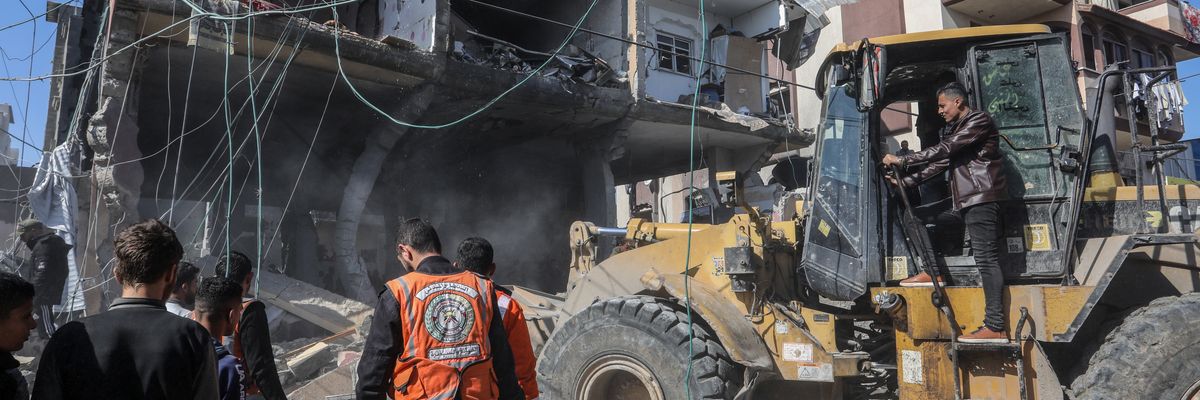
A tractor removes the rubble of a ruined house following an Israeli airstrike on 24 February 2024 in Rafah, Gaza.
One aid worker described conditions in Gaza as the "stuff of nightmares."
As Israel's blockade of aid into Gaza continues, misery in the enclave has been compounded after Israeli airstrikes on Tuesday destroyed several bulldozers used to clear streets and remove bodies from beneath rubble.
According to the United Nations, citing local officials, the destruction of the heavy machinery has brought rescue and recovery efforts to a halt, making it even more challenging to reach the thousands of bodies trapped under rubble.
A recent investigation from Sky News highlighted how Gazans trapped under debris and rubble die slow deaths as residents attempt to dig them out with inadequate equipment such as a trowel or hammer. The U.N., relying on local reports, estimates that 11,000 bodies are trapped under the rubble.
According to Gaza's Civil Defense, nine bulldozers were brought into the enclave during the six-week cease-fire that Israel upended on March 18. The general directorate of the Civil Defense called their destruction a "targeted attack" on the Jabalia al-Nazla Municipality headquarters in northern Gaza.
On Tuesday, the Center for Palestinian Human Rights, which is based in Gaza City, released a statement condemning the destruction of the bulldozers.
"Such equipment is essential for saving lives and facilitating the movement of ambulance and Civil Defense crews," said the group. These acts by Israeli security forces "reflect their policy of deliberately inflicting on Palestinians conditions of life calculated to bring about their physical destruction, in whole or in part, constituting integral act of the crime of genocide ongoing for over 18 months."
In a statement on Tuesday, the Israel Defense Forces (IDF) said it carried out attacks on "engineering vehicles" used for "terror purposes."
Meanwhile, Israel has imposed a complete blockade of aid into Gaza since early March and relaunched its military campaign on the strip on March 18, shattering the cease-fire that went into effect in mid-January.
One Oxfam aid worker described the conditions in Gaza as the "stuff of nightmares," according to a Tuesday statement from the global organization.
According to the group, Oxfam and its partners have not received any aid trucks, food parcels, hygiene kits, or other essential equipment since the siege began. Oxfam has a few water tanks remaining, otherwise its supplies is nearly exhausted.
The group also condemned repeated evacuation orders given by the Israeli military.
"It's hard to explain just how terrible things are in Gaza at the moment. Our staff and partners are witnessing scenes of carnage and despair every day," said Clemence Lagouardat, Oxfam's humanitarian response lead in Gaza. "People are in terror, fearing for their lives as displacement orders tell them, with little notice, to move with whatever they can carry."
The Guardian described the siege as imposing conditions "unmatched in severity" since the start of the war, due to the new evacuation orders, strikes targeting civilian infrastructure, and dwindling food, fuel, and medical supplies.
"Gaza City is packed with displaced people who have fled Israeli troops moving into the north, and they are living on the street or putting their tents inside damaged buildings that are going to collapse," Amande Bazerolle, the Gaza emergency coordinator for Médecins Sans Frontières, or Doctors Without Borders, told The Guardian. "There are not enough points of care for so many people. At our burns clinic in Gaza City, we are refusing patients by 10:00 am and we have to tell them to come back the next day, as we are triaging to make our drug supplies last as long as possible."
In October 2023, Hamas militants attacked southern Israel, killing over 1,000 people and taking roughly 250 hostages—prompting Israel to carry out a fierce military campaign in the Gaza Strip.
Multiple human rights groups have said Israel is guilt of committing genocide or "acts of genocide."
Over 51,000 people in Gaza have been killed since Israel's campaign began, according to local health officials.
This country and this world are at a monumental crossroads. US voters have an opportunity to beat back the forces of fascism and confront the billionaires who are rigging the economy, our media system, and our democracy, making it increasingly impossible for ordinary people to get by. We’re not just talking about the election. We’re talking about what must be done once these fascist elements are vanquished from power. We need a bolder set of solutions than what either major party has so far been willing to offer and a working-class movement ready to fight like hell for it. Trump didn't emerge from nowhere. The conditions that fueled MAGA authoritarianism were created by decades of radical neoliberal economic policies and a corrupt political system dominated by corporate interests. They slashed taxes on the super-rich, promising that the benefits would trickle down. They said giveaways to the corporate titans would make life more affordable for the rest of us. It was all bullshit. And when a bitter, betrayed populace searches for someone to blame, right-wing demagogues have little trouble finding scapegoats. People know when they're being lied to, but you won't hear any of this from the corporate media. Only independent journalism—powered and funded by people who believe in building a better world—can deliver truly trustworthy daily news. If you share our vision, please contribute whatever you can to sustain our work. |
As Israel's blockade of aid into Gaza continues, misery in the enclave has been compounded after Israeli airstrikes on Tuesday destroyed several bulldozers used to clear streets and remove bodies from beneath rubble.
According to the United Nations, citing local officials, the destruction of the heavy machinery has brought rescue and recovery efforts to a halt, making it even more challenging to reach the thousands of bodies trapped under rubble.
A recent investigation from Sky News highlighted how Gazans trapped under debris and rubble die slow deaths as residents attempt to dig them out with inadequate equipment such as a trowel or hammer. The U.N., relying on local reports, estimates that 11,000 bodies are trapped under the rubble.
According to Gaza's Civil Defense, nine bulldozers were brought into the enclave during the six-week cease-fire that Israel upended on March 18. The general directorate of the Civil Defense called their destruction a "targeted attack" on the Jabalia al-Nazla Municipality headquarters in northern Gaza.
On Tuesday, the Center for Palestinian Human Rights, which is based in Gaza City, released a statement condemning the destruction of the bulldozers.
"Such equipment is essential for saving lives and facilitating the movement of ambulance and Civil Defense crews," said the group. These acts by Israeli security forces "reflect their policy of deliberately inflicting on Palestinians conditions of life calculated to bring about their physical destruction, in whole or in part, constituting integral act of the crime of genocide ongoing for over 18 months."
In a statement on Tuesday, the Israel Defense Forces (IDF) said it carried out attacks on "engineering vehicles" used for "terror purposes."
Meanwhile, Israel has imposed a complete blockade of aid into Gaza since early March and relaunched its military campaign on the strip on March 18, shattering the cease-fire that went into effect in mid-January.
One Oxfam aid worker described the conditions in Gaza as the "stuff of nightmares," according to a Tuesday statement from the global organization.
According to the group, Oxfam and its partners have not received any aid trucks, food parcels, hygiene kits, or other essential equipment since the siege began. Oxfam has a few water tanks remaining, otherwise its supplies is nearly exhausted.
The group also condemned repeated evacuation orders given by the Israeli military.
"It's hard to explain just how terrible things are in Gaza at the moment. Our staff and partners are witnessing scenes of carnage and despair every day," said Clemence Lagouardat, Oxfam's humanitarian response lead in Gaza. "People are in terror, fearing for their lives as displacement orders tell them, with little notice, to move with whatever they can carry."
The Guardian described the siege as imposing conditions "unmatched in severity" since the start of the war, due to the new evacuation orders, strikes targeting civilian infrastructure, and dwindling food, fuel, and medical supplies.
"Gaza City is packed with displaced people who have fled Israeli troops moving into the north, and they are living on the street or putting their tents inside damaged buildings that are going to collapse," Amande Bazerolle, the Gaza emergency coordinator for Médecins Sans Frontières, or Doctors Without Borders, told The Guardian. "There are not enough points of care for so many people. At our burns clinic in Gaza City, we are refusing patients by 10:00 am and we have to tell them to come back the next day, as we are triaging to make our drug supplies last as long as possible."
In October 2023, Hamas militants attacked southern Israel, killing over 1,000 people and taking roughly 250 hostages—prompting Israel to carry out a fierce military campaign in the Gaza Strip.
Multiple human rights groups have said Israel is guilt of committing genocide or "acts of genocide."
Over 51,000 people in Gaza have been killed since Israel's campaign began, according to local health officials.

