SUBSCRIBE TO OUR FREE NEWSLETTER
Daily news & progressive opinion—funded by the people, not the corporations—delivered straight to your inbox.
5
#000000
#FFFFFF
To donate by check, phone, or other method, see our More Ways to Give page.
Daily news & progressive opinion—funded by the people, not the corporations—delivered straight to your inbox.
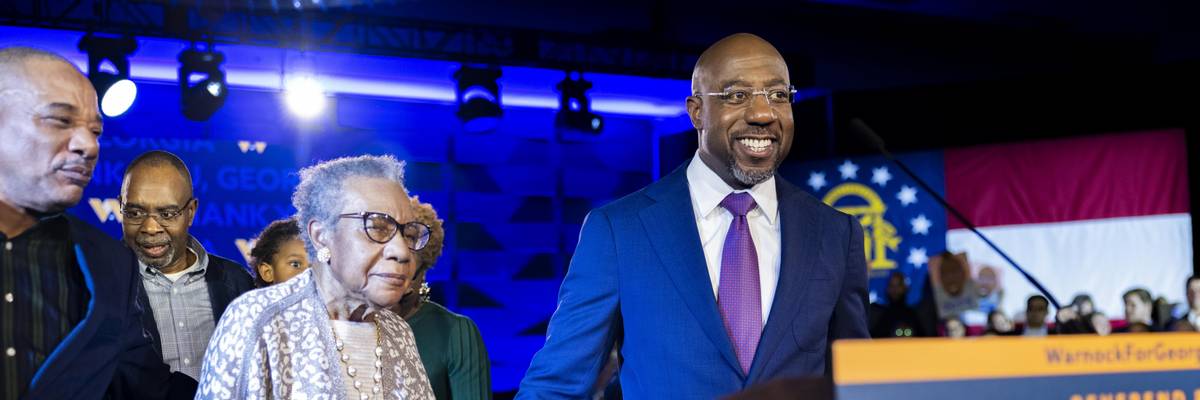
Senator Reverend Raphael Warnock (D-GA) celebrates his victory with family and friends at his election night party in Atlanta, Georgia on December 6th, 2022 following the stateas Senate runoff election. (Photo by Nathan Posner/Anadolu Agency via Getty Images)
"It is my honor to utter the four most powerful words ever spoken in a democracy: The people have spoken," Senator Raphael Warnock said on Tuesday night before a cheering crowd, after winning the runoff election for the U.S. senate in Georgia. Warnock ran against Republican Herschel Walker, a retired football star. Walker, recruited to run by former president Donald Trump, proved to be a deeply flawed candidate. Nevertheless, the Warnock campaign had to overcome a complex array of voter suppression laws and tactics deployed by Georgia Republicans.
Efforts to suppress the vote are rampant nationally.
"There are those who would look at the outcome of this race and say that there's no voter suppression in Georgia," Warnock continued. "Let me be clear, just because people endured long lines that wrapped around buildings, some blocks long, just because they endured the rain and the cold and all kinds of tricks in order to vote, doesn't mean that voter suppression does not exist. It simply means that you, the people, have decided that your voices will not be silenced."
After Donald Trump's defeat in 2020 and the unprecedented election two months later of Rev. Raphael Warnock and Jon Ossoff, the first African American and Jewish senators elected in Georgia, control of the Senate went to the Democrats. The Republican-controlled Georgia legislature responded, quickly passing SB202, the "Election Integrity Act of 2021." It restricted the time between a general election and a runoff, made it harder to get an absentee ballot, and even made it a crime to hand water to someone waiting hours in line to vote.
The turnout for this year's December 6th runoff election was historic. Republicans attempted to restrict early, in-person voting as much as possible, including on the Saturday after Thanksgiving. The justification used to eliminate that vital weekend day was that it followed "Observance of State Holiday 1," the new term for what was, until 2015, Georgia's holiday celebrating the birthday of Confederate General Robert E. Lee. The Warnock campaign sued, and the State Supreme Court overturned Georgia's new rules. "That weekend wound up being one of the largest voting turnout weekends in history," LaTosha Brown, co-founder of the Black Voters Matter Fund, said this week on the Democracy Now! news hour.
That the courts have a say in how Georgia runs its elections seems perfectly reasonable. But the ability of courts or state governors to weigh in on election laws passed by state legislatures is at risk. On Wednesday, the U.S. Supreme Court heard arguments in Moore v. Harper, a case in which the Republican-controlled North Carolina state legislature is arguing that neither state courts nor the governor can question any election legislation, including redistricting maps, passed by the legislature. The case was brought after the North Carolina Republicans' post-2020, heavily gerrymandered congressional map was overturned by the state's supreme court.
If this so-called "Independent State Legislature Theory" is upheld by the U.S. Supreme Court, it would mark a radical shift in U.S. election law and one of the most fundamental threats to democracy in modern history.
Efforts to suppress the vote are rampant nationally. The Brennan Center for Justice is tracking at least 405 restrictive voter suppression bills and 151 election interference bills, all introduced at the state level in 2022. If the Supreme Court decides in favor of the Independent State Legislature Theory, these laws couldn't be vetoed by governors nor reviewed by state courts.
Speaking on Democracy Now!, Georgia-based Cliff Albright, co-founder and executive director of Black Voters Matter, said of the case, "This could be the final nail in the concept of democracy in this country, if these state legislatures are able to run rogue without having any kind of accountability."
These voter suppression laws are just the latest front in the war on democracy. For so long, following the Civil War and Reconstruction, white supremacist violence and terrorism, lynchings, and Jim Crow laws like poll taxes and literacy tests were used to disenfranchise voters of color.
Raphael Warnock's win is the first time an African American Democrat has been elected to a full term in the U.S. Senate from the former Confederacy.
"I am a proud son of Savannah, Georgia, a coastal city known for its verdant town squares and its cobblestone streets, tall majestic oak trees dripping with Spanish moss," Warnock said in his victory speech on Tuesday. "My roots, like the roots of those oak trees, go deep down into the soil of Savannah...I am an example and an iteration of its history, of its pain, and its promise, of the brutality and the possibility."
The task before any American who supports the principle of democracy is to engage in grassroots action to expand the possibility of which Senator Warnock speaks, and to eliminate the brutality.
Dear Common Dreams reader, It’s been nearly 30 years since I co-founded Common Dreams with my late wife, Lina Newhouser. We had the radical notion that journalism should serve the public good, not corporate profits. It was clear to us from the outset what it would take to build such a project. No paid advertisements. No corporate sponsors. No millionaire publisher telling us what to think or do. Many people said we wouldn't last a year, but we proved those doubters wrong. Together with a tremendous team of journalists and dedicated staff, we built an independent media outlet free from the constraints of profits and corporate control. Our mission has always been simple: To inform. To inspire. To ignite change for the common good. Building Common Dreams was not easy. Our survival was never guaranteed. When you take on the most powerful forces—Wall Street greed, fossil fuel industry destruction, Big Tech lobbyists, and uber-rich oligarchs who have spent billions upon billions rigging the economy and democracy in their favor—the only bulwark you have is supporters who believe in your work. But here’s the urgent message from me today. It's never been this bad out there. And it's never been this hard to keep us going. At the very moment Common Dreams is most needed, the threats we face are intensifying. We need your support now more than ever. We don't accept corporate advertising and never will. We don't have a paywall because we don't think people should be blocked from critical news based on their ability to pay. Everything we do is funded by the donations of readers like you. When everyone does the little they can afford, we are strong. But if that support retreats or dries up, so do we. Will you donate now to make sure Common Dreams not only survives but thrives? —Craig Brown, Co-founder |
"It is my honor to utter the four most powerful words ever spoken in a democracy: The people have spoken," Senator Raphael Warnock said on Tuesday night before a cheering crowd, after winning the runoff election for the U.S. senate in Georgia. Warnock ran against Republican Herschel Walker, a retired football star. Walker, recruited to run by former president Donald Trump, proved to be a deeply flawed candidate. Nevertheless, the Warnock campaign had to overcome a complex array of voter suppression laws and tactics deployed by Georgia Republicans.
Efforts to suppress the vote are rampant nationally.
"There are those who would look at the outcome of this race and say that there's no voter suppression in Georgia," Warnock continued. "Let me be clear, just because people endured long lines that wrapped around buildings, some blocks long, just because they endured the rain and the cold and all kinds of tricks in order to vote, doesn't mean that voter suppression does not exist. It simply means that you, the people, have decided that your voices will not be silenced."
After Donald Trump's defeat in 2020 and the unprecedented election two months later of Rev. Raphael Warnock and Jon Ossoff, the first African American and Jewish senators elected in Georgia, control of the Senate went to the Democrats. The Republican-controlled Georgia legislature responded, quickly passing SB202, the "Election Integrity Act of 2021." It restricted the time between a general election and a runoff, made it harder to get an absentee ballot, and even made it a crime to hand water to someone waiting hours in line to vote.
The turnout for this year's December 6th runoff election was historic. Republicans attempted to restrict early, in-person voting as much as possible, including on the Saturday after Thanksgiving. The justification used to eliminate that vital weekend day was that it followed "Observance of State Holiday 1," the new term for what was, until 2015, Georgia's holiday celebrating the birthday of Confederate General Robert E. Lee. The Warnock campaign sued, and the State Supreme Court overturned Georgia's new rules. "That weekend wound up being one of the largest voting turnout weekends in history," LaTosha Brown, co-founder of the Black Voters Matter Fund, said this week on the Democracy Now! news hour.
That the courts have a say in how Georgia runs its elections seems perfectly reasonable. But the ability of courts or state governors to weigh in on election laws passed by state legislatures is at risk. On Wednesday, the U.S. Supreme Court heard arguments in Moore v. Harper, a case in which the Republican-controlled North Carolina state legislature is arguing that neither state courts nor the governor can question any election legislation, including redistricting maps, passed by the legislature. The case was brought after the North Carolina Republicans' post-2020, heavily gerrymandered congressional map was overturned by the state's supreme court.
If this so-called "Independent State Legislature Theory" is upheld by the U.S. Supreme Court, it would mark a radical shift in U.S. election law and one of the most fundamental threats to democracy in modern history.
Efforts to suppress the vote are rampant nationally. The Brennan Center for Justice is tracking at least 405 restrictive voter suppression bills and 151 election interference bills, all introduced at the state level in 2022. If the Supreme Court decides in favor of the Independent State Legislature Theory, these laws couldn't be vetoed by governors nor reviewed by state courts.
Speaking on Democracy Now!, Georgia-based Cliff Albright, co-founder and executive director of Black Voters Matter, said of the case, "This could be the final nail in the concept of democracy in this country, if these state legislatures are able to run rogue without having any kind of accountability."
These voter suppression laws are just the latest front in the war on democracy. For so long, following the Civil War and Reconstruction, white supremacist violence and terrorism, lynchings, and Jim Crow laws like poll taxes and literacy tests were used to disenfranchise voters of color.
Raphael Warnock's win is the first time an African American Democrat has been elected to a full term in the U.S. Senate from the former Confederacy.
"I am a proud son of Savannah, Georgia, a coastal city known for its verdant town squares and its cobblestone streets, tall majestic oak trees dripping with Spanish moss," Warnock said in his victory speech on Tuesday. "My roots, like the roots of those oak trees, go deep down into the soil of Savannah...I am an example and an iteration of its history, of its pain, and its promise, of the brutality and the possibility."
The task before any American who supports the principle of democracy is to engage in grassroots action to expand the possibility of which Senator Warnock speaks, and to eliminate the brutality.
"It is my honor to utter the four most powerful words ever spoken in a democracy: The people have spoken," Senator Raphael Warnock said on Tuesday night before a cheering crowd, after winning the runoff election for the U.S. senate in Georgia. Warnock ran against Republican Herschel Walker, a retired football star. Walker, recruited to run by former president Donald Trump, proved to be a deeply flawed candidate. Nevertheless, the Warnock campaign had to overcome a complex array of voter suppression laws and tactics deployed by Georgia Republicans.
Efforts to suppress the vote are rampant nationally.
"There are those who would look at the outcome of this race and say that there's no voter suppression in Georgia," Warnock continued. "Let me be clear, just because people endured long lines that wrapped around buildings, some blocks long, just because they endured the rain and the cold and all kinds of tricks in order to vote, doesn't mean that voter suppression does not exist. It simply means that you, the people, have decided that your voices will not be silenced."
After Donald Trump's defeat in 2020 and the unprecedented election two months later of Rev. Raphael Warnock and Jon Ossoff, the first African American and Jewish senators elected in Georgia, control of the Senate went to the Democrats. The Republican-controlled Georgia legislature responded, quickly passing SB202, the "Election Integrity Act of 2021." It restricted the time between a general election and a runoff, made it harder to get an absentee ballot, and even made it a crime to hand water to someone waiting hours in line to vote.
The turnout for this year's December 6th runoff election was historic. Republicans attempted to restrict early, in-person voting as much as possible, including on the Saturday after Thanksgiving. The justification used to eliminate that vital weekend day was that it followed "Observance of State Holiday 1," the new term for what was, until 2015, Georgia's holiday celebrating the birthday of Confederate General Robert E. Lee. The Warnock campaign sued, and the State Supreme Court overturned Georgia's new rules. "That weekend wound up being one of the largest voting turnout weekends in history," LaTosha Brown, co-founder of the Black Voters Matter Fund, said this week on the Democracy Now! news hour.
That the courts have a say in how Georgia runs its elections seems perfectly reasonable. But the ability of courts or state governors to weigh in on election laws passed by state legislatures is at risk. On Wednesday, the U.S. Supreme Court heard arguments in Moore v. Harper, a case in which the Republican-controlled North Carolina state legislature is arguing that neither state courts nor the governor can question any election legislation, including redistricting maps, passed by the legislature. The case was brought after the North Carolina Republicans' post-2020, heavily gerrymandered congressional map was overturned by the state's supreme court.
If this so-called "Independent State Legislature Theory" is upheld by the U.S. Supreme Court, it would mark a radical shift in U.S. election law and one of the most fundamental threats to democracy in modern history.
Efforts to suppress the vote are rampant nationally. The Brennan Center for Justice is tracking at least 405 restrictive voter suppression bills and 151 election interference bills, all introduced at the state level in 2022. If the Supreme Court decides in favor of the Independent State Legislature Theory, these laws couldn't be vetoed by governors nor reviewed by state courts.
Speaking on Democracy Now!, Georgia-based Cliff Albright, co-founder and executive director of Black Voters Matter, said of the case, "This could be the final nail in the concept of democracy in this country, if these state legislatures are able to run rogue without having any kind of accountability."
These voter suppression laws are just the latest front in the war on democracy. For so long, following the Civil War and Reconstruction, white supremacist violence and terrorism, lynchings, and Jim Crow laws like poll taxes and literacy tests were used to disenfranchise voters of color.
Raphael Warnock's win is the first time an African American Democrat has been elected to a full term in the U.S. Senate from the former Confederacy.
"I am a proud son of Savannah, Georgia, a coastal city known for its verdant town squares and its cobblestone streets, tall majestic oak trees dripping with Spanish moss," Warnock said in his victory speech on Tuesday. "My roots, like the roots of those oak trees, go deep down into the soil of Savannah...I am an example and an iteration of its history, of its pain, and its promise, of the brutality and the possibility."
The task before any American who supports the principle of democracy is to engage in grassroots action to expand the possibility of which Senator Warnock speaks, and to eliminate the brutality.