SUBSCRIBE TO OUR FREE NEWSLETTER
Daily news & progressive opinion—funded by the people, not the corporations—delivered straight to your inbox.
5
#000000
#FFFFFF
To donate by check, phone, or other method, see our More Ways to Give page.
Daily news & progressive opinion—funded by the people, not the corporations—delivered straight to your inbox.
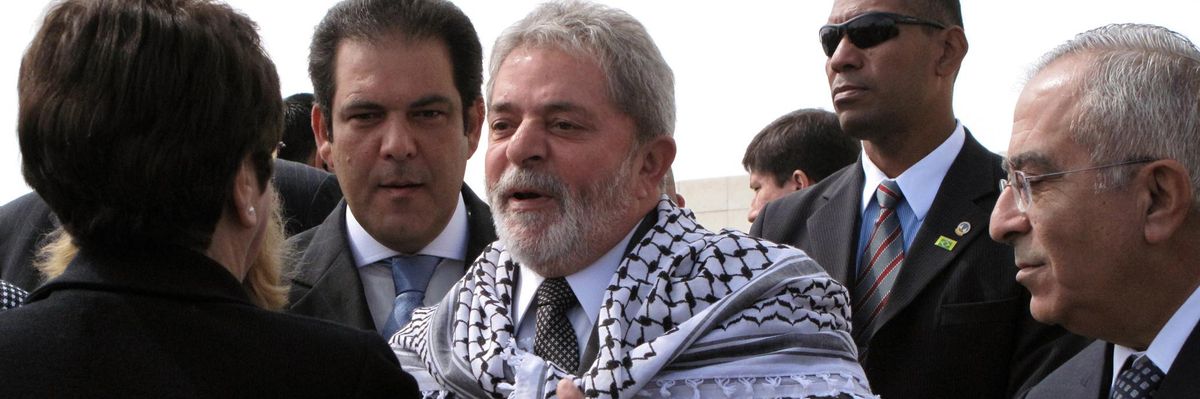
Brazilian President Luiz Inacio Lula da Silva, wearing a kaffiyeh, speaks with a Palestinian official after inaugurating Brazil Street alongside Palestinian Prime Minister Salam Fayyad (right), outside the Palestinian Authority headquarters in the Israeli-occupied West Bank city of Ramallah on March 17, 2010. (Photo: Marina Passos/AFP via Getty Images)
After a surprisingly tight result, Brazil's election is going into a second round in which far-right incumbent Jair Bolsonaro will face left-winger Luiz Inacio Lula da Silva after the latter received 48.4 percent of the votes cast, and the incumbent obtained 43.23 percent. Twenty years on from his first presidential victory - from 2003-2010 - which is remembered by many in the country as an era of economic growth and declining inequality, Lula da Silva could be days away from one of the most remarkable moments in political history.
Lula Da silva, referred to by former US President Barack Obama as "the most popular politician on Earth", is also known as a staunch supporter of the Palestinian cause. It was under his premiership that Brazil recognized an independent state of Palestine within the 1967 borders.
Who Is Lula?
Lula, who served as president for two terms between 2003 and 2010, left school having only completed the fifth grade to work full-time. He worked as a street vendor, factory worker, and a shoe-shine boy to provide a supplementary income for his family. He lost the pinky on his left hand as a result of a work accident.
He got involved in politics in 1980 and founded the Workers' Party. Lula ran for president several times before he finally won the spot in a decisive election in 2002, where he obtained 61.5 percent of ballots.
His two terms as president saw him help lift millions out of poverty, making him one of the country's most popular leaders.
In 2016, Lula Da Silva was charged in a money laundering investigation led by Sao Paulo state prosecutors who claimed his ownership of a seaside luxury apartment was a result of his ties to the OAS construction firm. Lula was detained for 580 days, leaving him unable to run in the 2018 presidential election.
Shortly after, the Federal Supreme Court annulled all decisions in the case and ruled that the actions of former judge Sergio Moro were biased. As a result, Lula was able to stand in the current elections.
"Four years ago I couldn't vote because I was a victim of a lie in this country. I was arrested by the federal police exactly on election day. I tried to get a ballot box brought to my cell to vote, but they didn't. Today I am here voting with recognition of my total freedom," the 76-year-old Lula said after voting in Sao Bernardo do Campo earlier this month.
If Lula Wins, Palestine Will Too
Lula received the majority of votes cast at the polling station inside the Brazilian Consulate in Ramallah by Brazilian citizens living and working in the occupied West Bank, only 52 votes went to Bolsonaro. According to Palestinians, a victory for Lula will make a significant difference to the position of the Palestinian cause in Brazil and international forums, as the Palestinian people will have a supportive Brazilian friend at the UN once again.
Lula had taken many measures in favor of Palestine, including raising diplomatic representation between the two countries and allocating a plot of land near the Brazilian presidential palace for the Palestinian embassy.
During a visit to the West Bank in 2010, Lula talked of his dream to see "an independent and free Palestine". Later that year, he recognized Palestine as an independent state within its 1967 borders, with Argentina, Bolivia, and Ecuador doing so almost immediately afterward. The majority of South American states followed suit within the first three months of 2011. Under the leadership of the leftist Workers' Party from 2003 to 2016, Brazil gave unlimited support for justice in Palestine.
Earlier this year, Lula called for supporting the Palestinians' right to establish a state. He reiterated his view that the UN should be restructured so progress can be made regarding major issues such as "the creation of a Palestinian state".
In June, he welcomed the Palestinian community and stressing on the important relations between Brazil and Palestine and the relations that Brazil built with the Arab world and its governments. "Palestinians deserve our full attention and solidarity," Lula said, wearing the Palestinian keffiyeh. He stressed that the Palestinian people have the right to live in a "free and sovereign state", adding that he will work to reestablish the leading role of Brazilian foreign policy in the mediation of conflicts and of peoples' right to defend themselves.
Brazil is only two days away from receiving the decisive result and knowing who will be the next president of Brazil: Lula or Bolsonaro? Lula da Silva, who has always shown great sympathy and support for the Palestinian cause and its people, or Bolsonaro who broke these ties and became Israel's best friend? This is what we will discover on Sunday.
This country and this world are at a monumental crossroads. US voters have an opportunity to beat back the forces of fascism and confront the billionaires who are rigging the economy, our media system, and our democracy, making it increasingly impossible for ordinary people to get by. We’re not just talking about the election. We’re talking about what must be done once these fascist elements are vanquished from power. We need a bolder set of solutions than what either major party has so far been willing to offer and a working-class movement ready to fight like hell for it. Trump didn't emerge from nowhere. The conditions that fueled MAGA authoritarianism were created by decades of radical neoliberal economic policies and a corrupt political system dominated by corporate interests. They slashed taxes on the super-rich, promising that the benefits would trickle down. They said giveaways to the corporate titans would make life more affordable for the rest of us. It was all bullshit. And when a bitter, betrayed populace searches for someone to blame, right-wing demagogues have little trouble finding scapegoats. People know when they're being lied to, but you won't hear any of this from the corporate media. Only independent journalism—powered and funded by people who believe in building a better world—can deliver truly trustworthy daily news. If you share our vision, please contribute whatever you can to sustain our work. |
After a surprisingly tight result, Brazil's election is going into a second round in which far-right incumbent Jair Bolsonaro will face left-winger Luiz Inacio Lula da Silva after the latter received 48.4 percent of the votes cast, and the incumbent obtained 43.23 percent. Twenty years on from his first presidential victory - from 2003-2010 - which is remembered by many in the country as an era of economic growth and declining inequality, Lula da Silva could be days away from one of the most remarkable moments in political history.
Lula Da silva, referred to by former US President Barack Obama as "the most popular politician on Earth", is also known as a staunch supporter of the Palestinian cause. It was under his premiership that Brazil recognized an independent state of Palestine within the 1967 borders.
Who Is Lula?
Lula, who served as president for two terms between 2003 and 2010, left school having only completed the fifth grade to work full-time. He worked as a street vendor, factory worker, and a shoe-shine boy to provide a supplementary income for his family. He lost the pinky on his left hand as a result of a work accident.
He got involved in politics in 1980 and founded the Workers' Party. Lula ran for president several times before he finally won the spot in a decisive election in 2002, where he obtained 61.5 percent of ballots.
His two terms as president saw him help lift millions out of poverty, making him one of the country's most popular leaders.
In 2016, Lula Da Silva was charged in a money laundering investigation led by Sao Paulo state prosecutors who claimed his ownership of a seaside luxury apartment was a result of his ties to the OAS construction firm. Lula was detained for 580 days, leaving him unable to run in the 2018 presidential election.
Shortly after, the Federal Supreme Court annulled all decisions in the case and ruled that the actions of former judge Sergio Moro were biased. As a result, Lula was able to stand in the current elections.
"Four years ago I couldn't vote because I was a victim of a lie in this country. I was arrested by the federal police exactly on election day. I tried to get a ballot box brought to my cell to vote, but they didn't. Today I am here voting with recognition of my total freedom," the 76-year-old Lula said after voting in Sao Bernardo do Campo earlier this month.
If Lula Wins, Palestine Will Too
Lula received the majority of votes cast at the polling station inside the Brazilian Consulate in Ramallah by Brazilian citizens living and working in the occupied West Bank, only 52 votes went to Bolsonaro. According to Palestinians, a victory for Lula will make a significant difference to the position of the Palestinian cause in Brazil and international forums, as the Palestinian people will have a supportive Brazilian friend at the UN once again.
Lula had taken many measures in favor of Palestine, including raising diplomatic representation between the two countries and allocating a plot of land near the Brazilian presidential palace for the Palestinian embassy.
During a visit to the West Bank in 2010, Lula talked of his dream to see "an independent and free Palestine". Later that year, he recognized Palestine as an independent state within its 1967 borders, with Argentina, Bolivia, and Ecuador doing so almost immediately afterward. The majority of South American states followed suit within the first three months of 2011. Under the leadership of the leftist Workers' Party from 2003 to 2016, Brazil gave unlimited support for justice in Palestine.
Earlier this year, Lula called for supporting the Palestinians' right to establish a state. He reiterated his view that the UN should be restructured so progress can be made regarding major issues such as "the creation of a Palestinian state".
In June, he welcomed the Palestinian community and stressing on the important relations between Brazil and Palestine and the relations that Brazil built with the Arab world and its governments. "Palestinians deserve our full attention and solidarity," Lula said, wearing the Palestinian keffiyeh. He stressed that the Palestinian people have the right to live in a "free and sovereign state", adding that he will work to reestablish the leading role of Brazilian foreign policy in the mediation of conflicts and of peoples' right to defend themselves.
Brazil is only two days away from receiving the decisive result and knowing who will be the next president of Brazil: Lula or Bolsonaro? Lula da Silva, who has always shown great sympathy and support for the Palestinian cause and its people, or Bolsonaro who broke these ties and became Israel's best friend? This is what we will discover on Sunday.