SUBSCRIBE TO OUR FREE NEWSLETTER
Daily news & progressive opinion—funded by the people, not the corporations—delivered straight to your inbox.
5
#000000
#FFFFFF
To donate by check, phone, or other method, see our More Ways to Give page.
Daily news & progressive opinion—funded by the people, not the corporations—delivered straight to your inbox.
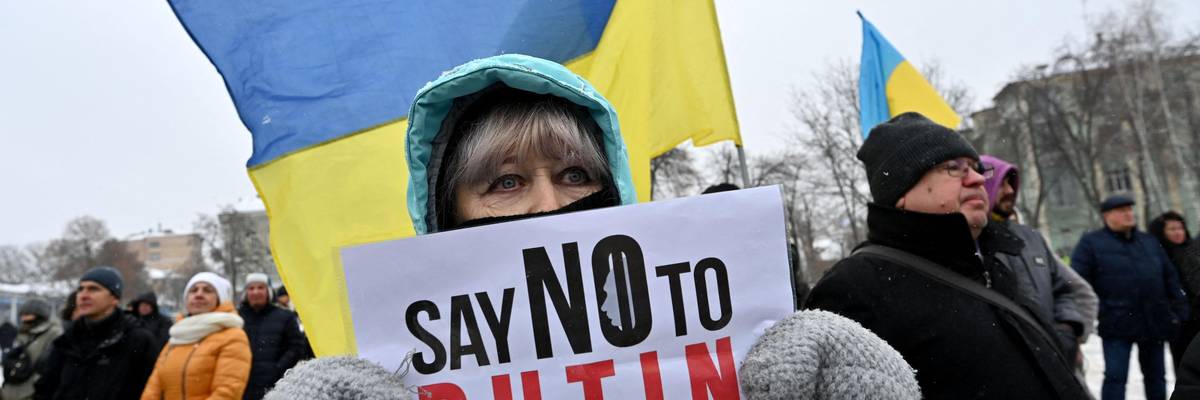
A demonstrator holds a placard during an action dubbed #SayNOtoPutin in Kyiv on January 9, 2022. (Photo: Sergei Supinsky / AFP via Getty Images)
Having worked inside mainstream U.S. media during the beginning of the "War on Terror" and run-up to the U.S. invasion of Iraq, the differences in today's war coverage are dizzying to me.
Civilians
While covering Russia's horrific aggression in Ukraine, there is a real focus--as there always should be--on civilian victims of war. Today, the focus on that essential aspect of the Russian invasion is prominent and continuous--from civilian deaths to the trauma felt by civilians as missiles strike nearby.
Unfortunately, there was virtually no focus on civilian death and agony when it was the U.S. military launching the invasions. After the U.S. invaded Iraq in 2003 on false pretenses--made possible by U.S. mainstream media complicity that I witnessed firsthand--civilian deaths were largely ignored and undercounted through the years.
Shortly after the U.S. invaded Afghanistan in October 2001, leaked directives from CNN's management to its correspondents and anchors showed that the network was intent on playing down and rationalizing the killing and maiming of Afghan civilians by the U.S. military. One memo instructed CNN anchors that if they ever referenced Afghan civilian victims, they needed to quickly announce to their audience: "These U.S. military actions are in response to a terrorist attack that killed close to 5,000 innocent people in the U.S." Such language was mandatory, said the memo: "Even though it may start sounding rote, it is important that we make this point each time."
A few weeks after 9/11, what CNN viewer had forgotten it?
Noting the cursory U.S. television coverage of Afghan civilian casualties, a New York Times reporter wrote: "In the United States, television images of Afghan bombing victims are fleeting, cushioned between anchors or American officials explaining that such sights are only one side of the story. In the rest of the world, however, images of wounded Afghan children curled in hospital beds or women rocking in despair over a baby's corpse, beamed via satellite by the Qatar-based network, Al Jazeera, or CNN International, are more frequent and lingering."
The near-blackout on coverage of the civilian toll continued for decades. In April of last year, NBC anchor Lester Holt did a summing-up report on Afghanistan as "America's longest war" by offering one and only one casualty figure: "2300 American deaths." There was no mention of the more than 70,000 Afghan civilian deaths since 2001, and no mention of a U.N. study that found in the first half of 2019, due mostly to aerial bombing, the U.S. and its allies killed more civilians than the Taliban and its allies.
As the war on terror expanded to other countries, U.S. mainstream media remained largely uninterested in civilian victims of U.S. warfare and drone strikes.
Invasions and military force by one country against another are clearly illegal under international law, unless conducted in true self-defense (or authorized by the U.N. Security Council). In coverage of Russia's invasion of Ukraine, U.S. mainstream media have correctly, repeatedly, and without equivocation, invoked international law and declared it illegal. As they did when Russia invaded Crimea in 2014.
By contrast, when the U.S. illegally invaded or attacked country after country in recent decades, international law has almost never been invoked by mainstream U.S. media. That was surely the case in the lead-up to the Iraq invasion--unlike in Britain, where major media prominently discussed the reality that invading Iraq would be a crime against international law unless authorized by a U.N. Security Council resolution. On a BBC television special six weeks before the invasion, for example, Tony Blair was cross-examined on that point by antiwar citizens.
In 1989, when the U.S. invaded Panama in perhaps the bloodiest drug bust in history, mainstream U.S. media made a determined effort to ignore international law and its violation--as well as the slaughter of civilians.
Mainstream media in our country today are outraged by imperialism. On Friday night, MSNBC's Lawrence O' Donnell indignantly and repeatedly denounced "Russian imperialism."
As a lifelong opponent of imperialism, I'm also indignant that a powerful country like Russia is using force to try to impose its will and its own chosen leadership on the Ukrainian people.
But I've never heard O'Donnell or anyone at MSNBC denounce U.S. imperialism. Indeed, the existence of something called "U.S. imperialism" is so adamantly denied by mainstream U.S. media that the phrase doesn't appear in print without scare quotes.
This stubborn unwillingness to recognize U.S. imperialism persists despite the fact that no country (including Russia) has come close to ours in the last 70 years in imposing its will in changing the leadership of foreign governments--often from good to bad (for example, Iran in 1953; Guatemala in 1954; Congo in 1960; Chile, in 1973; Honduras in 2009). Not to mention other U.S.-led regime changes (for example, Iraq in 2003 and Libya in 2011).
This denial persists despite the fact that our country maintains more than 750 military bases in nearly 80 foreign countries (Russia has about 20 foreign bases in a half-dozen countries); that our military budget dwarfs that of every other country (more than 12 times larger than Russia's); that the U.S. provides nearly 80 percent of the world's weapons exports--including weapons sales and military training to 40 of the 50 most oppressive, anti-democratic governments on earth.
Speaking of U.S. imperialism, former Secretary of State Hillary Clinton has been all over the news in recent days commenting on Ukraine and accurately denouncing Putin as anti-democratic. But her commentary reeks of hypocrisy on many grounds; one is her key role, largely ignored by mainstream U.S. media, in enabling the violent military coup regime that replaced elected Honduran President Manuel Zelaya in 2009. (You can read about it here and here.)
So as we rally to support Ukrainian civilians against great-power aggression from Russia, let's do so with the understanding that imperialism should always be opposed, that all civilian victims of wars and violent coups are worthy whether Iraqi or Honduran or Ukrainian--and that all criminals who violate international law should be held accountable whether they're based in Moscow or Washington, D.C.
Dear Common Dreams reader, It’s been nearly 30 years since I co-founded Common Dreams with my late wife, Lina Newhouser. We had the radical notion that journalism should serve the public good, not corporate profits. It was clear to us from the outset what it would take to build such a project. No paid advertisements. No corporate sponsors. No millionaire publisher telling us what to think or do. Many people said we wouldn't last a year, but we proved those doubters wrong. Together with a tremendous team of journalists and dedicated staff, we built an independent media outlet free from the constraints of profits and corporate control. Our mission has always been simple: To inform. To inspire. To ignite change for the common good. Building Common Dreams was not easy. Our survival was never guaranteed. When you take on the most powerful forces—Wall Street greed, fossil fuel industry destruction, Big Tech lobbyists, and uber-rich oligarchs who have spent billions upon billions rigging the economy and democracy in their favor—the only bulwark you have is supporters who believe in your work. But here’s the urgent message from me today. It's never been this bad out there. And it's never been this hard to keep us going. At the very moment Common Dreams is most needed, the threats we face are intensifying. We need your support now more than ever. We don't accept corporate advertising and never will. We don't have a paywall because we don't think people should be blocked from critical news based on their ability to pay. Everything we do is funded by the donations of readers like you. When everyone does the little they can afford, we are strong. But if that support retreats or dries up, so do we. Will you donate now to make sure Common Dreams not only survives but thrives? —Craig Brown, Co-founder |
Having worked inside mainstream U.S. media during the beginning of the "War on Terror" and run-up to the U.S. invasion of Iraq, the differences in today's war coverage are dizzying to me.
Civilians
While covering Russia's horrific aggression in Ukraine, there is a real focus--as there always should be--on civilian victims of war. Today, the focus on that essential aspect of the Russian invasion is prominent and continuous--from civilian deaths to the trauma felt by civilians as missiles strike nearby.
Unfortunately, there was virtually no focus on civilian death and agony when it was the U.S. military launching the invasions. After the U.S. invaded Iraq in 2003 on false pretenses--made possible by U.S. mainstream media complicity that I witnessed firsthand--civilian deaths were largely ignored and undercounted through the years.
Shortly after the U.S. invaded Afghanistan in October 2001, leaked directives from CNN's management to its correspondents and anchors showed that the network was intent on playing down and rationalizing the killing and maiming of Afghan civilians by the U.S. military. One memo instructed CNN anchors that if they ever referenced Afghan civilian victims, they needed to quickly announce to their audience: "These U.S. military actions are in response to a terrorist attack that killed close to 5,000 innocent people in the U.S." Such language was mandatory, said the memo: "Even though it may start sounding rote, it is important that we make this point each time."
A few weeks after 9/11, what CNN viewer had forgotten it?
Noting the cursory U.S. television coverage of Afghan civilian casualties, a New York Times reporter wrote: "In the United States, television images of Afghan bombing victims are fleeting, cushioned between anchors or American officials explaining that such sights are only one side of the story. In the rest of the world, however, images of wounded Afghan children curled in hospital beds or women rocking in despair over a baby's corpse, beamed via satellite by the Qatar-based network, Al Jazeera, or CNN International, are more frequent and lingering."
The near-blackout on coverage of the civilian toll continued for decades. In April of last year, NBC anchor Lester Holt did a summing-up report on Afghanistan as "America's longest war" by offering one and only one casualty figure: "2300 American deaths." There was no mention of the more than 70,000 Afghan civilian deaths since 2001, and no mention of a U.N. study that found in the first half of 2019, due mostly to aerial bombing, the U.S. and its allies killed more civilians than the Taliban and its allies.
As the war on terror expanded to other countries, U.S. mainstream media remained largely uninterested in civilian victims of U.S. warfare and drone strikes.
Invasions and military force by one country against another are clearly illegal under international law, unless conducted in true self-defense (or authorized by the U.N. Security Council). In coverage of Russia's invasion of Ukraine, U.S. mainstream media have correctly, repeatedly, and without equivocation, invoked international law and declared it illegal. As they did when Russia invaded Crimea in 2014.
By contrast, when the U.S. illegally invaded or attacked country after country in recent decades, international law has almost never been invoked by mainstream U.S. media. That was surely the case in the lead-up to the Iraq invasion--unlike in Britain, where major media prominently discussed the reality that invading Iraq would be a crime against international law unless authorized by a U.N. Security Council resolution. On a BBC television special six weeks before the invasion, for example, Tony Blair was cross-examined on that point by antiwar citizens.
In 1989, when the U.S. invaded Panama in perhaps the bloodiest drug bust in history, mainstream U.S. media made a determined effort to ignore international law and its violation--as well as the slaughter of civilians.
Mainstream media in our country today are outraged by imperialism. On Friday night, MSNBC's Lawrence O' Donnell indignantly and repeatedly denounced "Russian imperialism."
As a lifelong opponent of imperialism, I'm also indignant that a powerful country like Russia is using force to try to impose its will and its own chosen leadership on the Ukrainian people.
But I've never heard O'Donnell or anyone at MSNBC denounce U.S. imperialism. Indeed, the existence of something called "U.S. imperialism" is so adamantly denied by mainstream U.S. media that the phrase doesn't appear in print without scare quotes.
This stubborn unwillingness to recognize U.S. imperialism persists despite the fact that no country (including Russia) has come close to ours in the last 70 years in imposing its will in changing the leadership of foreign governments--often from good to bad (for example, Iran in 1953; Guatemala in 1954; Congo in 1960; Chile, in 1973; Honduras in 2009). Not to mention other U.S.-led regime changes (for example, Iraq in 2003 and Libya in 2011).
This denial persists despite the fact that our country maintains more than 750 military bases in nearly 80 foreign countries (Russia has about 20 foreign bases in a half-dozen countries); that our military budget dwarfs that of every other country (more than 12 times larger than Russia's); that the U.S. provides nearly 80 percent of the world's weapons exports--including weapons sales and military training to 40 of the 50 most oppressive, anti-democratic governments on earth.
Speaking of U.S. imperialism, former Secretary of State Hillary Clinton has been all over the news in recent days commenting on Ukraine and accurately denouncing Putin as anti-democratic. But her commentary reeks of hypocrisy on many grounds; one is her key role, largely ignored by mainstream U.S. media, in enabling the violent military coup regime that replaced elected Honduran President Manuel Zelaya in 2009. (You can read about it here and here.)
So as we rally to support Ukrainian civilians against great-power aggression from Russia, let's do so with the understanding that imperialism should always be opposed, that all civilian victims of wars and violent coups are worthy whether Iraqi or Honduran or Ukrainian--and that all criminals who violate international law should be held accountable whether they're based in Moscow or Washington, D.C.
Having worked inside mainstream U.S. media during the beginning of the "War on Terror" and run-up to the U.S. invasion of Iraq, the differences in today's war coverage are dizzying to me.
Civilians
While covering Russia's horrific aggression in Ukraine, there is a real focus--as there always should be--on civilian victims of war. Today, the focus on that essential aspect of the Russian invasion is prominent and continuous--from civilian deaths to the trauma felt by civilians as missiles strike nearby.
Unfortunately, there was virtually no focus on civilian death and agony when it was the U.S. military launching the invasions. After the U.S. invaded Iraq in 2003 on false pretenses--made possible by U.S. mainstream media complicity that I witnessed firsthand--civilian deaths were largely ignored and undercounted through the years.
Shortly after the U.S. invaded Afghanistan in October 2001, leaked directives from CNN's management to its correspondents and anchors showed that the network was intent on playing down and rationalizing the killing and maiming of Afghan civilians by the U.S. military. One memo instructed CNN anchors that if they ever referenced Afghan civilian victims, they needed to quickly announce to their audience: "These U.S. military actions are in response to a terrorist attack that killed close to 5,000 innocent people in the U.S." Such language was mandatory, said the memo: "Even though it may start sounding rote, it is important that we make this point each time."
A few weeks after 9/11, what CNN viewer had forgotten it?
Noting the cursory U.S. television coverage of Afghan civilian casualties, a New York Times reporter wrote: "In the United States, television images of Afghan bombing victims are fleeting, cushioned between anchors or American officials explaining that such sights are only one side of the story. In the rest of the world, however, images of wounded Afghan children curled in hospital beds or women rocking in despair over a baby's corpse, beamed via satellite by the Qatar-based network, Al Jazeera, or CNN International, are more frequent and lingering."
The near-blackout on coverage of the civilian toll continued for decades. In April of last year, NBC anchor Lester Holt did a summing-up report on Afghanistan as "America's longest war" by offering one and only one casualty figure: "2300 American deaths." There was no mention of the more than 70,000 Afghan civilian deaths since 2001, and no mention of a U.N. study that found in the first half of 2019, due mostly to aerial bombing, the U.S. and its allies killed more civilians than the Taliban and its allies.
As the war on terror expanded to other countries, U.S. mainstream media remained largely uninterested in civilian victims of U.S. warfare and drone strikes.
Invasions and military force by one country against another are clearly illegal under international law, unless conducted in true self-defense (or authorized by the U.N. Security Council). In coverage of Russia's invasion of Ukraine, U.S. mainstream media have correctly, repeatedly, and without equivocation, invoked international law and declared it illegal. As they did when Russia invaded Crimea in 2014.
By contrast, when the U.S. illegally invaded or attacked country after country in recent decades, international law has almost never been invoked by mainstream U.S. media. That was surely the case in the lead-up to the Iraq invasion--unlike in Britain, where major media prominently discussed the reality that invading Iraq would be a crime against international law unless authorized by a U.N. Security Council resolution. On a BBC television special six weeks before the invasion, for example, Tony Blair was cross-examined on that point by antiwar citizens.
In 1989, when the U.S. invaded Panama in perhaps the bloodiest drug bust in history, mainstream U.S. media made a determined effort to ignore international law and its violation--as well as the slaughter of civilians.
Mainstream media in our country today are outraged by imperialism. On Friday night, MSNBC's Lawrence O' Donnell indignantly and repeatedly denounced "Russian imperialism."
As a lifelong opponent of imperialism, I'm also indignant that a powerful country like Russia is using force to try to impose its will and its own chosen leadership on the Ukrainian people.
But I've never heard O'Donnell or anyone at MSNBC denounce U.S. imperialism. Indeed, the existence of something called "U.S. imperialism" is so adamantly denied by mainstream U.S. media that the phrase doesn't appear in print without scare quotes.
This stubborn unwillingness to recognize U.S. imperialism persists despite the fact that no country (including Russia) has come close to ours in the last 70 years in imposing its will in changing the leadership of foreign governments--often from good to bad (for example, Iran in 1953; Guatemala in 1954; Congo in 1960; Chile, in 1973; Honduras in 2009). Not to mention other U.S.-led regime changes (for example, Iraq in 2003 and Libya in 2011).
This denial persists despite the fact that our country maintains more than 750 military bases in nearly 80 foreign countries (Russia has about 20 foreign bases in a half-dozen countries); that our military budget dwarfs that of every other country (more than 12 times larger than Russia's); that the U.S. provides nearly 80 percent of the world's weapons exports--including weapons sales and military training to 40 of the 50 most oppressive, anti-democratic governments on earth.
Speaking of U.S. imperialism, former Secretary of State Hillary Clinton has been all over the news in recent days commenting on Ukraine and accurately denouncing Putin as anti-democratic. But her commentary reeks of hypocrisy on many grounds; one is her key role, largely ignored by mainstream U.S. media, in enabling the violent military coup regime that replaced elected Honduran President Manuel Zelaya in 2009. (You can read about it here and here.)
So as we rally to support Ukrainian civilians against great-power aggression from Russia, let's do so with the understanding that imperialism should always be opposed, that all civilian victims of wars and violent coups are worthy whether Iraqi or Honduran or Ukrainian--and that all criminals who violate international law should be held accountable whether they're based in Moscow or Washington, D.C.