SUBSCRIBE TO OUR FREE NEWSLETTER
Daily news & progressive opinion—funded by the people, not the corporations—delivered straight to your inbox.
5
#000000
#FFFFFF
To donate by check, phone, or other method, see our More Ways to Give page.
Daily news & progressive opinion—funded by the people, not the corporations—delivered straight to your inbox.
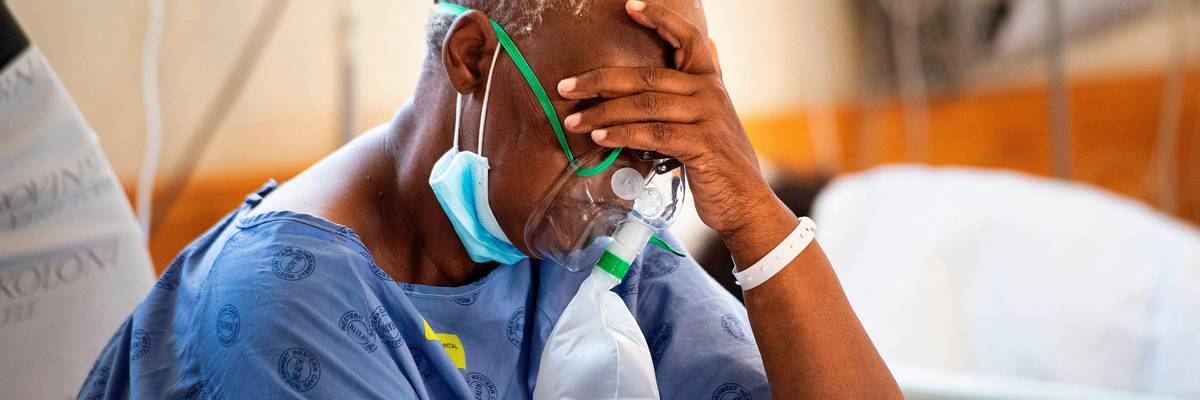
A patient with Covid-19 breaths in oxygen in the coronavirus ward at Khayelitsha Hospital outside of Cape Town, South Africa. (Photo: Rodger Bosch/AFP via Getty Images)
December 1st was World AIDS Day, marking forty years since symptoms were first reported. Over 36 million people have died worldwide from AIDS-related illnesses. The death rate is slowing as effective drug treatments gain wider distribution. But the inequity that long fueled the AIDS epidemic still exists, with punishing consequences, particularly for the people of southern Africa. The persistence and the vastly unequal impacts of the ongoing AIDS epidemic serve as a warning as the new Omicron variant of the COVID-19 virus makes its way around the world.
It would be easier to vaccinate the world than to try in vain to block Covid-19 variants from crossing borders.
Little is currently known about this newly-identified SARS-CoV-2 variant, particularly whether it spreads more easily or if it can cause more severe COVID-19. What we do know is thanks largely to its rapid identification by scientists in Botswana and South Africa. Fatima Hassan, founder of Health Justice Initiative praised those scientists on the Democracy Now! news hour, saying, "I think they need to be celebrated for that because there wasn't a cloud of secrecy around this particular variant."
Rather than being celebrated, though, the nations of southern Africa are being isolated. The United States quickly implemented a travel ban, barring anyone from eight southern African nations from entering the country. Brazil, Canada, the European Union, Iran and the U.K followed suit.
"An uneven travel ban was slapped on many countries in southern Africa," Hassan said. "It is actually quite racist."
South African President Cyril Ramaphosa responded to the bans on Sunday, "The emergence of the Omicron variant should be a wake-up call to the world that vaccine inequality cannot be allowed to continue. Until everyone is vaccinated, everyone will continue to be at risk. Instead of prohibiting travel, the rich countries of the world need to support the efforts of developing economies to access and to manufacture enough vaccine doses for their people without delay."
United Nations Secretary-General Antonio Guterres slammed the travel bans as "travel apartheid," which only serve to exacerbate the growing global divide caused by vaccine apartheid. In a recent opinion piece, World Health Organization Director General Tedros Adhanom Ghebreyesus called the hoarding of surplus vaccine doses by wealthy nations with populations that are highly vaccinated, including with booster shots, "morally repugnant and epidemiological madness."
It would be easier to vaccinate the world than to try in vain to block Covid-19 variants from crossing borders. Omicron is a case in point; as the New York Times detailed this week, the variant was already present in the Netherlands before its existence was announced in Africa. Travelers on airplanes from South Africa carried the variant to Europe, where the hodgepodge of conflicting national travel restrictions already in place and inadequate quarantine protocols led Dutch officials to force many potentially Omicron-positive travelers to depart for their final destinations, accelerating the new variant's spread.
Pharmaceutical corporations that are profiting off of the pandemic are slowing vaccination in poor and middle-income countries. With patents on the vaccines, companies like Pfizer, BioNTech, and Moderna are using intellectual property protections to block the sharing of their secret vaccine formulas.
Journalism professor Steven Thrasher sees a parallel between the role of Big Pharma now with Covid-19 and how the Global South, and primarily southern Africa, was and continues to be afflicted by AIDS:
"Today there is no reason why anybody should be dying of AIDS. It is a slow-moving virus and so from the time we know someone is infected, we can give them all the support they need. We have the science for it. We have the medicine for it. It is merely a matter of protecting capitalism and the profits of pharmaceutical companies," Thrasher said on Democracy Now! "We are seeing very similar dynamics again now with COVID-19...we have the vaccines, we have medications that are very effective and they are again being held from the Global South to protect the profits of pharmaceutical corporations."
Over a year ago, South Africa and India proposed that the World Trade Organization temporarily suspend TRIPS, or Trade-Related Aspects of Intellectual Property Rights, to speed COVID-19 vaccinations worldwide. President Joe Biden was applauded last May for supporting the waiver. Amnesty International, along with members of the U.S. Congress and many labor, health and other civil society groups delivered a petition signed by over three million people to the White House last week, noting, "six months later, in the absence of U.S. leadership to deliver a waiver deal, the European Union, on behalf of Germany, plus Switzerland and the United Kingdom have blocked progress."
People over profit must be the guiding mantra as we soon enter the third year of the COVID-19 pandemic. Without immediate action, we could well be dealing with COVID, just as we still battle AIDS, for the next forty years.
Dear Common Dreams reader, It’s been nearly 30 years since I co-founded Common Dreams with my late wife, Lina Newhouser. We had the radical notion that journalism should serve the public good, not corporate profits. It was clear to us from the outset what it would take to build such a project. No paid advertisements. No corporate sponsors. No millionaire publisher telling us what to think or do. Many people said we wouldn't last a year, but we proved those doubters wrong. Together with a tremendous team of journalists and dedicated staff, we built an independent media outlet free from the constraints of profits and corporate control. Our mission has always been simple: To inform. To inspire. To ignite change for the common good. Building Common Dreams was not easy. Our survival was never guaranteed. When you take on the most powerful forces—Wall Street greed, fossil fuel industry destruction, Big Tech lobbyists, and uber-rich oligarchs who have spent billions upon billions rigging the economy and democracy in their favor—the only bulwark you have is supporters who believe in your work. But here’s the urgent message from me today. It's never been this bad out there. And it's never been this hard to keep us going. At the very moment Common Dreams is most needed, the threats we face are intensifying. We need your support now more than ever. We don't accept corporate advertising and never will. We don't have a paywall because we don't think people should be blocked from critical news based on their ability to pay. Everything we do is funded by the donations of readers like you. When everyone does the little they can afford, we are strong. But if that support retreats or dries up, so do we. Will you donate now to make sure Common Dreams not only survives but thrives? —Craig Brown, Co-founder |
December 1st was World AIDS Day, marking forty years since symptoms were first reported. Over 36 million people have died worldwide from AIDS-related illnesses. The death rate is slowing as effective drug treatments gain wider distribution. But the inequity that long fueled the AIDS epidemic still exists, with punishing consequences, particularly for the people of southern Africa. The persistence and the vastly unequal impacts of the ongoing AIDS epidemic serve as a warning as the new Omicron variant of the COVID-19 virus makes its way around the world.
It would be easier to vaccinate the world than to try in vain to block Covid-19 variants from crossing borders.
Little is currently known about this newly-identified SARS-CoV-2 variant, particularly whether it spreads more easily or if it can cause more severe COVID-19. What we do know is thanks largely to its rapid identification by scientists in Botswana and South Africa. Fatima Hassan, founder of Health Justice Initiative praised those scientists on the Democracy Now! news hour, saying, "I think they need to be celebrated for that because there wasn't a cloud of secrecy around this particular variant."
Rather than being celebrated, though, the nations of southern Africa are being isolated. The United States quickly implemented a travel ban, barring anyone from eight southern African nations from entering the country. Brazil, Canada, the European Union, Iran and the U.K followed suit.
"An uneven travel ban was slapped on many countries in southern Africa," Hassan said. "It is actually quite racist."
South African President Cyril Ramaphosa responded to the bans on Sunday, "The emergence of the Omicron variant should be a wake-up call to the world that vaccine inequality cannot be allowed to continue. Until everyone is vaccinated, everyone will continue to be at risk. Instead of prohibiting travel, the rich countries of the world need to support the efforts of developing economies to access and to manufacture enough vaccine doses for their people without delay."
United Nations Secretary-General Antonio Guterres slammed the travel bans as "travel apartheid," which only serve to exacerbate the growing global divide caused by vaccine apartheid. In a recent opinion piece, World Health Organization Director General Tedros Adhanom Ghebreyesus called the hoarding of surplus vaccine doses by wealthy nations with populations that are highly vaccinated, including with booster shots, "morally repugnant and epidemiological madness."
It would be easier to vaccinate the world than to try in vain to block Covid-19 variants from crossing borders. Omicron is a case in point; as the New York Times detailed this week, the variant was already present in the Netherlands before its existence was announced in Africa. Travelers on airplanes from South Africa carried the variant to Europe, where the hodgepodge of conflicting national travel restrictions already in place and inadequate quarantine protocols led Dutch officials to force many potentially Omicron-positive travelers to depart for their final destinations, accelerating the new variant's spread.
Pharmaceutical corporations that are profiting off of the pandemic are slowing vaccination in poor and middle-income countries. With patents on the vaccines, companies like Pfizer, BioNTech, and Moderna are using intellectual property protections to block the sharing of their secret vaccine formulas.
Journalism professor Steven Thrasher sees a parallel between the role of Big Pharma now with Covid-19 and how the Global South, and primarily southern Africa, was and continues to be afflicted by AIDS:
"Today there is no reason why anybody should be dying of AIDS. It is a slow-moving virus and so from the time we know someone is infected, we can give them all the support they need. We have the science for it. We have the medicine for it. It is merely a matter of protecting capitalism and the profits of pharmaceutical companies," Thrasher said on Democracy Now! "We are seeing very similar dynamics again now with COVID-19...we have the vaccines, we have medications that are very effective and they are again being held from the Global South to protect the profits of pharmaceutical corporations."
Over a year ago, South Africa and India proposed that the World Trade Organization temporarily suspend TRIPS, or Trade-Related Aspects of Intellectual Property Rights, to speed COVID-19 vaccinations worldwide. President Joe Biden was applauded last May for supporting the waiver. Amnesty International, along with members of the U.S. Congress and many labor, health and other civil society groups delivered a petition signed by over three million people to the White House last week, noting, "six months later, in the absence of U.S. leadership to deliver a waiver deal, the European Union, on behalf of Germany, plus Switzerland and the United Kingdom have blocked progress."
People over profit must be the guiding mantra as we soon enter the third year of the COVID-19 pandemic. Without immediate action, we could well be dealing with COVID, just as we still battle AIDS, for the next forty years.
December 1st was World AIDS Day, marking forty years since symptoms were first reported. Over 36 million people have died worldwide from AIDS-related illnesses. The death rate is slowing as effective drug treatments gain wider distribution. But the inequity that long fueled the AIDS epidemic still exists, with punishing consequences, particularly for the people of southern Africa. The persistence and the vastly unequal impacts of the ongoing AIDS epidemic serve as a warning as the new Omicron variant of the COVID-19 virus makes its way around the world.
It would be easier to vaccinate the world than to try in vain to block Covid-19 variants from crossing borders.
Little is currently known about this newly-identified SARS-CoV-2 variant, particularly whether it spreads more easily or if it can cause more severe COVID-19. What we do know is thanks largely to its rapid identification by scientists in Botswana and South Africa. Fatima Hassan, founder of Health Justice Initiative praised those scientists on the Democracy Now! news hour, saying, "I think they need to be celebrated for that because there wasn't a cloud of secrecy around this particular variant."
Rather than being celebrated, though, the nations of southern Africa are being isolated. The United States quickly implemented a travel ban, barring anyone from eight southern African nations from entering the country. Brazil, Canada, the European Union, Iran and the U.K followed suit.
"An uneven travel ban was slapped on many countries in southern Africa," Hassan said. "It is actually quite racist."
South African President Cyril Ramaphosa responded to the bans on Sunday, "The emergence of the Omicron variant should be a wake-up call to the world that vaccine inequality cannot be allowed to continue. Until everyone is vaccinated, everyone will continue to be at risk. Instead of prohibiting travel, the rich countries of the world need to support the efforts of developing economies to access and to manufacture enough vaccine doses for their people without delay."
United Nations Secretary-General Antonio Guterres slammed the travel bans as "travel apartheid," which only serve to exacerbate the growing global divide caused by vaccine apartheid. In a recent opinion piece, World Health Organization Director General Tedros Adhanom Ghebreyesus called the hoarding of surplus vaccine doses by wealthy nations with populations that are highly vaccinated, including with booster shots, "morally repugnant and epidemiological madness."
It would be easier to vaccinate the world than to try in vain to block Covid-19 variants from crossing borders. Omicron is a case in point; as the New York Times detailed this week, the variant was already present in the Netherlands before its existence was announced in Africa. Travelers on airplanes from South Africa carried the variant to Europe, where the hodgepodge of conflicting national travel restrictions already in place and inadequate quarantine protocols led Dutch officials to force many potentially Omicron-positive travelers to depart for their final destinations, accelerating the new variant's spread.
Pharmaceutical corporations that are profiting off of the pandemic are slowing vaccination in poor and middle-income countries. With patents on the vaccines, companies like Pfizer, BioNTech, and Moderna are using intellectual property protections to block the sharing of their secret vaccine formulas.
Journalism professor Steven Thrasher sees a parallel between the role of Big Pharma now with Covid-19 and how the Global South, and primarily southern Africa, was and continues to be afflicted by AIDS:
"Today there is no reason why anybody should be dying of AIDS. It is a slow-moving virus and so from the time we know someone is infected, we can give them all the support they need. We have the science for it. We have the medicine for it. It is merely a matter of protecting capitalism and the profits of pharmaceutical companies," Thrasher said on Democracy Now! "We are seeing very similar dynamics again now with COVID-19...we have the vaccines, we have medications that are very effective and they are again being held from the Global South to protect the profits of pharmaceutical corporations."
Over a year ago, South Africa and India proposed that the World Trade Organization temporarily suspend TRIPS, or Trade-Related Aspects of Intellectual Property Rights, to speed COVID-19 vaccinations worldwide. President Joe Biden was applauded last May for supporting the waiver. Amnesty International, along with members of the U.S. Congress and many labor, health and other civil society groups delivered a petition signed by over three million people to the White House last week, noting, "six months later, in the absence of U.S. leadership to deliver a waiver deal, the European Union, on behalf of Germany, plus Switzerland and the United Kingdom have blocked progress."
People over profit must be the guiding mantra as we soon enter the third year of the COVID-19 pandemic. Without immediate action, we could well be dealing with COVID, just as we still battle AIDS, for the next forty years.