SUBSCRIBE TO OUR FREE NEWSLETTER
Daily news & progressive opinion—funded by the people, not the corporations—delivered straight to your inbox.
5
#000000
#FFFFFF
To donate by check, phone, or other method, see our More Ways to Give page.
Daily news & progressive opinion—funded by the people, not the corporations—delivered straight to your inbox.
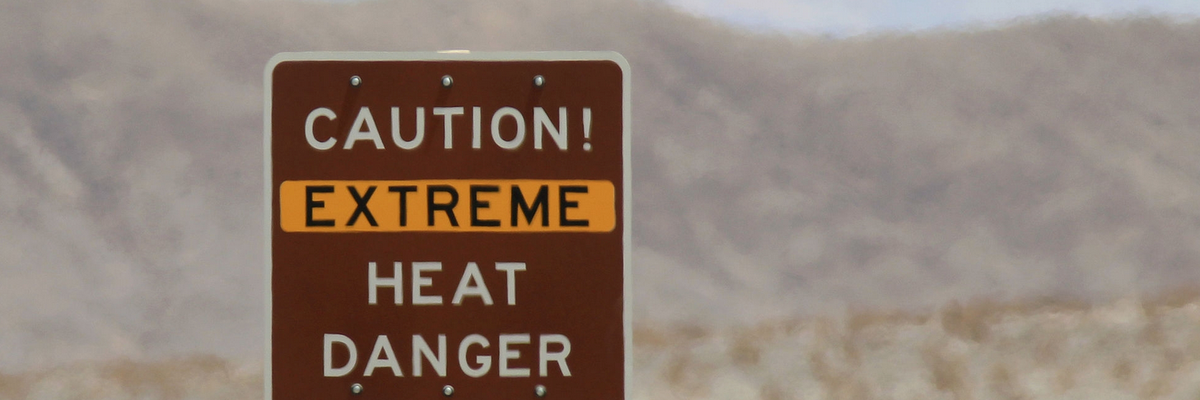
Heat waves rise near a heat danger warning sign in Death Valley National Park, California. (Photo: David McNew/Getty Images)
The recent UN report on climate change alerts the world to the dramatic consequences to the environment that increasing global warming trends in our planet pose for our survival. One of these negative consequences is on people's health, particularly in developing countries that don't have the financial resources to deal with them.
According to the National Oceanic and Atmospheric Administration 2020 was Earth's second hottest for the past 140 years. Furthermore, 19 of the warmest years on record have occurred since 2000. There has been a considerable impact of these increasing global warming trends on people of all ages.
Annual deaths as a result of climate change are estimated in 150,000 by the World Health Organization (WHO). Between 2030 and 2050, this number could be as high as 250,000 additional deaths. Most of those deaths will be due to heat stress, and to malnutrition, malaria and intestinal and respiratory infections, particularly in children from developing countries.
Climate change impacts negatively on social and environmental determinants of health such as clean air, safe drinking water, enough food and safe shelter. The direct costs of health conditions (excluding costs in health-determining sectors such as agriculture, water and sanitation) caused or worsened as a result of climate change is considerable. WHO estimates them at $2-4 billion by 2030.
It is possible that climate change may bring some benefits, such as fewer deaths in winter in some climates, as well as increased food production in areas free from the rigors of cold weather. However, an assessment of its consequences shows that most of them are negative.
The WHO reports that globally, the number of weather-related natural disasters has more than tripled since the 1960s. They have resulted in over 60,000 deaths, mainly in developing countries. Natural disasters force people to move, which increases the likelihood of negative health effects such as mental disorders and communicable diseases.
Ever more frequent heat waves increase illnesses and hospitalizations. On July 10, 2021, the third-hottest reliably measured temperature (129.4o F) was recorded at California's Death Valley. A study commissioned by AARP (American Association of Retired Persons) concludes that hospital admissions and emergency-room visits for kidney failure, urinary tract infections and other health problems increase significantly for older adults during heat waves.
Extremely high temperatures increase ground-level ozone concentrations which can lead to serious respiratory diseases such as asthma, emphysema and chronic obstructive pulmonary disease (COPD). Global warming also increases the number of infectious diseases carried by ticks, mosquitoes and other vectors.
Rising sea levels and floods not only destroy homes. They can also break down medical facilities and other health and social services. Floods contaminate freshwater supplies, thus increasing the risk of water-borne diseases. They also create breeding ground for mosquitoes, which have considerable disease-carrying capacity.
The tremendous challenge of climate change demands proper government policies to lower reliance on fossil fuels. Adequate policies are known; what is necessary is the political will to put them in action. By denying its dangers, the previous US administration has done tremendous harm to the cause of limiting the negative effects of climate change. Stronger action is now needed to overcome its deleterious effects.
It is necessary to increase individual resilience to be prepared to face adverse events by boosting personal preparedness, strengthening social and family connections, and creating and/or strengthening supportive mental health environments. The coronavirus pandemic has taught us that only by acting as a community we can solve global threats. Climate change not only affects our health and quality of life. It threatens our survival.
Dear Common Dreams reader, It’s been nearly 30 years since I co-founded Common Dreams with my late wife, Lina Newhouser. We had the radical notion that journalism should serve the public good, not corporate profits. It was clear to us from the outset what it would take to build such a project. No paid advertisements. No corporate sponsors. No millionaire publisher telling us what to think or do. Many people said we wouldn't last a year, but we proved those doubters wrong. Together with a tremendous team of journalists and dedicated staff, we built an independent media outlet free from the constraints of profits and corporate control. Our mission has always been simple: To inform. To inspire. To ignite change for the common good. Building Common Dreams was not easy. Our survival was never guaranteed. When you take on the most powerful forces—Wall Street greed, fossil fuel industry destruction, Big Tech lobbyists, and uber-rich oligarchs who have spent billions upon billions rigging the economy and democracy in their favor—the only bulwark you have is supporters who believe in your work. But here’s the urgent message from me today. It's never been this bad out there. And it's never been this hard to keep us going. At the very moment Common Dreams is most needed, the threats we face are intensifying. We need your support now more than ever. We don't accept corporate advertising and never will. We don't have a paywall because we don't think people should be blocked from critical news based on their ability to pay. Everything we do is funded by the donations of readers like you. When everyone does the little they can afford, we are strong. But if that support retreats or dries up, so do we. Will you donate now to make sure Common Dreams not only survives but thrives? —Craig Brown, Co-founder |
The recent UN report on climate change alerts the world to the dramatic consequences to the environment that increasing global warming trends in our planet pose for our survival. One of these negative consequences is on people's health, particularly in developing countries that don't have the financial resources to deal with them.
According to the National Oceanic and Atmospheric Administration 2020 was Earth's second hottest for the past 140 years. Furthermore, 19 of the warmest years on record have occurred since 2000. There has been a considerable impact of these increasing global warming trends on people of all ages.
Annual deaths as a result of climate change are estimated in 150,000 by the World Health Organization (WHO). Between 2030 and 2050, this number could be as high as 250,000 additional deaths. Most of those deaths will be due to heat stress, and to malnutrition, malaria and intestinal and respiratory infections, particularly in children from developing countries.
Climate change impacts negatively on social and environmental determinants of health such as clean air, safe drinking water, enough food and safe shelter. The direct costs of health conditions (excluding costs in health-determining sectors such as agriculture, water and sanitation) caused or worsened as a result of climate change is considerable. WHO estimates them at $2-4 billion by 2030.
It is possible that climate change may bring some benefits, such as fewer deaths in winter in some climates, as well as increased food production in areas free from the rigors of cold weather. However, an assessment of its consequences shows that most of them are negative.
The WHO reports that globally, the number of weather-related natural disasters has more than tripled since the 1960s. They have resulted in over 60,000 deaths, mainly in developing countries. Natural disasters force people to move, which increases the likelihood of negative health effects such as mental disorders and communicable diseases.
Ever more frequent heat waves increase illnesses and hospitalizations. On July 10, 2021, the third-hottest reliably measured temperature (129.4o F) was recorded at California's Death Valley. A study commissioned by AARP (American Association of Retired Persons) concludes that hospital admissions and emergency-room visits for kidney failure, urinary tract infections and other health problems increase significantly for older adults during heat waves.
Extremely high temperatures increase ground-level ozone concentrations which can lead to serious respiratory diseases such as asthma, emphysema and chronic obstructive pulmonary disease (COPD). Global warming also increases the number of infectious diseases carried by ticks, mosquitoes and other vectors.
Rising sea levels and floods not only destroy homes. They can also break down medical facilities and other health and social services. Floods contaminate freshwater supplies, thus increasing the risk of water-borne diseases. They also create breeding ground for mosquitoes, which have considerable disease-carrying capacity.
The tremendous challenge of climate change demands proper government policies to lower reliance on fossil fuels. Adequate policies are known; what is necessary is the political will to put them in action. By denying its dangers, the previous US administration has done tremendous harm to the cause of limiting the negative effects of climate change. Stronger action is now needed to overcome its deleterious effects.
It is necessary to increase individual resilience to be prepared to face adverse events by boosting personal preparedness, strengthening social and family connections, and creating and/or strengthening supportive mental health environments. The coronavirus pandemic has taught us that only by acting as a community we can solve global threats. Climate change not only affects our health and quality of life. It threatens our survival.
The recent UN report on climate change alerts the world to the dramatic consequences to the environment that increasing global warming trends in our planet pose for our survival. One of these negative consequences is on people's health, particularly in developing countries that don't have the financial resources to deal with them.
According to the National Oceanic and Atmospheric Administration 2020 was Earth's second hottest for the past 140 years. Furthermore, 19 of the warmest years on record have occurred since 2000. There has been a considerable impact of these increasing global warming trends on people of all ages.
Annual deaths as a result of climate change are estimated in 150,000 by the World Health Organization (WHO). Between 2030 and 2050, this number could be as high as 250,000 additional deaths. Most of those deaths will be due to heat stress, and to malnutrition, malaria and intestinal and respiratory infections, particularly in children from developing countries.
Climate change impacts negatively on social and environmental determinants of health such as clean air, safe drinking water, enough food and safe shelter. The direct costs of health conditions (excluding costs in health-determining sectors such as agriculture, water and sanitation) caused or worsened as a result of climate change is considerable. WHO estimates them at $2-4 billion by 2030.
It is possible that climate change may bring some benefits, such as fewer deaths in winter in some climates, as well as increased food production in areas free from the rigors of cold weather. However, an assessment of its consequences shows that most of them are negative.
The WHO reports that globally, the number of weather-related natural disasters has more than tripled since the 1960s. They have resulted in over 60,000 deaths, mainly in developing countries. Natural disasters force people to move, which increases the likelihood of negative health effects such as mental disorders and communicable diseases.
Ever more frequent heat waves increase illnesses and hospitalizations. On July 10, 2021, the third-hottest reliably measured temperature (129.4o F) was recorded at California's Death Valley. A study commissioned by AARP (American Association of Retired Persons) concludes that hospital admissions and emergency-room visits for kidney failure, urinary tract infections and other health problems increase significantly for older adults during heat waves.
Extremely high temperatures increase ground-level ozone concentrations which can lead to serious respiratory diseases such as asthma, emphysema and chronic obstructive pulmonary disease (COPD). Global warming also increases the number of infectious diseases carried by ticks, mosquitoes and other vectors.
Rising sea levels and floods not only destroy homes. They can also break down medical facilities and other health and social services. Floods contaminate freshwater supplies, thus increasing the risk of water-borne diseases. They also create breeding ground for mosquitoes, which have considerable disease-carrying capacity.
The tremendous challenge of climate change demands proper government policies to lower reliance on fossil fuels. Adequate policies are known; what is necessary is the political will to put them in action. By denying its dangers, the previous US administration has done tremendous harm to the cause of limiting the negative effects of climate change. Stronger action is now needed to overcome its deleterious effects.
It is necessary to increase individual resilience to be prepared to face adverse events by boosting personal preparedness, strengthening social and family connections, and creating and/or strengthening supportive mental health environments. The coronavirus pandemic has taught us that only by acting as a community we can solve global threats. Climate change not only affects our health and quality of life. It threatens our survival.