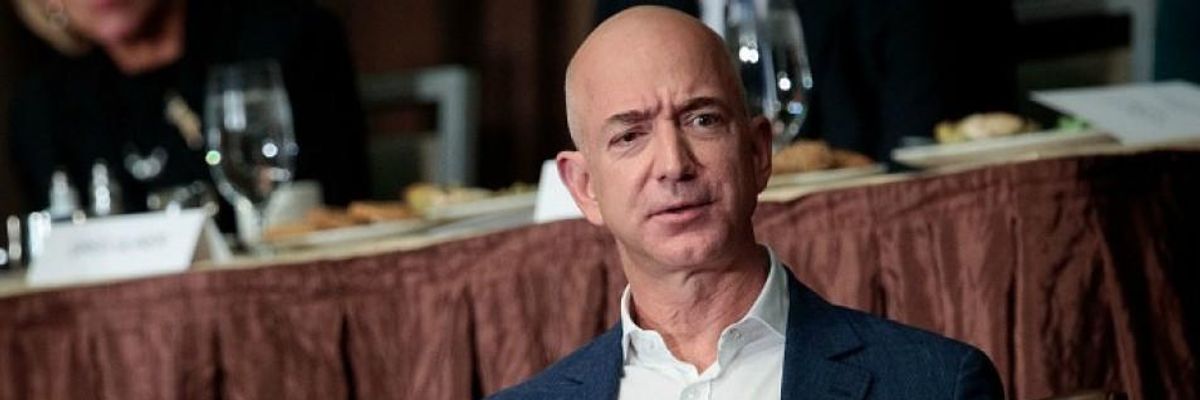
Jeff Bezos, chairman and founder of Amazon.com and owner of the Washington Post, addresses the Economic Club of New York, at the Sheraton New York Times Square Hotel, October 27, 2016 in New York City. (Photo: Drew Angerer/Getty Images)
Why Is Amazon Abusing Its Workers? Because It Can
The power shift can be reversed—but only with stronger labor laws, tougher trade deals, and a renewed commitment to antitrust.
The most dramatic change in American capitalism over the last half century has been the emergence of corporate behemoths like Amazon and the simultaneous shrinkage of organized labor. The resulting imbalance has spawned near-record inequalities of income and wealth, corruption of democracy by big money, and the abandonment of the working class.
All this is coming to a head in several ways.
Next week, Amazon faces a union vote at its warehouse in Bessemer, Alabama. If successful, it would be Amazon's first U.S.-based union in its nearly 27-year history.
Conditions in Amazon's warehouses would please Kim Jong un--strict production quotas, 10-hour workdays with only two half-hour breaks, unsafe procedures, arbitrary firings, "and they track our every move," Jennifer Bates, a warehouse worker at Bessemer, told the Senate Budget Committee last week.
To thwart the union drive, Amazon has required Bessemer workers to attend anti-union meetings, warned workers they'd have to pay union dues (wrong--Alabama is a so-called "right-to-work" state that bars mandatory dues), and intimidated and harassed organizers.
Why is Amazon abusing its workers?
The company isn't exactly hard-up. It's the most profitable firm in America. Its executive chairman and largest shareholder, Jeff Bezos, is the richest man in the world, holding more wealth than the bottom 39 percent of Americans put together.
Amazon is abusing workers because it can.
Fifty years ago, General Motors was the largest employer in America. The typical GM worker earned $35 an hour in today's dollars and had a major say over working conditions. Today's largest employers are Amazon and Walmart, each paying around $15 an hour and treating their workers like cattle.
This decades-long power shift--the emergence of corporate leviathans and the demise of labor unions--has resulted in a massive upward redistribution of income and wealth.
The typical GM worker wasn't "worth" more than twice today's Amazon or Walmart worker and didn't have more valuable insights about how work should be organized. The difference is GM workers a half-century ago had a strong union behind them, summoning the collective bargaining power of over a third of the entire American workforce.
By contrast, today's Amazon and Walmart workers are on their own. And because only 6.4 percent of America's private-sector workers are now unionized, there's little collective pressure on Amazon or Walmart to treat their workers any better.
Fifty years ago, "big labor" had enough political clout to ensure labor laws were enforced and that the government pushed giant firms like GM to sustain the middle class.
Today, organized labor's political clout is miniscule by comparison. The biggest political players are giant corporations like Amazon. And what have they done with their muscle? Encouraged state "right-to-work" laws, diluted federal labor protections, and kept the National Labor Relations Board understaffed and overburdened.
They've also impelled government to lower their taxes (Amazon paid zero federal taxes in 2018); extorted states to provide them tax breaks as condition for locating facilities there (Amazon is a champion at this game); bullied cities where they're headquartered (Amazon forced Seattle to back down on a plan to tax big corporations like itself to pay for homeless shelters); and wangled trade treaties allowing them to outsource so many jobs that blue-collar workers in America have little choice but to take low-paying, high-stress warehouse and delivery gigs.
Oh, and they've neutered antitrust laws, which in earlier era would have had companies like Amazon in their crosshairs.
This decades-long power shift--the emergence of corporate leviathans and the demise of labor unions--has resulted in a massive upward redistribution of income and wealth. The richest 0.1 of Americans now has almost as much wealth as the bottom 90 percent put together.
Corporate profits account for a growing share of the total economy and wages a declining share, with multi-billionaire executives and investors like Bezos taking home the lion's share.
The power shift can be reversed--but only with stronger labor laws, tougher trade deals, and a renewed commitment to antitrust.
The Biden administration and congressional Democrats appear willing. The House has just passed the toughest labor law reforms in over a generation. Biden's new trade representative, Katherine Tai, promises that trade deals will protect the interests of American workers rather than exporters. And Biden is putting trustbusters in critical positions at the Federal Trade Commission and in the White House.
I'd like to think America is at a tipping point similar to where it was some hundred twenty years ago when the ravages and excesses of the Gilded Age precipitated what became known as the Progressive Era. Then, reformers reversed the course of American capitalism for the next 70 years, making it work for the many rather than the few.
Today's progressive activists--in Washington, at Amazon's Bessemer warehouse, and elsewhere around the nation--may be on the verge of doing the same.
We are at a crossroads
This country and this world are at a monumental crossroads. In a few short weeks, US voters will have an opportunity to beat back the forces of fascism and confront the billionaires who are rigging the economy, our media system, and our democracy, making it increasingly impossible for ordinary people to get by. We’re not just talking about the election. We’re talking about what must be done once these fascist elements are vanquished from power. We need a bolder set of solutions than what either major party has so far been willing to offer and a working-class movement ready to fight like hell for it. Trump didn't emerge from nowhere. The conditions that fueled MAGA authoritarianism were created by decades of radical neoliberal economic policies and a corrupt political system dominated by corporate interests. They slashed taxes on the super-rich, promising that the benefits would trickle down. They said giveaways to the corporate titans would make life more affordable for the rest of us. It was all bullshit. And when a bitter, betrayed populace searches for someone to blame, right-wing demagogues have little trouble finding scapegoats. People know when they're being lied to, but you won't hear any of this from the corporate media. Only independent journalism—powered and funded by people who believe in building a better world—can deliver truly trustworthy daily news. Our Fall Campaign is underway, and we need your help. To power our newsroom through the rest of the year, we need to raise $125,000 by midnight on October 31. So if you share our vision, please contribute whatever you can to sustain our work. |
The most dramatic change in American capitalism over the last half century has been the emergence of corporate behemoths like Amazon and the simultaneous shrinkage of organized labor. The resulting imbalance has spawned near-record inequalities of income and wealth, corruption of democracy by big money, and the abandonment of the working class.
All this is coming to a head in several ways.
Next week, Amazon faces a union vote at its warehouse in Bessemer, Alabama. If successful, it would be Amazon's first U.S.-based union in its nearly 27-year history.
Conditions in Amazon's warehouses would please Kim Jong un--strict production quotas, 10-hour workdays with only two half-hour breaks, unsafe procedures, arbitrary firings, "and they track our every move," Jennifer Bates, a warehouse worker at Bessemer, told the Senate Budget Committee last week.
To thwart the union drive, Amazon has required Bessemer workers to attend anti-union meetings, warned workers they'd have to pay union dues (wrong--Alabama is a so-called "right-to-work" state that bars mandatory dues), and intimidated and harassed organizers.
Why is Amazon abusing its workers?
The company isn't exactly hard-up. It's the most profitable firm in America. Its executive chairman and largest shareholder, Jeff Bezos, is the richest man in the world, holding more wealth than the bottom 39 percent of Americans put together.
Amazon is abusing workers because it can.
Fifty years ago, General Motors was the largest employer in America. The typical GM worker earned $35 an hour in today's dollars and had a major say over working conditions. Today's largest employers are Amazon and Walmart, each paying around $15 an hour and treating their workers like cattle.
This decades-long power shift--the emergence of corporate leviathans and the demise of labor unions--has resulted in a massive upward redistribution of income and wealth.
The typical GM worker wasn't "worth" more than twice today's Amazon or Walmart worker and didn't have more valuable insights about how work should be organized. The difference is GM workers a half-century ago had a strong union behind them, summoning the collective bargaining power of over a third of the entire American workforce.
By contrast, today's Amazon and Walmart workers are on their own. And because only 6.4 percent of America's private-sector workers are now unionized, there's little collective pressure on Amazon or Walmart to treat their workers any better.
Fifty years ago, "big labor" had enough political clout to ensure labor laws were enforced and that the government pushed giant firms like GM to sustain the middle class.
Today, organized labor's political clout is miniscule by comparison. The biggest political players are giant corporations like Amazon. And what have they done with their muscle? Encouraged state "right-to-work" laws, diluted federal labor protections, and kept the National Labor Relations Board understaffed and overburdened.
They've also impelled government to lower their taxes (Amazon paid zero federal taxes in 2018); extorted states to provide them tax breaks as condition for locating facilities there (Amazon is a champion at this game); bullied cities where they're headquartered (Amazon forced Seattle to back down on a plan to tax big corporations like itself to pay for homeless shelters); and wangled trade treaties allowing them to outsource so many jobs that blue-collar workers in America have little choice but to take low-paying, high-stress warehouse and delivery gigs.
Oh, and they've neutered antitrust laws, which in earlier era would have had companies like Amazon in their crosshairs.
This decades-long power shift--the emergence of corporate leviathans and the demise of labor unions--has resulted in a massive upward redistribution of income and wealth. The richest 0.1 of Americans now has almost as much wealth as the bottom 90 percent put together.
Corporate profits account for a growing share of the total economy and wages a declining share, with multi-billionaire executives and investors like Bezos taking home the lion's share.
The power shift can be reversed--but only with stronger labor laws, tougher trade deals, and a renewed commitment to antitrust.
The Biden administration and congressional Democrats appear willing. The House has just passed the toughest labor law reforms in over a generation. Biden's new trade representative, Katherine Tai, promises that trade deals will protect the interests of American workers rather than exporters. And Biden is putting trustbusters in critical positions at the Federal Trade Commission and in the White House.
I'd like to think America is at a tipping point similar to where it was some hundred twenty years ago when the ravages and excesses of the Gilded Age precipitated what became known as the Progressive Era. Then, reformers reversed the course of American capitalism for the next 70 years, making it work for the many rather than the few.
Today's progressive activists--in Washington, at Amazon's Bessemer warehouse, and elsewhere around the nation--may be on the verge of doing the same.