SUBSCRIBE TO OUR FREE NEWSLETTER
Daily news & progressive opinion—funded by the people, not the corporations—delivered straight to your inbox.
5
#000000
#FFFFFF
To donate by check, phone, or other method, see our More Ways to Give page.
Daily news & progressive opinion—funded by the people, not the corporations—delivered straight to your inbox.
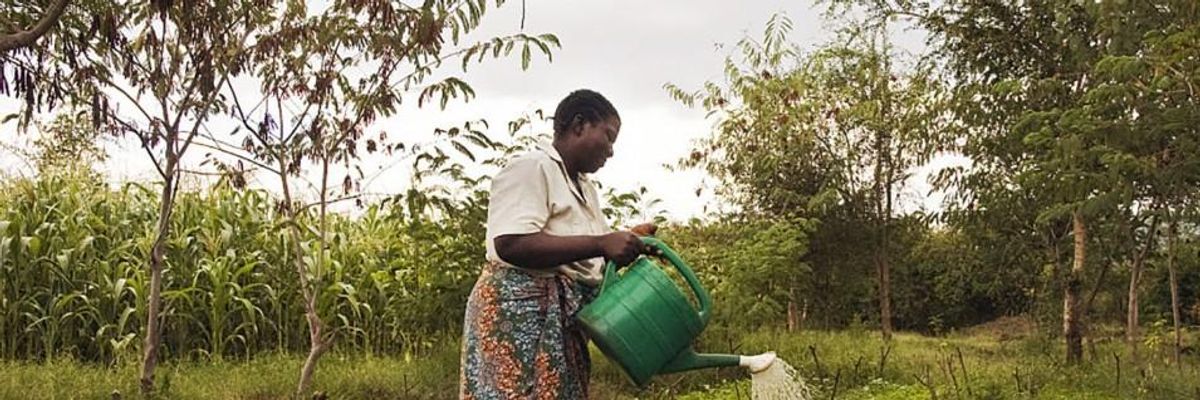
While farmers need to be supported in transitioning to climate-friendly practices, using carbon offsets to compensate for emissions elsewhere does not bring about the necessary changes. (Photo: Wendy Stone/Corbis via Getty Images)
Today, governments at the United Nations Framework Convention on Climate Change (UNFCCC) are discussing the role of carbon markets in international climate action. The "Article 6" rules, which define how countries can reduce their emissions using international carbon markets, are the last part of the Paris Agreement to be resolved. In preparation for these negotiations, IATP and partners released a briefing paper outlining why agricultural offsets do not work and should be kept out of international carbon markets.
International carbon markets would allow countries struggling to meet their emissions reduction goals to purchase offsets from other countries that cut their emissions more than they pledged. Agricultural offsets, which permit carbon sequestered in the soil to act as an offset for emissions elsewhere, are increasingly being integrated into carbon markets. Unfortunately, agricultural offsets are a false solution. The tools to measure soil carbon to the degree of accuracy and reliability that a market would require do not exist currently. Soil carbon storage is also extremely impermanent; any carbon sequestered in the soil can be released with a change in land management practices or through severe weather events.
In addition to measurement and permanence uncertainties, agricultural offsetting projects are extremely expensive. The FAO estimates that establishing market infrastructure for monitoring, reporting and verifying agricultural carbon credits would cost 3.8 billion euros for the agriculture sector in 2030. These expenses are passed on to the farmer; in the Kenya Agricultural Carbon Project, farmers are expected to receive just over one dollar per year over the 20 years of the project. The main benefit for farmers is presented as increased yields; however, participation in these projects can lock farmers into agricultural practices dependent on synthetic inputs that cost money and cause environmental degradation. Given the high transaction costs associated with many agricultural offset projects, they tend to work best for large-scale farms, which could contribute to further consolidation in agriculture.
Farmers suffer consequences beyond low and volatile prices. Some projects increase farmers' dependency on agribusiness by requiring them to use proprietary seeds or chemical inputs. This can prevent farmers from using traditional knowledge of fighting pests and fertilizing soils and creates a dependency on the multinational corporations that sell the inputs. Farmers may also come to depend on certain companies to buy their products. In the Mount Elgon project in Kenya, Brookside Africa committed to buying all the milk produced by farmers 10 years. Once the project ends, farmers could find themselves without a buyer. This also undercuts communities' ability to develop local markets for local populations.
Agricultural offset projects put the impetus on farmers, especially in the Global South, to change. Putting the responsibility of mitigation on farmers lets companies off the hook for reducing emissions along the entire supply chain. This is especially problematic for offset projects in the Global South, where farmers are the least responsible for causing climate change and are suffering most from its consequences.
Negotiators at the UNFCCC should exclude agriculture from carbon markets under the Paris Agreement. While farmers need to be supported in transitioning to climate-friendly practices, using carbon offsets to compensate for emissions elsewhere does not bring about the necessary changes. Governments should invest in policies and programs that incentivize agroecology, without allowing the achieved emission reductions to justify pollution elsewhere.
Dear Common Dreams reader, It’s been nearly 30 years since I co-founded Common Dreams with my late wife, Lina Newhouser. We had the radical notion that journalism should serve the public good, not corporate profits. It was clear to us from the outset what it would take to build such a project. No paid advertisements. No corporate sponsors. No millionaire publisher telling us what to think or do. Many people said we wouldn't last a year, but we proved those doubters wrong. Together with a tremendous team of journalists and dedicated staff, we built an independent media outlet free from the constraints of profits and corporate control. Our mission has always been simple: To inform. To inspire. To ignite change for the common good. Building Common Dreams was not easy. Our survival was never guaranteed. When you take on the most powerful forces—Wall Street greed, fossil fuel industry destruction, Big Tech lobbyists, and uber-rich oligarchs who have spent billions upon billions rigging the economy and democracy in their favor—the only bulwark you have is supporters who believe in your work. But here’s the urgent message from me today. It's never been this bad out there. And it's never been this hard to keep us going. At the very moment Common Dreams is most needed, the threats we face are intensifying. We need your support now more than ever. We don't accept corporate advertising and never will. We don't have a paywall because we don't think people should be blocked from critical news based on their ability to pay. Everything we do is funded by the donations of readers like you. When everyone does the little they can afford, we are strong. But if that support retreats or dries up, so do we. Will you donate now to make sure Common Dreams not only survives but thrives? —Craig Brown, Co-founder |
Today, governments at the United Nations Framework Convention on Climate Change (UNFCCC) are discussing the role of carbon markets in international climate action. The "Article 6" rules, which define how countries can reduce their emissions using international carbon markets, are the last part of the Paris Agreement to be resolved. In preparation for these negotiations, IATP and partners released a briefing paper outlining why agricultural offsets do not work and should be kept out of international carbon markets.
International carbon markets would allow countries struggling to meet their emissions reduction goals to purchase offsets from other countries that cut their emissions more than they pledged. Agricultural offsets, which permit carbon sequestered in the soil to act as an offset for emissions elsewhere, are increasingly being integrated into carbon markets. Unfortunately, agricultural offsets are a false solution. The tools to measure soil carbon to the degree of accuracy and reliability that a market would require do not exist currently. Soil carbon storage is also extremely impermanent; any carbon sequestered in the soil can be released with a change in land management practices or through severe weather events.
In addition to measurement and permanence uncertainties, agricultural offsetting projects are extremely expensive. The FAO estimates that establishing market infrastructure for monitoring, reporting and verifying agricultural carbon credits would cost 3.8 billion euros for the agriculture sector in 2030. These expenses are passed on to the farmer; in the Kenya Agricultural Carbon Project, farmers are expected to receive just over one dollar per year over the 20 years of the project. The main benefit for farmers is presented as increased yields; however, participation in these projects can lock farmers into agricultural practices dependent on synthetic inputs that cost money and cause environmental degradation. Given the high transaction costs associated with many agricultural offset projects, they tend to work best for large-scale farms, which could contribute to further consolidation in agriculture.
Farmers suffer consequences beyond low and volatile prices. Some projects increase farmers' dependency on agribusiness by requiring them to use proprietary seeds or chemical inputs. This can prevent farmers from using traditional knowledge of fighting pests and fertilizing soils and creates a dependency on the multinational corporations that sell the inputs. Farmers may also come to depend on certain companies to buy their products. In the Mount Elgon project in Kenya, Brookside Africa committed to buying all the milk produced by farmers 10 years. Once the project ends, farmers could find themselves without a buyer. This also undercuts communities' ability to develop local markets for local populations.
Agricultural offset projects put the impetus on farmers, especially in the Global South, to change. Putting the responsibility of mitigation on farmers lets companies off the hook for reducing emissions along the entire supply chain. This is especially problematic for offset projects in the Global South, where farmers are the least responsible for causing climate change and are suffering most from its consequences.
Negotiators at the UNFCCC should exclude agriculture from carbon markets under the Paris Agreement. While farmers need to be supported in transitioning to climate-friendly practices, using carbon offsets to compensate for emissions elsewhere does not bring about the necessary changes. Governments should invest in policies and programs that incentivize agroecology, without allowing the achieved emission reductions to justify pollution elsewhere.
Today, governments at the United Nations Framework Convention on Climate Change (UNFCCC) are discussing the role of carbon markets in international climate action. The "Article 6" rules, which define how countries can reduce their emissions using international carbon markets, are the last part of the Paris Agreement to be resolved. In preparation for these negotiations, IATP and partners released a briefing paper outlining why agricultural offsets do not work and should be kept out of international carbon markets.
International carbon markets would allow countries struggling to meet their emissions reduction goals to purchase offsets from other countries that cut their emissions more than they pledged. Agricultural offsets, which permit carbon sequestered in the soil to act as an offset for emissions elsewhere, are increasingly being integrated into carbon markets. Unfortunately, agricultural offsets are a false solution. The tools to measure soil carbon to the degree of accuracy and reliability that a market would require do not exist currently. Soil carbon storage is also extremely impermanent; any carbon sequestered in the soil can be released with a change in land management practices or through severe weather events.
In addition to measurement and permanence uncertainties, agricultural offsetting projects are extremely expensive. The FAO estimates that establishing market infrastructure for monitoring, reporting and verifying agricultural carbon credits would cost 3.8 billion euros for the agriculture sector in 2030. These expenses are passed on to the farmer; in the Kenya Agricultural Carbon Project, farmers are expected to receive just over one dollar per year over the 20 years of the project. The main benefit for farmers is presented as increased yields; however, participation in these projects can lock farmers into agricultural practices dependent on synthetic inputs that cost money and cause environmental degradation. Given the high transaction costs associated with many agricultural offset projects, they tend to work best for large-scale farms, which could contribute to further consolidation in agriculture.
Farmers suffer consequences beyond low and volatile prices. Some projects increase farmers' dependency on agribusiness by requiring them to use proprietary seeds or chemical inputs. This can prevent farmers from using traditional knowledge of fighting pests and fertilizing soils and creates a dependency on the multinational corporations that sell the inputs. Farmers may also come to depend on certain companies to buy their products. In the Mount Elgon project in Kenya, Brookside Africa committed to buying all the milk produced by farmers 10 years. Once the project ends, farmers could find themselves without a buyer. This also undercuts communities' ability to develop local markets for local populations.
Agricultural offset projects put the impetus on farmers, especially in the Global South, to change. Putting the responsibility of mitigation on farmers lets companies off the hook for reducing emissions along the entire supply chain. This is especially problematic for offset projects in the Global South, where farmers are the least responsible for causing climate change and are suffering most from its consequences.
Negotiators at the UNFCCC should exclude agriculture from carbon markets under the Paris Agreement. While farmers need to be supported in transitioning to climate-friendly practices, using carbon offsets to compensate for emissions elsewhere does not bring about the necessary changes. Governments should invest in policies and programs that incentivize agroecology, without allowing the achieved emission reductions to justify pollution elsewhere.