SUBSCRIBE TO OUR FREE NEWSLETTER
Daily news & progressive opinion—funded by the people, not the corporations—delivered straight to your inbox.
5
#000000
#FFFFFF
To donate by check, phone, or other method, see our More Ways to Give page.
Daily news & progressive opinion—funded by the people, not the corporations—delivered straight to your inbox.
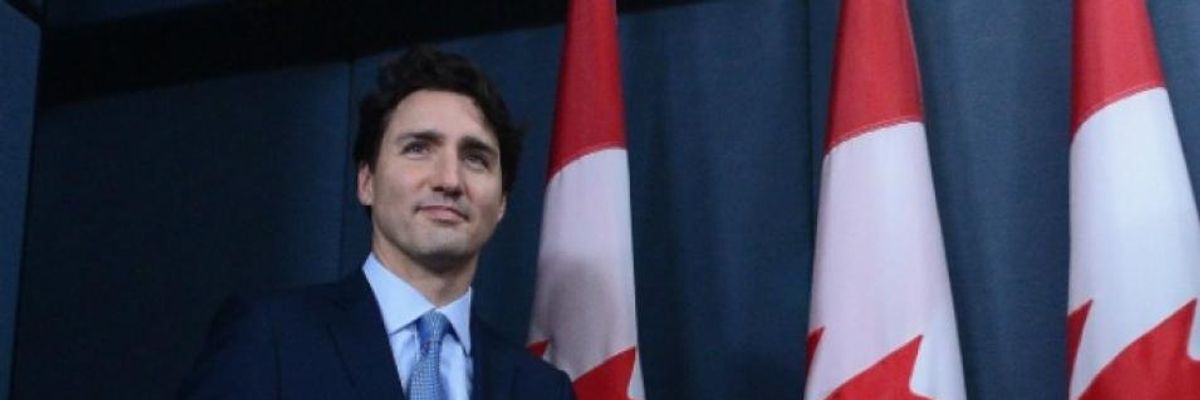
Trudeau's doing a great deal to make the situation worse during this pandemic for some of the most vulnerable people on the planet. (Photo: Sean Kilpatrick/Canadian Press)
These days, any national leader not actively urging their citizens to drink disinfectant is managing to look (relatively) good on the world stage.
Certainly, compared to the neurotic leadership south of the border, Justin Trudeau has emerged as a steady hand on the tiller, quickly providing Canadians with a wide economic safety net and behaving like an adult in the crisis.
So it's all the more disappointing that, out of the limelight, he's doing a great deal to make the situation worse during this pandemic for some of the most vulnerable people on the planet.
The impact of sanctions, while always painful, is particularly deadly during the pandemic, when even advanced nations have struggled to obtain life-saving equipment.
That sounds like a reasonable request, under the circumstances.
Indeed, even if we don't care about the world's vulnerable people, helping them deal with the crisis is in our interests too. As the UN leader noted: "Let us remember that we are only as strong as the weakest health system in our interconnected world."
Yet Canada, ignoring the plea from the UN's highest official, continues in the midst of the pandemic to impose sanctions on 20 nations, including Lebanon, Venezuela, Syria, Iran, Libya, Somalia, Nicaragua and Yemen.
Kubursi, who also served as a UN under-secretary-general and has extensive UN experience in the Middle East and Asia, says the impact of Canada's sanctions on the people in these countries is devastating.
While the sanctions often appear to be directed exclusively at military items, they frequently end up being applied to virtually all goods -- including spare parts needed to operate machinery in hospitals and pharmaceutical companies, notes Kubursi, who signed a letter from prominent Canadians to Trudeau requesting the lifting of sanctions.
For instance, if a Syrian businessman wants to buy Canadian products, he has to open an account for the transaction. But Kubursi says the Canadian government instructs Canadian banks not to allow such accounts for the purposes of trade with Syria -- no matter how benign the Canadian product may be, or how urgently it might be needed in Syria.
For that matter, Ottawa's sanctions prevent Canadians from using our banks or financial services to transfer money to Syria -- for instance, to family members living in Syria.
While Canada's sanctions mostly date back to the Harper era or earlier, the Trudeau government has generally maintained them and even added new ones against Venezuela.
Ottawa's sanctions appear primarily aimed at appeasing the U.S., which ruthlessly enforces sanctions against regimes it wishes to destabilize or overthrow. Washington also punishes countries and companies that don't co-operate with its sanctions.
Ottawa's willingness to fall in line behind Washington is reflected in the fact it doesn't impose sanctions against U.S allies Saudi Arabia or Israel, despite Saudi Arabia's brutal murder of dissident Jamal Khashoggi and Israel's illegal occupation of the West Bank.
Trudeau's decision to continue sanctioning 20 nations seems quite out of sync with the spirit of the times, when it's hard to find a TV commercial that doesn't proclaim the sentiment that "we're all in this together."
That spirit of international togetherness has been amply demonstrated by Cuba, which sent Cuban doctors to Italy to help its overwhelmed health care system and has offered similar medical help to First Nations in Canada.
When 36 Cuban doctors arrived in Milan last month, a grateful Italy thanked them and Italians at the airport cheered.
Meanwhile, Canada, in the spirit of the international togetherness, rebuffs Cuban doctors, ignores the UN and imposes sanctions on some of the world's poorest nations
Dear Common Dreams reader, It’s been nearly 30 years since I co-founded Common Dreams with my late wife, Lina Newhouser. We had the radical notion that journalism should serve the public good, not corporate profits. It was clear to us from the outset what it would take to build such a project. No paid advertisements. No corporate sponsors. No millionaire publisher telling us what to think or do. Many people said we wouldn't last a year, but we proved those doubters wrong. Together with a tremendous team of journalists and dedicated staff, we built an independent media outlet free from the constraints of profits and corporate control. Our mission has always been simple: To inform. To inspire. To ignite change for the common good. Building Common Dreams was not easy. Our survival was never guaranteed. When you take on the most powerful forces—Wall Street greed, fossil fuel industry destruction, Big Tech lobbyists, and uber-rich oligarchs who have spent billions upon billions rigging the economy and democracy in their favor—the only bulwark you have is supporters who believe in your work. But here’s the urgent message from me today. It's never been this bad out there. And it's never been this hard to keep us going. At the very moment Common Dreams is most needed, the threats we face are intensifying. We need your support now more than ever. We don't accept corporate advertising and never will. We don't have a paywall because we don't think people should be blocked from critical news based on their ability to pay. Everything we do is funded by the donations of readers like you. When everyone does the little they can afford, we are strong. But if that support retreats or dries up, so do we. Will you donate now to make sure Common Dreams not only survives but thrives? —Craig Brown, Co-founder |
These days, any national leader not actively urging their citizens to drink disinfectant is managing to look (relatively) good on the world stage.
Certainly, compared to the neurotic leadership south of the border, Justin Trudeau has emerged as a steady hand on the tiller, quickly providing Canadians with a wide economic safety net and behaving like an adult in the crisis.
So it's all the more disappointing that, out of the limelight, he's doing a great deal to make the situation worse during this pandemic for some of the most vulnerable people on the planet.
The impact of sanctions, while always painful, is particularly deadly during the pandemic, when even advanced nations have struggled to obtain life-saving equipment.
That sounds like a reasonable request, under the circumstances.
Indeed, even if we don't care about the world's vulnerable people, helping them deal with the crisis is in our interests too. As the UN leader noted: "Let us remember that we are only as strong as the weakest health system in our interconnected world."
Yet Canada, ignoring the plea from the UN's highest official, continues in the midst of the pandemic to impose sanctions on 20 nations, including Lebanon, Venezuela, Syria, Iran, Libya, Somalia, Nicaragua and Yemen.
Kubursi, who also served as a UN under-secretary-general and has extensive UN experience in the Middle East and Asia, says the impact of Canada's sanctions on the people in these countries is devastating.
While the sanctions often appear to be directed exclusively at military items, they frequently end up being applied to virtually all goods -- including spare parts needed to operate machinery in hospitals and pharmaceutical companies, notes Kubursi, who signed a letter from prominent Canadians to Trudeau requesting the lifting of sanctions.
For instance, if a Syrian businessman wants to buy Canadian products, he has to open an account for the transaction. But Kubursi says the Canadian government instructs Canadian banks not to allow such accounts for the purposes of trade with Syria -- no matter how benign the Canadian product may be, or how urgently it might be needed in Syria.
For that matter, Ottawa's sanctions prevent Canadians from using our banks or financial services to transfer money to Syria -- for instance, to family members living in Syria.
While Canada's sanctions mostly date back to the Harper era or earlier, the Trudeau government has generally maintained them and even added new ones against Venezuela.
Ottawa's sanctions appear primarily aimed at appeasing the U.S., which ruthlessly enforces sanctions against regimes it wishes to destabilize or overthrow. Washington also punishes countries and companies that don't co-operate with its sanctions.
Ottawa's willingness to fall in line behind Washington is reflected in the fact it doesn't impose sanctions against U.S allies Saudi Arabia or Israel, despite Saudi Arabia's brutal murder of dissident Jamal Khashoggi and Israel's illegal occupation of the West Bank.
Trudeau's decision to continue sanctioning 20 nations seems quite out of sync with the spirit of the times, when it's hard to find a TV commercial that doesn't proclaim the sentiment that "we're all in this together."
That spirit of international togetherness has been amply demonstrated by Cuba, which sent Cuban doctors to Italy to help its overwhelmed health care system and has offered similar medical help to First Nations in Canada.
When 36 Cuban doctors arrived in Milan last month, a grateful Italy thanked them and Italians at the airport cheered.
Meanwhile, Canada, in the spirit of the international togetherness, rebuffs Cuban doctors, ignores the UN and imposes sanctions on some of the world's poorest nations
These days, any national leader not actively urging their citizens to drink disinfectant is managing to look (relatively) good on the world stage.
Certainly, compared to the neurotic leadership south of the border, Justin Trudeau has emerged as a steady hand on the tiller, quickly providing Canadians with a wide economic safety net and behaving like an adult in the crisis.
So it's all the more disappointing that, out of the limelight, he's doing a great deal to make the situation worse during this pandemic for some of the most vulnerable people on the planet.
The impact of sanctions, while always painful, is particularly deadly during the pandemic, when even advanced nations have struggled to obtain life-saving equipment.
That sounds like a reasonable request, under the circumstances.
Indeed, even if we don't care about the world's vulnerable people, helping them deal with the crisis is in our interests too. As the UN leader noted: "Let us remember that we are only as strong as the weakest health system in our interconnected world."
Yet Canada, ignoring the plea from the UN's highest official, continues in the midst of the pandemic to impose sanctions on 20 nations, including Lebanon, Venezuela, Syria, Iran, Libya, Somalia, Nicaragua and Yemen.
Kubursi, who also served as a UN under-secretary-general and has extensive UN experience in the Middle East and Asia, says the impact of Canada's sanctions on the people in these countries is devastating.
While the sanctions often appear to be directed exclusively at military items, they frequently end up being applied to virtually all goods -- including spare parts needed to operate machinery in hospitals and pharmaceutical companies, notes Kubursi, who signed a letter from prominent Canadians to Trudeau requesting the lifting of sanctions.
For instance, if a Syrian businessman wants to buy Canadian products, he has to open an account for the transaction. But Kubursi says the Canadian government instructs Canadian banks not to allow such accounts for the purposes of trade with Syria -- no matter how benign the Canadian product may be, or how urgently it might be needed in Syria.
For that matter, Ottawa's sanctions prevent Canadians from using our banks or financial services to transfer money to Syria -- for instance, to family members living in Syria.
While Canada's sanctions mostly date back to the Harper era or earlier, the Trudeau government has generally maintained them and even added new ones against Venezuela.
Ottawa's sanctions appear primarily aimed at appeasing the U.S., which ruthlessly enforces sanctions against regimes it wishes to destabilize or overthrow. Washington also punishes countries and companies that don't co-operate with its sanctions.
Ottawa's willingness to fall in line behind Washington is reflected in the fact it doesn't impose sanctions against U.S allies Saudi Arabia or Israel, despite Saudi Arabia's brutal murder of dissident Jamal Khashoggi and Israel's illegal occupation of the West Bank.
Trudeau's decision to continue sanctioning 20 nations seems quite out of sync with the spirit of the times, when it's hard to find a TV commercial that doesn't proclaim the sentiment that "we're all in this together."
That spirit of international togetherness has been amply demonstrated by Cuba, which sent Cuban doctors to Italy to help its overwhelmed health care system and has offered similar medical help to First Nations in Canada.
When 36 Cuban doctors arrived in Milan last month, a grateful Italy thanked them and Italians at the airport cheered.
Meanwhile, Canada, in the spirit of the international togetherness, rebuffs Cuban doctors, ignores the UN and imposes sanctions on some of the world's poorest nations