SUBSCRIBE TO OUR FREE NEWSLETTER
Daily news & progressive opinion—funded by the people, not the corporations—delivered straight to your inbox.
5
#000000
#FFFFFF
To donate by check, phone, or other method, see our More Ways to Give page.
Daily news & progressive opinion—funded by the people, not the corporations—delivered straight to your inbox.
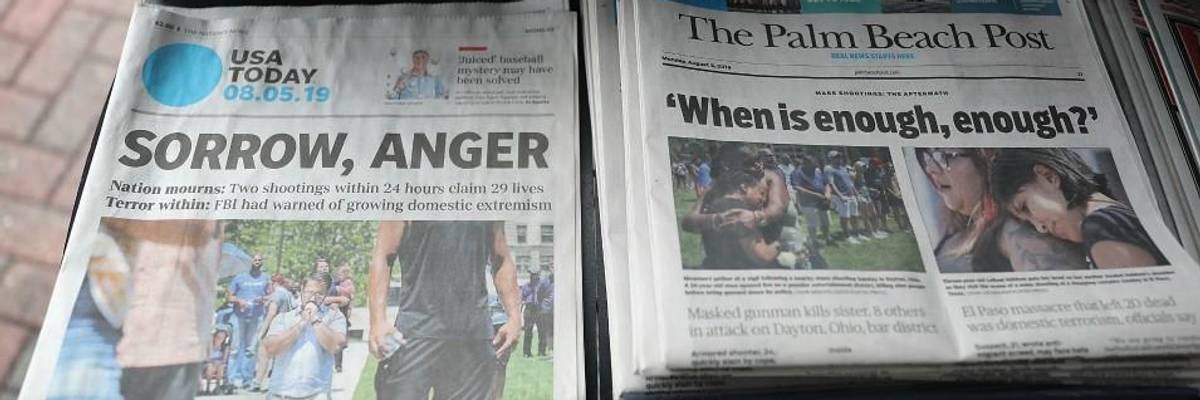
Do we really want our reporting on Warren, Sanders or Klobuchar--all of whom support bills to defend local media and block media mergers--brought to you by the world's biggest wealth-suckers? (Photo: Joe Raedle/Getty Images)
In the first week of February, every four years, coastal correspondents decamp to Iowa to cover the first-in-the nation nominating contest. Face-to-face, caucus by caucus, what the state lacks in demographics, it makes up for in down-home democracy, we're told. And down-home democracy rests on down-the-street media. That's why when the Des Moines Register endorses Elizabeth Warren, it makes national news. When Bernie Sanders leads in the Register's celebrated Iowa Poll, it sends shockwaves through the Democratic establishment. But much as we may want to believe that Iowa takes us back in time, it's not a time capsule. It's the frontier face of our media future.
Last November, GateHouse Media, the nation's largest newspaper chain gobbled up the Register when it merged with Gannett, the second largest, in a merger valued at $1.2 billion. The new company, called Gannett, now owns one in every six papers in the country, and the paymasters are a private equity firm, Fortress Investment Group, which itself is owned by a Japanese conglomerate, SoftBank.
At least 3.2 million Americans in 200 counties have no local paper.
Local news brought to you by profit predators is as American as apple pie. The most recent study by PEN America reads like an obituary for the US news business. At least 3.2 million Americans in 200 counties have no local paper. Most of the rest have only one--usually a weekly.
Casino capitalists have been vacuuming up the press, not to spruce things up, but to suck what remains dry. It's not scoops they're after, it's so-called "synergies." Gannett says they'll be seeking some $300 million of those, and across the network, layoffs are already happening.
What's a synergy in a newsroom? It's Tony Leys, veteran Register reporter, writing a feature, an analysis of the Iowa Poll, a human-interest piece and two explosive investigations in 3.5 weeks. He described his job to Politico.
Journalists from the Register, or papers like Sioux City Journal or the Quad-City Times, may still appear on your screens caucus night, bringing authenticity and some actual local knowledge to national coverage, but beat reporters in rural states are not some quaint exotic species. They need to eat too, and all across the country, they've been taking a beating from the very same monopoly capitalists and finance vultures who control commerce, communications and even our consciousness through buy-outs, buy-ups and advertising.
Local broadcasting is faring no better. Two leading TV stations in Des Moines and Davenport changed owners in the last year. Christian stations dominate the airwaves and Iowa has very few national public radio affiliates. The state's solitary community station, KHOI in Ames, is funded by listeners and staffed by volunteers. That's where I'll be this monday, co-hosting for the Pacifica network so that those volunteers can go caucus.
"We will go directly to the people--from farms to cities to the Meskwaki Native Tribe--for the important insights and context driving the results. It's not your typical national news coverage," says station manager Ursula Ruedenberg.
It may not be typical, but it may be the future. If local residents want local media, they'd be smart to volunteer or pledge for it, and maybe that's not so bad. After all, do we really want our reporting on Warren, Sanders or Klobuchar--all of whom support bills to defend local media and block media mergers--brought to you by the world's biggest wealth-suckers? I don't.
You will be able to follow the livestream of KHOI'S caucus coverage at our Facebook page and catch my live posts on Twitter. Monday, Feb 3 at 7 p.m. to Midnight EST. FIND OUT HOW AT LAURAFLANDERS.ORG
Dear Common Dreams reader, It’s been nearly 30 years since I co-founded Common Dreams with my late wife, Lina Newhouser. We had the radical notion that journalism should serve the public good, not corporate profits. It was clear to us from the outset what it would take to build such a project. No paid advertisements. No corporate sponsors. No millionaire publisher telling us what to think or do. Many people said we wouldn't last a year, but we proved those doubters wrong. Together with a tremendous team of journalists and dedicated staff, we built an independent media outlet free from the constraints of profits and corporate control. Our mission has always been simple: To inform. To inspire. To ignite change for the common good. Building Common Dreams was not easy. Our survival was never guaranteed. When you take on the most powerful forces—Wall Street greed, fossil fuel industry destruction, Big Tech lobbyists, and uber-rich oligarchs who have spent billions upon billions rigging the economy and democracy in their favor—the only bulwark you have is supporters who believe in your work. But here’s the urgent message from me today. It's never been this bad out there. And it's never been this hard to keep us going. At the very moment Common Dreams is most needed, the threats we face are intensifying. We need your support now more than ever. We don't accept corporate advertising and never will. We don't have a paywall because we don't think people should be blocked from critical news based on their ability to pay. Everything we do is funded by the donations of readers like you. When everyone does the little they can afford, we are strong. But if that support retreats or dries up, so do we. Will you donate now to make sure Common Dreams not only survives but thrives? —Craig Brown, Co-founder |
In the first week of February, every four years, coastal correspondents decamp to Iowa to cover the first-in-the nation nominating contest. Face-to-face, caucus by caucus, what the state lacks in demographics, it makes up for in down-home democracy, we're told. And down-home democracy rests on down-the-street media. That's why when the Des Moines Register endorses Elizabeth Warren, it makes national news. When Bernie Sanders leads in the Register's celebrated Iowa Poll, it sends shockwaves through the Democratic establishment. But much as we may want to believe that Iowa takes us back in time, it's not a time capsule. It's the frontier face of our media future.
Last November, GateHouse Media, the nation's largest newspaper chain gobbled up the Register when it merged with Gannett, the second largest, in a merger valued at $1.2 billion. The new company, called Gannett, now owns one in every six papers in the country, and the paymasters are a private equity firm, Fortress Investment Group, which itself is owned by a Japanese conglomerate, SoftBank.
At least 3.2 million Americans in 200 counties have no local paper.
Local news brought to you by profit predators is as American as apple pie. The most recent study by PEN America reads like an obituary for the US news business. At least 3.2 million Americans in 200 counties have no local paper. Most of the rest have only one--usually a weekly.
Casino capitalists have been vacuuming up the press, not to spruce things up, but to suck what remains dry. It's not scoops they're after, it's so-called "synergies." Gannett says they'll be seeking some $300 million of those, and across the network, layoffs are already happening.
What's a synergy in a newsroom? It's Tony Leys, veteran Register reporter, writing a feature, an analysis of the Iowa Poll, a human-interest piece and two explosive investigations in 3.5 weeks. He described his job to Politico.
Journalists from the Register, or papers like Sioux City Journal or the Quad-City Times, may still appear on your screens caucus night, bringing authenticity and some actual local knowledge to national coverage, but beat reporters in rural states are not some quaint exotic species. They need to eat too, and all across the country, they've been taking a beating from the very same monopoly capitalists and finance vultures who control commerce, communications and even our consciousness through buy-outs, buy-ups and advertising.
Local broadcasting is faring no better. Two leading TV stations in Des Moines and Davenport changed owners in the last year. Christian stations dominate the airwaves and Iowa has very few national public radio affiliates. The state's solitary community station, KHOI in Ames, is funded by listeners and staffed by volunteers. That's where I'll be this monday, co-hosting for the Pacifica network so that those volunteers can go caucus.
"We will go directly to the people--from farms to cities to the Meskwaki Native Tribe--for the important insights and context driving the results. It's not your typical national news coverage," says station manager Ursula Ruedenberg.
It may not be typical, but it may be the future. If local residents want local media, they'd be smart to volunteer or pledge for it, and maybe that's not so bad. After all, do we really want our reporting on Warren, Sanders or Klobuchar--all of whom support bills to defend local media and block media mergers--brought to you by the world's biggest wealth-suckers? I don't.
You will be able to follow the livestream of KHOI'S caucus coverage at our Facebook page and catch my live posts on Twitter. Monday, Feb 3 at 7 p.m. to Midnight EST. FIND OUT HOW AT LAURAFLANDERS.ORG
In the first week of February, every four years, coastal correspondents decamp to Iowa to cover the first-in-the nation nominating contest. Face-to-face, caucus by caucus, what the state lacks in demographics, it makes up for in down-home democracy, we're told. And down-home democracy rests on down-the-street media. That's why when the Des Moines Register endorses Elizabeth Warren, it makes national news. When Bernie Sanders leads in the Register's celebrated Iowa Poll, it sends shockwaves through the Democratic establishment. But much as we may want to believe that Iowa takes us back in time, it's not a time capsule. It's the frontier face of our media future.
Last November, GateHouse Media, the nation's largest newspaper chain gobbled up the Register when it merged with Gannett, the second largest, in a merger valued at $1.2 billion. The new company, called Gannett, now owns one in every six papers in the country, and the paymasters are a private equity firm, Fortress Investment Group, which itself is owned by a Japanese conglomerate, SoftBank.
At least 3.2 million Americans in 200 counties have no local paper.
Local news brought to you by profit predators is as American as apple pie. The most recent study by PEN America reads like an obituary for the US news business. At least 3.2 million Americans in 200 counties have no local paper. Most of the rest have only one--usually a weekly.
Casino capitalists have been vacuuming up the press, not to spruce things up, but to suck what remains dry. It's not scoops they're after, it's so-called "synergies." Gannett says they'll be seeking some $300 million of those, and across the network, layoffs are already happening.
What's a synergy in a newsroom? It's Tony Leys, veteran Register reporter, writing a feature, an analysis of the Iowa Poll, a human-interest piece and two explosive investigations in 3.5 weeks. He described his job to Politico.
Journalists from the Register, or papers like Sioux City Journal or the Quad-City Times, may still appear on your screens caucus night, bringing authenticity and some actual local knowledge to national coverage, but beat reporters in rural states are not some quaint exotic species. They need to eat too, and all across the country, they've been taking a beating from the very same monopoly capitalists and finance vultures who control commerce, communications and even our consciousness through buy-outs, buy-ups and advertising.
Local broadcasting is faring no better. Two leading TV stations in Des Moines and Davenport changed owners in the last year. Christian stations dominate the airwaves and Iowa has very few national public radio affiliates. The state's solitary community station, KHOI in Ames, is funded by listeners and staffed by volunteers. That's where I'll be this monday, co-hosting for the Pacifica network so that those volunteers can go caucus.
"We will go directly to the people--from farms to cities to the Meskwaki Native Tribe--for the important insights and context driving the results. It's not your typical national news coverage," says station manager Ursula Ruedenberg.
It may not be typical, but it may be the future. If local residents want local media, they'd be smart to volunteer or pledge for it, and maybe that's not so bad. After all, do we really want our reporting on Warren, Sanders or Klobuchar--all of whom support bills to defend local media and block media mergers--brought to you by the world's biggest wealth-suckers? I don't.
You will be able to follow the livestream of KHOI'S caucus coverage at our Facebook page and catch my live posts on Twitter. Monday, Feb 3 at 7 p.m. to Midnight EST. FIND OUT HOW AT LAURAFLANDERS.ORG