SUBSCRIBE TO OUR FREE NEWSLETTER
Daily news & progressive opinion—funded by the people, not the corporations—delivered straight to your inbox.
5
#000000
#FFFFFF
To donate by check, phone, or other method, see our More Ways to Give page.
Daily news & progressive opinion—funded by the people, not the corporations—delivered straight to your inbox.
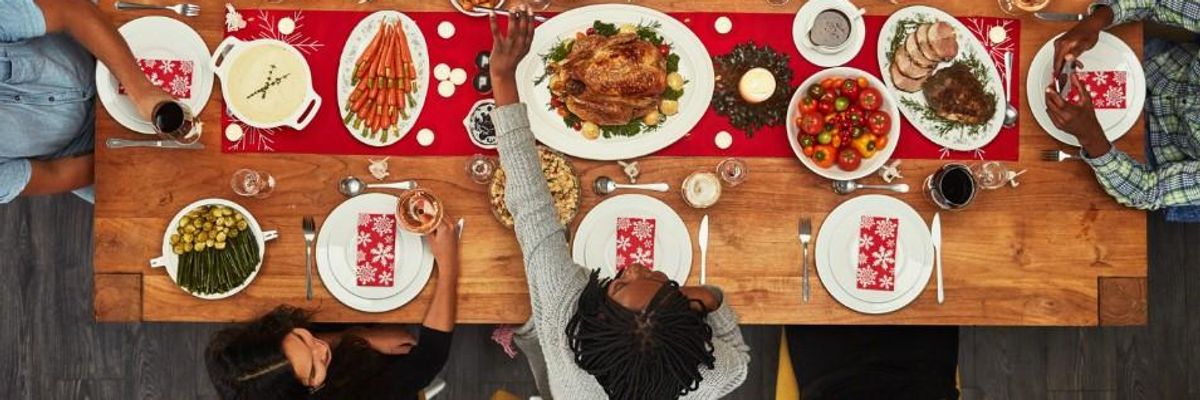
Now the fastest-growing segment of the food economy, it is creating the alternative model of a local, sustainable, small-scale, community-based, organic, humane, healthy, democratic -- and tasty! -- food system for all. (Photo: PeopleImages/Getty Images)
It's time to talk turkey!
No, not the Butterball sitting in the Oval Office. I'm talking about the real thing, the big bird, 46 million of which we Americans will devour on this Thanksgiving Day.
It was the Aztecs who first domesticated the gallopavo , but leave it to the Spanish explorers to "foul up" the bird's origins. They declared it to be related to the peacock -- wrong! They also thought the peacock originated in Turkey -- wrong! And, they thought Turkey was located in Africa -- well, you can see the Spanish were pretty confused.
Actually, the origin of Thanksgiving is confused. The popular assumption is that it was first celebrated by the Mayflower immigrants and the Wampanoag natives in Plymouth, Massachusetts in 1621. They feasted on venison, furkees (Wampanoag for gobblers) eels, mussels, corn and beer. But wait, say Virginians, the first precursor to our annual November Food-a-Palooza was not in Massachusetts; the Thanksgiving feast originated down here in the Jamestown colony back in 1608.
Whoa there. Hold your horses, Pilgrims. Folks in El Paso, Texas, say it all began way out there in 1598, when Spanish settlers sat down with people of the Piro and Manso tribes, gave thanks and then feasted on roasted duck, geese and fish.
"Ha!" says a Florida group, asserting that the very, very first Thanksgiving happened in 1565 when the Spanish settlers of St. Augustine and friends from the Timucuan tribe chowed down on "cocido" -- a stew of salt pork, garbanzo beans and garlic -- washing it all down with red wine.
Wherever it began, and whatever the purists claim is "official," Thanksgiving today is as multicultural as America. So let's enjoy! Kick back; give thanks that we're in a country with such ethnic richness; and dive into your turkey rellenos, Moo Shu Turkey, turkey falafel, barbecued turkey...
America certainly has an abundance of food (even though many Americans do not), yet we face a momentous choice of whether to pursue a food future rooted in the ethic of sustainable agriCULTURE -- or one based on the exploitative ethic of agriINDUSTRY.
What better symbol of agri-industry's vision of "food" than that ubiquitous Thanksgiving bird, the Butterball turkey? The Butterball has been hoisted onto our tables by huge advertising budgets and regular promotion payments to supermarkets. The birds themselves have been grotesquely deformed by industrial geneticists, who created breasts so ponderous that the turkeys can't walk, stand up or even reproduce on their own (thus earning the nickname "dead-end birds"). Adding torture to this intentional deformity, the industry sentences these once-majestic fowl to dismal lives in tiny confinement cages inside the sprawling steel-and-concrete animal factories that scar America's rural landscape -- monuments to greed-based corporate "husbandry."
As the eminent farmer-poet-activist Wendell Berry tells us, eating is a profound political act. It lets you and me vote for the Butterball industrial model or choose to go back to the future of agriculture, which is the art and science of cooperating with, rather than trying to overwhelm, nature. That cooperative ethic is the choice of the remarkable Good Food Uprising that has spread across the country in the past 30 years. Now the fastest-growing segment of the food economy, it is creating the alternative model of a local, sustainable, small-scale, community-based, organic, humane, healthy, democratic -- and tasty! -- food system for all.
To take part in the good-food movement and find small-scale farmers, artisans, farmers markets and other resources in your area, visit the LocalHarvest website.
Dear Common Dreams reader, It’s been nearly 30 years since I co-founded Common Dreams with my late wife, Lina Newhouser. We had the radical notion that journalism should serve the public good, not corporate profits. It was clear to us from the outset what it would take to build such a project. No paid advertisements. No corporate sponsors. No millionaire publisher telling us what to think or do. Many people said we wouldn't last a year, but we proved those doubters wrong. Together with a tremendous team of journalists and dedicated staff, we built an independent media outlet free from the constraints of profits and corporate control. Our mission has always been simple: To inform. To inspire. To ignite change for the common good. Building Common Dreams was not easy. Our survival was never guaranteed. When you take on the most powerful forces—Wall Street greed, fossil fuel industry destruction, Big Tech lobbyists, and uber-rich oligarchs who have spent billions upon billions rigging the economy and democracy in their favor—the only bulwark you have is supporters who believe in your work. But here’s the urgent message from me today. It's never been this bad out there. And it's never been this hard to keep us going. At the very moment Common Dreams is most needed, the threats we face are intensifying. We need your support now more than ever. We don't accept corporate advertising and never will. We don't have a paywall because we don't think people should be blocked from critical news based on their ability to pay. Everything we do is funded by the donations of readers like you. When everyone does the little they can afford, we are strong. But if that support retreats or dries up, so do we. Will you donate now to make sure Common Dreams not only survives but thrives? —Craig Brown, Co-founder |
It's time to talk turkey!
No, not the Butterball sitting in the Oval Office. I'm talking about the real thing, the big bird, 46 million of which we Americans will devour on this Thanksgiving Day.
It was the Aztecs who first domesticated the gallopavo , but leave it to the Spanish explorers to "foul up" the bird's origins. They declared it to be related to the peacock -- wrong! They also thought the peacock originated in Turkey -- wrong! And, they thought Turkey was located in Africa -- well, you can see the Spanish were pretty confused.
Actually, the origin of Thanksgiving is confused. The popular assumption is that it was first celebrated by the Mayflower immigrants and the Wampanoag natives in Plymouth, Massachusetts in 1621. They feasted on venison, furkees (Wampanoag for gobblers) eels, mussels, corn and beer. But wait, say Virginians, the first precursor to our annual November Food-a-Palooza was not in Massachusetts; the Thanksgiving feast originated down here in the Jamestown colony back in 1608.
Whoa there. Hold your horses, Pilgrims. Folks in El Paso, Texas, say it all began way out there in 1598, when Spanish settlers sat down with people of the Piro and Manso tribes, gave thanks and then feasted on roasted duck, geese and fish.
"Ha!" says a Florida group, asserting that the very, very first Thanksgiving happened in 1565 when the Spanish settlers of St. Augustine and friends from the Timucuan tribe chowed down on "cocido" -- a stew of salt pork, garbanzo beans and garlic -- washing it all down with red wine.
Wherever it began, and whatever the purists claim is "official," Thanksgiving today is as multicultural as America. So let's enjoy! Kick back; give thanks that we're in a country with such ethnic richness; and dive into your turkey rellenos, Moo Shu Turkey, turkey falafel, barbecued turkey...
America certainly has an abundance of food (even though many Americans do not), yet we face a momentous choice of whether to pursue a food future rooted in the ethic of sustainable agriCULTURE -- or one based on the exploitative ethic of agriINDUSTRY.
What better symbol of agri-industry's vision of "food" than that ubiquitous Thanksgiving bird, the Butterball turkey? The Butterball has been hoisted onto our tables by huge advertising budgets and regular promotion payments to supermarkets. The birds themselves have been grotesquely deformed by industrial geneticists, who created breasts so ponderous that the turkeys can't walk, stand up or even reproduce on their own (thus earning the nickname "dead-end birds"). Adding torture to this intentional deformity, the industry sentences these once-majestic fowl to dismal lives in tiny confinement cages inside the sprawling steel-and-concrete animal factories that scar America's rural landscape -- monuments to greed-based corporate "husbandry."
As the eminent farmer-poet-activist Wendell Berry tells us, eating is a profound political act. It lets you and me vote for the Butterball industrial model or choose to go back to the future of agriculture, which is the art and science of cooperating with, rather than trying to overwhelm, nature. That cooperative ethic is the choice of the remarkable Good Food Uprising that has spread across the country in the past 30 years. Now the fastest-growing segment of the food economy, it is creating the alternative model of a local, sustainable, small-scale, community-based, organic, humane, healthy, democratic -- and tasty! -- food system for all.
To take part in the good-food movement and find small-scale farmers, artisans, farmers markets and other resources in your area, visit the LocalHarvest website.
It's time to talk turkey!
No, not the Butterball sitting in the Oval Office. I'm talking about the real thing, the big bird, 46 million of which we Americans will devour on this Thanksgiving Day.
It was the Aztecs who first domesticated the gallopavo , but leave it to the Spanish explorers to "foul up" the bird's origins. They declared it to be related to the peacock -- wrong! They also thought the peacock originated in Turkey -- wrong! And, they thought Turkey was located in Africa -- well, you can see the Spanish were pretty confused.
Actually, the origin of Thanksgiving is confused. The popular assumption is that it was first celebrated by the Mayflower immigrants and the Wampanoag natives in Plymouth, Massachusetts in 1621. They feasted on venison, furkees (Wampanoag for gobblers) eels, mussels, corn and beer. But wait, say Virginians, the first precursor to our annual November Food-a-Palooza was not in Massachusetts; the Thanksgiving feast originated down here in the Jamestown colony back in 1608.
Whoa there. Hold your horses, Pilgrims. Folks in El Paso, Texas, say it all began way out there in 1598, when Spanish settlers sat down with people of the Piro and Manso tribes, gave thanks and then feasted on roasted duck, geese and fish.
"Ha!" says a Florida group, asserting that the very, very first Thanksgiving happened in 1565 when the Spanish settlers of St. Augustine and friends from the Timucuan tribe chowed down on "cocido" -- a stew of salt pork, garbanzo beans and garlic -- washing it all down with red wine.
Wherever it began, and whatever the purists claim is "official," Thanksgiving today is as multicultural as America. So let's enjoy! Kick back; give thanks that we're in a country with such ethnic richness; and dive into your turkey rellenos, Moo Shu Turkey, turkey falafel, barbecued turkey...
America certainly has an abundance of food (even though many Americans do not), yet we face a momentous choice of whether to pursue a food future rooted in the ethic of sustainable agriCULTURE -- or one based on the exploitative ethic of agriINDUSTRY.
What better symbol of agri-industry's vision of "food" than that ubiquitous Thanksgiving bird, the Butterball turkey? The Butterball has been hoisted onto our tables by huge advertising budgets and regular promotion payments to supermarkets. The birds themselves have been grotesquely deformed by industrial geneticists, who created breasts so ponderous that the turkeys can't walk, stand up or even reproduce on their own (thus earning the nickname "dead-end birds"). Adding torture to this intentional deformity, the industry sentences these once-majestic fowl to dismal lives in tiny confinement cages inside the sprawling steel-and-concrete animal factories that scar America's rural landscape -- monuments to greed-based corporate "husbandry."
As the eminent farmer-poet-activist Wendell Berry tells us, eating is a profound political act. It lets you and me vote for the Butterball industrial model or choose to go back to the future of agriculture, which is the art and science of cooperating with, rather than trying to overwhelm, nature. That cooperative ethic is the choice of the remarkable Good Food Uprising that has spread across the country in the past 30 years. Now the fastest-growing segment of the food economy, it is creating the alternative model of a local, sustainable, small-scale, community-based, organic, humane, healthy, democratic -- and tasty! -- food system for all.
To take part in the good-food movement and find small-scale farmers, artisans, farmers markets and other resources in your area, visit the LocalHarvest website.