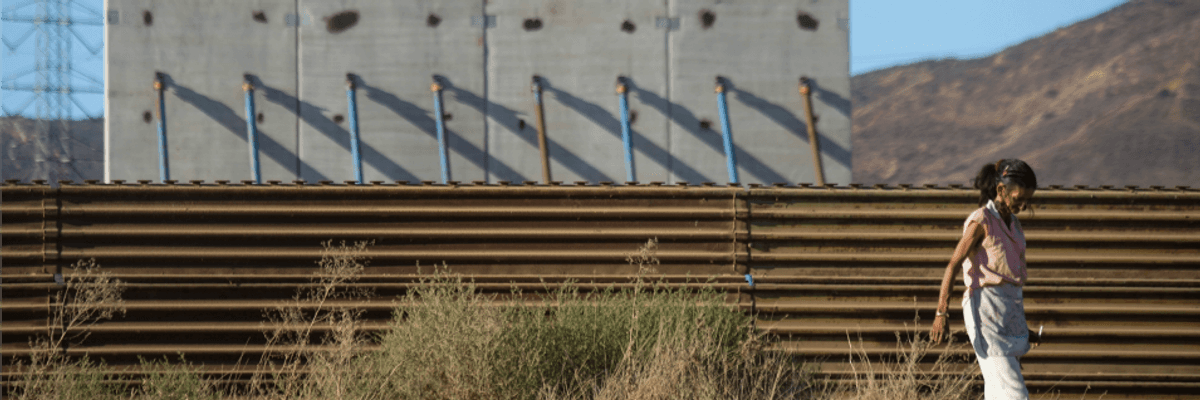
A woman walk past prototype sections of a border wall between Mexico and the United States under construction on October 5, 2017 in Tijuana, Mexico. (Photo: Sandy Huffaker/Getty Images)
Trump Found a Different Way to Build His Wall
The Trump administration is using a wide range of cruel policies to stop people in need from seeking safety in the US.
President Donald Trump's obsession with building a wall on the United States-Mexico border knows few limits - he reportedly even entertained extreme ideas such as building a moat over the border and filling it with alligators. This is why when it became apparent that his administration was not going to succeed in erecting a complete physical barrier on the border, the president found a different way to "build the wall": inhumane asylum policies.
The Trump administration has advanced a wide range of cruel policies that have stymied the internationally-recognised right to seek asylum. The bricks in Trump's border wall take several forms: "metering", which constricts the number of asylum seekers who can apply on any given day; the so-called Migrant Protection Protocols, which require asylum seekers to remain in Mexico while they wait for their cases to be processed, and; the Safe Third Country Agreement, which requires migrants to apply for asylum and get rejected in a country they transit through before seeking asylum in the US.
Trump also boasts that he is "using Mexico to protect our border," as the administration weaponises the trade and economic leverage it has over Mexico to effectively outsource US immigration enforcement to its southern neighbour and other countries in Central America.
I have seen first-hand the devastating impact of these policies on people who are in dire need of help and protection.
Earlier this year I led a team of doctors on a field investigation to Tijuana, Mexico, where we interviewed asylum seekers about the experiences that drove them to flee their homes and seek protection in the US. Our investigation, published earlier this month, documents medical evidence of the violence these asylum seekers survived. Their physical and psychological scars corroborate their testimonies of persecution.
I witnessed how the Trump administration's asylum policies are contributing to the suffering of these already-traumatised people. He could not literally build a wall, so he decided to leave thousands of asylum seekers from around the world stranded on the Mexican side of the border. His administration has created growing migrant encampments - refugee camps in the making. Some 60,000 asylum seekers are currently stuck in Mexico, exposed to further violence.
One important component of Trump's "wall" is expanding the practice of metering, severely restricting the number of asylum seekers who can be processed at a US port of entry on any given day. For example, the San Ysidro-Tijuana port of entry processed between 40 to 100 asylum seekers per day in 2018. This year, it has been processing just 25 per day. This practice has created a massive backlog of asylum seekers who are then placed on a waiting list. One of them is Natalia*, a woman we interviewed in Tijuana.
Natalia was a schoolteacher in Mexico who dreamed of one day running a daycare centre. Her husband repeatedly physically and sexually assaulted her and beat their young children. She tried relocating within Mexico to escape his death threats, but he eventually found her and told her he had sold her and her children to organ traffickers. Natalia immediately fled to Tijuana, where she tried to make an asylum claim. But she was told to "get in line". With no food or money, Natalia waited for months in Tijuana for her turn to request protection in the US.
Trump then built his wall higher with the third-country asylum rule, which requires asylum seekers who travel through a "third country" en-route to the US to apply for asylum and get rejected there first. In practice, this bans asylum claims at the US-Mexico border for all nationalities except for Mexicans, who do not have to travel through a "third country" to reach the border. For example, an asylum seeker named Sergio*, whose family was targeted by gangs in Honduras, told me that they fled to Guatemala after they were attacked by men with machetes. But once in Guatemala, the same men found Sergio's family. With their lives in imminent danger, how could Sergio's family be asked to apply for asylum "protection" in Guatemala?
These punitive policies stem from President Trump's antipathy toward migrants and inability to realise his border wall fantasies. While they may not have been able to build a complete wall on the US's southern border, the Trump administration has made it virtually impossible for most asylum seekers to request protection in the US. The human toll is clear: tens of thousands who have fled persecution in their home countries are trapped along the US-Mexico border, vulnerable to further trauma and exploitation.
The right to seek asylum is a human right, protected in both US and international law. The US needs a government that safeguards that right, not one that constructs policy barriers when so many lives are on the line.
We are at a crossroads
This country and this world are at a monumental crossroads. In a few short weeks, US voters will have an opportunity to beat back the forces of fascism and confront the billionaires who are rigging the economy, our media system, and our democracy, making it increasingly impossible for ordinary people to get by. We’re not just talking about the election. We’re talking about what must be done once these fascist elements are vanquished from power. We need a bolder set of solutions than what either major party has so far been willing to offer and a working-class movement ready to fight like hell for it. Trump didn't emerge from nowhere. The conditions that fueled MAGA authoritarianism were created by decades of radical neoliberal economic policies and a corrupt political system dominated by corporate interests. They slashed taxes on the super-rich, promising that the benefits would trickle down. They said giveaways to the corporate titans would make life more affordable for the rest of us. It was all bullshit. And when a bitter, betrayed populace searches for someone to blame, right-wing demagogues have little trouble finding scapegoats. People know when they're being lied to, but you won't hear any of this from the corporate media. Only independent journalism—powered and funded by people who believe in building a better world—can deliver truly trustworthy daily news. Our Fall Campaign is underway, and we need your help. To power our newsroom through the rest of the year, we need to raise $125,000 by midnight on October 31. So if you share our vision, please contribute whatever you can to sustain our work. |
President Donald Trump's obsession with building a wall on the United States-Mexico border knows few limits - he reportedly even entertained extreme ideas such as building a moat over the border and filling it with alligators. This is why when it became apparent that his administration was not going to succeed in erecting a complete physical barrier on the border, the president found a different way to "build the wall": inhumane asylum policies.
The Trump administration has advanced a wide range of cruel policies that have stymied the internationally-recognised right to seek asylum. The bricks in Trump's border wall take several forms: "metering", which constricts the number of asylum seekers who can apply on any given day; the so-called Migrant Protection Protocols, which require asylum seekers to remain in Mexico while they wait for their cases to be processed, and; the Safe Third Country Agreement, which requires migrants to apply for asylum and get rejected in a country they transit through before seeking asylum in the US.
Trump also boasts that he is "using Mexico to protect our border," as the administration weaponises the trade and economic leverage it has over Mexico to effectively outsource US immigration enforcement to its southern neighbour and other countries in Central America.
I have seen first-hand the devastating impact of these policies on people who are in dire need of help and protection.
Earlier this year I led a team of doctors on a field investigation to Tijuana, Mexico, where we interviewed asylum seekers about the experiences that drove them to flee their homes and seek protection in the US. Our investigation, published earlier this month, documents medical evidence of the violence these asylum seekers survived. Their physical and psychological scars corroborate their testimonies of persecution.
I witnessed how the Trump administration's asylum policies are contributing to the suffering of these already-traumatised people. He could not literally build a wall, so he decided to leave thousands of asylum seekers from around the world stranded on the Mexican side of the border. His administration has created growing migrant encampments - refugee camps in the making. Some 60,000 asylum seekers are currently stuck in Mexico, exposed to further violence.
One important component of Trump's "wall" is expanding the practice of metering, severely restricting the number of asylum seekers who can be processed at a US port of entry on any given day. For example, the San Ysidro-Tijuana port of entry processed between 40 to 100 asylum seekers per day in 2018. This year, it has been processing just 25 per day. This practice has created a massive backlog of asylum seekers who are then placed on a waiting list. One of them is Natalia*, a woman we interviewed in Tijuana.
Natalia was a schoolteacher in Mexico who dreamed of one day running a daycare centre. Her husband repeatedly physically and sexually assaulted her and beat their young children. She tried relocating within Mexico to escape his death threats, but he eventually found her and told her he had sold her and her children to organ traffickers. Natalia immediately fled to Tijuana, where she tried to make an asylum claim. But she was told to "get in line". With no food or money, Natalia waited for months in Tijuana for her turn to request protection in the US.
Trump then built his wall higher with the third-country asylum rule, which requires asylum seekers who travel through a "third country" en-route to the US to apply for asylum and get rejected there first. In practice, this bans asylum claims at the US-Mexico border for all nationalities except for Mexicans, who do not have to travel through a "third country" to reach the border. For example, an asylum seeker named Sergio*, whose family was targeted by gangs in Honduras, told me that they fled to Guatemala after they were attacked by men with machetes. But once in Guatemala, the same men found Sergio's family. With their lives in imminent danger, how could Sergio's family be asked to apply for asylum "protection" in Guatemala?
These punitive policies stem from President Trump's antipathy toward migrants and inability to realise his border wall fantasies. While they may not have been able to build a complete wall on the US's southern border, the Trump administration has made it virtually impossible for most asylum seekers to request protection in the US. The human toll is clear: tens of thousands who have fled persecution in their home countries are trapped along the US-Mexico border, vulnerable to further trauma and exploitation.
The right to seek asylum is a human right, protected in both US and international law. The US needs a government that safeguards that right, not one that constructs policy barriers when so many lives are on the line.