SUBSCRIBE TO OUR FREE NEWSLETTER
Daily news & progressive opinion—funded by the people, not the corporations—delivered straight to your inbox.
5
#000000
#FFFFFF
To donate by check, phone, or other method, see our More Ways to Give page.
Daily news & progressive opinion—funded by the people, not the corporations—delivered straight to your inbox.
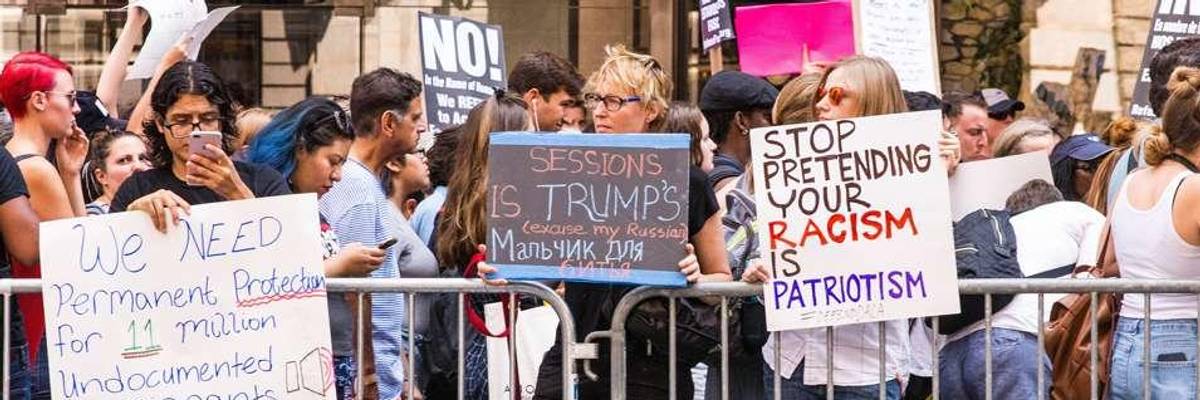
DACA protest at Trump Tower in NYC, September 5, 2017. (cc/Harrie van Veen)
Let America be America again.
Let it be the dream it used to be.
Let it be the pioneer on the plain
Seeking a home where he himself is free.
-- Langston Hughes, Let America be America Again
Let America be America again.
Let it be the dream it used to be.
Let it be the pioneer on the plain
Seeking a home where he himself is free.
-- Langston Hughes, Let America be America Again
It all started in September 2017. That was when the Trump, acting through his attorney general, Jeff Sessions, let it be known that the program known as the Deferred Action for Childhood Arrivals (DACA) was coming to an end. The program provided protection for 800,000 young undocumented immigrants who had entered the United States illegally.
DACA was the culmination of years of failed efforts by Congress to take steps to protect illegal immigrants. Those efforts began in 2002 with the introduction of legislation known as the "Development, Relief, and Education for Alien Minors Act" or "Dream Act." In its early incarnations, it was focused on providing financial aid for children who were in the country illegally. As it continued to be introduced in subsequent years, it was modified to include a pathway to citizenship for "dreamers." Although the legislation was introduced repeatedly following its initial introduction in Congress in 2002, it never became law. As a result, the plight of "dreamers" remained in limbo. There are reportedly 3.6 million undocumented immigrants living in the United States who were brought into the United States before they attained age 18 and would be the beneficiaries of the legislation were it ever to pass. Without it they live under the constant threat of deportation.
In 2012, supporters of the legislation to protect dreamers persuaded President Obama to take steps to protect children who had been brought into this country illegally. On June 15, 2012, President Obama created DACA. Describing the program, the Department of Human Services said that immigrants who had been brought into the country illegally as children could be considered for temporary lawful status with work authorization, subject to taking certain steps to establish eligibility. Those steps included, among other things, demonstrating that on June 15, 2012 they were under the age of 31, had arrived in the United States, before attaining age 16, and had lived in the United States continuously since June 15, 2007, 5 years before DACA was created. DACA did not provide its beneficiaries the more comprehensive protection they would have received had Congress passed the Dream Act, but it was considerably better than nothing. And it was DACA that the Trump through his henchman Sessions, let the country know was coming to an end.
Here are some coincidences affecting DACA recipients and federal workers. There are approximately 800,000 people who are beneficiaries of DACA. There are approximately 800,000 federal workers who are not being paid because of the federal shutdown that the Trump has petulantly imposed on the country and its workers until he gets what he wants. There are also similarities in the words the Trump used to describe the effects of ending DACA and the effects of not paying federal workers.
On September 5, 2017, after Jeff Sessions announced that DACA was ending, the Trump said that the program had been created by President Obama using his executive authority and "It is now time for Congress to act. As I've said before, we will resolve the DACA issue with heart and compassion-but through the lawful Democratic process. . . while at the same time ensuring that any immigration reform we adopt provides enduring benefits for the American citizens we were elected to serve. We must also have heart and compassion for the unemployed struggling and forgotten Americans." In speaking with reporters after his prepared remarks, he expressed compassion for the immigrants but said: "long term it's going to be the right solution." He went on to say: "I have a great heart for these folks we're talking about. A great love for them and people think in terms of children but they're really young adults. I have a love for these people and hopefully now Congress will be able to help them and do it properly."
The Trump sounded the same note about the federal workers who are not being paid, although he was not as effusive in expressing his love for the federal workers as he was in expressing his love for the immigrants. "Mr. President, can you relate to the pain of federal workers who can't pay their bills?" a reporter asked the Trump outside the White House in early January. "I can relate," the Trump responded. "And I'm sure that the people that are toward the receiving end will make adjustments, they always do. And they'll make adjustments. People understand exactly what's going on." Addressing the federal workers during the fourth week of the shutdown he had an encouraging tweet: "To all of the great people who are working so hard for your Country and not getting paid I say, THANK YOU - YOU ARE GREAT PATRIOTS! We must now work together, after decades of abuse, to finally fix the Humanitarian, Criminal & Drug Crisis at our Border. WE WILL WIN BIG!"
His words made DACA recipients feel a lot better. His words and tweets made unpaid federal employees feel a lot better. The Trump is a real word wizard.
This country and this world are at a monumental crossroads. US voters have an opportunity to beat back the forces of fascism and confront the billionaires who are rigging the economy, our media system, and our democracy, making it increasingly impossible for ordinary people to get by. We’re not just talking about the election. We’re talking about what must be done once these fascist elements are vanquished from power. We need a bolder set of solutions than what either major party has so far been willing to offer and a working-class movement ready to fight like hell for it. Trump didn't emerge from nowhere. The conditions that fueled MAGA authoritarianism were created by decades of radical neoliberal economic policies and a corrupt political system dominated by corporate interests. They slashed taxes on the super-rich, promising that the benefits would trickle down. They said giveaways to the corporate titans would make life more affordable for the rest of us. It was all bullshit. And when a bitter, betrayed populace searches for someone to blame, right-wing demagogues have little trouble finding scapegoats. People know when they're being lied to, but you won't hear any of this from the corporate media. Only independent journalism—powered and funded by people who believe in building a better world—can deliver truly trustworthy daily news. If you share our vision, please contribute whatever you can to sustain our work. |
Let America be America again.
Let it be the dream it used to be.
Let it be the pioneer on the plain
Seeking a home where he himself is free.
-- Langston Hughes, Let America be America Again
It all started in September 2017. That was when the Trump, acting through his attorney general, Jeff Sessions, let it be known that the program known as the Deferred Action for Childhood Arrivals (DACA) was coming to an end. The program provided protection for 800,000 young undocumented immigrants who had entered the United States illegally.
DACA was the culmination of years of failed efforts by Congress to take steps to protect illegal immigrants. Those efforts began in 2002 with the introduction of legislation known as the "Development, Relief, and Education for Alien Minors Act" or "Dream Act." In its early incarnations, it was focused on providing financial aid for children who were in the country illegally. As it continued to be introduced in subsequent years, it was modified to include a pathway to citizenship for "dreamers." Although the legislation was introduced repeatedly following its initial introduction in Congress in 2002, it never became law. As a result, the plight of "dreamers" remained in limbo. There are reportedly 3.6 million undocumented immigrants living in the United States who were brought into the United States before they attained age 18 and would be the beneficiaries of the legislation were it ever to pass. Without it they live under the constant threat of deportation.
In 2012, supporters of the legislation to protect dreamers persuaded President Obama to take steps to protect children who had been brought into this country illegally. On June 15, 2012, President Obama created DACA. Describing the program, the Department of Human Services said that immigrants who had been brought into the country illegally as children could be considered for temporary lawful status with work authorization, subject to taking certain steps to establish eligibility. Those steps included, among other things, demonstrating that on June 15, 2012 they were under the age of 31, had arrived in the United States, before attaining age 16, and had lived in the United States continuously since June 15, 2007, 5 years before DACA was created. DACA did not provide its beneficiaries the more comprehensive protection they would have received had Congress passed the Dream Act, but it was considerably better than nothing. And it was DACA that the Trump through his henchman Sessions, let the country know was coming to an end.
Here are some coincidences affecting DACA recipients and federal workers. There are approximately 800,000 people who are beneficiaries of DACA. There are approximately 800,000 federal workers who are not being paid because of the federal shutdown that the Trump has petulantly imposed on the country and its workers until he gets what he wants. There are also similarities in the words the Trump used to describe the effects of ending DACA and the effects of not paying federal workers.
On September 5, 2017, after Jeff Sessions announced that DACA was ending, the Trump said that the program had been created by President Obama using his executive authority and "It is now time for Congress to act. As I've said before, we will resolve the DACA issue with heart and compassion-but through the lawful Democratic process. . . while at the same time ensuring that any immigration reform we adopt provides enduring benefits for the American citizens we were elected to serve. We must also have heart and compassion for the unemployed struggling and forgotten Americans." In speaking with reporters after his prepared remarks, he expressed compassion for the immigrants but said: "long term it's going to be the right solution." He went on to say: "I have a great heart for these folks we're talking about. A great love for them and people think in terms of children but they're really young adults. I have a love for these people and hopefully now Congress will be able to help them and do it properly."
The Trump sounded the same note about the federal workers who are not being paid, although he was not as effusive in expressing his love for the federal workers as he was in expressing his love for the immigrants. "Mr. President, can you relate to the pain of federal workers who can't pay their bills?" a reporter asked the Trump outside the White House in early January. "I can relate," the Trump responded. "And I'm sure that the people that are toward the receiving end will make adjustments, they always do. And they'll make adjustments. People understand exactly what's going on." Addressing the federal workers during the fourth week of the shutdown he had an encouraging tweet: "To all of the great people who are working so hard for your Country and not getting paid I say, THANK YOU - YOU ARE GREAT PATRIOTS! We must now work together, after decades of abuse, to finally fix the Humanitarian, Criminal & Drug Crisis at our Border. WE WILL WIN BIG!"
His words made DACA recipients feel a lot better. His words and tweets made unpaid federal employees feel a lot better. The Trump is a real word wizard.