SUBSCRIBE TO OUR FREE NEWSLETTER
Daily news & progressive opinion—funded by the people, not the corporations—delivered straight to your inbox.
5
#000000
#FFFFFF
To donate by check, phone, or other method, see our More Ways to Give page.

It's been a tough year for those of us in the climate change community. Each week has seemed to bring either a fresh report reminding us of how precious little time we have left to try to turn this ship around or a disaster that has climate change's fingerprints all over it. Friends, family, colleagues, and reporters have all asked whether I'm optimistic or hopeful about our ability to limit the severity of future climate change. And I'll be honest: I'm not. But that doesn't mean we should give up--in fact that would be among the worst things we could do. Rather, we need to hold fiercely to a vision of the future we want to see and work like hell to make it a reality.
During 2017--the year in which Trump announced that the US would withdraw from the Paris Agreement, three Category 4 hurricanes made landfall in the US for the first time ever, and my home state of California witnessed its most destructive wildfire in recorded history--I found myself faced with the reality that we were witnessing the very events that climate scientists had long been saying we'd see as our climate warmed. And that was jarring. But 2018 marks the year that I truly started to grieve for what we have done and what we have failed to do.
There has been much to fuel that grief this year. So much, in fact, that words on a screen and cells in a spreadsheet didn't feel real enough. Instead, I had to write and draw about this in my notebook to make sense of it all, letting it pour out dot by dot into what I call my "Grief Graph."
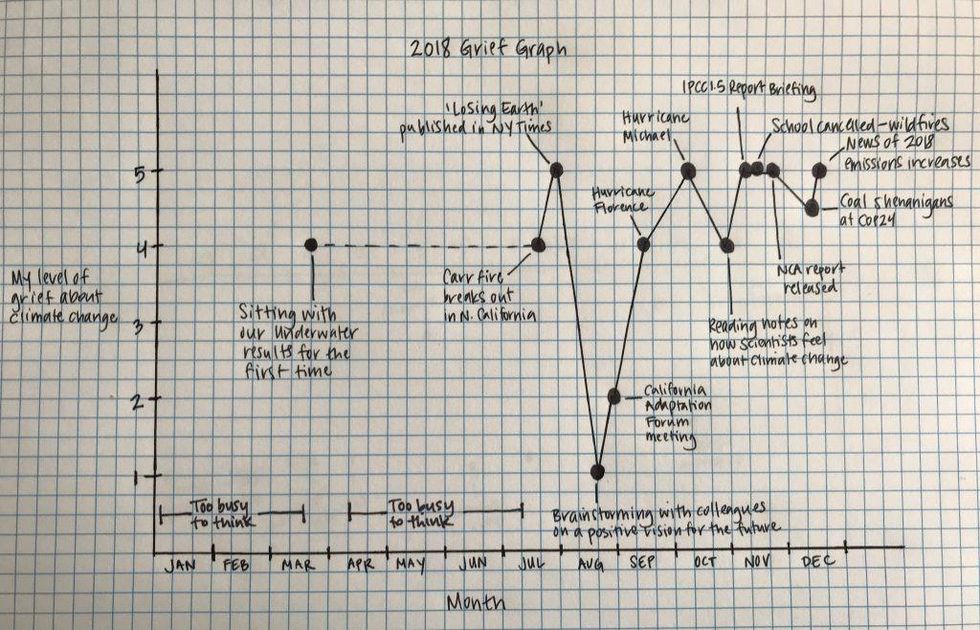
For the first half of the year, the intensity of generating the data for our Underwater report mostly prevented the climate change arrows that were being slung from piercing my armor. Oh, blessed, messy data, thank you for distracting me from whatever was going on during those months. I trust that it was all unicorns and fairy dust.
But for the second half of the year the blinders were off. Shortly after taking my own turn at unleashing a new set of data showing just how profoundly changed our country will be if we continue along this path, and as wildfire smoke created a blanket of doom over the Bay Area, I had more time to ingest everyone else's dire reports. Oh, and there were two devastating hurricanes.
Readers, because I care about your well-being, if you are immersed in this stuff day in and day out, go ahead and skip to the next section. Yes, I'm issuing a trigger warning regarding the following list, which highlights a few of the lowlights shown in the graph above.
And that doesn't even begin to wade into the heartbreaking impacts of extreme weather all around the world.
The grief graph above demonstrates the grief-stemming power of two activities: being hard at work on activities that one hopes will make a difference and taking the time to think about the future you're working for. I'd like to focus on the latter here because the former is productive, for sure, but in terms of emotions, it is little more than a distraction from the grief.
"Let's hold that beautiful future in our hearts and minds so that it can give us the courage, the ambition, and the endurance to keep up the fight."
In late August, my colleagues and I had a free-form conversation about what we're really excited to work on as a group. What energized us most focused not on climate impacts--our bread and butter--but on climate opportunities.
For a few weeks, when I closed my eyes, I envisioned a world in which our coasts are transformed by wide swaths of beautiful wetlands that have the space they need to migrate inland. A world in which the people who used to live on the land the wetlands inhabit have found new opportunities on higher ground and are thriving because they had the support and resources they needed to relocate. A world in which we can turn on A/C that's powered without carbon-based fuels and we no longer have that nagging feeling that by making ourselves comfortable, we are ultimately making the heat worse.
This sort of thought exercise can be much more than that. Competitions like Resilient by Design challenge us to envision what our communities could be like, and present us with beautiful, sustainable options that are even more appealing than what we see around us today. Similarly, the Urban Resilience to Extremes Sustainability Research Network and the Seeds of the Good Anthropocene initiative have developed frameworks for workshops in which participants develop positive visions for a future in which the climate is warmer and extremes are more frequent.
We may not be able to decrease our emissions fast enough to keep warming to below 1.5degC. My children will likely see the extinction of species, the deterioration of coral reefs, and ice-free summers in the Arctic. And with all of that, grief feels justified.
But I can also see a future in which we have done everything within our power to make our world as beautiful and healthy as it can be for our children and grandchildren. If hope and optimism aren't in your toolkit right now, I think that's OK. They're not in mine. But the last thing we're going to do is give up, right? So let's hold that beautiful future in our hearts and minds so that it can give us the courage, the ambition, and the endurance to keep up the fight.
It's been a tough year for those of us in the climate change community. Each week has seemed to bring either a fresh report reminding us of how precious little time we have left to try to turn this ship around or a disaster that has climate change's fingerprints all over it. Friends, family, colleagues, and reporters have all asked whether I'm optimistic or hopeful about our ability to limit the severity of future climate change. And I'll be honest: I'm not. But that doesn't mean we should give up--in fact that would be among the worst things we could do. Rather, we need to hold fiercely to a vision of the future we want to see and work like hell to make it a reality.
During 2017--the year in which Trump announced that the US would withdraw from the Paris Agreement, three Category 4 hurricanes made landfall in the US for the first time ever, and my home state of California witnessed its most destructive wildfire in recorded history--I found myself faced with the reality that we were witnessing the very events that climate scientists had long been saying we'd see as our climate warmed. And that was jarring. But 2018 marks the year that I truly started to grieve for what we have done and what we have failed to do.
There has been much to fuel that grief this year. So much, in fact, that words on a screen and cells in a spreadsheet didn't feel real enough. Instead, I had to write and draw about this in my notebook to make sense of it all, letting it pour out dot by dot into what I call my "Grief Graph."
For the first half of the year, the intensity of generating the data for our Underwater report mostly prevented the climate change arrows that were being slung from piercing my armor. Oh, blessed, messy data, thank you for distracting me from whatever was going on during those months. I trust that it was all unicorns and fairy dust.
But for the second half of the year the blinders were off. Shortly after taking my own turn at unleashing a new set of data showing just how profoundly changed our country will be if we continue along this path, and as wildfire smoke created a blanket of doom over the Bay Area, I had more time to ingest everyone else's dire reports. Oh, and there were two devastating hurricanes.
Readers, because I care about your well-being, if you are immersed in this stuff day in and day out, go ahead and skip to the next section. Yes, I'm issuing a trigger warning regarding the following list, which highlights a few of the lowlights shown in the graph above.
And that doesn't even begin to wade into the heartbreaking impacts of extreme weather all around the world.
The grief graph above demonstrates the grief-stemming power of two activities: being hard at work on activities that one hopes will make a difference and taking the time to think about the future you're working for. I'd like to focus on the latter here because the former is productive, for sure, but in terms of emotions, it is little more than a distraction from the grief.
"Let's hold that beautiful future in our hearts and minds so that it can give us the courage, the ambition, and the endurance to keep up the fight."
In late August, my colleagues and I had a free-form conversation about what we're really excited to work on as a group. What energized us most focused not on climate impacts--our bread and butter--but on climate opportunities.
For a few weeks, when I closed my eyes, I envisioned a world in which our coasts are transformed by wide swaths of beautiful wetlands that have the space they need to migrate inland. A world in which the people who used to live on the land the wetlands inhabit have found new opportunities on higher ground and are thriving because they had the support and resources they needed to relocate. A world in which we can turn on A/C that's powered without carbon-based fuels and we no longer have that nagging feeling that by making ourselves comfortable, we are ultimately making the heat worse.
This sort of thought exercise can be much more than that. Competitions like Resilient by Design challenge us to envision what our communities could be like, and present us with beautiful, sustainable options that are even more appealing than what we see around us today. Similarly, the Urban Resilience to Extremes Sustainability Research Network and the Seeds of the Good Anthropocene initiative have developed frameworks for workshops in which participants develop positive visions for a future in which the climate is warmer and extremes are more frequent.
We may not be able to decrease our emissions fast enough to keep warming to below 1.5degC. My children will likely see the extinction of species, the deterioration of coral reefs, and ice-free summers in the Arctic. And with all of that, grief feels justified.
But I can also see a future in which we have done everything within our power to make our world as beautiful and healthy as it can be for our children and grandchildren. If hope and optimism aren't in your toolkit right now, I think that's OK. They're not in mine. But the last thing we're going to do is give up, right? So let's hold that beautiful future in our hearts and minds so that it can give us the courage, the ambition, and the endurance to keep up the fight.