

SUBSCRIBE TO OUR FREE NEWSLETTER
Daily news & progressive opinion—funded by the people, not the corporations—delivered straight to your inbox.
5
#000000
#FFFFFF
To donate by check, phone, or other method, see our More Ways to Give page.
Daily news & progressive opinion—funded by the people, not the corporations—delivered straight to your inbox.

"If you have a hurricane now as opposed to the same hurricane 150 years ago, the impacts would be different," said one researcher.
A study published Monday in Nature Communications is the latest of several recent reports to detail the rapid rise of sea levels in the southern U.S., which is happening faster than scientists previously realized and has also intensified hurricane damage in coastal cities.
Scientists from institutions including Tulane University and the National Oceanography Center in the United Kingdom wrote in the study that "mean sea level acceleration" in the U.S. Southeast and Gulf coasts has led to a rate of increase of more than 10 millimeters, or one centimeter, per year since 2010—a rate that is "unprecedented in at least 120 years."
That finding bolstered a study published last month in the Journal of Climate by Jianjun Yin at the University of Arizona, who found that sea level changed by a total of nearly five inches in the region from 2010-2022—more than double the global mean sea level acceleration rate, according to The Washington Post, which called the rapid sea level rise "abnormal and dramatic."
Scientists who have studied the phenomenon recently say that the warming of the Gulf of Mexico, which is happening much faster than in oceans across the globe, is causing sea levels to rise in the area as the water expands with heat and gets carried out of the gulf into the Atlantic Ocean.
"A home purchased today in Pensacola will be underwater before the mortgage is paid off. This is so scary."
Yin reported that Hurricanes Michael in 2018 and Ian in 2022, which were already two of the strongest storms to make landfall in the U.S., were made more devastating by the high sea levels in the Gulf Coast.
"The faster [sea level rise] on the Southeast and Gulf Coasts... coincided with active and even record-breaking North Atlantic hurricane seasons in recent years," reads Yin's study. "As a consequence, the elevated storm surge exacerbated coastal flooding and damages particularly on the Gulf Coast."
Hurricane Michael killed at least 45 people and damaged about 60,000 homes, costing about $25 billion. Ian was linked to roughly 160 deaths and was one of the costliest disasters in U.S. history, causing at least $50 billion in property and infrastructure damage.
"It turns out that the water level associated with Hurricane Ian was the highest on record due to the combined effect of sea level rise and storm surge," Yin told the Post on Monday.
Thomas Wahl of the University of Central Florida, a co-author of the report published Monday, noted that rising sea levels lead to the erosion of wetlands, which coastal communities rely on for protection.
"Now you have a higher base water level," Wahl told The Post. "If you have a hurricane now as opposed to the same hurricane 150 years ago, the impacts would be different."
The trend in the region has so far only been detected for about 12 years, but with global sea levels rising steadily—a pattern scientists have warned will continue especially as long as fossil fuel extraction and greenhouse gas emissions persist—Sönke Dangendorf of the Nature Communications study said the research provides "a window into the future."
The rate of acceleration is close to what scientists expected from sea level rise towards "the end of the century in a very high greenhouse gas emissions scenario," the Post reported.
Rep. Sean Casten (D-Ill.) tweeted that the new research shows the likely short-term impact of continued planetary heating and sea level rise, following a report released by the National Oceanic and Atmospheric Administration (NOAA) last year which warned ocean levels along U.S. coastlines will rise by an average of 10 to 12 inches by 2050—and that Gulf Coast communities can expect an increase of 14 to 18 inches.
"The implication is that a home purchased today in Pensacola will be underwater before the mortgage is paid off," said Casten. "This is so scary."
Aside from making storms like Ian and Michael more devastating, Wahl told the Post, a higher coastal sea level "messes up your daily life."
"It corrodes infrastructure," he said. "It corrodes cars that are driving through saltwater on a daily basis. You can't open your business or get to work."

Each year Foreign Policy In Focus columnist Conn Hallinan gives awards to individuals, companies, and governments that make reading the news a daily adventure. Here are the awards for 2018.
The Golden Sprocket Wrench Award goes to Lockheed Martin, the world's largest arms manufacturer, for its F-22 Raptor Stealth fighter, a fifth-generation interceptor said to be the best in the world.
That is when it works, which isn't often.
When Hurricane Michael swept through Florida this fall, 17 Raptors -- $339 million apiece -- were destroyed or badly damaged. How come the Air Force didn't fly those F-22s out of harm's way? Because the Raptor is a "hanger queen"-- it loves the machine shop. Less than 50 percent of the F-22 fleet is functional at any given moment. The planes couldn't fly, so they got trashed at a cost to taxpayers of around $5 billion.
Lockheed Martin also gets an Oak Leaf Cluster for its F-35 Lightning II fighter, at $1.5 trillion the most expensive weapon system in U.S. history. Some 200 F-35s aren't considered "combat capable," and may never be, because the Pentagon would rather buy new planes than fix the ones it has. That may cost taxpayers $40 billion.
The F-22s and F-35s also have problems with their oxygen systems, but no one can figure out why.
However, both planes did get into combat. According to Vice Admiral Scott Stearney, the F-35 achieved "tactical supremacy" over the Taliban (which doesn't have an air force). The F-22, the most sophisticated stealth fighter in the world, took on Afghan drug dealers.
As for Lockheed Martin, the company was just awarded an extra $7 billion for F-22 "sustainment."
The Golden Parenting Award goes to the U.S. State Department, for trying to water down a resolution by the UN's World Health Assembly encouraging breastfeeding over infant formula.
A Lancet study found that universal breastfeeding would prevent 800,000 infant deaths a year, decrease ear infections by 50 percent, and reduce gastrointestinal disease by 64 percent. It lowers the risk for Type 1 diabetes, two kinds of leukemia, sudden infant death syndrome, and asthma. It also makes for healthier mothers.
In contrast, infant formula -- a $70 billion industry dominated by a few American and European companies -- is expensive and not nearly as healthy for children as breast milk.
When Ecuador tried to introduce the breastfeeding resolution, the U.S. threatened it with aid cuts and trade barriers. Several other Latin American countries were also threatened and quickly withdrew their names from a list of endorsers. Finally, Russia stepped in and introduced the resolution.
The measure finally passed, but the U.S. successfully lobbied to remove language urging the World Health Organization to challenge "inappropriate promotion of foods for infants and young children."
The Golden Cuisine Award goes to Ron Colburn, president of the U.S. Border Patrol Foundation, who told Fox & Friends that the tear gas used on migrants at the U.S. border was not harmful, because pepper spray was such a "natural" product that "you could actually put on your nachos and eat it."
The Marie Antoinette Award has two winners this year:
*Nikki Haley, retiring U.S. ambassador to the UN, who blasted Senator Bernie Sanders (I-Vt) for supporting the UN's special rapporteur report on poverty in the United States, who found that tens of millions of Americans suffer "massive levels of deprivation." In a letter to Sanders, Haley said it was "patently ridiculous" for the UN to even look at poverty in the United States, because it is "the wealthiest and freest country in the world."
In a response, Sanders pointed out that while this country is indeed the wealthiest in the world, it is also one of the most unequal. "Some 40 million people still live in poverty, more than 30 million have no health insurance, over half of older workers have no retirement savings, 140 million Americans are struggling to pay for basic living expenses, 40 percent of Americans cannot afford a $400 emergency, and millions of Americans are leaving school deeply in debt."
*U.S. Secretary of the Treasury Steven Mnuchin, who expressed surprise that the people attending the World Economic Forum in the resort town of Davos, Switzerland were considered elite. "I didn't realize it was the global elite."
Basic membership in the forum costs more than $70,000, and getting to the event by helicopter or car is expensive, as are accommodations. There also numerous glittering parties hosted by celebrities like Bono and Leonardo DiCaprio. (But those parties can have a sharp edge: one had attendees crawl on their hands and knees to feel what's like to flee an army.)
The Golden Matthew 19:14 Award ("Suffer the little children") goes to Danish Prime Minister Lars Lokke Rasmussen for threatening to seize the children of poor people if parents commit crimes or fail to teach children "Danish values."
The Danish parliament has designated 25 "ghetto" areas -- Denmark's term -- which Muslim immigrants are crowded into. Families living in "ghettos" must send their children -- starting at age 1 -- to schools for 25 hours a week, where they're taught about Christmas, Easter, and the Danish language. Failure to do so can result in a welfare cutoff.
Proposals are also being considered to double prison sentences for anyone from a "ghetto" convicted of a crime, and a four year prison sentence for parents who send their children back to their home countries to learn about their cultures.
The neo-fascist People's Party, part of the governing coalition, also proposed forcing all "ghetto" children to wear electronic ankle bracelets and be confined to their homes after 8 PM. The measure was tabled.
Runners up are:
* The British Home Office, which, according to a report by the House of Lords, is using children for undercover operations against drug dealers, terrorists, and criminal gangs. "We are concerned that enabling a young person to participate in covert activity for an extended period of time may expose them to increased risk in their mental and physical welfare," the Lord's report concluded.
* The U.S. Environmental Protection Agency for placing Dr. Ruth Etzel, head of Children's Health Protection, on administrative leave and derailing programs aimed at reducing children's exposure to lead, pesticides, mercury, and smog. Etzel was pressing to tighten up regulations because children are more sensitive to pollutants than adults. A leader in children's environmental health for more than 30 years, Etzel was asked for her badge, cell phone, and keys and put on administrative leave.
The Gang That Couldn't Shoot Straight Award goes to arms maker Raytheon (with a tip of the hat to contributors Northup Grumman and Lockheed Martin) for its Patriot anti-missile that has downed exactly one missile in 28 years of use (and that was a clunky old Scud).
An analysis of the missile interceptor system by Jeffrey Lewis of the Middlebury Institute of International Studies in Monterey, California, concluded that Patriot is "a lemon." Writing in Foreign Policy, Lewis says, "I am deeply skeptical that Patriot has ever intercepted a long-range ballistic missile in combat."
But it sure sells well. Saudi Arabia forked over $5.4 billion for Patriots in 2015, Romania $4 billion in 2017, Poland $4.5 billion in 2018, and Turkey $3.5 billion this year.
The Golden "Say What?" Award has three winners:
*The U.S. Department of Defense for cutting a deal in the Yemen civil war to allow al-Qaeda members -- the organization that brought us the September 11 attacks -- to join with the Saudis and United Arab Emirates (UAE) in their fight against the Houthis.
According to Associated Press, while the Saudis claim that their forces are driving al-Qaeda out of cities, in fact, the terrorist organization's members were allowed to leave with their weapons and looted cash.
U.S. drones gave them free passage. Why, you may ask? Because the Saudi coalition says the Houthis are supported by Iran.
* Saudi Arabia and the UAE for bankrolling a series of racist and Islamophobic attacks on newly elected Muslim Congress members Ilhan Omar (D-Minnesota) and Rashid Tlaib (D-Michigan) because the Gulf monarchies accuse both of being members of the Muslim Brotherhood. Neither is, but both are critical of the absolute monarchs of the Persian Gulf and are opposed to the Saudi-instigated war in Yemen.
* Israel, for selling weapons to the racist and anti-Semitic Azov Battalion in the Ukraine. On its YouTube channel, members of the militia showed off Israeli Tavor rifles, the primary weapon of the Israeli Special Forces. The Tavor is produced under license by the Israel Weapons Industries. The unit's commander and Ukraine's Interior Minister, Arsen Avakov, met with Israel's Interior Minister Aryeh Deri last year to discuss "fruitful cooperation."
Azov's founder, Anriy Biletsky, now a Ukrainian parliament member, says his mission is "to restore the honor of the white race," and lead "a crusade against the Semite-led untermenschen."
The Blue Meanie Award goes to U.S. Secretary of State Mike Pompeo for blocking medical supplies to North Korea. Drugs to fight malaria and tuberculosis have been held up, as have surgical equipment and soy milk for child care centers and orphanages.
According to the UN, sanctions "are not intended to have adverse humanitarian consequences for the civilian population" of North Korea. The U.S. position has come in for criticism by Sweden, France, Britain, Canada, and the International Red Cross.
The Little Bo Peep Award goes to the Pentagon for its recent audit indicating that some $21 trillion (yes, that is a "t") is unaccounted for. Sharing this honor is the U.S. Air Force for losing a box of grenades, which apparently fell off a Humvee in North Dakota. The Air Forces says the weapons won't go off without a special launcher. Right. What can possibly go wrong with grenades?
In Memory of Dr. Victor Sidel, a founding member of the Physicians for Social Responsibility and the Nobel Prize winning International Physicians for the Prevention of Nuclear War. Sidel, along with Dr. Barry S. Levy, wrote several important books, including War and Public Health, and Social Justice and Public Health. In 1986 he was arrested, along with astronomer Carl Sagan, at the Mercury, Nevada nuclear test site. He once said, "The cost of one-half day of world arms spending could pay for the full immunization of all the children of the world against the common infectious diseases."
It's been a tough year for those of us in the climate change community. Each week has seemed to bring either a fresh report reminding us of how precious little time we have left to try to turn this ship around or a disaster that has climate change's fingerprints all over it. Friends, family, colleagues, and reporters have all asked whether I'm optimistic or hopeful about our ability to limit the severity of future climate change. And I'll be honest: I'm not. But that doesn't mean we should give up--in fact that would be among the worst things we could do. Rather, we need to hold fiercely to a vision of the future we want to see and work like hell to make it a reality.
During 2017--the year in which Trump announced that the US would withdraw from the Paris Agreement, three Category 4 hurricanes made landfall in the US for the first time ever, and my home state of California witnessed its most destructive wildfire in recorded history--I found myself faced with the reality that we were witnessing the very events that climate scientists had long been saying we'd see as our climate warmed. And that was jarring. But 2018 marks the year that I truly started to grieve for what we have done and what we have failed to do.
There has been much to fuel that grief this year. So much, in fact, that words on a screen and cells in a spreadsheet didn't feel real enough. Instead, I had to write and draw about this in my notebook to make sense of it all, letting it pour out dot by dot into what I call my "Grief Graph."
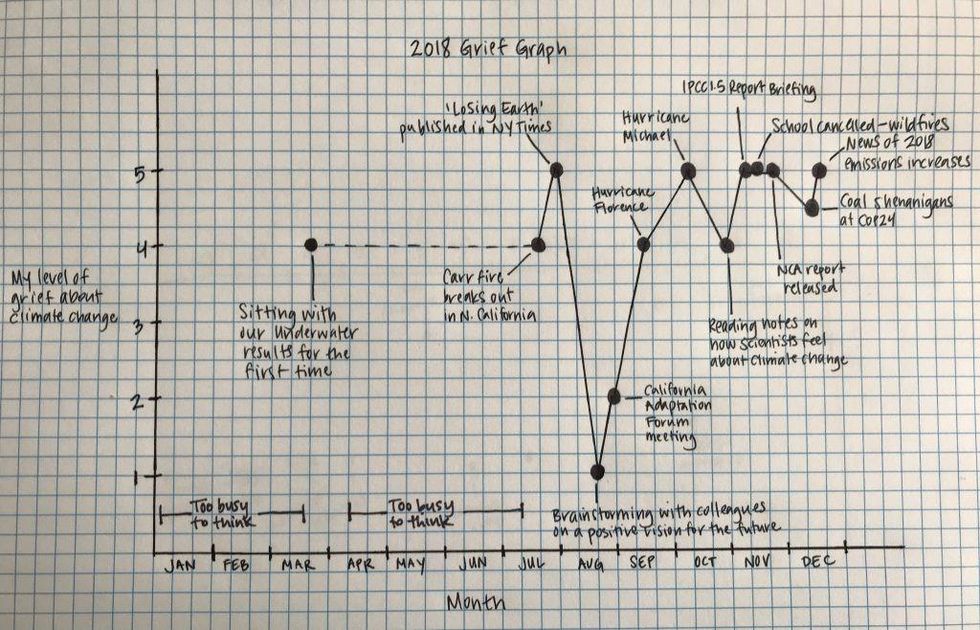
For the first half of the year, the intensity of generating the data for our Underwater report mostly prevented the climate change arrows that were being slung from piercing my armor. Oh, blessed, messy data, thank you for distracting me from whatever was going on during those months. I trust that it was all unicorns and fairy dust.
But for the second half of the year the blinders were off. Shortly after taking my own turn at unleashing a new set of data showing just how profoundly changed our country will be if we continue along this path, and as wildfire smoke created a blanket of doom over the Bay Area, I had more time to ingest everyone else's dire reports. Oh, and there were two devastating hurricanes.
Readers, because I care about your well-being, if you are immersed in this stuff day in and day out, go ahead and skip to the next section. Yes, I'm issuing a trigger warning regarding the following list, which highlights a few of the lowlights shown in the graph above.
And that doesn't even begin to wade into the heartbreaking impacts of extreme weather all around the world.
The grief graph above demonstrates the grief-stemming power of two activities: being hard at work on activities that one hopes will make a difference and taking the time to think about the future you're working for. I'd like to focus on the latter here because the former is productive, for sure, but in terms of emotions, it is little more than a distraction from the grief.
"Let's hold that beautiful future in our hearts and minds so that it can give us the courage, the ambition, and the endurance to keep up the fight."
In late August, my colleagues and I had a free-form conversation about what we're really excited to work on as a group. What energized us most focused not on climate impacts--our bread and butter--but on climate opportunities.
For a few weeks, when I closed my eyes, I envisioned a world in which our coasts are transformed by wide swaths of beautiful wetlands that have the space they need to migrate inland. A world in which the people who used to live on the land the wetlands inhabit have found new opportunities on higher ground and are thriving because they had the support and resources they needed to relocate. A world in which we can turn on A/C that's powered without carbon-based fuels and we no longer have that nagging feeling that by making ourselves comfortable, we are ultimately making the heat worse.
This sort of thought exercise can be much more than that. Competitions like Resilient by Design challenge us to envision what our communities could be like, and present us with beautiful, sustainable options that are even more appealing than what we see around us today. Similarly, the Urban Resilience to Extremes Sustainability Research Network and the Seeds of the Good Anthropocene initiative have developed frameworks for workshops in which participants develop positive visions for a future in which the climate is warmer and extremes are more frequent.
We may not be able to decrease our emissions fast enough to keep warming to below 1.5degC. My children will likely see the extinction of species, the deterioration of coral reefs, and ice-free summers in the Arctic. And with all of that, grief feels justified.
But I can also see a future in which we have done everything within our power to make our world as beautiful and healthy as it can be for our children and grandchildren. If hope and optimism aren't in your toolkit right now, I think that's OK. They're not in mine. But the last thing we're going to do is give up, right? So let's hold that beautiful future in our hearts and minds so that it can give us the courage, the ambition, and the endurance to keep up the fight.

In the waning hours of 2017, the Federal Communications Commission voted to repeal the 2015 Open Internet Order, ending net neutrality protections for the millions of Americans who support them. The fallout of that decision continued all throughout 2018, with attempts to reverse the FCC in Congress, new state laws, and governor executive orders written to secure state-level protections, court cases, and ever-increasing evidence that a world without the Open Internet Order is simply a worse one.
The story surrounding net neutrality has always been one of the greed of the largest Internet Service Providers (ISPs) versus the desires of the majority of people, the actual way the Internet is structured, and the ideal of a free and open Internet. Every win this year represented a win by actual people speaking out over big ISP money.
The so-called "Restoring Internet Freedom Order" didn't go into effect until June 11, 2018, but states started preparing for the FCC's abdication of oversight over the Internet early on. State leaders immediately committed before the ink was dry to stand up for net neutrality. A net neutrality bill, S.B. 822 was introduced the very first day of the California legislative session. Gov. Bullock of Montana issued his executive order only weeks later in January. By March, Washington's state legislature had overwhelmingly passed net neutrality legislation to the governor. In April, Oregon signed into law H.B. 4155, which required any ISP getting money from the state to adhere to net neutrality principals.
California's S.B. 822 turned out to be a particularly contentious battle, as that was the strongest bill moving this year. After passing in the California Senate, a state Assembly hearing gutted it, removing the strong protections that made the bill a net neutrality gold standard. But Californians spoke out en masse and a potent coalition of firefighters, college students, startups, local ISPs, public interest advocates, and low-income advocates made clear the support a free and open Internet has. As a result, the final bill retained the ban blocking, throttling, and paid prioritization--paid prioritization has been a particular target of misleading ISP arguments. The ban on certain kinds of zero rating--the kinds that lead consumers to services that ISPs want them to use rather than giving them choices--also remained. And so did the ban on access fees, which means ISPs will not be able to get around these protections by charging fees at the places where data enters their networks.
The result was a bill that passed with bipartisan support and was signed by Gov. Jerry Brown in September. By the end of 2018, six states--Hawaii, New Jersey, New York, Montana, Rhode Island, and Vermont--had executive orders preventing the state from contracting with ISPs that didn't adhere to net neutrality principles. Four--the aforementioned Oregon, California, and Washington, as well as Vermont--had net neutrality laws. Every time the opportunity arose a bipartisan group of lawmakers voted in favor of net neutrality.
Almost immediately after California's law was signed, the state was sued by the federal government along with the major ISPs that supported the repeal. The FCC, in an attempt to keep any states from daring to step in to the vacuum it created when it repealed the Open Internet Order, had included language in the "Restoring Internet Freedom Order" that "preempted" states from writing net neutrality laws. EFF and other legal experts contend that when the FCC gave up its authority to regulate net neutrality, it also gave up the authority to tell the states what to do in that field.
Because the fundamental question of whether it is even legal for the FCC to preempt states in such a way, California agreed to put enacting S.B. 822 on hold until the D.C. Circuit case is resolved. The preemption effort after all was in response to a last-minute ask by Verizon and other wireless industry players and even asked the FCC to block state privacy laws. Nothing in the federal law has any statutory language that authorizes the FCC to block state action.
The central case, Mozilla Corporation versus the FCC, also began this year. Mozilla, Vimeo, twenty-two states, and the District of Columbia have sued the FCC, as the FCC's "Restoring Internet Freedom Order" was based on the FCC being simply wrong about how the Internet works and because the FCC failed to adequately consider all the things it is legally required to do, the order is "arbitrary and capricious" and therefore not valid.
EFF filed an amicus brief in this case on behalf of 130 technologists who helped develop core Internet technologies. In this brief we explained the ways that the "Restoring Internet Freedom Order" mischaracterized how broadband Internet access service works; for example, the FCC claimed that because you can download movies using your broadband connection, your ISP is actually the entity responsible for providing those movies--not YouTube or Netflix or whatever video provider actually hosts the movies. We also explained the importance of net neutrality to speech and innovation.
We'll be watching to see if the FCC repeats these false conclusions about the Internet when the case continues in 2019.
Throughout 2018 there remained the possibility that Congress could overturn the FCC's decision. The Congressional Review Act (CRA) allows a simple majority vote by Congress to overturn an agency order, provided the vote happens soon after the order is published.
In May, the Senate reflected the will of the 86 percent of Americans who support net neutrality by voting 52-47 for the CRA. It remained for the House of Representatives to follow suit, but although 180 representatives signed the discharge petition calling for the vote before the end of the year, they didn't get the majority of 218 required to get there.
That said, next year's Congress could still pass net neutrality legislation that overturns the FCC, just in a different form. We will also have to be vigilant as major ISPs push for their own fake net neutrality bills through their allies in Congress. Undoubtedly they have realized that absent convincing Congress to delete non-discrimination from the Communications Act, their days of pushing an anti-net neutrality agenda in complete defiance of the American public will eventually come to an end.
2018 kept illuminating ways the 2015 Open Internet Order protected users beyond just net neutrality rules but in areas of public safety and competition. In August it was revealed that Verizon had throttled the Santa Clara fire department's "unlimited" service during a wildfire. In the midst of trying to fight the Mendocino Complex Fire, Santa Clara's fire department found its Verizon Internet slowing to dial-up speeds, and when it called Verizon to ask what was going on, Verizon told them to switch to a plan that cost twice as much. The 2015 Open Internet Order would have let the FCC investigate Verizon's actions in this situation and if necessary to use its power to remedy the situation in the future, but, instead, an overburdened and limited in power FTC is left and likely cannot penalize Verizon for conduct the company itself admits full fault.
The service outages in Florida (some that may still be present today) following the hurricanes likewise reminded the world that a FCC with no authority over broadband companies is reduced to issuing press releases asking them to treat people better. Both of these situations show that a post-Open Internet Order world is having problems resolving issues relating to public safety. That makes sense, since public safety is the role of the government and maximizing profit is the concern of companies.
Fortunately, 2018 didn't see a sudden avalanche of countries joining the United States' approach of abandoning net neutrality. South Korea contemplated following suit and abandoning net neutrality in light of the FCC action at the behest of their ISPs. EFF testified before the parliament to explain the level of opposition American regulators were facing from the public as well as the dire competitive situation United States broadband market faces due to a lack of fiber to the home competition (a problem completely unheard of in South Korea). In light of the local circumstances surrounding what is arguably the biggest mistake in Internet policy history, from the national protests to the fire department being unjustly throttled, the South Korean parliament decided to stick with net neutrality.
2018 proved just how important the 2015 Open Internet Order was to protecting net neutrality. It showed states and the Senate stepping up to try to rectify the FCC's decision. And it started the court battles that will decide the future of the free and open Internet.
This article is part of our Year in Review series. Read other articles about the fight for digital rights in 2018.

You know the story: the globalists want your guns. They want your democracy. They're hovering just beyond the horizon in those black helicopters. They control the media and Wall Street. They've burrowed into a deep state that stretches like a vast tectonic plate beneath America's fragile government institutions. They want to replace the United States with the United Nations, erase national borders, and create one huge, malevolent international order.
The only thing that stands in their way is--take your pick--the Second Amendment, Twitter, or Donald Trump.
Conspiracy theorists have, in fact, been warning about just such a New World Order for decades, going all the way back to the isolationist critics of President Franklin Delano Roosevelt and to fears about the United Nations in the post-World War II moment. During the Cold War, the John Birch Society and fringe elements of the Republican Party nurtured just such anti-globalist sentiments, but they never made much headway in the mainstream world. As the Cold War ended, however, the anti-globalist virus began to spread again, this time more rapidly, and it's threatening to become a pandemic.
The Agenda 21 Dystopia
On September 11, 1990, just after Saddam Hussein ordered the invasion of Kuwait and just before the reunification of Germany, George H.W. Bush spoke of a "new world order" that would unite all countries in defense of the rule of law and thwart the Iraqi autocrat's regional ambitions. The phrase was meant as a rallying cry, not an actual plan, but that didn't stop the president's America First critics from reading all manner of mayhem into his speech.
The elder Bush, who had long toiled in the shadow of Ronald Reagan, was in some ways a curious target for those who feared the end of U.S. sovereignty. As recent posthumous assessments revealed, he was an early champion of states' rights (against civil rights), supported prayer in school and the NRA, made a U-turn as a presidential candidate to oppose abortion, launched wars in Panama and the Persian Gulf, and presided over the collapse of the Soviet Union. Anti-globalists, however, focused on a different part of Bush's resume: he'd gone to Yale, later belonged to a wealthy elite of Texas oil barons, served as ambassador to the United Nations, and was a card-carrying member of both the Council on Foreign Relations and that most elite of global agenda-setting outfits, the Trilateral Commission.
Such characteristics made him particularly vulnerable to attacks from the far right. Preacher Pat Robertson, for instance, disliked Bush's staid Episcopalianism and resented losing to the future president in the 1988 Republican primaries. In his 1991 bestseller, The New World Order, Robertson refocused all his ire on the president's presumed global ambitions. "Is George Bush merely an idealist or are there now plans underway to merge the interests of the U.S. and the Soviet Union in the United Nations?" he asked rhetorically and then, of course, provided the answer:
"A single thread runs from the White House to the State Department to the Council on Foreign Relations to the Trilateral Commission to secret societies to extreme New Agers. There must be a new world order... There must be world government, a world police force, world courts, world banking and currency, and a world elite in charge of it all."
Though that 1991 book is largely forgotten, the televangelist's attacks on Bush's "globalism" resurfaced again and again in different forms. Beginning in 1994, for instance, Tim LaHaye and Jerry Jenkins' Left Behind series spun Robertson's dire predictions of a one-world government into 16 novels and several dreadful movies. Just to ensure that readers wouldn't miss their point, they even installed the anti-Christ as the head of the United Nations. More recently, Donald Trump's attacks on Hillary Clinton's elitism echoed some of the very themes Robertson had sounded almost three decades earlier.
Oddly, though, Bush and Robertson agreed on one thing, on which they even found common ground with former Vice President Al Gore: the importance of addressing climate change.
As president, Bush pushed a number of environmental initiatives related to air quality, ozone depletion, and climate change more generally. In 1992, his administration even endorsed a tepid "action plan," Agenda 21, that came out of that year's global environmental meeting in Rio de Janeiro. In reality, it was just another of an endless stream of documents produced by such environmental conferences. For some Americans, however, those two words came to evoke the most terrifying aspect of the Bush era, proof positive that he was covertly constructing the very New World Order that he had invoked.
A nightmarish New World Order was indeed being constructed around them. It's global, malevolent, aimed at destroying ever more American lives, and--according to a recent Trump administration report--getting worse by the minute.
Perhaps the leading proponent of Agenda 21 conspiracy theories has been TV and radio personality Glenn Beck. In 2012, he even published a dystopian novel called (you won't be surprised to learn) Agenda 21. In it, he and co-author Harriet Parke fingered environmentalists as the true agents of the coming apocalypse and issued dire warnings about climate change becoming the lever a future global authority would use to eradicate national sovereignty and enslave Americans to a collective vision. "Just a generation ago, this place was called America," Beck and Parke wrote. "Now, after the worldwide implementation of a UN-led program called Agenda 21, it's simply known as 'the Republic.' There is no president. No Congress. No Supreme Court. No freedom."
Once you start looking for Agenda 21, it pops up in all sorts of strange places. Newt Gingrich ran for president in 2012 with a pledge to rescind the "plan." Ted Cruz linked it to--you guessed it--George Soros and warned that its implementation would deprive Americans of their right to play golf (no joke). Most recently, YouTube and Twitter have lit up with contrived reports that Agenda 21, not climate change, was somehow responsible for the latest California wildfires.
And here's the truly bizarre part: while Glenn Beck, Newt Gingrich, Ted Cruz, and the rest of them were nattering on about an obscure, non-binding U.N. document, they were missing the real story. A nightmarish New World Order was indeed being constructed around them. It's global, malevolent, aimed at destroying ever more American lives, and--according to a recent Trump administration report--getting worse by the minute.
The Real New World Order
A significant number of Americans believe that they're still relatively safe behind the walls of Donald Trump's Fortress America. Homeland Security protects them from international terrorists. Border patrol agents block caravans of refugees and asylum-seekers. By refusing to ratify membership in institutions like the International Criminal Court, Congress keeps the U.S. safe from foreign influences. President Trump has only reinforced such feelings by pulling the United States out of international pacts like the Paris climate accord and global bodies like the U.N. Human Rights Council.
Because the world keeps knocking on America's door, the present wave of nationalist politicians has added a few more locks for safety's sake. All such precautions, however, have done nothing to prevent the establishment of an actual New World Order on American soil. Yes, it's happened, even if the conspiracy mongers haven't cared to notice.
There is indeed a new global order. It's called climate change and, unlike the scenarios imagined by the anti-globalists, it's wreaking havoc not in some dystopian future but right in the here and now.
There is indeed a new global order. It's called climate change and, unlike the scenarios imagined by the anti-globalists, it's wreaking havoc not in some dystopian future but right in the here and now: the prairie fires that struck Oklahoma, Kansas, and the Texas panhandle in the spring of 2017, killing seven people and destroying an area equivalent to three Rhode Islands; Hurricane Maria that devastated large areas of Puerto Rico that fall, leaving nearly 3,000 people dead; Hurricane Michael that swept through Florida, Georgia, the Carolinas, and Virginia with unprecedented winds and flooding this October, killing 45 and causing $30 billion in damage; and the wildfires that raged across California in November, killing more than 80 people and destroying nearly 14,000 homes. And that's just to begin a list of weather catastrophes in this country.
Global warming did not, of course, create the weather itself. It's only intensifying it. As the Intergovernmental Panel on Climate Change recently put it, "A changing climate leads to changes in the frequency, intensity, spatial extent, duration, and timing of extreme weather and climate events, and can result in unprecedented extreme weather and climate events." This summer, for instance, saw record-high temperatures in the United States and around the world. Large stretches of the South and West experienced near-record droughts in 2018, while other parts of the country suffered from historic levels of rainfall. (North Carolina recently endured an astounding years' worth of snow in barely more than 24 hours. Both the number and the severity of Atlantic hurricanes are also on the rise.
And according to a Trump administration report released last month that the president himself rejects, it's going to get a lot worse fast. That Fourth National Climate Assessment paints a dire picture of plummeting agricultural yields, declining dairy and seafood production, spreading wildfires, shrinking water resources in the interior of the country, and flooded areas on the coasts before century's end. Extreme weather events since 1980 have already cost the United States more than $1 trillion. By 2100, the assessment projects, the costs of climate change will absorb as much as 10% of this country's annual gross domestic product. Meanwhile, any hopes that global carbon emissions had begun to flatline in recent years, thanks to efforts to move toward renewable sources of energy, were dashed this month with reports that the output will actually grow by a projected 2.7% in 2018, a larger percentage than the previous year, on the way to the highest levels on record.
Americans can blame state governments or Washington for failing to respond in a timely manner to these disasters, but such intensifying weather patterns aren't a local or even a national phenomenon. What's happening in the United States is happening everywhere. The New World Order of climate change connects people abandoning their homes to rising tides in Florida and Bangladesh, dying from drought-related fires in California and Australia, being swept away by huge storms in the Carolinas and the Philippines, or losing their livelihoods in Nebraska and Honduras. It's an order defined by a terrifying new rulebook in which more carbon emissions translate directly into less polar ice, an increase in sea levels, and more extreme weather.
Climate change doesn't care about borders. It thumbs its nose at laws and legislation. It is unaffected by the size or destructive capabilities of even the mightiest militaries. But perhaps the most remarkable aspect of this particular New World Order, at least in the United States, is that many of those most affected by it refuse to acknowledge its existence.
Interviewing people affected by last year's prairie fires in the Midwest, for instance, the New Yorker's Ian Frazier encountered an extraordinary level of denial:
"No one I talked to in Kansas told me that he believed in climate change. Prevailing opinion holds that nothing about the recent extreme weather here is much different from what's always been. People say that Native Americans sometimes used prairie fires as an environmental tool."
Yet the recent fires were both unprecedented and part of a longer-term transformation of the Great Plains from irrigated farmland into what will someday be a spreading desert thanks to rising temperatures and extreme weather above ground and the disappearing Ogallala aquifer beneath it. And this time, the dispossessed Midwesterners are unlikely to be able to relocate to California, as they did when dust storms hit in the 1930s, because the West Coast will have major problems supporting even its existing agriculture.
If all the death and destruction connected to this New World Order were simply the result of periodic shifts in the life cycle of the planet--as some climate-change deniers maintain--then humans could just prepare for the inevitable, dinosaur-style extinction to come. But that's hardly the case. Climate change is the direct result of human action--and some humans are so much more responsible than others.
Blame the Globalists
From 2006 through 2016, before he served briefly as secretary of state, Rex Tillerson was the head of ExxonMobil. He was supposed to be a cleaner, greener Big Energy CEO, but during his tenure he never altered the company's basic DNA of drill, drill, drill. He entered into murky energy deals with Russia, Iraqi Kurdistan, and Saudi Arabia. Worse, he attempted to profit off climate change by, among other things, expanding operations into a rapidly warming Arctic. Even though he publicly acknowledged global warming--with plenty of caveats and misstatements --he also helped funnel millions of dollars to climate denial groups and suitably climate-denying politicians.
Not much changed when Tillerson became Trump's first secretary of state. He failed to prevent the president from withdrawing from the Paris climate accord. He dutifully implemented new rules to facilitate the international funding of coal-fired power plants. And he presided over a gutting of the State Department meant to hamper its ability to address global issues like climate change.
Through it all, however, Rex Tillerson remained just the kind of globalist that Donald Trump had railed against as a presidential candidate. While head of Exxon, he had, for instance, been a regular participant at the World Economic Forum at Davos as well as in the Clinton Global Initiative. Ultimately, Trump criticized his secretary of state for having "totally establishment" views on foreign policy before unceremoniously firing him by tweet.
Despite their very public falling out, the president has always admired establishment types in the Tillerson mold, those who belong to the international network of fossil fuel execs (oil, gas, and coal) chiefly responsible for building the New World Order of climate change.
But there's the establishment Trump likes and the establishment he doesn't. Despite their very public falling out, the president has always admired establishment types in the Tillerson mold, those who belong to the international network of fossil fuel execs (oil, gas, and coal) chiefly responsible for building the New World Order of climate change. Rockefeller, Hunt, Getty, Mellon, Drake, Buffet, Koch, and Icahn: these are the globalists who set in motion the transformation of our world in which a growing dependency on fossil fuels morphed into an economic system geared to ever-expanding exploitation of such resources, and finally to an ecosystem on the verge of catastrophe.
Keep in mind that this is exactly what Donald Trump grew up with in fossil-fueled New York City in the 1950s and 1960s. It's what he's still nostalgic for. Hence, his push for the United States to become "energy dominant" by extracting every last drop of fossil fuel from land, sea, and ice. Hence, his close relationships with petro-autocrats, especially Russian President Vladimir Putin and Saudi Crown Prince Mohammed bin Salman. This is, in short, his kind of globalism, and it's now fully embedded in the White House, his administration, and Washington.
The U.N.? Environmentalists? George Soros? Peanuts compared to the real globalists, the ones who have controlled the supply and pricing of energy for more than a century and now have a representative sitting in the Oval Office. Think of it as a magician's classic misdirection trick: look over there at Agenda 21 while the real globalists pick your pocket and poison your world. As environmentalist Bill McKibben has pointed out, the latest generation of fossil-fuel globalists knew exactly what they were doing (and what the consequences would be) when they devoted immense amounts of money to emphasizing "the uncertainty" of the science of climate change.
The magician David Copperfield once created the illusion that the Statue of Liberty had disappeared. The present crew of magical globalists have done him one better. They have been surprisingly successful in creating the illusion that the New World Order of climate change doesn't exist when the proof is increasingly all around us.
There's no conspiracy, no weather mafia, but the United States is nonetheless firmly in the grip of a New World Order. Many thousands have already lost their lives, their liberty, or their ability to pursue happiness thanks to the global forces now being loosed on our planet--and the more the United States has asserted its exceptionalism in recent years, the more it has proven to be no exception to the rules of climate change.
Here's the rub: it's long past the warning stage. Metaphorically speaking, the black helicopters have already landed on the White House lawn (and probably in your own backyard as well). A New World Order is indeed beginning to tyrannize America and Donald Trump is encouraging the globalists responsible to do even more of the same. The only way to address this ultimate threat is through the sort of international cooperation that the anti-globalists fear the most, a linking of arms across the rising seas to defeat a malign global force and the powerful elite that maintains it.
This challenge requires the equivalent of war against something as evil as totalitarianism. Anything less would be like trying to put out a wildfire with gasoline or like spitting into a (Category 5) hurricane. Anything less would be an epoch fail.

In the wake of an earth rattling mid-term election that brought a change in leadership in the House and seven governor's offices, debate has picked up again over the political direction of the Democratic Party as it picks itself up off the floor.
After a decade in which it lost more than 900 federal and state elections, the Wall Street-dominated wing of the Democratic Party continues to insist on adherence to a political path that landed them in wilderness in Washington and most state capitols.
But, it would be a serious misread of the election results to assume that voters, including those disgusted with the Trump Administration and its acolytes in Congress, will reward Democrats in the next election cycle if they settle for band aid adjustment to the pervasive crisis faced by tens of millions of people abandoned by decades of neoliberal policies pursued by both major parties.
Staggering income and wealth inequality, millions still handcuffed in low paying jobs, appalling levels of homelessness, poverty and food insecurity, gaping inequities in health care, education, and housing, a climate crisis rapidly spinning out of control, and systemic racism affecting nearly every walk of life, demand real, comprehensive solutions animated by a genuine vision of social change, not business as usual.
If Democrats fail to respond, voters will remember, political disaffection and cynicism will grow, no matter how disgusted millions are by the disgraceful actions and policies of President Trump, and the next election could easily look like 2010, 2014, or 2016, not 2018.
Consider the scope of just some of the emergencies facing our families, communities and nation:
Income and Wealth Inequality
Employment
Health care
Hunger/Food Insecurity
Housing
Poverty
Mass Incarceration
Education
Voter Suppression

While one-at-a-time disasters fueled by a rapidly warming planet have become commonplace in recent years--with the ongoing and deadly wildfires in California just one example--new research shows that by century's end the frightening new normal could be cities and states facing multiple extreme climate events all at once.
Researchers at the University of Hawaii found that without keeping the warming of the planet below two degrees Celsius above pre-industrial levels, major cities like New York, Sydney, and Rio de Janeiro could soon face up to five catastrophic weather events in a single year--including wildfires, hurricanes, storm surges, and droughts.
The phenomenon has already taken place, the report notes, with Florida experiencing more than 100 wildfires, drought, and the severely destructive Hurricane Michael in the past year--but with most news reports and climate researchers focusing on one disastrous weather event at a time, the current reality has been obscured.
"The costs of inaction greatly outweigh the costs of taking action on climate change. We can still reduce future damage and suffering if we act quickly and dramatically to reduce carbon emissions." --Michael Mann, climatologist
"A focus on one or few hazards may mask the impacts of other hazards, resulting in incomplete assessments of the consequences of climate change on humanity," lead author Camilo Mora told the Agence France Presse.
The report only bolsters the argument of those forced to issue urgent action demands in the wake of whatever climate-related disaster has most recently struck. In the U.S. right now, that means the unprecedented wildfires that have ravaged California in recent weeks.
"The costs of inaction greatly outweigh the costs of taking action on climate change," Michael Mann, a climatologist at Penn State University, told the AFP. "We can still reduce future damage and suffering if we act quickly and dramatically to reduce carbon emissions."
At least 80 people have been killed in the fires, with nearly 1,000 unaccounted for as of Tueasday morning, according to NBC.
"An untold number of people lost their lives due to the Camp Fire wildfire in California, many are missing and communities have been destroyed. Last week, the air quality in Sacramento and the San Francisco Bay were the worst on the planet," said Abigail Dillen, president of Earthjustice, in a statement.
"The increasing risks make it clear that this nation must deepen its commitment to stemming climate change now. We cannot accept the tragic loss of life and displacement from these wildfires as the new normal," she continued. "We must honor the victims now by fighting for a better and safer tomorrow for their families and communities."
One far-reaching solution was the subject of direct actions in lawmakers' offices across the country on Tuesday, as the youth-led climate action group Sunrise Movement demanded that Democrats back the Green New Deal--a bold set of proposals modeled on the Depression-era New Deal and aimed at investing in carbon-free energy infrastructure and the millions of jobs it would create.
"It's these kinds of social movement actions that we know can change the zeitgeist," May Boeve, executive director of 350.org, told The Real News last week. "And we can't always be talking about what we don't want. That is why the Green New Deal is so essential, because it's about the future we need to build...and that is, I think, a way of really capturing that we can do better."
Proactive measures to combat the climate crisis will have far-reaching effects on the quality of life enjoyed by people all over the world, said Jonathan Patz, one of the authors of the University of Hawaii's study--not just the effect of avoiding destructive wildfires, hurricanes, and floods.
"Our health depends on multiple factors, from clean air and water, to safe food and shelter," Patz told the AFP. "If we only consider the most direct threats from climate change--heatwaves or severe storms, for example--we inevitably will be blindsided by even larger threats that, in combination, can have even broader societal impacts."

With all precincts reporting in Georgia after weeks of voter suppression efforts and emerging revelations about issues at polling stations throughout the state on Election Day, Democratic gubernatorial candidate Stacey Abrams on Wednesday is holding out hope for a runoff as she trails Republican Secretary of State Brian Kemp--accused of abusing "the official powers of his office to interfere in the election to benefit himself and his party"--by an increasingly small margin.
"As we have done since day one, my team will continue to work around the clock to make sure that every ballot is counted--because voting is the bedrock and lifeblood of our democracy."
--Georgia Democratic gubernatorial candidate Stacey Abrams
"Make no mistake: This race is not over," Abrams tweeted on Wednesday afternoon. "As we have done since day one, my team will continue to work around the clock to make sure that every ballot is counted--because voting is the bedrock and lifeblood of our democracy."
As Abrams and her supporters wait for the results from absentee and provisional ballots, her campaign manager Lauren Groh-Wargo told reporters on a Wednesday morning conference call that the campaign's attorneys are consulting county election boards and considering litigation. "All options are on the table," she said, according to the Wall Street Journal.
The latest numbers have Kemp ahead of Abrams by about 64,000 votes, putting him at 50.3 percent of the vote to her 48.7 percent. With 37,056 votes, Libertarian Ted Metz has secured just under 1 percent. If Kemp's lead falls below the majority threshold after the mail-in ballots are tallied, there will be a runoff in the race for governor.
Estimating that there are about 77,000 outstanding ballots, Groh-Wargo vowed, "We are committed and remain committed to ensuring that every vote is counted," reiterating Abrams' remarks during a rousing speech at the Hyatt Regency in downtown Atlanta around 2am on Wednesday.
"Votes remain to be counted. There are voices that are waiting to be heard," Abrams had said, refusing to concede in her battle to become the nation's first African-American female governor. "We are going to make sure that every vote is counted--every single vote--because I'll tell you this, in a civilized nation, the machinery of democracy should work for everyone everywhere, not just in certain places and not just on a certain day."
"This election has tested our faith. I'm not going to name names, but some have worked hard to take our voices away, to scare us away, to distract us," she continued. Suggesting that there will be a runoff, Abrams--a 44-year-old former state House minority leader and romance novelist who has garnered support from progressives across the country and even celebrities including Oprah Winfrey--promised, "You're going to have a chance to do a do-over."
Watch:
Her speech came after Georgia voters encountered hourslong lines and broken machines on Tuesday. Groh-Wargo told reporters on Wednesday that the campaign is officially inquiring about those issues. As the Washington Post reported:
In Fulton County, where some voters stood in lines for up to three hours, in some cases because of an inadequate number of voting machines, WSB Channel 2 reported that 700 machines sat in a warehouse because they were sequestered as part of a pending law suit.
In Dougherty County, which was hit hard when Hurricane Michael roared through southwest Georgia, thousands of mail-in ballots were delayed because county offices were shut down for three days and mail is reportedly being routed through Tallahassee. The Georgia Democratic Party had asked Gov. Nathan Deal (R) to extend the deadline for Dougherty County to received mail-in ballots, but got no response.
Just before the polls closed on Tuesday, Georgia voters supported by the advocacy group Protect Democracy filed a last-minute lawsuit that aims to force Kemp to recuse himself from any vote counts for this race, arguing that "it would be improper, unfair, and contrary to the due process of law for Defendant Kemp to have the power to certify the winners of the 2018 elections, to administer a run-off of the 2018 election, to adjudicate any challenges to the administration of the 2018 election, or otherwise to oversee the reporting of the 2018 election results."

As climate experts around the world warn how anthropogenic global warming will continue to make extreme weather worse, the "catastrophic" Super Typhoon Yutu has left the Northern Mariana Islands, a U.S. commonwealth in the Pacific Ocean, "mangled," as one local official described the devastation.
"There's a lot of damage and destruction. It's like a small war just passed through."
--Congressman Gregorio Kilili Camacho Sablan
The powerful storm struck overnight, with the eye of the storm passing over the island Tinian around 2 a.m. local time on Thursday, and brought with it 20-foot waves and 180mph winds--meaning the typhoon was comparable to a Category 5 hurricane. At least one person was killed.
"Tinian has been devastated by Typhoon Yutu," Mayor Joey P. San Nicolas told USA Today. "The homes, main roads have been destroyed. Our critical infrastructure has been compromised. We currently have no power and water. Our ports at this time are inaccessible and several points within the island are inaccessible."
San Nicolas added that the island's "power distribution system is completely destroyed."
"There's a lot of damage and destruction," said Gregorio Kilili Camacho Sablan, the commonwealth's non-voting delegate to the U.S. Congress. "It's like a small war just passed through."
Gov. Ralph Deleon Guerrero Torres has requested immediate humanitarian aid from the Federal Emergency Management Agency, or FEMA, in the form of "food, water, cots, toilet kits, tarps, and temporary shelter resources," according to a statement from the governor's office that Sablan posted to Facebook.
Democratic Rep. Barbara Lee of California, in a tweet, called on Congress to ensure that the agency provides adequate relief to the islands--especially given that FEMA, and the Trump administration more broadly, failed to do so after Hurricane Maria ravaged Puerto Rico last year.
Edwin K. Propst, a representative in the commonwealth's Legislature, spent a sleepless night at home with his family on Saipan, according to the New York Times. "Last night, it was like a freight train and a 747 were racing, and you're right in between them," he told the newspaper on Thursday.
After the typhoon passed, Propst visited "several constituents who lost it all... Their homes, their valuables, their prized possessions." He doesn't expect electricity to return to the territory for several months. "We really need help," he said. "Our island has been flattened. It's one of the worst typhoons we've seen in a very, very long time."
The super typhoon was the strongest storm to strike U.S. soil since 1935, and the fifth most powerful storm ever recorded, according to Weather Underground. Seven of the world's top 10 have occurred in just the past 12 years.
Beyond its devastating wind speeds, this storm is also notable because of the rate at which it became so powerful. As Vox explained:
Yutu very quickly intensified, transforming from a tropical storm to a massive dangerous typhoon in just two days. Atmospheric scientists suspect that in a warming world, rapid intensification of storms will become more common, fueled by increased sea temperatures.
Rapid intensification is very dangerous, because it can catch coastal communities off guard. Recall Hurricane Michael, which devastated Florida's panhandle, also rapidly intensified from a Category 2 to a Category 5 in a day. Hurricane Willa, which impacted Mexico this week, also rapidly intensified from 40 mph winds to 160 mph winds in just two days. (Overall, forecasting hurricane intensity is hard, and scientists don't perfectly understand the mechanisms that lead to rapid intensification.) These rapidly intensifying tropical cyclones may be a sign of the world to come.
After pummeling the Northern Mariana Islands, Yutu charged across the Pacific toward the Philippines, Japan, and Taiwan.

Senator Elizabeth Warren
317 Hart Senate Office Building
Washington, D.C.
Dear Senator Warren:
As a constituent, I have noted with interest your suggestion that you will "take a hard look" at running for president in 2020, even as you campaign for reelection to the Senate next month. Forgive me for saying that I interpret that comment to mean "I'm in." Forgive me, as well, for my presumption in offering this unsolicited -- and perhaps unwanted -- advice on how to frame your candidacy.
You are an exceedingly smart and gifted politician, so I'm confident that you have accurately gauged the obstacles ahead. Preeminent among them is the challenge of persuading citizens beyond the confines of New England, where you are known and respected, to cast their ballot for a Massachusetts liberal who possesses neither executive nor military experience and is a woman to boot.
Voters will undoubtedly need reassurance that you have what it takes to keep the nation safe and protect its vital interests. And yes, there is a distinct double standard at work here. Without possessing the most minimal of qualifications to serve as commander-in-chief, Donald Trump won the presidency in 2016. Who can doubt that gender and race played a role?
So the challenge you face is an enormous one. To meet it, in my estimation, you should begin by exposing the tangle of obsolete assumptions and hitherto unresolvablecontradictions embedded in present-day U.S. national security policy. You'll have to demonstrate a superior understanding of how events are actually trending. And you'll have to articulate a plausible way of coping with the problems that lie ahead. To become a viable candidate in 2020, to win the election, and then to govern effectively, you'll need to formulate policies that not only sound better, but are better than what we've got today or have had in the recent past. So there's no time to waste in beginning to formulate a Warren Doctrine.
Of course, the city in which you spend your workweek is awash with endless blather about a changing world, emerging challenges, and the need for fresh thinking. Yet, curiously enough, what passes for national security policy has remained largely immune to change, fixed in place by two specific episodes that retain a chokehold on that city's policy elite: the Cold War and the events of 9/11.
The Cold War ended three decades ago in what was ostensibly a decisive victory for the United States. History itself had seemingly anointed us as the "indispensable nation."
Yet here we are, all these years later, gearing up again to duel our old Cold War adversaries, the Ruskies and ChiComs. How, in the intervening decades, did the United States manage to squander the benefits of coming out on top in that "long twilight struggle"? Few members of the foreign policy establishment venture to explain how or why things so quickly went awry. Fewer still are willing to consider the possibility that our own folly offers the principal explanation.
"The point of departure for the Warren Doctrine should be to subject [America's] imperial project to an honest cost-benefit appraisal, demonstrating that it leads inexorably to bankruptcy, both fiscal and moral."
By the time you are elected, the 20th anniversary of 9/11 will be just around the corner, and with it the 20th anniversary of the Global War on Terrorism. Who can doubt that when you are inaugurated on January 20, 2021, U.S. forces will still be engaged in combat operations in Afghanistan, Syria, Libya, and various other places across the Greater Middle East and Africa? Yet in present-day Washington, the purpose and prospects of those campaigns elude serious discussion. Does global leadership necessarily entail being permanently at war? In Washington, the question goes not only unanswered, but essentially unasked.
Note that President Trump has repeatedly made plain his desire to extricate the United States from our wars without end, only to be told by his subordinates that he can't. Trump then bows to the insistence of the hawks because, for all his bluster, he's weak and easily rolled. Yet there's a crucial additional factor in play as well: Trump is himself bereft of strategic principles that might provide the basis for a military posture that is not some version of more of the same. When he's told "we have to stay," he simply can't refute the argument. So we stay.
You, too, will meet pressure to perpetuate the status quo. You, too, will be told that no real alternatives exist. Hence, the importance of bringing into office a distinctive strategic vision that offers the possibility of real change.
You will want to tailor that vision so that it finds favor with three disparate audiences. First, to win the nomination, you'll need to persuade members of your own party to prefer your views to those of your potential competitors, including Democrats with far more impressive national security credentials than your own. Among those already hinting at a possible run for the presidency are a well-regarded former vice president and possibly even a former secretary of state who is a decorated combat veteran and chaired the Senate Foreign Relations Committee. Although long in the tooth, they are not to be dismissed.
Second, having won the nomination, you'll have to motivate voters who are not Democrats that your vision will, in the words of the preamble to the Constitution, "secure the Blessings of Liberty to ourselves and our Posterity." In this context, motivation should start with education, with, that is, disabusing citizens of the conviction -- now prevalent in Washington -- that "global leadership" is synonymous with a willingness to use force.
Finally, once you enter the Oval Office, you'll need to get buy-ins from Congress, the national security apparatus, and U.S. allies. That means convincing them that your approach can work, won't entail unacceptable risks, and won't do undue damage to their own parochial interests.
To recap, a Warren Doctrine will need to appeal to progressives likely to have an aversion to the very phrase "national security," even as it inspires middle-of-the-roaders to give you their vote and persuades elites that you can be trusted to exercise power responsibly. All in all, that is a tall order.
Yet I think it can be done. Indeed, it needs to be done if the United States is ever to find a way out of the strategic wilderness in which it is presently wandering, with the likes of Donald Trump, John Bolton, Mike Pompeo, and James Mattis taking turns holding the compass while trying to figure out which way is north.
1 + 3 = You Win
A strategic paradigm worthy of the name begins with a tough-minded appraisal of the existing situation. There is, to put it mildly, a lot going on in our world today, much of it not good: terrorism, whether Islamist or otherwise; unchecked refugee flows; cross-border trafficking in drugs, weapons, and human beings; escalating Saudi-Iranian competition to dominate the Persian Gulf; pent-up resentment among Palestinians, Kurds, and other communities denied their right to self-determination; the provocations of "rogue states" like Russia, Pakistan, and North Korea; and, not to be forgotten, the ever-present danger of unintended nuclear war. As a candidate, you will need to have informed views on each of these.
Yet let me suggest that these are legacy issues, most of them detritus traceable to the twentieth century. None of them are without importance. None can be ignored. If mishandled, two or three of them have the potential to produce apocalyptic catastrophes. Even so, the place to begin formulating a distinctive Warren Doctrine that will resonate with each of those three constituencies -- Democrats, the general public, and the establishment -- is to posit that these have become secondary concerns.
Eclipsing such legacy issues in immediate significance are three developments that Washington currently neglects or treats as afterthoughts, along with one contradiction that simultaneously permeates and warps any discussion of national security. If properly understood, the items in this quartet would rightly cause Americans to wonder if the blessings of liberty will remain available to their posterity. It's incumbent upon you to provide that understanding. In short, a Warren Doctrine should tackle all four head-on.
Addressing that contradiction should come first. Its essence is this: we Americans believe that we are a peaceful people. Our elected and appointed leaders routinely affirm this as true. Yet our nation is permanently at war. We Americans also believe that we have a pronounced aversion to empire. Indeed, our very founding as a republic testifies to our anti-imperial credentials. Yet in Washington, D.C. -- an imperial city if there ever was one -- references to the United States of America as the rightful successor to Rome in the era of the Caesars and the British Empire in its heyday abound. And there is more here than mere rhetoric: The military presence of U.S. forces around the planet testifies in concrete terms to our imperial ambitions. We may be an "empire in denial," but we are an empire.
The point of departure for the Warren Doctrine should be to subject this imperial project to an honest cost-benefit appraisal, demonstrating that it leads inexorably to bankruptcy, both fiscal and moral. Allow militarized imperialism to stand as the central theme of U.S. policy and the national security status quo will remain sacrosanct. Expose its defects and the reordering of national security and other priorities becomes eminently possible.
That reordering ought to begin with three neglected developments that should be at the forefront of a Warren Doctrine. The first is a warming planet. The second is an ongoing redistribution of global power, signified by (but not limited to) the rise of China. The third is a growing cyber-threat to our ever more network-dependent way of life. A Warren Doctrine centered on this trio of challenges will both set you apart from your competitors and enable you to take office with clearly defined priorities -- at least until some unexpected event, comparable to the fall of the Berlin Wall or the attack on the Twin Towers, obliges you to extemporize, as will inevitably happen.
Here, then, is a CliffsNotes take on each of the Big Three. (You can hire some smart young folk to fill in the details.)
Climate change poses a looming national security threat with existential implications. With this summer's heat waves and recent staggering storms, evidence of this threat has become incontrovertible. Its adverse consequences have already ruined thousands of American lives as evidenced by Hurricanes Katrina (2005), Irma (2017), Harvey (2017), Maria (2017), and Michael (2018), along with Superstorm Sandy (2013), not to mention pervasive drought and increasingly destructive wildfires in a fire season that seems hardly to end. It no longer suffices to categorize these as Acts of God.
The government response to such events has, to say the least, been grossly inadequate. So, too, has government action to cushion Americans from the future impact of far more of the same. A Warren administration needs to make climate change a priority, improving both warning and response to the most immediate dangers and, more importantly, implementing a coherent long-term strategy aimed at addressing (and staunching) the causes of climate change. For those keen for the United States to shoulder the responsibilities of global leadership, here's an opportunity for us to show our stuff.
Second, say goodbye to the conceit of America as the "last" or "sole" superpower. The power shift now well underway, especially in East Asia, but also in other parts of the world, is creating a multipolar global order in which -- no matter what American elites might fancy -- the United States will no longer qualify as the one and only "indispensable nation." Peace and stability will depend on incorporating into that order other nations with their own claims to indispensability, preeminently China.
And no, China is not our friend and won't be. It's our foremost competitor. Yet China is also an essential partner, especially when it comes to trade, investment, and climate change -- that country and the U.S. being the two biggest emitters of greenhouse gases. So classifying China as an enemy, an idea now gaining traction in policy circles, is the height of folly. Similarly, playing games of chicken over artificial islands in the South China Sea, citing as an imperative "freedom of navigation," exemplifies the national security establishment's devotion to dangerously obsolete routines.
Beyond China are other powers, some of them not so new, with interests that the United States will have to take into account. Included in their ranks are India, Russia, Turkey, Japan, a potentially united Korea, Iran (not going away any time soon), and even, if only as a matter of courtesy, Europe. Recognizing the imperative of avoiding a recurrence of the great power rivalries that made the twentieth century a bath of blood, a Warren administration should initiate and sustain an intensive diplomatic dialogue directed at negotiating lasting terms of mutual coexistence -- not peace perhaps but at least a reasonable facsimile thereof.
Then there's that cyber-threat, which has multiple facets. First, it places at risk networks on which Americans, even tech-challenged contributors to TomDispatch like me, have become dependent. Yet deflecting these threats may invite "solutions" likely to demolish the last remnants of our personal privacy while exposing Americans to comprehensive surveillance by both domestic and foreign intelligence services. A Warren Doctrine would have to ensure that Americans enjoy full access to the "network of things," but on their own terms, not those dictated by corporate entities or governments.
Second, the same technologies that allow the Pentagon to equip U.S. forces with an ever-expanding and ever-more expensive arsenal of "smart" weapons are also creating vulnerabilities that may well render those weapons useless. It's a replication of the Enigma phenomenon: to assume that your secrets are yours alone is to invite disaster, as the Nazis learned in World War II when their unbreakable codes turned out to be breakable. A Warren Doctrine would challenge the assumption, omnipresent in military circles, that equates advances in technology with greater effectiveness. If technology held the key to winning wars, we'd have declared victory in Afghanistan many moons ago.
Finally, there is the dangerous new concept of offensive cyber-warfare, introduced by the United States when it unleashed the Stuxnet virus on Iran's nuclear program back in 2011. Now, as the Trump administration prepares to make American offensive cyber-operations far more likely, it appears to be the coming thing -- like strategic bombing in the run-up to World War II or nukes in its aftermath. Yet before charging further down that cyber-path, we would do well to reflect on the consequences of the twentieth century's arms races. They invariably turned out to be far more expensive than anticipated, often with horrific results. A Warren Doctrine should seek to avert the normalization of offensive cyber-warfare.
Let me mention a potential bonus here. Even modest success in addressing the Big Three may create openings to deal with some of those nagging legacy issues as well. Cooperation among great powers on climate change, for example, could create an environment more favorable to resolving regional disputes.
Of course, none of this promises to be easy. Naysayers will describe a Warren Doctrine of this sort as excessively ambitious and insufficiently bellicose. Yet as President Kennedy declared in 1962, when announcing that the United States would go to the moon within the decade, some goals are worthy precisely "because they are hard." Back then, Americans thrilled to Kennedy's promises.
Here's my bet: This may well be another moment when Americans will respond positively to goals that are hard but also daring and of pressing importance. Make yourself the champion of those goals and you just might win yourself a promotion to the White House.
The road between now and November 2020 is a long one. I wish you well as you embark upon the journey.
Respectfully,