SUBSCRIBE TO OUR FREE NEWSLETTER
Daily news & progressive opinion—funded by the people, not the corporations—delivered straight to your inbox.
5
#000000
#FFFFFF
To donate by check, phone, or other method, see our More Ways to Give page.
Daily news & progressive opinion—funded by the people, not the corporations—delivered straight to your inbox.
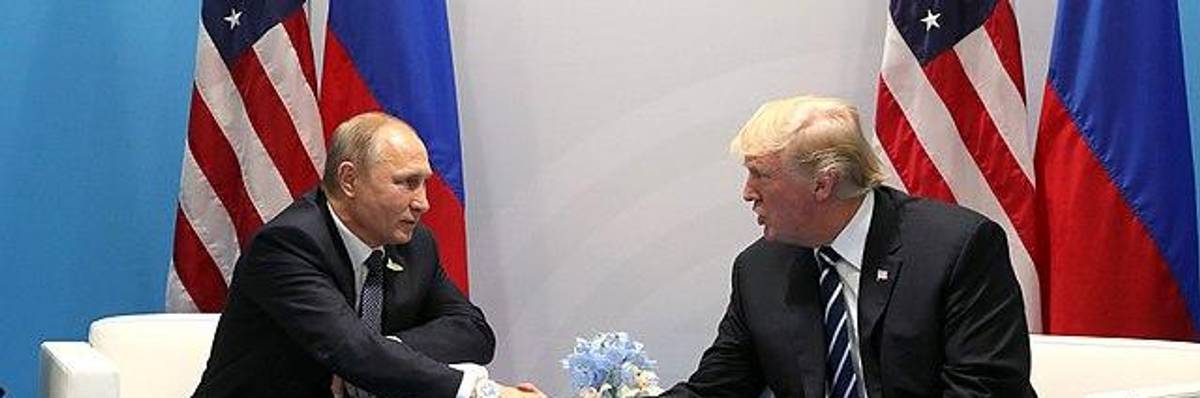
Vladimir Putin and Donald Trump (Wikimedia Commons)
Every elected and appointed U.S. official, other than the president, must take the following oath:
I, ____, do solemnly swear (or affirm) that I will support and defend the Constitution of the United States against all enemies, foreign and domestic; that I will bear true faith and allegiance to the same; that I take this obligation freely, without any mental reservation or purpose of evasion; and that I will well and faithfully discharge the duties of the office on which I am about to enter. So help me God.
It is no longer possible for any senior official in the Trump administration to uphold that obligation.
There is no question that Russia attacked the most sacred institution of American democracy: the system of free and fair elections. In 2017 the intelligence community issued, with "high confidence," its unified assessment that "Russian President Vladimir Putin ordered an influence campaign in 2016 aimed at the US presidential election" in order "to undermine public faith in the US democratic process, denigrate Secretary Clinton, and harm her electability and potential presidency." Such activities "demonstrated a significant escalation in directness, level of activity, and scope of effort compared to previous operations."
Earlier this month the Senate Select Committee on Intelligence, chaired by Republican Senator Richard Burr, affirmed that the intelligence community's findings were "accurate and on point" and that "Russian cyber operations were more extensive than the hack of the Democratic National Committee and continued well through the 2016 election."
On July 13, Special Counsel Robert Mueller indicted 12 Russian military intelligence officers, acting in their official capacity, for engaging in "large-scale cyber operations to interfere with the 2016 U.S. presidential election."
In many ways, this attack is far more serious than the type of military aggression the United States has spent trillions of dollars over the past 70 years to deter and repel. Rather than seizing U.S. territory, Russia has stolen the integrity of the constitutional system that our soldiers and diplomats risk their lives to protect.
Yet President Trump has not condemned the ongoing assault or punished the man who directed it. Instead, he held a friendly meeting with Russian autocrat Vladimir Putin, announcing afterwards that he believes Putin's denials over the findings of U.S. intelligence agencies. Trump not only declined to confront Putin over Russia's cyber invasion of America, but blamed the special counsel, not Russian meddling, for keeping the two countries apart.
There is nothing wrong with holding talks with an adversary. There is nothing wrong with critically assessing the judgments of U.S. intelligence agencies. And there is nothing wrong with acknowledging that the United States, too, has a long history of secretly interfering in democratic elections (see: Chile, Congo, Guatemala, Iran).
Where Trump crosses the line is in failing to perform his sworn duty to preserve, protect, and defend the constitution of the United States. By acquiescing to the Russian attack--whether or not he and his campaign actually had a hand in its direction and execution--he is now, in effect, the agent of a foreign power.
Americans of all political persuasions have hoped or assumed that senior national security officials would keep the president from acting on his worst instincts, as former Secretary of State Tillerson and former National Security Advisor McMaster did when Trump proposed invading Venezuela. But none of them was in the room with Trump and Putin.
Since the secretary of defense, secretary of state, White House chief of staff, national security advisor, and director of national intelligence have been unwilling or unable to convince President Trump to faithfully defend the interests of the United States, they are in violation of their own oaths. It is time for them all to resign.
This country and this world are at a monumental crossroads. US voters have an opportunity to beat back the forces of fascism and confront the billionaires who are rigging the economy, our media system, and our democracy, making it increasingly impossible for ordinary people to get by. We’re not just talking about the election. We’re talking about what must be done once these fascist elements are vanquished from power. We need a bolder set of solutions than what either major party has so far been willing to offer and a working-class movement ready to fight like hell for it. Trump didn't emerge from nowhere. The conditions that fueled MAGA authoritarianism were created by decades of radical neoliberal economic policies and a corrupt political system dominated by corporate interests. They slashed taxes on the super-rich, promising that the benefits would trickle down. They said giveaways to the corporate titans would make life more affordable for the rest of us. It was all bullshit. And when a bitter, betrayed populace searches for someone to blame, right-wing demagogues have little trouble finding scapegoats. People know when they're being lied to, but you won't hear any of this from the corporate media. Only independent journalism—powered and funded by people who believe in building a better world—can deliver truly trustworthy daily news. If you share our vision, please contribute whatever you can to sustain our work. |
Every elected and appointed U.S. official, other than the president, must take the following oath:
I, ____, do solemnly swear (or affirm) that I will support and defend the Constitution of the United States against all enemies, foreign and domestic; that I will bear true faith and allegiance to the same; that I take this obligation freely, without any mental reservation or purpose of evasion; and that I will well and faithfully discharge the duties of the office on which I am about to enter. So help me God.
It is no longer possible for any senior official in the Trump administration to uphold that obligation.
There is no question that Russia attacked the most sacred institution of American democracy: the system of free and fair elections. In 2017 the intelligence community issued, with "high confidence," its unified assessment that "Russian President Vladimir Putin ordered an influence campaign in 2016 aimed at the US presidential election" in order "to undermine public faith in the US democratic process, denigrate Secretary Clinton, and harm her electability and potential presidency." Such activities "demonstrated a significant escalation in directness, level of activity, and scope of effort compared to previous operations."
Earlier this month the Senate Select Committee on Intelligence, chaired by Republican Senator Richard Burr, affirmed that the intelligence community's findings were "accurate and on point" and that "Russian cyber operations were more extensive than the hack of the Democratic National Committee and continued well through the 2016 election."
On July 13, Special Counsel Robert Mueller indicted 12 Russian military intelligence officers, acting in their official capacity, for engaging in "large-scale cyber operations to interfere with the 2016 U.S. presidential election."
In many ways, this attack is far more serious than the type of military aggression the United States has spent trillions of dollars over the past 70 years to deter and repel. Rather than seizing U.S. territory, Russia has stolen the integrity of the constitutional system that our soldiers and diplomats risk their lives to protect.
Yet President Trump has not condemned the ongoing assault or punished the man who directed it. Instead, he held a friendly meeting with Russian autocrat Vladimir Putin, announcing afterwards that he believes Putin's denials over the findings of U.S. intelligence agencies. Trump not only declined to confront Putin over Russia's cyber invasion of America, but blamed the special counsel, not Russian meddling, for keeping the two countries apart.
There is nothing wrong with holding talks with an adversary. There is nothing wrong with critically assessing the judgments of U.S. intelligence agencies. And there is nothing wrong with acknowledging that the United States, too, has a long history of secretly interfering in democratic elections (see: Chile, Congo, Guatemala, Iran).
Where Trump crosses the line is in failing to perform his sworn duty to preserve, protect, and defend the constitution of the United States. By acquiescing to the Russian attack--whether or not he and his campaign actually had a hand in its direction and execution--he is now, in effect, the agent of a foreign power.
Americans of all political persuasions have hoped or assumed that senior national security officials would keep the president from acting on his worst instincts, as former Secretary of State Tillerson and former National Security Advisor McMaster did when Trump proposed invading Venezuela. But none of them was in the room with Trump and Putin.
Since the secretary of defense, secretary of state, White House chief of staff, national security advisor, and director of national intelligence have been unwilling or unable to convince President Trump to faithfully defend the interests of the United States, they are in violation of their own oaths. It is time for them all to resign.