SUBSCRIBE TO OUR FREE NEWSLETTER
Daily news & progressive opinion—funded by the people, not the corporations—delivered straight to your inbox.
5
#000000
#FFFFFF
To donate by check, phone, or other method, see our More Ways to Give page.
The Republican-led House voted to eliminate $1.5 trillion in discretionary spending through 2022 during the much-publicized sequester, causing widespread pain and havoc through American communities, the effects of which we're starting to see. In some cases, these cuts are literally stripping the clothes from children's backs and taking food and shelter from the needy.
In Kentucky and Southern Indiana regions, tens of thousands of individuals are receiving smaller emergency unemployment checks, while thousands of elderly will be receiving fewer
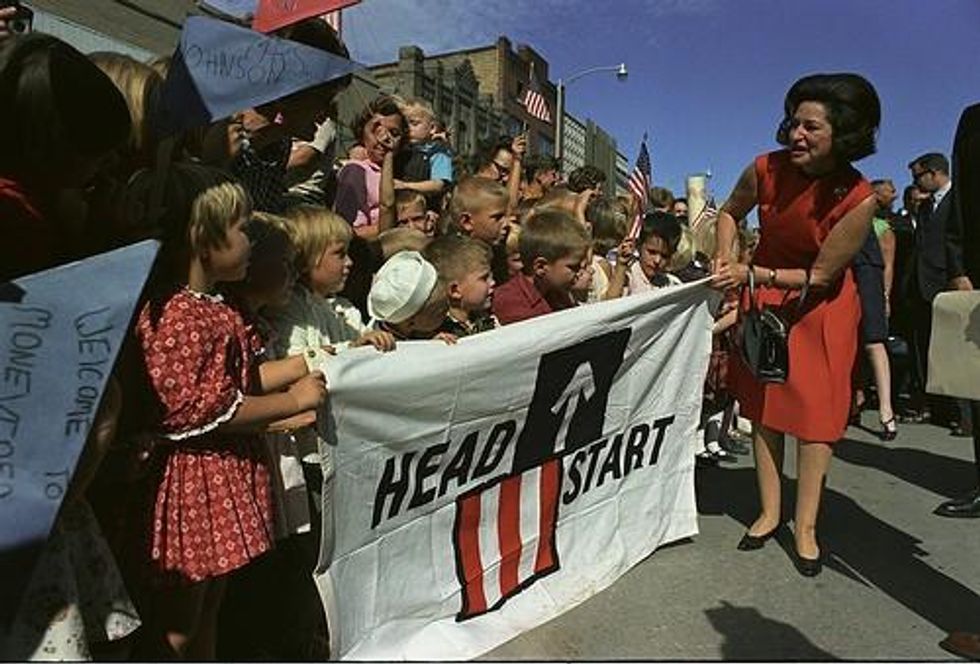
The Courier-Journal reports that federal probation offices that cover Louisville and Western Kentucky have let go of some support staff, and families who hoped to enrol their children in Head Start in Jeffersonville, Indiana, this summer have to make the plans.
Kentucky Gov. Steve Beshear, a Democrat, said in a statement last week that he is "disgusted" by federal lawmakers' inability to stave off the cuts, which he estimates total about $81.2 million in Kentucky. "Sequestration carries real and negative impacts for Kentucky families, including serious cuts to Kentucky's classrooms," he said in a statement. "Our families are paying the price for the petty political antics of the privileged few in Washington."
At least thirty-three families in Kansas City, Missouri, recently faced eviction because of cuts to federal hosing programs. In total, some 125,000 families could lose assistance from the housing choice voucher program because of the cuts, according to the White House.
Michigan eliminated a program that provided 21,000 schoolchildren across the state with a $137 clothing allowance each August. Governor Rick Snyder has made clear that help would not be coming from the state, adding that he believes in targeted cuts. "We've said from the start that Michigan would not be replacing lost federal dollars with state dollars due to sequestration and that still holds true," he said in a release. "We support getting the nation's fiscal house in order, though across-the-board cuts like this are not the way to go about it."
The Miami Herald describes a "ripple effect" of austerity that extends beyond inconveniencing travellers at airports, detailing cuts to social services, including $730,000 in stipends to help the poor pay their utility bills and $25,000 for the county's victims-assistance office.
Miami-Dade initially estimated a $89,000 cut from Alliance for Aging, a local organization charged with distributing federal dollars earmarked for elderly care, amounting to a reduction of about 15,000 meals served at senior centers and other gathering places and about 1,800 meals delivered to seniors' homes. However, Max Rothman, president of the Alliance for Aging, said the county was notified that roughly half of the money will be restored for Miami-Dade.
Still, Rothman says the damage is significant. Even with the reductions being smaller than anticipated, Rothman said the agencies that rely on Alliance dollars to cover food costs have few options but to rollback service. "When something like this happens and you're not particularly prepared for it,'' he said, "you can't make it up."
In St. Louis, scientific research took a massive hit during the sequester when lawmakers voted to gut the annual $140 billion program. St. Louis Public Radio spoke with Rachel Delston, who formerly worked as a postdoctoral researcher at Washington University, but is now employed at Confluence Life Sciences, a drug-discovery company.
"I was working on breast cancer," Delston said. "And I was really trying to answer one of the biggest questions in cancer research today." That is, which genetic mutations drive the formation of tumors--and could be good targets for anti-cancer drugs. Delston says her research was going great. She was about two and half years into what was supposed to be a five-year project. "So you're really just at the heart of the project, right in the middle of it, right in the thick of it," Delston said. "And it was a real shock to get laid off."
Her former boss, Washington University cancer biologist Jason Weber, blames the sequestration for the loss of funding. "I had to let go of some folks, and I had to let go of some science," Weber said. Six months ago, Weber's lab supported about a dozen researchers and graduate students. Now he's down to fewer than half that. He says Delston's research was just hitting its stride. They were getting ready to test some of her findings in cancer patients and were working with a pharmaceutical company on a potential new treatment. "Now we can't do any of that," Weber said. "She's gone, and the science is gone because I don't have anybody to work on it."
An ABC News/Washington Post poll in May found that 37 percent of Americans say they've been negatively affected by the sequester, up from 25 percent in March. And 18 percent say they've felt a "major impact." Naturally, those who feel the brunt of the cuts oppose them. About 80 percent of those who say they've felt a "major impact" oppose the austerity measure.
In West Virginia's Eastern Panhandle, at least one Head Start classroom will be eliminated in the next school year because the region is losing $230,000 in federal funding. In concrete terms, this means at least fifteen preschoolers who would normally have been eligible for Head Start in this region will not have a spot in the program.
Multiply the effect in that one region across the country. The National Head Start Association estimates the cuts will eventually keep some 70,000--mostly low-income--children out of the Head Start programs.
Poor people who wind up in federal court and need legal representation are waiting longer for trials, because so many public defenders are being forced to stay home unpaid, federal public defender Lisa Peebles of Syracuse, New York, told CNN's Jennifer Liberto. Her staff is taking twenty days off, some of the longest furloughs among federal employees.
The dire consequences of furloughing public defenders becomes all the more apparent when one considers there are only 15,000 of them in the entire country.
The Washington Post reports public defenders have seen a 10 percent cut to their budget--and a 12 percent cut in salaries. By one estimate, some 2,000 judiciary workers will be laid off or furloughed this year between March 1 and September 30. Two federal judges on the US District Court for the District of Columbia recently expressed worry that the cuts pose "an existential threat to the right of indigent defendants to have publicly funded legal representation."
"These are the things low income people need: Legal representation, health care, child care," said Professor Tim Smeeding, director of the Institute for Research on Poverty at the University of Wisconsin, Madison. "The more inequality grows, the more they'll need the exact programs we're cutting,"
Some of the on-the-ground consequences of the sequester were initially hidden because giant safety-net programs like Medicaid and food stamps, as well as aid programs funded by the Veterans Administration, remained intact.
However, CNN's Liberto reports agencies and programs that are thinly funded and lack the ability to shuffle money around have been hit extremely hard by the sequester. Steven Bell, senior economic policy director at the Bipartisan Policy Center, says that includes programs that spend their budget allocation on the sick and poor and labor.
"As time goes, you will see more of a cumulative impact," Bell said. "We call it a slow-motion train wreck."
The Republican-led House voted to eliminate $1.5 trillion in discretionary spending through 2022 during the much-publicized sequester, causing widespread pain and havoc through American communities, the effects of which we're starting to see. In some cases, these cuts are literally stripping the clothes from children's backs and taking food and shelter from the needy.
In Kentucky and Southern Indiana regions, tens of thousands of individuals are receiving smaller emergency unemployment checks, while thousands of elderly will be receiving fewer
The Courier-Journal reports that federal probation offices that cover Louisville and Western Kentucky have let go of some support staff, and families who hoped to enrol their children in Head Start in Jeffersonville, Indiana, this summer have to make the plans.
Kentucky Gov. Steve Beshear, a Democrat, said in a statement last week that he is "disgusted" by federal lawmakers' inability to stave off the cuts, which he estimates total about $81.2 million in Kentucky. "Sequestration carries real and negative impacts for Kentucky families, including serious cuts to Kentucky's classrooms," he said in a statement. "Our families are paying the price for the petty political antics of the privileged few in Washington."
At least thirty-three families in Kansas City, Missouri, recently faced eviction because of cuts to federal hosing programs. In total, some 125,000 families could lose assistance from the housing choice voucher program because of the cuts, according to the White House.
Michigan eliminated a program that provided 21,000 schoolchildren across the state with a $137 clothing allowance each August. Governor Rick Snyder has made clear that help would not be coming from the state, adding that he believes in targeted cuts. "We've said from the start that Michigan would not be replacing lost federal dollars with state dollars due to sequestration and that still holds true," he said in a release. "We support getting the nation's fiscal house in order, though across-the-board cuts like this are not the way to go about it."
The Miami Herald describes a "ripple effect" of austerity that extends beyond inconveniencing travellers at airports, detailing cuts to social services, including $730,000 in stipends to help the poor pay their utility bills and $25,000 for the county's victims-assistance office.
Miami-Dade initially estimated a $89,000 cut from Alliance for Aging, a local organization charged with distributing federal dollars earmarked for elderly care, amounting to a reduction of about 15,000 meals served at senior centers and other gathering places and about 1,800 meals delivered to seniors' homes. However, Max Rothman, president of the Alliance for Aging, said the county was notified that roughly half of the money will be restored for Miami-Dade.
Still, Rothman says the damage is significant. Even with the reductions being smaller than anticipated, Rothman said the agencies that rely on Alliance dollars to cover food costs have few options but to rollback service. "When something like this happens and you're not particularly prepared for it,'' he said, "you can't make it up."
In St. Louis, scientific research took a massive hit during the sequester when lawmakers voted to gut the annual $140 billion program. St. Louis Public Radio spoke with Rachel Delston, who formerly worked as a postdoctoral researcher at Washington University, but is now employed at Confluence Life Sciences, a drug-discovery company.
"I was working on breast cancer," Delston said. "And I was really trying to answer one of the biggest questions in cancer research today." That is, which genetic mutations drive the formation of tumors--and could be good targets for anti-cancer drugs. Delston says her research was going great. She was about two and half years into what was supposed to be a five-year project. "So you're really just at the heart of the project, right in the middle of it, right in the thick of it," Delston said. "And it was a real shock to get laid off."
Her former boss, Washington University cancer biologist Jason Weber, blames the sequestration for the loss of funding. "I had to let go of some folks, and I had to let go of some science," Weber said. Six months ago, Weber's lab supported about a dozen researchers and graduate students. Now he's down to fewer than half that. He says Delston's research was just hitting its stride. They were getting ready to test some of her findings in cancer patients and were working with a pharmaceutical company on a potential new treatment. "Now we can't do any of that," Weber said. "She's gone, and the science is gone because I don't have anybody to work on it."
An ABC News/Washington Post poll in May found that 37 percent of Americans say they've been negatively affected by the sequester, up from 25 percent in March. And 18 percent say they've felt a "major impact." Naturally, those who feel the brunt of the cuts oppose them. About 80 percent of those who say they've felt a "major impact" oppose the austerity measure.
In West Virginia's Eastern Panhandle, at least one Head Start classroom will be eliminated in the next school year because the region is losing $230,000 in federal funding. In concrete terms, this means at least fifteen preschoolers who would normally have been eligible for Head Start in this region will not have a spot in the program.
Multiply the effect in that one region across the country. The National Head Start Association estimates the cuts will eventually keep some 70,000--mostly low-income--children out of the Head Start programs.
Poor people who wind up in federal court and need legal representation are waiting longer for trials, because so many public defenders are being forced to stay home unpaid, federal public defender Lisa Peebles of Syracuse, New York, told CNN's Jennifer Liberto. Her staff is taking twenty days off, some of the longest furloughs among federal employees.
The dire consequences of furloughing public defenders becomes all the more apparent when one considers there are only 15,000 of them in the entire country.
The Washington Post reports public defenders have seen a 10 percent cut to their budget--and a 12 percent cut in salaries. By one estimate, some 2,000 judiciary workers will be laid off or furloughed this year between March 1 and September 30. Two federal judges on the US District Court for the District of Columbia recently expressed worry that the cuts pose "an existential threat to the right of indigent defendants to have publicly funded legal representation."
"These are the things low income people need: Legal representation, health care, child care," said Professor Tim Smeeding, director of the Institute for Research on Poverty at the University of Wisconsin, Madison. "The more inequality grows, the more they'll need the exact programs we're cutting,"
Some of the on-the-ground consequences of the sequester were initially hidden because giant safety-net programs like Medicaid and food stamps, as well as aid programs funded by the Veterans Administration, remained intact.
However, CNN's Liberto reports agencies and programs that are thinly funded and lack the ability to shuffle money around have been hit extremely hard by the sequester. Steven Bell, senior economic policy director at the Bipartisan Policy Center, says that includes programs that spend their budget allocation on the sick and poor and labor.
"As time goes, you will see more of a cumulative impact," Bell said. "We call it a slow-motion train wreck."
The Republican-led House voted to eliminate $1.5 trillion in discretionary spending through 2022 during the much-publicized sequester, causing widespread pain and havoc through American communities, the effects of which we're starting to see. In some cases, these cuts are literally stripping the clothes from children's backs and taking food and shelter from the needy.
In Kentucky and Southern Indiana regions, tens of thousands of individuals are receiving smaller emergency unemployment checks, while thousands of elderly will be receiving fewer
The Courier-Journal reports that federal probation offices that cover Louisville and Western Kentucky have let go of some support staff, and families who hoped to enrol their children in Head Start in Jeffersonville, Indiana, this summer have to make the plans.
Kentucky Gov. Steve Beshear, a Democrat, said in a statement last week that he is "disgusted" by federal lawmakers' inability to stave off the cuts, which he estimates total about $81.2 million in Kentucky. "Sequestration carries real and negative impacts for Kentucky families, including serious cuts to Kentucky's classrooms," he said in a statement. "Our families are paying the price for the petty political antics of the privileged few in Washington."
At least thirty-three families in Kansas City, Missouri, recently faced eviction because of cuts to federal hosing programs. In total, some 125,000 families could lose assistance from the housing choice voucher program because of the cuts, according to the White House.
Michigan eliminated a program that provided 21,000 schoolchildren across the state with a $137 clothing allowance each August. Governor Rick Snyder has made clear that help would not be coming from the state, adding that he believes in targeted cuts. "We've said from the start that Michigan would not be replacing lost federal dollars with state dollars due to sequestration and that still holds true," he said in a release. "We support getting the nation's fiscal house in order, though across-the-board cuts like this are not the way to go about it."
The Miami Herald describes a "ripple effect" of austerity that extends beyond inconveniencing travellers at airports, detailing cuts to social services, including $730,000 in stipends to help the poor pay their utility bills and $25,000 for the county's victims-assistance office.
Miami-Dade initially estimated a $89,000 cut from Alliance for Aging, a local organization charged with distributing federal dollars earmarked for elderly care, amounting to a reduction of about 15,000 meals served at senior centers and other gathering places and about 1,800 meals delivered to seniors' homes. However, Max Rothman, president of the Alliance for Aging, said the county was notified that roughly half of the money will be restored for Miami-Dade.
Still, Rothman says the damage is significant. Even with the reductions being smaller than anticipated, Rothman said the agencies that rely on Alliance dollars to cover food costs have few options but to rollback service. "When something like this happens and you're not particularly prepared for it,'' he said, "you can't make it up."
In St. Louis, scientific research took a massive hit during the sequester when lawmakers voted to gut the annual $140 billion program. St. Louis Public Radio spoke with Rachel Delston, who formerly worked as a postdoctoral researcher at Washington University, but is now employed at Confluence Life Sciences, a drug-discovery company.
"I was working on breast cancer," Delston said. "And I was really trying to answer one of the biggest questions in cancer research today." That is, which genetic mutations drive the formation of tumors--and could be good targets for anti-cancer drugs. Delston says her research was going great. She was about two and half years into what was supposed to be a five-year project. "So you're really just at the heart of the project, right in the middle of it, right in the thick of it," Delston said. "And it was a real shock to get laid off."
Her former boss, Washington University cancer biologist Jason Weber, blames the sequestration for the loss of funding. "I had to let go of some folks, and I had to let go of some science," Weber said. Six months ago, Weber's lab supported about a dozen researchers and graduate students. Now he's down to fewer than half that. He says Delston's research was just hitting its stride. They were getting ready to test some of her findings in cancer patients and were working with a pharmaceutical company on a potential new treatment. "Now we can't do any of that," Weber said. "She's gone, and the science is gone because I don't have anybody to work on it."
An ABC News/Washington Post poll in May found that 37 percent of Americans say they've been negatively affected by the sequester, up from 25 percent in March. And 18 percent say they've felt a "major impact." Naturally, those who feel the brunt of the cuts oppose them. About 80 percent of those who say they've felt a "major impact" oppose the austerity measure.
In West Virginia's Eastern Panhandle, at least one Head Start classroom will be eliminated in the next school year because the region is losing $230,000 in federal funding. In concrete terms, this means at least fifteen preschoolers who would normally have been eligible for Head Start in this region will not have a spot in the program.
Multiply the effect in that one region across the country. The National Head Start Association estimates the cuts will eventually keep some 70,000--mostly low-income--children out of the Head Start programs.
Poor people who wind up in federal court and need legal representation are waiting longer for trials, because so many public defenders are being forced to stay home unpaid, federal public defender Lisa Peebles of Syracuse, New York, told CNN's Jennifer Liberto. Her staff is taking twenty days off, some of the longest furloughs among federal employees.
The dire consequences of furloughing public defenders becomes all the more apparent when one considers there are only 15,000 of them in the entire country.
The Washington Post reports public defenders have seen a 10 percent cut to their budget--and a 12 percent cut in salaries. By one estimate, some 2,000 judiciary workers will be laid off or furloughed this year between March 1 and September 30. Two federal judges on the US District Court for the District of Columbia recently expressed worry that the cuts pose "an existential threat to the right of indigent defendants to have publicly funded legal representation."
"These are the things low income people need: Legal representation, health care, child care," said Professor Tim Smeeding, director of the Institute for Research on Poverty at the University of Wisconsin, Madison. "The more inequality grows, the more they'll need the exact programs we're cutting,"
Some of the on-the-ground consequences of the sequester were initially hidden because giant safety-net programs like Medicaid and food stamps, as well as aid programs funded by the Veterans Administration, remained intact.
However, CNN's Liberto reports agencies and programs that are thinly funded and lack the ability to shuffle money around have been hit extremely hard by the sequester. Steven Bell, senior economic policy director at the Bipartisan Policy Center, says that includes programs that spend their budget allocation on the sick and poor and labor.
"As time goes, you will see more of a cumulative impact," Bell said. "We call it a slow-motion train wreck."