SUBSCRIBE TO OUR FREE NEWSLETTER
Daily news & progressive opinion—funded by the people, not the corporations—delivered straight to your inbox.
5
#000000
#FFFFFF
To donate by check, phone, or other method, see our More Ways to Give page.
With seven strikes of fast food workers in eight weeks, demanding $15/hour and the right to a union, a discussion of raising the minimum wage has begun to stir up the predictable frenzy of pro-market mythology.
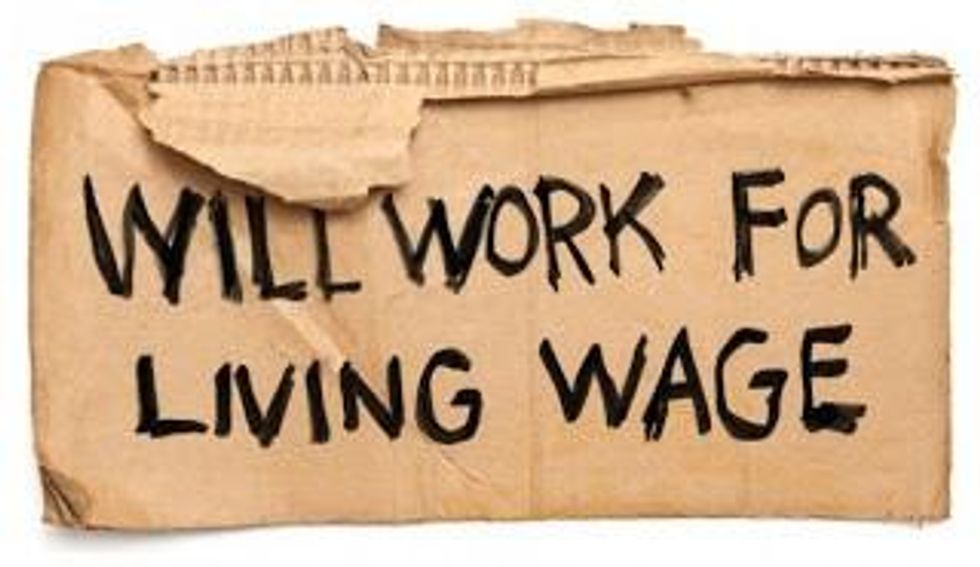
As in every previous discussion of raising the minimum wage, it has been asserted that such a move would increase unemployment, be harmful to the most underprivileged workers, bad for small businesses, and indeed, disastrous for the wider economy. In this same narrative, low-wage jobs are stepping stones, and hard work and higher education are reliable paths to middle class employment.
Is any of this true?
Who Are Low-Wage Workers?
Let's start with a useful benchmark of a low-wage job as one that keeps a full-time worker and their family of four at or below the federal poverty threshold - $23,005 per year, or $11.06/hour in 2011.
Contrary to the myths, the working poor are an ever-expanding contingent of America's labor force, while the middle class has been steadily shrinking. Over 25 percent of all workers qualify as low-wage workers.
Lest we think this is an issue only in Tennessee and Alabama, nearly 20 percent of Washington workers qualify as low-wage workers, with an additional 40 percent living within what is known as the supplemental poverty measure.
The road of higher education also increasingly leads nowhere. Low-wage workers are better educated than ever before, with over 26 percent having had some college education. Low-wage workers now carry sizable sums of student debt.
Conditions have deteriorated even more rapidly since the Great Recession began. Low-wage jobs comprised about 35 percent of jobs lost in 2008 and 2009, yet they accounted for 76 percent of net job growth in 2010.
Minimum Wage Already Too High in Washington?
It is true that Washington is currently the only state with a minimum wage above $9.00/hour.
What this demonstrates, however, is not a lavishness of wages here, but rather the abysmal standard of living faced by tens of millions of hardworking people nationwide. A full-time job at Washington's minimum wage fetches about $18,000, clearly far less than necessary to meet basic expenses.
A more useful benchmark is a living wage. The Alliance for a Just Society defines living-wage jobs for Washington state, assuming full-time hours, as $16.13/hour or $33,544 annually for a single adult. Those figures would rise to $28.71/hour or $59,715 a year for a household of one adult and one child, and $29.42/hour or $61,188 a year for a family of four with one adult working. Keep in mind, many low-wage workers are unable to get full-time employment.
What Would the Fallout of $15/Hour Be?
Much is made of the impact a higher minimum wage would have on small businesses. But what about Starbucks, McDonald's, Subway, Pizza Hut and the vast array of huge corporations whose mega profits rest on the poverty wages of their workforce?
The CEO of YUM! Brands (KFC, Pizza Hut, Taco Bell) made $20.5 million last year. The average worker in one of the stores made $7.50/hour. Restaurant chains spent nearly a million dollars in 2006 to fight minimum-wage increases in six states.
The past several decades have seen worker productivity skyrocket, and wages for most stagnate. Where did the balance go? It went to the top one percent. If minimum wage had kept pace with productivity, it would be approximately $22/hour. If it had grown at the same pace as the income to the one percent, it would be around $33/hour.
Increasing the minimum wage to $15/hour is surely reasonable in the face of the massive siphoning of income to the very top. Should those who work hard every day have to struggle to pay for rent and groceries?
Research does show that a minimum wage increase can initially pose difficulty to some small businesses. However, this can be addressed by increasing taxes on big business (which are at historically low rates) and eliminating corporate welfare to subsidize small businesses, along with cutting B&O and property tax burden on small businesses.
But the main danger facing working people and small businesses is the continued proliferation of low wages. The economy is reeling with over 20 million people unemployed or underemployed, a low-wage workforce, a collapse of the housing bubble, and staggering consumer and student debt. Raising wages is a vital measure to break out of the depressionary spiral.
Statistical studies show a positive impact of wage increases on jobs. When working people have more income, their spending power goes up, which in turn boosts sales, which further increases jobs and overall spending power, and so on.
The idea that raising the wage would harm the most disadvantaged workers is a fig leaf to justify anti-worker policymaking. In fact, increasing the minimum wage raises the bargaining power of all workers, and has the effect of raising wages across the board.
The Great Recession has left in tatters the idea that capitalism works. It works well for the billionaires, but for the rest of us, it has meant fast eroding standards of living. The American middle class was created on the edifice of courage and sacrifice of a mobilized labor movement. Let us support the workers demanding $15/hour. They are a sign of the times.
With seven strikes of fast food workers in eight weeks, demanding $15/hour and the right to a union, a discussion of raising the minimum wage has begun to stir up the predictable frenzy of pro-market mythology.
As in every previous discussion of raising the minimum wage, it has been asserted that such a move would increase unemployment, be harmful to the most underprivileged workers, bad for small businesses, and indeed, disastrous for the wider economy. In this same narrative, low-wage jobs are stepping stones, and hard work and higher education are reliable paths to middle class employment.
Is any of this true?
Who Are Low-Wage Workers?
Let's start with a useful benchmark of a low-wage job as one that keeps a full-time worker and their family of four at or below the federal poverty threshold - $23,005 per year, or $11.06/hour in 2011.
Contrary to the myths, the working poor are an ever-expanding contingent of America's labor force, while the middle class has been steadily shrinking. Over 25 percent of all workers qualify as low-wage workers.
Lest we think this is an issue only in Tennessee and Alabama, nearly 20 percent of Washington workers qualify as low-wage workers, with an additional 40 percent living within what is known as the supplemental poverty measure.
The road of higher education also increasingly leads nowhere. Low-wage workers are better educated than ever before, with over 26 percent having had some college education. Low-wage workers now carry sizable sums of student debt.
Conditions have deteriorated even more rapidly since the Great Recession began. Low-wage jobs comprised about 35 percent of jobs lost in 2008 and 2009, yet they accounted for 76 percent of net job growth in 2010.
Minimum Wage Already Too High in Washington?
It is true that Washington is currently the only state with a minimum wage above $9.00/hour.
What this demonstrates, however, is not a lavishness of wages here, but rather the abysmal standard of living faced by tens of millions of hardworking people nationwide. A full-time job at Washington's minimum wage fetches about $18,000, clearly far less than necessary to meet basic expenses.
A more useful benchmark is a living wage. The Alliance for a Just Society defines living-wage jobs for Washington state, assuming full-time hours, as $16.13/hour or $33,544 annually for a single adult. Those figures would rise to $28.71/hour or $59,715 a year for a household of one adult and one child, and $29.42/hour or $61,188 a year for a family of four with one adult working. Keep in mind, many low-wage workers are unable to get full-time employment.
What Would the Fallout of $15/Hour Be?
Much is made of the impact a higher minimum wage would have on small businesses. But what about Starbucks, McDonald's, Subway, Pizza Hut and the vast array of huge corporations whose mega profits rest on the poverty wages of their workforce?
The CEO of YUM! Brands (KFC, Pizza Hut, Taco Bell) made $20.5 million last year. The average worker in one of the stores made $7.50/hour. Restaurant chains spent nearly a million dollars in 2006 to fight minimum-wage increases in six states.
The past several decades have seen worker productivity skyrocket, and wages for most stagnate. Where did the balance go? It went to the top one percent. If minimum wage had kept pace with productivity, it would be approximately $22/hour. If it had grown at the same pace as the income to the one percent, it would be around $33/hour.
Increasing the minimum wage to $15/hour is surely reasonable in the face of the massive siphoning of income to the very top. Should those who work hard every day have to struggle to pay for rent and groceries?
Research does show that a minimum wage increase can initially pose difficulty to some small businesses. However, this can be addressed by increasing taxes on big business (which are at historically low rates) and eliminating corporate welfare to subsidize small businesses, along with cutting B&O and property tax burden on small businesses.
But the main danger facing working people and small businesses is the continued proliferation of low wages. The economy is reeling with over 20 million people unemployed or underemployed, a low-wage workforce, a collapse of the housing bubble, and staggering consumer and student debt. Raising wages is a vital measure to break out of the depressionary spiral.
Statistical studies show a positive impact of wage increases on jobs. When working people have more income, their spending power goes up, which in turn boosts sales, which further increases jobs and overall spending power, and so on.
The idea that raising the wage would harm the most disadvantaged workers is a fig leaf to justify anti-worker policymaking. In fact, increasing the minimum wage raises the bargaining power of all workers, and has the effect of raising wages across the board.
The Great Recession has left in tatters the idea that capitalism works. It works well for the billionaires, but for the rest of us, it has meant fast eroding standards of living. The American middle class was created on the edifice of courage and sacrifice of a mobilized labor movement. Let us support the workers demanding $15/hour. They are a sign of the times.
With seven strikes of fast food workers in eight weeks, demanding $15/hour and the right to a union, a discussion of raising the minimum wage has begun to stir up the predictable frenzy of pro-market mythology.
As in every previous discussion of raising the minimum wage, it has been asserted that such a move would increase unemployment, be harmful to the most underprivileged workers, bad for small businesses, and indeed, disastrous for the wider economy. In this same narrative, low-wage jobs are stepping stones, and hard work and higher education are reliable paths to middle class employment.
Is any of this true?
Who Are Low-Wage Workers?
Let's start with a useful benchmark of a low-wage job as one that keeps a full-time worker and their family of four at or below the federal poverty threshold - $23,005 per year, or $11.06/hour in 2011.
Contrary to the myths, the working poor are an ever-expanding contingent of America's labor force, while the middle class has been steadily shrinking. Over 25 percent of all workers qualify as low-wage workers.
Lest we think this is an issue only in Tennessee and Alabama, nearly 20 percent of Washington workers qualify as low-wage workers, with an additional 40 percent living within what is known as the supplemental poverty measure.
The road of higher education also increasingly leads nowhere. Low-wage workers are better educated than ever before, with over 26 percent having had some college education. Low-wage workers now carry sizable sums of student debt.
Conditions have deteriorated even more rapidly since the Great Recession began. Low-wage jobs comprised about 35 percent of jobs lost in 2008 and 2009, yet they accounted for 76 percent of net job growth in 2010.
Minimum Wage Already Too High in Washington?
It is true that Washington is currently the only state with a minimum wage above $9.00/hour.
What this demonstrates, however, is not a lavishness of wages here, but rather the abysmal standard of living faced by tens of millions of hardworking people nationwide. A full-time job at Washington's minimum wage fetches about $18,000, clearly far less than necessary to meet basic expenses.
A more useful benchmark is a living wage. The Alliance for a Just Society defines living-wage jobs for Washington state, assuming full-time hours, as $16.13/hour or $33,544 annually for a single adult. Those figures would rise to $28.71/hour or $59,715 a year for a household of one adult and one child, and $29.42/hour or $61,188 a year for a family of four with one adult working. Keep in mind, many low-wage workers are unable to get full-time employment.
What Would the Fallout of $15/Hour Be?
Much is made of the impact a higher minimum wage would have on small businesses. But what about Starbucks, McDonald's, Subway, Pizza Hut and the vast array of huge corporations whose mega profits rest on the poverty wages of their workforce?
The CEO of YUM! Brands (KFC, Pizza Hut, Taco Bell) made $20.5 million last year. The average worker in one of the stores made $7.50/hour. Restaurant chains spent nearly a million dollars in 2006 to fight minimum-wage increases in six states.
The past several decades have seen worker productivity skyrocket, and wages for most stagnate. Where did the balance go? It went to the top one percent. If minimum wage had kept pace with productivity, it would be approximately $22/hour. If it had grown at the same pace as the income to the one percent, it would be around $33/hour.
Increasing the minimum wage to $15/hour is surely reasonable in the face of the massive siphoning of income to the very top. Should those who work hard every day have to struggle to pay for rent and groceries?
Research does show that a minimum wage increase can initially pose difficulty to some small businesses. However, this can be addressed by increasing taxes on big business (which are at historically low rates) and eliminating corporate welfare to subsidize small businesses, along with cutting B&O and property tax burden on small businesses.
But the main danger facing working people and small businesses is the continued proliferation of low wages. The economy is reeling with over 20 million people unemployed or underemployed, a low-wage workforce, a collapse of the housing bubble, and staggering consumer and student debt. Raising wages is a vital measure to break out of the depressionary spiral.
Statistical studies show a positive impact of wage increases on jobs. When working people have more income, their spending power goes up, which in turn boosts sales, which further increases jobs and overall spending power, and so on.
The idea that raising the wage would harm the most disadvantaged workers is a fig leaf to justify anti-worker policymaking. In fact, increasing the minimum wage raises the bargaining power of all workers, and has the effect of raising wages across the board.
The Great Recession has left in tatters the idea that capitalism works. It works well for the billionaires, but for the rest of us, it has meant fast eroding standards of living. The American middle class was created on the edifice of courage and sacrifice of a mobilized labor movement. Let us support the workers demanding $15/hour. They are a sign of the times.