SUBSCRIBE TO OUR FREE NEWSLETTER
Daily news & progressive opinion—funded by the people, not the corporations—delivered straight to your inbox.
5
#000000
#FFFFFF
To donate by check, phone, or other method, see our More Ways to Give page.
Daily news & progressive opinion—funded by the people, not the corporations—delivered straight to your inbox.
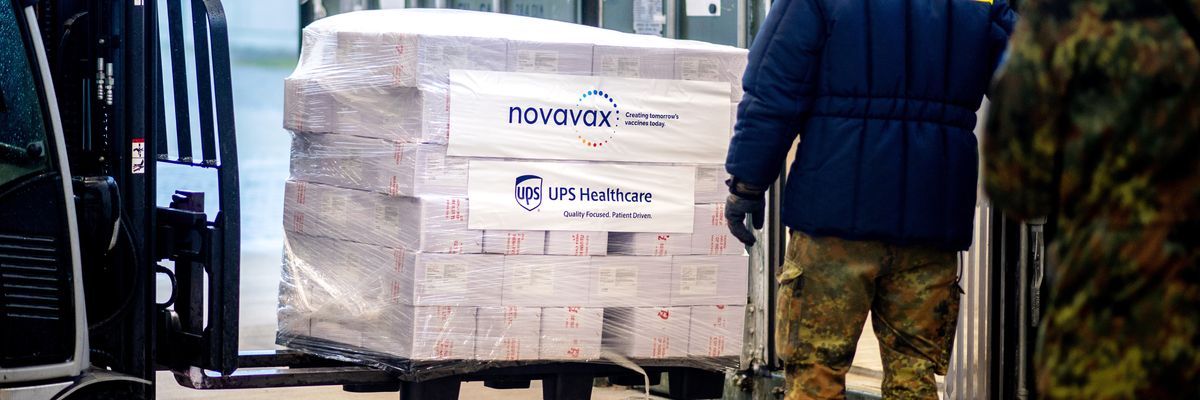
The coronavirus vaccine Nuvaxovid from Novavax was seen being delivered to the premises of the Bundeswehr pharmacy on February 24, 2022 in Quakenbrück, Germany.
"Handing exclusive rights to publicly-funded vaccines and medicines to just a few companies simply does not work—for rich countries or poorer ones," said an adviser to the People's Vaccine Alliance.
Vaccine equity campaigners on Monday condemned European Union nations for hoarding Covid-19 vaccine doses at the expense of low-income countries after a new Politico analysis estimated that the bloc's members have thrown out at least €4 billion—roughly $4.4 billion—worth of the lifesaving shots.
That equates to around 215 million coronavirus vaccine doses—very likely an undercount, given that Politico wasn't able to obtain waste numbers from every E.U. member country.
"Calculations based on available data show that E.U. countries have discarded an average of 0.7 jabs for every member of their population," the outlet reported. "Top of the scale is Estonia, which binned more than one dose per inhabitant, followed closely by Germany, which also threw away the largest raw volume of jabs."
Piotr Kolczyński, E.U. health policy adviser at the People's Vaccine Alliance and Oxfam International, said in a statement that the new analysis is "further proof that the E.U. wasted millions of its Covid-19 vaccines, hoarded early in the pandemic, as it locked poorer countries out of access."
"The appalling waste in the world's pandemic response was disastrous," said Kolczyński. "Handing exclusive rights to publicly-funded vaccines and medicines to just a few companies simply does not work—for rich countries or poorer ones."
Politico attributed much of the waste to the E.U.'s massive 2021 deal with Pfizer and BioNTech, which agreed to sell 1.1 billion doses of their mRNA jab to members of the bloc as low-income countries struggled to obtain shots for their populations.
"Despite considering a significant reform to reign in pharmaceutical waste and profiteering within its borders, the EU fails to support similar efforts on the global stage."
E.U. members—Germany in particular—pushed back aggressively against the India and South Africa-led call for a Covid-19 vaccine patent waiver, which proponents said would have lifted key barriers to expanding vaccine manufacturing and access. Germany alone has wasted 83 million vaccine doses, according to Politico.
The pharmaceutical industry, for its part, lobbied aggressively to preserve its monopoly control over vaccine recipes and production, focusing significant attention on the European Commission.
With the global health emergency formally over, countries are currently negotiating the terms of a pandemic agreement that would govern how the international community responds to the next global crisis.
Reuters reported in September that "governments remain divided, failing to agree on some of the basics needed to strengthen health systems worldwide."
"Those basics, all issues that hindered a coordinated global response to the Covid-19 outbreak, include the sharing of information, costs, and vaccines," Reuters added. "The divisions arose anew in June, when the European Union negotiated new agreements with pharmaceutical companies to reserve vaccines for future pandemics. The agreements led critics to accuse the bloc of 'vaccine apartheid.'"
Last month, 18 members of the European Parliament wrote to the Council of the European Union and the European Commission expressing "concerns about the E.U.'s negotiating position."
"It proposes to continue relying solely on voluntary measures in the deployment of key public health interventions, such as the transfer of technology, know-how and 'trade secrets,' or the removal of intellectual property barriers," the lawmakers wrote. "In the meantime, the E.U. avoids specific commitments for equitable access to pandemic products."
As the People's Vaccine Alliance noted Monday, the E.U.'s latest proposed text "suggests removing transparency and equity measures."
"Despite considering a significant reform to reign in pharmaceutical waste and profiteering within its borders, the E.U. fails to support similar efforts on the global stage," said Kolczyński. "It is one rule for the E.U. and another for everyone else."
Dear Common Dreams reader, It’s been nearly 30 years since I co-founded Common Dreams with my late wife, Lina Newhouser. We had the radical notion that journalism should serve the public good, not corporate profits. It was clear to us from the outset what it would take to build such a project. No paid advertisements. No corporate sponsors. No millionaire publisher telling us what to think or do. Many people said we wouldn't last a year, but we proved those doubters wrong. Together with a tremendous team of journalists and dedicated staff, we built an independent media outlet free from the constraints of profits and corporate control. Our mission has always been simple: To inform. To inspire. To ignite change for the common good. Building Common Dreams was not easy. Our survival was never guaranteed. When you take on the most powerful forces—Wall Street greed, fossil fuel industry destruction, Big Tech lobbyists, and uber-rich oligarchs who have spent billions upon billions rigging the economy and democracy in their favor—the only bulwark you have is supporters who believe in your work. But here’s the urgent message from me today. It's never been this bad out there. And it's never been this hard to keep us going. At the very moment Common Dreams is most needed, the threats we face are intensifying. We need your support now more than ever. We don't accept corporate advertising and never will. We don't have a paywall because we don't think people should be blocked from critical news based on their ability to pay. Everything we do is funded by the donations of readers like you. When everyone does the little they can afford, we are strong. But if that support retreats or dries up, so do we. Will you donate now to make sure Common Dreams not only survives but thrives? —Craig Brown, Co-founder |
Vaccine equity campaigners on Monday condemned European Union nations for hoarding Covid-19 vaccine doses at the expense of low-income countries after a new Politico analysis estimated that the bloc's members have thrown out at least €4 billion—roughly $4.4 billion—worth of the lifesaving shots.
That equates to around 215 million coronavirus vaccine doses—very likely an undercount, given that Politico wasn't able to obtain waste numbers from every E.U. member country.
"Calculations based on available data show that E.U. countries have discarded an average of 0.7 jabs for every member of their population," the outlet reported. "Top of the scale is Estonia, which binned more than one dose per inhabitant, followed closely by Germany, which also threw away the largest raw volume of jabs."
Piotr Kolczyński, E.U. health policy adviser at the People's Vaccine Alliance and Oxfam International, said in a statement that the new analysis is "further proof that the E.U. wasted millions of its Covid-19 vaccines, hoarded early in the pandemic, as it locked poorer countries out of access."
"The appalling waste in the world's pandemic response was disastrous," said Kolczyński. "Handing exclusive rights to publicly-funded vaccines and medicines to just a few companies simply does not work—for rich countries or poorer ones."
Politico attributed much of the waste to the E.U.'s massive 2021 deal with Pfizer and BioNTech, which agreed to sell 1.1 billion doses of their mRNA jab to members of the bloc as low-income countries struggled to obtain shots for their populations.
"Despite considering a significant reform to reign in pharmaceutical waste and profiteering within its borders, the EU fails to support similar efforts on the global stage."
E.U. members—Germany in particular—pushed back aggressively against the India and South Africa-led call for a Covid-19 vaccine patent waiver, which proponents said would have lifted key barriers to expanding vaccine manufacturing and access. Germany alone has wasted 83 million vaccine doses, according to Politico.
The pharmaceutical industry, for its part, lobbied aggressively to preserve its monopoly control over vaccine recipes and production, focusing significant attention on the European Commission.
With the global health emergency formally over, countries are currently negotiating the terms of a pandemic agreement that would govern how the international community responds to the next global crisis.
Reuters reported in September that "governments remain divided, failing to agree on some of the basics needed to strengthen health systems worldwide."
"Those basics, all issues that hindered a coordinated global response to the Covid-19 outbreak, include the sharing of information, costs, and vaccines," Reuters added. "The divisions arose anew in June, when the European Union negotiated new agreements with pharmaceutical companies to reserve vaccines for future pandemics. The agreements led critics to accuse the bloc of 'vaccine apartheid.'"
Last month, 18 members of the European Parliament wrote to the Council of the European Union and the European Commission expressing "concerns about the E.U.'s negotiating position."
"It proposes to continue relying solely on voluntary measures in the deployment of key public health interventions, such as the transfer of technology, know-how and 'trade secrets,' or the removal of intellectual property barriers," the lawmakers wrote. "In the meantime, the E.U. avoids specific commitments for equitable access to pandemic products."
As the People's Vaccine Alliance noted Monday, the E.U.'s latest proposed text "suggests removing transparency and equity measures."
"Despite considering a significant reform to reign in pharmaceutical waste and profiteering within its borders, the E.U. fails to support similar efforts on the global stage," said Kolczyński. "It is one rule for the E.U. and another for everyone else."
Vaccine equity campaigners on Monday condemned European Union nations for hoarding Covid-19 vaccine doses at the expense of low-income countries after a new Politico analysis estimated that the bloc's members have thrown out at least €4 billion—roughly $4.4 billion—worth of the lifesaving shots.
That equates to around 215 million coronavirus vaccine doses—very likely an undercount, given that Politico wasn't able to obtain waste numbers from every E.U. member country.
"Calculations based on available data show that E.U. countries have discarded an average of 0.7 jabs for every member of their population," the outlet reported. "Top of the scale is Estonia, which binned more than one dose per inhabitant, followed closely by Germany, which also threw away the largest raw volume of jabs."
Piotr Kolczyński, E.U. health policy adviser at the People's Vaccine Alliance and Oxfam International, said in a statement that the new analysis is "further proof that the E.U. wasted millions of its Covid-19 vaccines, hoarded early in the pandemic, as it locked poorer countries out of access."
"The appalling waste in the world's pandemic response was disastrous," said Kolczyński. "Handing exclusive rights to publicly-funded vaccines and medicines to just a few companies simply does not work—for rich countries or poorer ones."
Politico attributed much of the waste to the E.U.'s massive 2021 deal with Pfizer and BioNTech, which agreed to sell 1.1 billion doses of their mRNA jab to members of the bloc as low-income countries struggled to obtain shots for their populations.
"Despite considering a significant reform to reign in pharmaceutical waste and profiteering within its borders, the EU fails to support similar efforts on the global stage."
E.U. members—Germany in particular—pushed back aggressively against the India and South Africa-led call for a Covid-19 vaccine patent waiver, which proponents said would have lifted key barriers to expanding vaccine manufacturing and access. Germany alone has wasted 83 million vaccine doses, according to Politico.
The pharmaceutical industry, for its part, lobbied aggressively to preserve its monopoly control over vaccine recipes and production, focusing significant attention on the European Commission.
With the global health emergency formally over, countries are currently negotiating the terms of a pandemic agreement that would govern how the international community responds to the next global crisis.
Reuters reported in September that "governments remain divided, failing to agree on some of the basics needed to strengthen health systems worldwide."
"Those basics, all issues that hindered a coordinated global response to the Covid-19 outbreak, include the sharing of information, costs, and vaccines," Reuters added. "The divisions arose anew in June, when the European Union negotiated new agreements with pharmaceutical companies to reserve vaccines for future pandemics. The agreements led critics to accuse the bloc of 'vaccine apartheid.'"
Last month, 18 members of the European Parliament wrote to the Council of the European Union and the European Commission expressing "concerns about the E.U.'s negotiating position."
"It proposes to continue relying solely on voluntary measures in the deployment of key public health interventions, such as the transfer of technology, know-how and 'trade secrets,' or the removal of intellectual property barriers," the lawmakers wrote. "In the meantime, the E.U. avoids specific commitments for equitable access to pandemic products."
As the People's Vaccine Alliance noted Monday, the E.U.'s latest proposed text "suggests removing transparency and equity measures."
"Despite considering a significant reform to reign in pharmaceutical waste and profiteering within its borders, the E.U. fails to support similar efforts on the global stage," said Kolczyński. "It is one rule for the E.U. and another for everyone else."