SUBSCRIBE TO OUR FREE NEWSLETTER
Daily news & progressive opinion—funded by the people, not the corporations—delivered straight to your inbox.
5
#000000
#FFFFFF
To donate by check, phone, or other method, see our More Ways to Give page.
Daily news & progressive opinion—funded by the people, not the corporations—delivered straight to your inbox.
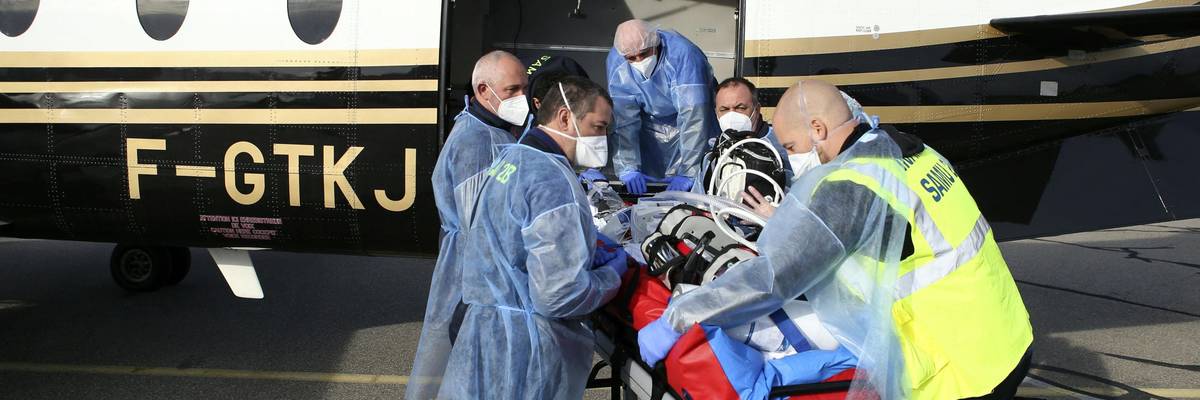
Paramedics, nurses, and doctors use a trolley to transfer a Covid-19 patient from an ambulance into a medical aircraft in Bastia on the French Mediterranean island of Corsica on January 5, 2022.
We urgently need global rules and international cooperation to prevent, prepare for, and respond to the next dangerous infectious disease.
This week, World Health Organization member states meeting at the World Health Assembly are widely expected to extend negotiations for a new pandemic treaty after talks collapsed last Friday.
The political blowback and disinformation campaign against the treaty have been fierce.
Reps. Jim Jordan (R-Ohio) and Thomas Massie (R-Ky.) claimed the “WHO agreement may contravene the First Amendment.” It doesn’t. Twenty-four governors wrote to President Joe Biden raising constitutional concerns, none of which hold water.
The concentration of global vaccine manufacturing capacity in rich countries drives inequities.
More about disinformation later. What’s most important is that the risk of the next pandemic looms—just witness the spread of H5N1 avian influenza among dairy cattle and farm workers. We urgently need to shore up international rules to prevent, prepare for, and respond to the next pandemic.
The pandemic agreement would, in essence, strike a global social bargain.
The Biden administrationwants a transparent exchange of scientific information in real-time, including surveillance data, notification of dangerous outbreaks, and sharing pathogen samples and their genomic sequences. Global rules on scientific exchange can help curb outbreaks at their source and detect dangerous variants. More importantly, these data are the lifeblood needed to develop lifesaving diagnostics, vaccines, and treatments rapidly.
This global social bargain also requires equitable allocation of medical products made possible by scientific sharing. And without equity, the Global South rightly won’t sign on.
We think of equity as a matter of ethics, and it is. But it is also the most effective way to stop the international spread of novel diseases before they become pandemics. Equity is central to rebuilding trust between the West and the Global South, which was shattered during Covid-19.
The concentration of global vaccine manufacturing capacity in rich countries drives inequities. As we saw with Covid-19, high-income countries pre-purchased vaccines from pharmaceutical companies, causing serious international vaccine shortages.
Building manufacturing capacity in low- and middle-income countries like Brazil, India, and South Africa would remove bottlenecks in global supply. But this will require sharing intellectual property, dedicated financing, and transferring technology from powerful multinational pharmaceutical companies.
The pandemic treaty would also address the “upstream drivers” of pandemics. Biodiversity loss, climate change, and chemical pollutionall contribute to the emergence of novel diseases. Up to 75% of new or emerging infectious diseases result from “spillovers” from animals to humans. Zoonotic spillovers have caused most global health emergencies, like SARS, Ebola, mpox, and most likely Covid-19.
A “one health” approach ensures that governments take action at the interfaces between human, animal, and environmental health. This could mean global rules on deforestation, intense farming of animals, overuse of antibiotics, and the trade in wild animals, including wet markets.
But all these global public goods are at risk from a worldwide disinformation campaign aimed at derailing the treaty. False claims include the loss of U.S. sovereignty to craft public health policies. Yet, the draft treaty expressly affirms national sovereignty. Also, the WHO director-general does not have the power to require lockdowns or issue mandates for masks or vaccinations.
This year, more than 64 countries are holding elections. Elections in the United States pose a particularly virulent risk to the success of diplomatic negotiations. Recall that then President Donald Trump withdrew the U.S. from WHO, only to be reversed by Biden. There’s little doubt that a future Trump administration would torpedo WHO negotiations.
The next pandemic is percolating somewhere—whether in dairy cows here in the United States, in a cave in southern China replete with bats, or through the work of nefarious actors using novel technologies like synthetic biology to recreate or enhance dangerous viruses like smallpox.
More than 1 million Americans lost their lives to Covid-19. The next pandemic could be much worse. We urgently need global rules and international cooperation to prevent, prepare for, and respond to the next dangerous infectious disease.
Dear Common Dreams reader, It’s been nearly 30 years since I co-founded Common Dreams with my late wife, Lina Newhouser. We had the radical notion that journalism should serve the public good, not corporate profits. It was clear to us from the outset what it would take to build such a project. No paid advertisements. No corporate sponsors. No millionaire publisher telling us what to think or do. Many people said we wouldn't last a year, but we proved those doubters wrong. Together with a tremendous team of journalists and dedicated staff, we built an independent media outlet free from the constraints of profits and corporate control. Our mission has always been simple: To inform. To inspire. To ignite change for the common good. Building Common Dreams was not easy. Our survival was never guaranteed. When you take on the most powerful forces—Wall Street greed, fossil fuel industry destruction, Big Tech lobbyists, and uber-rich oligarchs who have spent billions upon billions rigging the economy and democracy in their favor—the only bulwark you have is supporters who believe in your work. But here’s the urgent message from me today. It's never been this bad out there. And it's never been this hard to keep us going. At the very moment Common Dreams is most needed, the threats we face are intensifying. We need your support now more than ever. We don't accept corporate advertising and never will. We don't have a paywall because we don't think people should be blocked from critical news based on their ability to pay. Everything we do is funded by the donations of readers like you. When everyone does the little they can afford, we are strong. But if that support retreats or dries up, so do we. Will you donate now to make sure Common Dreams not only survives but thrives? —Craig Brown, Co-founder |
This week, World Health Organization member states meeting at the World Health Assembly are widely expected to extend negotiations for a new pandemic treaty after talks collapsed last Friday.
The political blowback and disinformation campaign against the treaty have been fierce.
Reps. Jim Jordan (R-Ohio) and Thomas Massie (R-Ky.) claimed the “WHO agreement may contravene the First Amendment.” It doesn’t. Twenty-four governors wrote to President Joe Biden raising constitutional concerns, none of which hold water.
The concentration of global vaccine manufacturing capacity in rich countries drives inequities.
More about disinformation later. What’s most important is that the risk of the next pandemic looms—just witness the spread of H5N1 avian influenza among dairy cattle and farm workers. We urgently need to shore up international rules to prevent, prepare for, and respond to the next pandemic.
The pandemic agreement would, in essence, strike a global social bargain.
The Biden administrationwants a transparent exchange of scientific information in real-time, including surveillance data, notification of dangerous outbreaks, and sharing pathogen samples and their genomic sequences. Global rules on scientific exchange can help curb outbreaks at their source and detect dangerous variants. More importantly, these data are the lifeblood needed to develop lifesaving diagnostics, vaccines, and treatments rapidly.
This global social bargain also requires equitable allocation of medical products made possible by scientific sharing. And without equity, the Global South rightly won’t sign on.
We think of equity as a matter of ethics, and it is. But it is also the most effective way to stop the international spread of novel diseases before they become pandemics. Equity is central to rebuilding trust between the West and the Global South, which was shattered during Covid-19.
The concentration of global vaccine manufacturing capacity in rich countries drives inequities. As we saw with Covid-19, high-income countries pre-purchased vaccines from pharmaceutical companies, causing serious international vaccine shortages.
Building manufacturing capacity in low- and middle-income countries like Brazil, India, and South Africa would remove bottlenecks in global supply. But this will require sharing intellectual property, dedicated financing, and transferring technology from powerful multinational pharmaceutical companies.
The pandemic treaty would also address the “upstream drivers” of pandemics. Biodiversity loss, climate change, and chemical pollutionall contribute to the emergence of novel diseases. Up to 75% of new or emerging infectious diseases result from “spillovers” from animals to humans. Zoonotic spillovers have caused most global health emergencies, like SARS, Ebola, mpox, and most likely Covid-19.
A “one health” approach ensures that governments take action at the interfaces between human, animal, and environmental health. This could mean global rules on deforestation, intense farming of animals, overuse of antibiotics, and the trade in wild animals, including wet markets.
But all these global public goods are at risk from a worldwide disinformation campaign aimed at derailing the treaty. False claims include the loss of U.S. sovereignty to craft public health policies. Yet, the draft treaty expressly affirms national sovereignty. Also, the WHO director-general does not have the power to require lockdowns or issue mandates for masks or vaccinations.
This year, more than 64 countries are holding elections. Elections in the United States pose a particularly virulent risk to the success of diplomatic negotiations. Recall that then President Donald Trump withdrew the U.S. from WHO, only to be reversed by Biden. There’s little doubt that a future Trump administration would torpedo WHO negotiations.
The next pandemic is percolating somewhere—whether in dairy cows here in the United States, in a cave in southern China replete with bats, or through the work of nefarious actors using novel technologies like synthetic biology to recreate or enhance dangerous viruses like smallpox.
More than 1 million Americans lost their lives to Covid-19. The next pandemic could be much worse. We urgently need global rules and international cooperation to prevent, prepare for, and respond to the next dangerous infectious disease.
This week, World Health Organization member states meeting at the World Health Assembly are widely expected to extend negotiations for a new pandemic treaty after talks collapsed last Friday.
The political blowback and disinformation campaign against the treaty have been fierce.
Reps. Jim Jordan (R-Ohio) and Thomas Massie (R-Ky.) claimed the “WHO agreement may contravene the First Amendment.” It doesn’t. Twenty-four governors wrote to President Joe Biden raising constitutional concerns, none of which hold water.
The concentration of global vaccine manufacturing capacity in rich countries drives inequities.
More about disinformation later. What’s most important is that the risk of the next pandemic looms—just witness the spread of H5N1 avian influenza among dairy cattle and farm workers. We urgently need to shore up international rules to prevent, prepare for, and respond to the next pandemic.
The pandemic agreement would, in essence, strike a global social bargain.
The Biden administrationwants a transparent exchange of scientific information in real-time, including surveillance data, notification of dangerous outbreaks, and sharing pathogen samples and their genomic sequences. Global rules on scientific exchange can help curb outbreaks at their source and detect dangerous variants. More importantly, these data are the lifeblood needed to develop lifesaving diagnostics, vaccines, and treatments rapidly.
This global social bargain also requires equitable allocation of medical products made possible by scientific sharing. And without equity, the Global South rightly won’t sign on.
We think of equity as a matter of ethics, and it is. But it is also the most effective way to stop the international spread of novel diseases before they become pandemics. Equity is central to rebuilding trust between the West and the Global South, which was shattered during Covid-19.
The concentration of global vaccine manufacturing capacity in rich countries drives inequities. As we saw with Covid-19, high-income countries pre-purchased vaccines from pharmaceutical companies, causing serious international vaccine shortages.
Building manufacturing capacity in low- and middle-income countries like Brazil, India, and South Africa would remove bottlenecks in global supply. But this will require sharing intellectual property, dedicated financing, and transferring technology from powerful multinational pharmaceutical companies.
The pandemic treaty would also address the “upstream drivers” of pandemics. Biodiversity loss, climate change, and chemical pollutionall contribute to the emergence of novel diseases. Up to 75% of new or emerging infectious diseases result from “spillovers” from animals to humans. Zoonotic spillovers have caused most global health emergencies, like SARS, Ebola, mpox, and most likely Covid-19.
A “one health” approach ensures that governments take action at the interfaces between human, animal, and environmental health. This could mean global rules on deforestation, intense farming of animals, overuse of antibiotics, and the trade in wild animals, including wet markets.
But all these global public goods are at risk from a worldwide disinformation campaign aimed at derailing the treaty. False claims include the loss of U.S. sovereignty to craft public health policies. Yet, the draft treaty expressly affirms national sovereignty. Also, the WHO director-general does not have the power to require lockdowns or issue mandates for masks or vaccinations.
This year, more than 64 countries are holding elections. Elections in the United States pose a particularly virulent risk to the success of diplomatic negotiations. Recall that then President Donald Trump withdrew the U.S. from WHO, only to be reversed by Biden. There’s little doubt that a future Trump administration would torpedo WHO negotiations.
The next pandemic is percolating somewhere—whether in dairy cows here in the United States, in a cave in southern China replete with bats, or through the work of nefarious actors using novel technologies like synthetic biology to recreate or enhance dangerous viruses like smallpox.
More than 1 million Americans lost their lives to Covid-19. The next pandemic could be much worse. We urgently need global rules and international cooperation to prevent, prepare for, and respond to the next dangerous infectious disease.