

SUBSCRIBE TO OUR FREE NEWSLETTER
Daily news & progressive opinion—funded by the people, not the corporations—delivered straight to your inbox.
5
#000000
#FFFFFF
To donate by check, phone, or other method, see our More Ways to Give page.
Daily news & progressive opinion—funded by the people, not the corporations—delivered straight to your inbox.
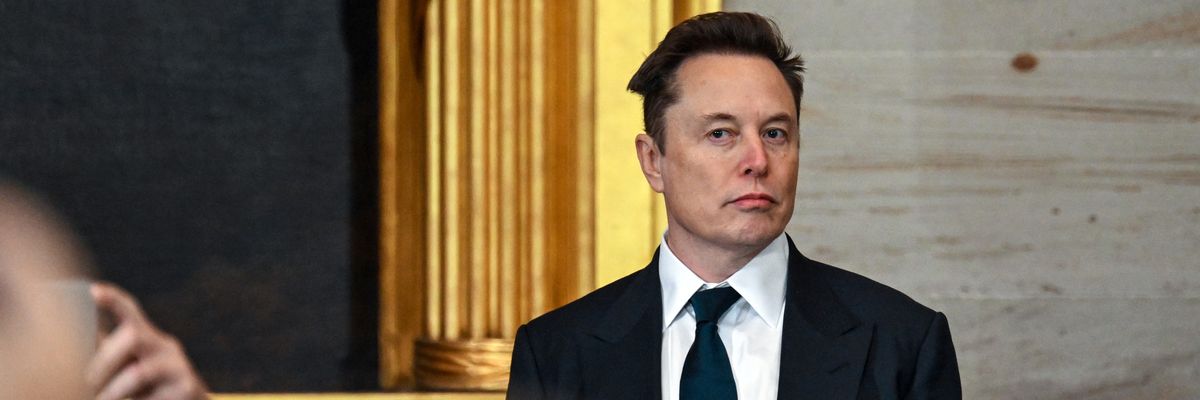
Elon Musk arrives for the inauguration of President Donald Trump in the US Capitol Rotunda on January 20, 2025 in Washington, DC.
"Musk is not cloaked in some federal immunity just because he's off-again/on-again buddies with Trump."
Elon Musk is facing calls for legal ramifications after Grok, the AI chatbot used on his X social media platform, produced sexually suggestive images of children.
Politico reported on Friday that the Paris prosecutor's office in France is opening an investigation into X after Grok, following prompts from users, created deepfake photographs of both adult women and underage girls that removed their clothes and replaced them with bikinis.
Politico added that the investigation into X over the images will "bolster" an ongoing investigation launched by French prosecutors last year into Grok's dissemination of Holocaust denial propaganda.
France is not the only government putting pressure on Musk, as TechCrunch reported on Friday that India's information technology ministry has given X 72 hours to restrict users' ability to generate content deemed "obscene, pornographic, vulgar, indecent, sexually explicit, pedophilic, or otherwise prohibited under law."
Failure to comply with this order, the ministry warned, could lead to the government ending X's legal immunity from being sued over user-generated content.
In an interview with Indian cable news network CNBC TV18, cybersecurity expert Ritesh Bhatia argued that legal liability for the images generated by Grok should not just lie with the users whose prompts generated them, but with the creators of the chatbot itself.
"When a platform like Grok even allows such prompts to be executed, the responsibility squarely lies with the intermediary," said Bhatia. "Technology is not neutral when it follows harmful commands. If a system can be instructed to violate dignity, the failure is not human behavior alone—it is design, governance, and ethical neglect. Creators of Grok need to take immediate action."
Corey Rayburn Yung, a professor at the University of Kansas School of Law, argued on Bluesky that it was "unprecedented" for a digital platform to give "users a tool to actively create" child sexual abuse material (CSAM).
"There are no other instances of a major company affirmatively facilitating the production of child pornography," Yung emphasized. "Treating this as the inevitable result of generative AI and social media is a harrowing mistake."
Andy Craig, a fellow at the Institute for Humane Studies, said that US states should use their powers to investigate X over Grok's generation of CSAM, given that it is unlikely the federal government under President Donald Trump will do so.
"Every state has its equivalent laws about this stuff," Craig explained. "Musk is not cloaked in some federal immunity just because he's off-again/on-again buddies with Trump."
Grok first gained the ability to generate sexual content this past summer when Musk introduced a new "spicy mode" for the chatbot that was immediately used to generate deepfake nude photos of celebrities.
Weeks before this, Grok began calling itself "MechaHitler" after Musk ordered his team to make tweaks to the chatbot to make it more "politically incorrect."
Dear Common Dreams reader, It’s been nearly 30 years since I co-founded Common Dreams with my late wife, Lina Newhouser. We had the radical notion that journalism should serve the public good, not corporate profits. It was clear to us from the outset what it would take to build such a project. No paid advertisements. No corporate sponsors. No millionaire publisher telling us what to think or do. Many people said we wouldn't last a year, but we proved those doubters wrong. Together with a tremendous team of journalists and dedicated staff, we built an independent media outlet free from the constraints of profits and corporate control. Our mission has always been simple: To inform. To inspire. To ignite change for the common good. Building Common Dreams was not easy. Our survival was never guaranteed. When you take on the most powerful forces—Wall Street greed, fossil fuel industry destruction, Big Tech lobbyists, and uber-rich oligarchs who have spent billions upon billions rigging the economy and democracy in their favor—the only bulwark you have is supporters who believe in your work. But here’s the urgent message from me today. It's never been this bad out there. And it's never been this hard to keep us going. At the very moment Common Dreams is most needed, the threats we face are intensifying. We need your support now more than ever. We don't accept corporate advertising and never will. We don't have a paywall because we don't think people should be blocked from critical news based on their ability to pay. Everything we do is funded by the donations of readers like you. When everyone does the little they can afford, we are strong. But if that support retreats or dries up, so do we. Will you donate now to make sure Common Dreams not only survives but thrives? —Craig Brown, Co-founder |
Elon Musk is facing calls for legal ramifications after Grok, the AI chatbot used on his X social media platform, produced sexually suggestive images of children.
Politico reported on Friday that the Paris prosecutor's office in France is opening an investigation into X after Grok, following prompts from users, created deepfake photographs of both adult women and underage girls that removed their clothes and replaced them with bikinis.
Politico added that the investigation into X over the images will "bolster" an ongoing investigation launched by French prosecutors last year into Grok's dissemination of Holocaust denial propaganda.
France is not the only government putting pressure on Musk, as TechCrunch reported on Friday that India's information technology ministry has given X 72 hours to restrict users' ability to generate content deemed "obscene, pornographic, vulgar, indecent, sexually explicit, pedophilic, or otherwise prohibited under law."
Failure to comply with this order, the ministry warned, could lead to the government ending X's legal immunity from being sued over user-generated content.
In an interview with Indian cable news network CNBC TV18, cybersecurity expert Ritesh Bhatia argued that legal liability for the images generated by Grok should not just lie with the users whose prompts generated them, but with the creators of the chatbot itself.
"When a platform like Grok even allows such prompts to be executed, the responsibility squarely lies with the intermediary," said Bhatia. "Technology is not neutral when it follows harmful commands. If a system can be instructed to violate dignity, the failure is not human behavior alone—it is design, governance, and ethical neglect. Creators of Grok need to take immediate action."
Corey Rayburn Yung, a professor at the University of Kansas School of Law, argued on Bluesky that it was "unprecedented" for a digital platform to give "users a tool to actively create" child sexual abuse material (CSAM).
"There are no other instances of a major company affirmatively facilitating the production of child pornography," Yung emphasized. "Treating this as the inevitable result of generative AI and social media is a harrowing mistake."
Andy Craig, a fellow at the Institute for Humane Studies, said that US states should use their powers to investigate X over Grok's generation of CSAM, given that it is unlikely the federal government under President Donald Trump will do so.
"Every state has its equivalent laws about this stuff," Craig explained. "Musk is not cloaked in some federal immunity just because he's off-again/on-again buddies with Trump."
Grok first gained the ability to generate sexual content this past summer when Musk introduced a new "spicy mode" for the chatbot that was immediately used to generate deepfake nude photos of celebrities.
Weeks before this, Grok began calling itself "MechaHitler" after Musk ordered his team to make tweaks to the chatbot to make it more "politically incorrect."
Elon Musk is facing calls for legal ramifications after Grok, the AI chatbot used on his X social media platform, produced sexually suggestive images of children.
Politico reported on Friday that the Paris prosecutor's office in France is opening an investigation into X after Grok, following prompts from users, created deepfake photographs of both adult women and underage girls that removed their clothes and replaced them with bikinis.
Politico added that the investigation into X over the images will "bolster" an ongoing investigation launched by French prosecutors last year into Grok's dissemination of Holocaust denial propaganda.
France is not the only government putting pressure on Musk, as TechCrunch reported on Friday that India's information technology ministry has given X 72 hours to restrict users' ability to generate content deemed "obscene, pornographic, vulgar, indecent, sexually explicit, pedophilic, or otherwise prohibited under law."
Failure to comply with this order, the ministry warned, could lead to the government ending X's legal immunity from being sued over user-generated content.
In an interview with Indian cable news network CNBC TV18, cybersecurity expert Ritesh Bhatia argued that legal liability for the images generated by Grok should not just lie with the users whose prompts generated them, but with the creators of the chatbot itself.
"When a platform like Grok even allows such prompts to be executed, the responsibility squarely lies with the intermediary," said Bhatia. "Technology is not neutral when it follows harmful commands. If a system can be instructed to violate dignity, the failure is not human behavior alone—it is design, governance, and ethical neglect. Creators of Grok need to take immediate action."
Corey Rayburn Yung, a professor at the University of Kansas School of Law, argued on Bluesky that it was "unprecedented" for a digital platform to give "users a tool to actively create" child sexual abuse material (CSAM).
"There are no other instances of a major company affirmatively facilitating the production of child pornography," Yung emphasized. "Treating this as the inevitable result of generative AI and social media is a harrowing mistake."
Andy Craig, a fellow at the Institute for Humane Studies, said that US states should use their powers to investigate X over Grok's generation of CSAM, given that it is unlikely the federal government under President Donald Trump will do so.
"Every state has its equivalent laws about this stuff," Craig explained. "Musk is not cloaked in some federal immunity just because he's off-again/on-again buddies with Trump."
Grok first gained the ability to generate sexual content this past summer when Musk introduced a new "spicy mode" for the chatbot that was immediately used to generate deepfake nude photos of celebrities.
Weeks before this, Grok began calling itself "MechaHitler" after Musk ordered his team to make tweaks to the chatbot to make it more "politically incorrect."

