

SUBSCRIBE TO OUR FREE NEWSLETTER
Daily news & progressive opinion—funded by the people, not the corporations—delivered straight to your inbox.
5
#000000
#FFFFFF
To donate by check, phone, or other method, see our More Ways to Give page.
Daily news & progressive opinion—funded by the people, not the corporations—delivered straight to your inbox.
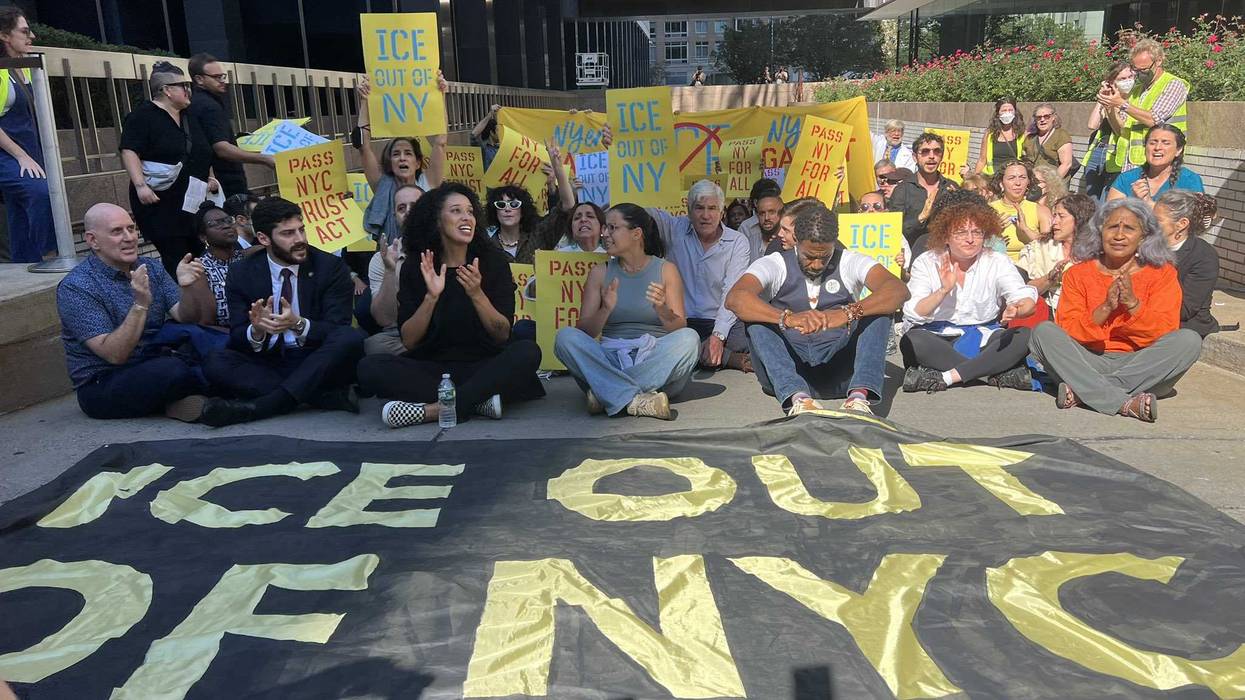
"We are talking about people fleeing violence and terror, and we are subjecting them to violence and terror," said New York City Comptroller Brad Lander, who was arrested for the second time this summer for attempting to block ICE.
Department of Homeland Security police arrested 11 New York state lawmakers on Thursday as they demanded access to a secretive immigrant detention facility in Lower Manhattan.
As The City reports:
The arrests at 26 Federal Plaza happened after an hour-long standoff, with the lawmakers refusing to leave the hallway outside the lockup, banging on the locked doors, and eventually sitting down to chant and sing before they were hauled off in zip ties.
All 11 have been released. Those arrested were city Comptroller Brad Lander along with state Senators Jabari Brisport, Gustavo Rivera and Julia Salazar and Assemblymembers Robert Carroll, Emily Gallagher, Jessica Gonzalez Rojas, Marcela Mitaynes, Steve Raga, Tony Simone and Claire Valdez.
The lawmakers were among at least 71 people arrested at the facility, according to a statement from the Department of Homeland Security (DHS). Others included immigrants’ rights activists and religious leaders who held a sit-in to block Immigration and Customs Enforcement (ICE) vans from entering and exiting the facility with detainees.
The agency has previously denied that an immigrant detention site exists at 26 Federal Plaza, a federal building that contains DHS and FBI offices as well as one of New York City's main immigration courts.
But in July, videos obtained by the New York Immigration Coalition confirmed accounts that it was confining people in wretched conditions.
(Video: The Guardian, via the New York Immigration Coalition)
Those clips, first reported by The City, showed around two dozen men in a fluorescent-lit room without beds. Several of them were shown lying on the ground under aluminum emergency blankets. The camera showed two toilets in the same room, separated from the living quarters by nothing but a short wall.
One of the men described the conditions: "They haven’t given us food, they haven’t given us medicine. We’re cold. There are people who’ve been here for 10, 15 days inside. We’re just waiting.”
New York City public advocate Jumaane Williams, who would become the first person arrested on Thursday, explained why he was helping to block the driveway to the facility.
"I think everybody can now see that everything going on behind us is not only illegal, it's inhumane, and has nothing to do with public safety," he said, with chants echoing behind him. "Those of us who have a little bit more privilege have to step up and do our best to protect those who have even less."
New York City Comptroller Brad Lander—a top ally of the Democratic nominee for mayor, Zohran Mamdani—was arrested for the second time at 26 Federal Plaza this summer. In June, he was grabbed by masked agents there while he escorted a defendant out of immigration court.
"I've been here more than a dozen times, and every single time, I have seen a lawless abduction," Lander said while sitting in a circle with protesters inside the building. "We are talking about people fleeing violence and terror, and we are subjecting them to violence and terror."
In a statement responding to the protests, Tricia McLaughlin, a spokesperson for the DHS, accused the immigrants inside the facility of being gang members, possessing fentanyl, or having a gun, though she did not identify any of the detainees.
According to the most recent immigration data, about 71% of those held in ICE detention have no criminal convictions, while most of those who do have committed only minor offenses. Data from June showed that just 7% of those taken into custody have violent criminal convictions.
McLaughlin blamed Lander for starting the "chaos" at the facility, which she said led to the arrest of "71 agitators and sanctuary politicians.”
Long known as a "sanctuary city," New York City has laws on the books forbidding agencies, including the New York Police Department (NYPD), from cooperating with federal immigration enforcement unless the person ICE seeks to detain has been convicted of a serious crime and ICE officials present a judicial warrant.
However, facing a lawsuit and aggressive pressure campaign from the Trump administration, Mayor Eric Adams has sought to loosen that policy and increase collaboration with federal authorities.
Thursday's protests come as ICE ramps up arrests and detentions to record numbers across the state of New York, which the protesters argued the state legislature has done little to combat.
Among the protesters' demands was for the legislature to pass the New York For All Act, which would limit state agencies' ability to collaborate with ICE and other federal agencies. They also called on the city council to pass the NYC Trust Act, which would allow individuals to sue the NYPD and the city's Department of Corrections for collaborating with ICE in violation of the city's sanctuary laws.
Tiffany Cabán, a city council member who was arrested outside the plaza, addressed the press while being led away by a pair of police officers.
"We need to get ICE out of New York," Cabán said. "We need to make sure that every detainee in Federal Plaza is released. There is a humanitarian crisis. They're being tortured. We need to, at the state and city level, pass laws to make sure that we remain a sanctuary city."
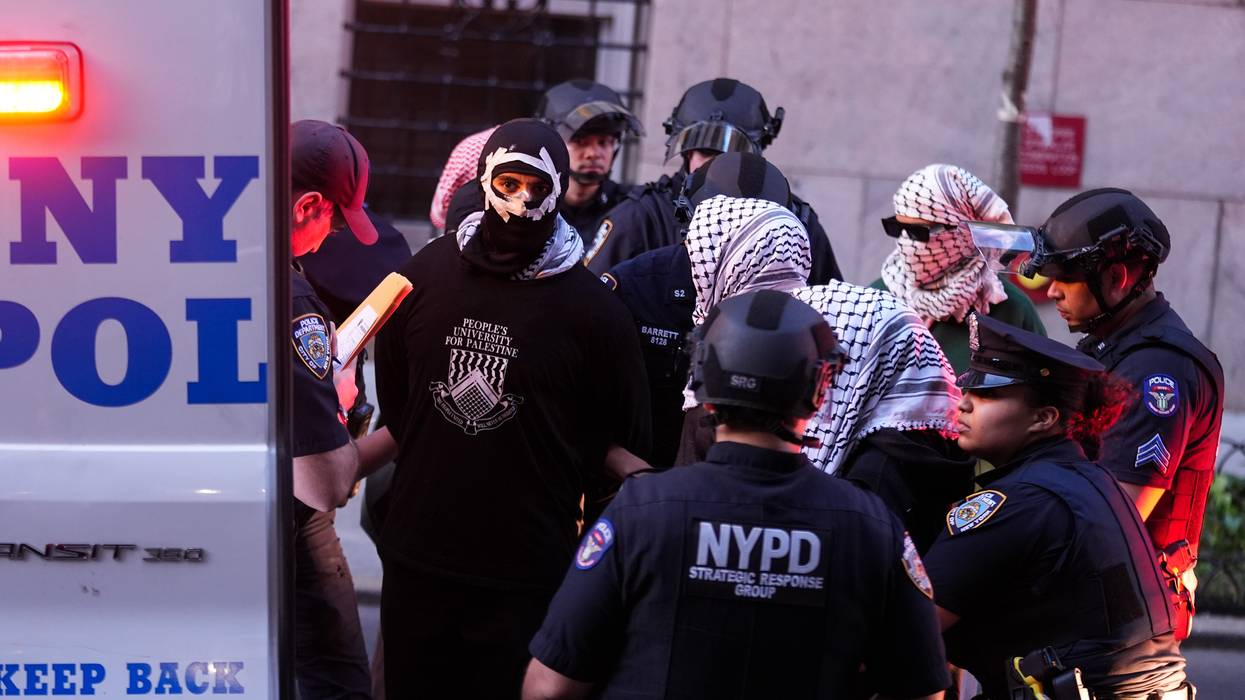
"Repression breeds resistance—if Columbia escalates repression, the people will continue to escalate disruptions on this campus," wrote Columbia University Apartheid Divest.
The New York Police Department arrested dozens of pro-Palestinian protestors on Columbia University's campus on Wednesday evening—prompting U.S. Secretary of State Marco Rubio to announce on X that the federal government is reviewing the visa status of those involved in the action.
On Wednesday afternoon, masked protestors, many wearing keffiyehs, gathered in Columbia's Butler Library. Video of the protest posted to social media shows demonstrators inside the library chanting "free Palestine."
Columbia has been under intense scrutiny from the Trump administration in recent months over the school's alleged failure to protect Jewish students. Critics say the administration is weaponizing antisemitism to attack Palestinian rights advocates. In March, the school faced backlash for making policy changes in line with demands from the Trump administration following the administration's decision to freeze $400 million in federal grants for the school.
Late Wednesday, U.S. Secretary of State Marco Rubio wrote on X: "We are reviewing the visa status of the trespassers and vandals who took over Columbia University's library. Pro-Hamas thugs are no longer welcome in our great nation."
In January, U.S. President Donald Trump signed an executive order with the professed aim of rooting out antisemitism at higher education institutions, and vowed to target foreign-born students who have engaged in "pro-jihadist" protests.
Acting university president Claire Shipman authorized the NYPD to enter campus around 7 pm on Wednesday in response to the rally in the library, according to the Columbia Daily Spectator. The student paper reported that the NYPD arrested roughly 75 protesters and began leading them out of the library shortly thereafter.
The Daily Spectator also reported that there were altercations between the police and protestors after the arrests made in connection to the library protest.
Eighty people "who did not comply with verbal warnings by the NYPD to disperse" were taken into custody, according to the NYPD, per reporting from CNN. Seventy-eight of those taken into custody were arrested and two others were issued summonses, the NYPD told the outlet. CNN noted that it's not clear how many of those arrested came from the protest inside the building.
The group Columbia University Apartheid Divest wrote on Substack on Wednesday that the protestors renamed the library in honor of Palestinian activist Basil al-Araj.
The organizers said that the action at the library "shows that as long as Columbia funds and profits from imperialist violence, the people will continue to disrupt Columbia's profits and legitimacy. Repression breeds resistance—if Columbia escalates repression, the people will continue to escalate disruptions on this campus."
In May of last year, the NYPD swept an occupation of Hamilton Hall and arrested dozens of student protestors.
Wednesday's events come not long after arrests by federal immigration agents of multiple noncitizens who had been active in pro-Palestine actions on Columbia's campus.
In March, federal immigration agents arrested pro-Palestinian activist and former Columbia student Mahmoud Khalil, who is currently languishing in an U.S. Immigration and Customs Enforcement facility in Jena, Louisiana. Another Palestinian green-card holder active in Columbia's student protest movement, Mohsen Mahdawi, was also arrested by federal immigration agents, but last month was released on bail.
Both of those cases have generated significant national attention.
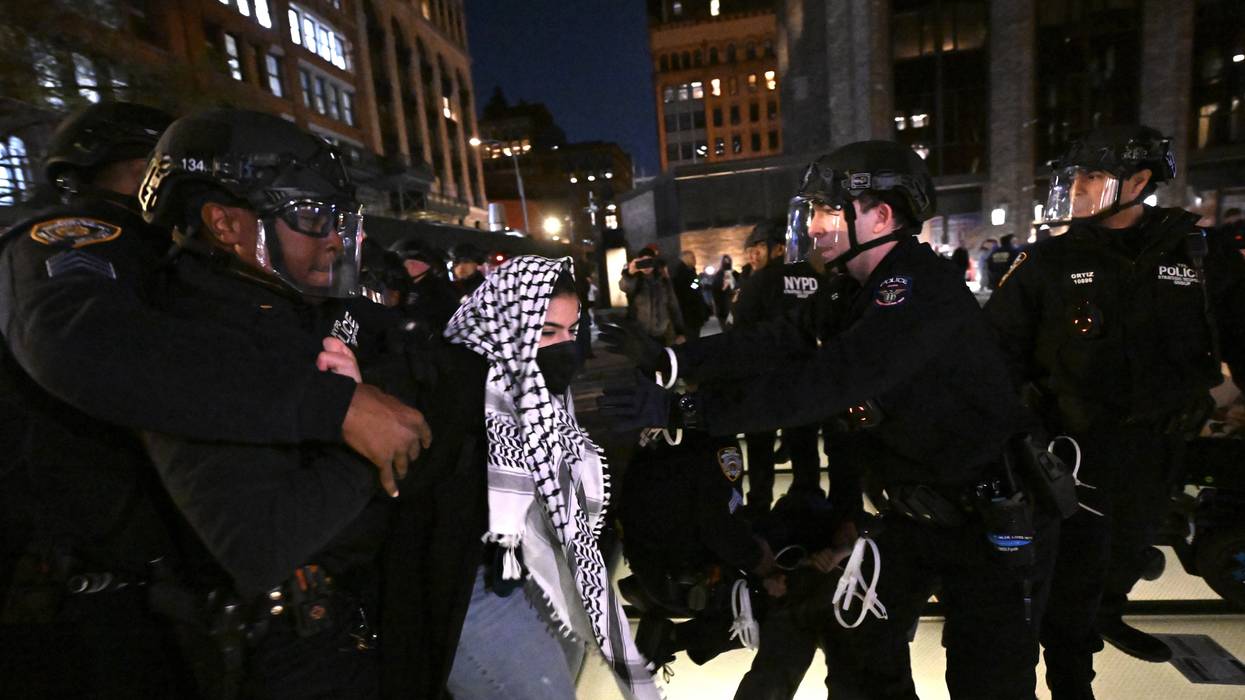
Police use of "catch-and-release" tactics is particularly worrying for press freedom advocates, according to the U.S. Press Freedom Tracker.
Arrests and detainments of journalists in the United States surged in 2024 compared to the year prior, according to the U.S. Press Freedom Tracker, a project of the Freedom of the Press Foundation.
The tracker reports that journalists were arrested or detained by police at least 48 times this year—eclipsing the number of arrests that took place in the previous two years combined, and constituting the third highest number of yearly arrests and detentions since the project began cataloging press freedom violations in 2017. 2020, however, still stands as far and away the year with the most arrests and detentions.
The 48 arrests and detentions this year is also part of a larger list of "press freedom incidents" that the tracker documents, including things like equipment damage, equipment seizure, and assault.
While a year with a high number of protests typically leads to more arrests, "it was protests in response to the Israel-Gaza war that caused this year's uptick," according to the tracker.
The vast majority of the arrests and detainments out of the total 48 were linked to these sorts of demonstrations, and it was protests at Columbia University's Manhattan campus that were the site of this year's largest detainment of journalists.
The report also recounts the story of Roni Jacobson, a freelance reporter whose experience on the last day of 2023 was a harbinger of press freedom incidents to come in 2024. Jacobson was on assignment to cover a pro-Palestinian demonstration for the New York Daily News on December 31, 2023 when she was told to leave by police because she didn't have city-issued press credentials with her. She recounted that she accidentally bumped into an officer and was arrested. She was held overnight at a precinct and then released after the charges against her, which included disorderly conduct, were dropped.
Even five arrests that the tracker deems "election-related" took place at protests that were "at least partially if not entirely focused on the Israel-Gaza war." Three of those election-related arrests took place at protests happening around the Democratic National Convention in August.
One police force in particular bears responsibility for this year's crackdown: Nearly 50% of the arrests of journalists this year were at the hands of the New York Police Department (NYPD). Many of those taken into custody had their charges dropped quickly, but the tracker notes that the NYPD's use of "catch-and-release" tactics was particularly worrying to press freedom advocates.
Two photojournalists, Josh Pacheco and Olga Federova, were detained four times this year in both New York City and Chicago while photographing protests. They were both "assaulted and arrested and [had] their equipment damaged" while documenting police clearing a student encampment at Manhattan's Fashion Institute of Technology; however, they were released the next day and told their arrests had been voided.
"While [we are] glad that some common sense prevailed by the NYPD not charging these two photographers with any crime, we are very concerned that they are perfecting 'catch-and-release' to an art form,” Mickey Osterreicher, general counsel for the National Press Photographers Association, told the tracker.
"The fact that they took two photojournalists off the street, preventing them from making any more images or transmitting the ones they already had on a matter of extreme public concern, is very disturbing," he said.
Besides covering protests, 2024 also saw the continued practice of "criminally charging journalists for standard journalistic practices," according to the tracker. For example, one investigative journalist in Los Angeles was repeatedly threatened with arrest while attempting to cover a homeless encampment sweep in the city, and then was detained in October, though he was let go without charges.

"A reminder: the U.S. has the #1 most expensive healthcare system in the world, yet we rank roughly #42 in life expectancy," the 26-year-old accused of assassinating a health insurance CEO reportedly wrote.
This is a breaking story… Please check back for possible updates...
A day after Luigi Mangione was arrested and charged as the alleged killer of UnitedHealthcare CEO Brian Thompson, independent journalist Ken Klippenstein on Tuesday published what he said was the 26-year-old's highly reported on manifesto.
The existence of the handwritten document found on Mangione when he was taken into custody in Pennsylvania on Monday was confirmed by the New York Police Department, and major media outlets have quoted from it, but none had released it in full.
"My queries to The New York Times, CNN, and ABC to explain their rationale for withholding the manifesto, while gladly quoting from it selectively, have not been answered," Klippenstein said on his Substack.
According to Klippenstein—who previously published dossiers on Vice President-elect JD Vance and Sen. Marco Rubio (R-Fla.), the nominee for U.S. secretary of state—Mangione's manifesto reads:
To the Feds, I'll keep this short, because I do respect what you do for our country. To save you a lengthy investigation, I state plainly that I wasn't working with anyone. This was fairly trivial: some elementary social engineering, basic CAD, a lot of patience. The spiral notebook, if present, has some straggling notes and To Do lists that illuminate the gist of it. My tech is pretty locked down because I work in engineering so probably not much info there. I do apologize for any strife of traumas but it had to be done. Frankly, these parasites simply had it coming. A reminder: the US has the #1 most expensive healthcare system in the world, yet we rank roughly #42 in life expectancy. United is the [indecipherable] largest company in the US by market cap, behind only Apple, Google, Walmart. It has grown and grown, but as our life expectancy? No the reality is, these [indecipherable] have simply gotten too powerful, and they continue to abuse our country for immense profit because the American public has allwed them to get away with it. Obviously the problem is more complex, but I do not have space, and frankly I do not pretend to be the most qualified person to lay out the full argument. But many have illuminated the corruption and greed (e.g.: Rosenthal, Moore), decades ago and the problems simply remain. It is not an issue of awareness at this point, but clearly power games at play. Evidently I am the first to face it with such brutal honesty.
Common Dreams has not independently verified its authenticity.
Klippenstein
said on social media that the manifesto he published is "the real one, not the fake one circulating online."
NBC News deputy technology editor Ben Goggin noted that language shared by Klippenstein "matches what NBC has reported here as real."
Earlier on Tuesday, Klippenstein published leaked talking points that UnitedHealthcare reportedly circulated to its employees as the insurance company faces widespread public criticism.

"I do apologize for any strife or trauma, but it had to be done," the Ivy League graduate reportedly wrote in a manifesto admitting to killing UnitedHealthcare CEO Brian Thompson. "These parasites had it coming."
Luigi Mangione—the 26-year-old man arrested in Pennsylvania Monday on gun charges and suspected of last week's assassination of UnitedHealthcare CEO Brian Thompson—was carrying a manifesto condemning insurance industry greed, police said after his apprehension.
Mangione, a Maryland native who according to his social media profiles has a master's degree in engineering from the University of Pennsylvania, was apprehended after being recognized in a McDonald's in Altoona,
The New York Times reported. He has been charged with weapons, forgery, and other crimes and is scheduled to appear before a judge in western Pennsylvania.
New York Police Department (NYPD) Chief of Detectives Joseph Kenny said Mangione was in possession of a 9mm handgun—possibly a ghost gun made with numerous parts or a 3D printer—the type used to kill Thompson, as well as a silencer and what he described as an anti-corporate manifesto.
"It does seem he has some ill will toward corporate America," Kenny said.
A police official who said they saw the manifesto told CNN that Mangione admitted to killing Thompson in the hand-written document, writing that he acted alone and was "self-funded."
"I do apologize for any strife or trauma," the document stated, "but it had to be done. These parasites had it coming."
NYPD Commissioner Jessica Tisch claimed that Mangione was also carrying a fake New Jersey ID matching the one the suspecter killer used to check into a New York City hostel 10 days before Thompson was gunned down in broad daylight in Manhattan with a silencer-equipped gun firing 9mm bullets.
Three bullet casings were inscribed with the words "deny," "defend," and "depose"—a phrase commonly used by critics to describe insurance industry tactics to avoid paying patient claims. UnitedHealth, the nation's biggest private insurer, is notorious for denying more claims than any other insurance company.
Mangione's social media posts run the gamut from praising the opinions of right-wing figures like Elon Musk and Tucker Carlson to leaving positive reviews on Goodreads for books including Dr. Seuss' cautionary environmental tale The Lorax and the manifesto of Theodore Kaczynski—better known as the Unabomber.
"He had the balls to recognize that peaceful protest has gotten us absolutely nowhere and at the end of the day, he's probably right," Mangione controversially opined of Kaczynski, whom he called "an extreme political revolutionary."
"When all other forms of communication fail, violence is necessary to survive," he asserted.

"This does not appear to be a random act of violence," according to the police commissioner.
The CEO of UnitedHealthcare, Brian Thompson, was fatally shot early Wednesday outside of a hotel in midtown Manhattan.
During a press conference, New York Police Department Commissioner Jessica Tisch said that Thompson was killed "in what appears, at this early stage in our investigation, to be a brazen, targeted attack. This does not appear to be a random act of violence." Thompson was taken to Mount Sinai West hospital before being pronounced dead.
Thompson, 50, was believed to be on his way to attend the company's annual investor conference, which was set to take place at the New York Hilton Hotel. Thompson, according to his LinkedIn page, has worked for UnitedHealth Group for 20 years and was named CEO of UnitedHealthcare in April 2021. He was a resident of Minnesota, according to the NYPD.
According to the NYPD, it appears the suspect was "lying in wait for several minutes" before approaching Thompson from behind and firing and striking Thompson multiple times. "Many people passed the suspect, but he appeared to wait for his intended target," said the commissioner.
The shooter, who a detective with the NYPD said appears to be male, then fled the scene, first on foot, and then on an e-bike, and was last seen in Central Park early this morning. There is currently a search underway for the shooter.

While expressing gratitude for solidarity actions, Congresswoman Ilhan Omar—whose daughter was suspended—said that "this about the genocide in Gaza and the attention has to remain on that."
Over 34,000 Palestinians in Gaza have been killed by U.S.-backed Israeli troops, and Columbia University students have been suspended and arrested by New York Police Department officers in recent days for protesting the slaughter—which led to a walkout by the Ivy League institution's faculty on Monday.
The Guardian reported that "hundreds of members of the teaching cohort at Columbia walked out in solidarity with the students who were arrested" while "students put protest tents back up in the middle of campus on Monday after they were torn down last week when more than 100 arrests were made."
Yonah Lieberman, co-founder of IfNotNow, a Jewish-led U.S. group that organizes against Israel's apartheid, declared: "Solidarity with these faculty members. Shame on establishment politicians and agitators who are smearing the anti-war protest at Columbia as anything other than what it is: a courageous stand for freedom and peace."
Naureen Akhter, a founding member of the New York-based group Muslims for Progress, said: "Thank you to the professors who stood in solidarity with student protestors, who didn't give into instigators who are fanning flames of hate and division. Remember the calls are for transparency, divestment, and amnesty for students!"
Congresswoman Ilhan Omar (D-Minn.)—a critic of Israel's war on Gaza whose own daughter, Isra Hirsi, was suspended from Columbia's Barnard College last week for "standing in solidarity with Palestinians facing a genocide," as the 21-year-old junior put it—also noted the faculty walkout and "nationwide Gaza solidarity movement."
"This is more than the students hoped for and I am glad to see this type of solidarity," said Omar. "But to be clear, this about the genocide in Gaza and the attention has to remain on that."
The walkout in New York City followed 54 Columbia Law School professors sending a letter to administrators that states, "While we as a faculty disagree about the relevant political issues and express no opinion on the merits of the protest, we are writing to urge respect for basic rule-of-law values that ought to govern our university."
"Procedural irregularity, a lack of transparency about the university's decision-making, and the extraordinary involvement of the NYPD all threaten the university's legitimacy within its own community and beyond its gates," they wrote. "We urge the university to conform student discipline to clear and well-established procedures that respect the rule of law."
In a statement early Monday, several hours before the walkout, Columbia University president Minouche Shafik—who last week enabled NYPD arrests of students at the encampment—announced in her first statement since the sweep that all classes would be virtual "to deescalate the rancor and give us all a chance to consider next steps."
"Faculty and staff who can work remotely should do so; essential personnel should report to work according to university policy. Our preference is that students who do not live on campus will not come to campus," Shafik said. "During the coming days, a working group of deans, university administrators, and faculty members will try to bring this crisis to a resolution."
The national group Jewish Voice for Peace (JVP) on Monday accused Columbia of creating "a climate of repression and harm for students peacefully protesting for an end to the Israeli genocide against Palestinians in Gaza" over the past six months.
"Columbia University has actively created a hostile environment for students who are Palestinian or who support Palestinian freedom. Additionally, the administration's actions have made the campus much less safe for Jewish students," JVP said.
According to JVP:
Instead of listening to the calls of Columbia and Barnard students to divest from the genocide perpetrated by the Israeli government, the university has called in the NYPD to arrest students, suspended them, and even expelled them. At present 85 students, 15 of whom are Jewish, are suspended.
Yesterday's statement by the White House, like the administrators of Columbia University, dangerously and inaccurately presumes that all Jewish students support the Israeli government's genocide of Palestinians. This assumption is actively harming Palestinian and Jewish students.
The administration has not only harassed Jewish students and failed to ensure their safety and well-being, it has also obstructed their religious observances during Shabbat and prevented them from accessing their Jewish community on the eve of Passover.
While President Joe Biden's Sunday statement was officially about Passover—a Jewish holiday that begins at sundown on Monday—and not the protests at Columbia and other campuses across the country, it was widely received as a response to the latter.
Biden said in part that "we must speak out against the alarming surge of antisemitism—in our schools, communities, and online. Silence is complicity. Even in recent days, we've seen harassment and calls for violence against Jews. This blatant antisemitism is reprehensible and dangerous—and it has absolutely no place on college campuses, or anywhere in our country."
Jonathan Ben-Menachem, a Ph.D. student at the university, told CNN that "Columbia students organizing in solidarity with Palestine—including Jewish students—have faced harassment, doxxing, and now arrest by the NYPD. These are the main threats to the safety of Jewish Columbia students."
"On the other hand, student protesters have led interfaith joint prayers for several days now, and Passover Seder will be held at the Gaza solidarity encampment tomorrow," he added. "Saying that student protesters are a threat to Jewish students is a dangerous smear."
Columbia Students for Justice in Palestine said in a lengthy statement that "we are student activists at Columbia calling for divestment from genocide. We are frustrated by media distractions focusing on inflammatory individuals who do not represent us. At universities across the nation, our movement is united in valuing every human life."
"As a diverse group united by love and justice, we demand our voices be heard against the mass slaughter of Palestinians in Gaza," the statement continues. "We've been horrified each day, watching children crying over the bodies of their slain parents, families without food to eat, and doctors operating without anesthesia. Our university is complicit in this violence and this is why we protest."
The Columbia Spectator reported Monday that Columbia College passed a divestment referendum that "asked whether the university should divest financially from Israel, cancel the Tel Aviv Global Center, and end Columbia's dual degree program with Tel Aviv University," with respective votes of 76.55%, 68.36%, and 65.62%. However, a statement from a university spokesperson signaled the referendum would not lead to any shift in campus policies.
Beyond Columbia, there are ongoing demonstrations at institutions including the Massachusetts Institute of Technology, New York University, the University of Michigan, and Yale University, another Ivy League school, where at least 47 peaceful student protesters were arrested on Monday.
Those arrested were "charged with class A misdemeanors, which is the highest class of misdemeanors in Connecticut—the same degree applies to third-degree assault," according to the Yale Daily News. Citing a university spokesperson, the student newspaper added that they "will be referred for Yale disciplinary action—which could include reprimand, probation, or suspension."
Pushing back against some administrators' statements, journalist Thomas Birmingham, who was with the Yale protesters overnight, said on social media: "Here's some things I saw... 1. Repeated and loud calls to remain peaceful. 2. Students locking arms, teaching Arabic and Hebrew, and passing around pizza and water. 3. Lots of singing."

Even after dozens of students were arrested, hundreds "rushed to take the place of their classmates" and continued the protest.
The arrests of dozens of Columbia University and Barnard College students on Thursday "galvanized" other supporters of Palestinian rights on the campuses, as hundreds of students occupied the school's western lawn after New York City police filled at least two buses with protesters who had been detained for setting up an encampment.
"Disclose, divest, we will not stop, we will not rest," chanted hundreds of students as they marched around the area where organizers had set up a tent encampment early Wednesday morning.
Columbia President Minouche Shafik informed the campus community on Thursday that she had authorized the police to clear the encampment.
As it has been in the past, the school has become a center of anti-war protests—and crackdowns by school officials and the police—since Israel began its bombardment of Gaza in October.
Pro-Palestinian students and alumni have demanded that Columbia divest from companies that profit from Israel's apartheid policies in the occupied Palestinian territories and cancel its dual degree program with Tel Aviv University.
In response to pro-Palestinian demonstrations, Columbia in November suspended the campus chapters of Jewish Voice for Peace and Students for Justice in Palestine—an action that pushed the New York Civil Liberties Union and Palestine Legal to file a lawsuit on behalf of the students last month.
On Thursday, police and Columbia employees took down about 50 tents that had been up for more than a day and disposed of them in trash cans and alleyways—but The New York Times reported later that "demonstrators repitched a couple of tents, and ... recovered the main signage from the encampment as well," while hundreds of students were "still gathered and chanting on the south side of the grass."
The arrests came a day after Shafik testified before the U.S. House Committee on Education and the Workforce about antisemitism on campus.
U.S. Rep. Ilhan Omar (D-Minn.), whose daughter, Isra Hirsi, was among the Barnard students who were suspended on Thursday for participating in the encampment protest, questioned Shafik about whether antisemitic protests have actually taken place at Columbia, prompting the president to say there have not.
"There has been a rise in targeting and harassment against anti-war protesters, because it's been pro-war and anti-war protesters is what it seems, like, correct?" asked Omar.
"Correct," replied Shafik.
On Thursday, Omar posted on social media two images of protesters at Columbia: one from the encampment this week, and one from 1968, when students protested the U.S. war in Vietnam.
New York City Council member Tiffany Cabán was among those who condemned the university's crackdown on the protests on Thursday.
"Suspending and arresting Columbia/Barnard student activists and disbanding student organizations—including Jewish students and organizations—doesn't combat antisemitism or increase safety," said Cabán. "All it does is punish and intimidate those who believe in human rights for Palestinians. Shameful."